
Chefs to represent NZ –
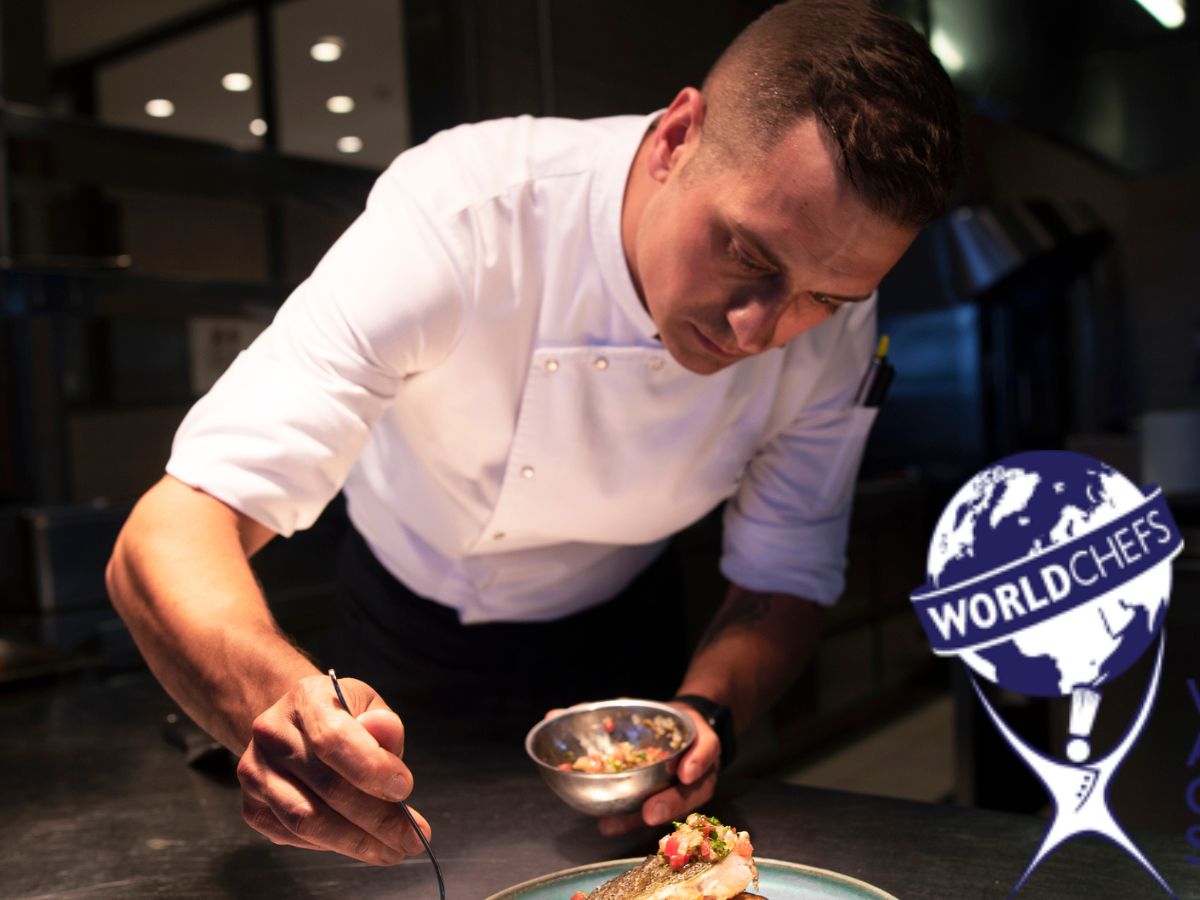
Expressions of Interest are open for chefs keen to represent New Zealand at the Worldchefs Pacific Rim semi-finals in Christchurch from July 4 – 6, 2023.
The Semi-final winners progress to represent the Pacific Rim region at the Worldchefs final to be held in Singapore from October 22 – 25th 2024.
All entrants must be members of NZ Chefs on or before May 30, 2023 and if successful, maintain membership for the duration of the competition programme.
The semi-finals category challenges are:
• Global Chefs
• Young Chef – must be born on or after 1st January 1999
• Pastry Chefs
• Vegan Chefs
Along with the opportunity to represent New Zealand on the international stage, the chosen candidate in each category will also receive the following prize package:
• Mentoring from a former NZ Culinary Team member
• $500 account credit from Bidfood NZ to assist with the cost of ingredients for the practice
• Flights and accommodation to Christchurch for the Pacific Rim semi-finals
• Profile of themselves and place of work in industry publications
To be eligible for selection as the New Zealand candidate entrants must be a full member of NZ Chefs and be a NZ citizen or permanent resident. They must also provide the following:
• Completed application form with two referees and competition history
• Head and shoulders photo in chefs uniform
• Up-to-date professional CV
• A written menu featuring the dishes required for the chosen category, with a description outlining design choices and philosophy (200 words max).
For more information on this event visit https://worldchefs.org/globalchefschallenge/
and
https://worldchefs.hosco.com/en/association/new-zealand
Meet NZ’s Divine Hot Cross buns! –
A team effort is behind the best hot cross bun in New Zealand, and its biggest critic, Daily Bread head baker Patrick Welzenbach describes it as “perfect”.
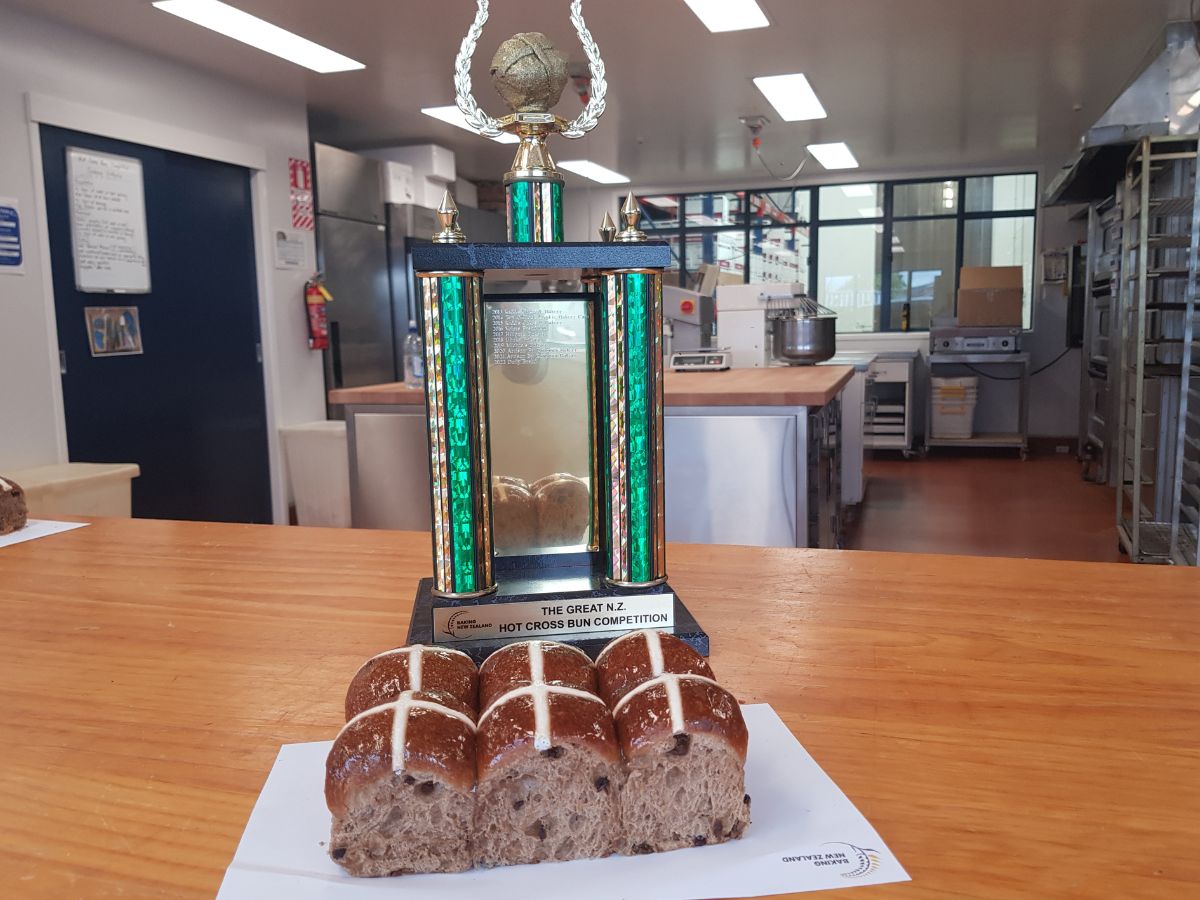
Daily Bread, Auckland took out the top place for a second consecutive year in Baking New Zealand’s Great NZ Hot Cross Bun Competition, which was judged in Palmerston North on March 17.
With extra butter, a little more moisture and a faster proving of the sourdough, the winning entry is the fluffiest hot cross bun Daily Bread has created while continuing to produce a classical bun.
“I have to say that this year’s bun was perfect. I was so happy. Normally I’m just 90% happy about the finished bun, but this year I couldn’t make it any better. It was perfect,” says Patrick.
And he credits the perfection to locally sourced ingredients as much as possible, even the candied peel and orange glaze, which is made in the bakery, use New Zealand oranges.
Part of the secret is Patrick’s baking history in which he can trace back to more than 20 generations of his family and he’s grateful to his grandfather for teaching him to bake as a six year-old. “I was born to be a baker.” And while hot cross buns are not part of German bakery goods, Patrick knows just how they should taste.
With the team at Daily Bread, he develops the recipe before individual bakers add their expertise focusing on a specific element.
“At Daily Bread we put the team in front. It was absolutely a team effort. I couldn’t do it without the team. One guy did the crosses perfectly and super wide and straight, another baker made the perfect dough and another made the absolute shiniest glaze. Everyone has a small part to make the complete product and everyone is so proud that we have won for a second year.”
You can get your hands on the winning hot cross buns at any of the Daily Bread bakeries in Auckland, at Farro, New World in Remuera who is a keen supporter of the bakery, and at other Auckland New World stores and some Four Square supermarkets. Outside of Auckland, they are available by ordering online.
Nada Bakery takes second place
Who would have considered adding pimento – a type of chilli pepper, or coriander to a hot cross bun spice recipe? Well Michael Gray and his mother Judith Gray did along with their bakers at Nada Bakery in Wellington.
The spicy combination blended with plump presoaked fruit gave their hot cross bin the in the Great NZ Hot Cross Bun Competition earning them a second place win.
Nada Bakery general manager Michael Gray says: “Our dough is made in a precise way before we bulk ferment the dough to allow the yeast to feed and develop a more intense flavour. Our qualified bakers weigh off each bun at 140gm, hand mold each one before a final proofing, adding a crispy cross and baking. Once our buns are baked, we glaze them with an apricot and yuzu glaze.”
To get your hands on Nada’s hot cross buns you can purchase them at their Tawa or Johnsonville bakeries or order them online.
Inventive taste of Denmark
You can take a Dane from Denmark but their love of chocolate will always follow them.
For John Thomsen, head baker and owner of Christchurch’s iconic Copenhagen Bakery with wife Donna, opening up the category for the 2023 Great Hot Cross Bun Competition meant he could add chocolate to his much loved buns.
In 2022 Copenhagen Bakery won third place in the national competition and this year they’ve claimed third place again.
Copenhagen’s recipe features indulgent spicy flavours, three traditional fruits but also cranberries and the finishing touch of Belgian chocolate. “We made our hot cross buns for the competition with the indulgent traditional spicy flavors of a zesty three-fruited cross bun, blended harmoniously with cranberries and Belgian chocolate.
John describes it as: “Decadence – a spicy, zesty fruity, oh so nicely warmed through…with a melted choccy explosion.”

From banking to hospo – meet Queenie Lai –
Claiming to have more eateries per capita than New York, Wellington has no shortage of restaurants and cafes to choose from. Fortunately, there are plenty of women-led restaurants in the capital which is fitting this week as we celebrate and support International Women’s Day, which was March 8 this year.
If you’re finding it hard to choose what to eat – you might want to do a DoorDash and support women-led businesses in the city!
If you’re after chicken waffles for breakfast, scrumptious burgers, mouth-watering milkshakes, and classic American-style cheesecakes, Wellington institution, Mama Brown, might be just the ticket.
Mama Brown is led by Queenie Lai, who swapped a career in banking and technology for hospitality. As General Manager, she is focused on making Mama Brown an inspiring place to work and delivering a standout experience for customers.
Queenie has been in hospitality for enough time to see the change that the pandemic and evolving dining preferences have brought to the industry. Technology has changed the way people dine – from how they make reservations and orders, through to where they eat. Given the last few tumultuous years for the industry, Queenie has observed how technology has helped restaurants like themselves survive through lockdowns.
“Mobile delivery apps such as DoorDash have been a game-changer for Mama Brown, and a lifesaver during the pandemic. They have enabled us to reach a broader audience and expand our reach beyond our physical location, meaning we can share Mama Brown’s goodies with more Wellingtonians.
“In my experience, using DoorDash has been fantastic – who doesn’t love having delicious food delivered right to their doorstep for a marathon Netflix session or a brekkie in bed after a fun Saturday night out, right?”
Having seen Mama Brown make it through the pandemic, Queenie and the team are excited to see what the next few years have in store.
When asked what tips she’d give to other women considering careers in hospitality, Queenie has some simple advice.
“Do not hesitate to speak up and demonstrate your capabilities. Always stay true to your values, be persistent, patient, and always be yourself.”

MBIE survey highlights hospo workplace challenges –
New Zealand now has better data on working conditions in tourism and hospitality, for those on the frontline as well as for managers, following a survey of more than 900 people working in the industry.

the Hey Tangata survey, conducted by AUT, was commissioned by the Ministry of Business, Innovation and Employment and helps to inform the work of the Tourism Industry Transformation Plan Better Work Action Plan, launched by the Minister of Tourism Peeni Henare, today in Queenstown.
The Better Work Action Plan is a partnership between government, unions, industry and Māori and seeks to address workforce tourism challenges, including those highlighted by this research.
The 68-page survey report found that 59 per cent of staff were either planning to leave their job within a year or were unsure if they would stay. Of those planning to leave, about a third wanted out of the industry altogether.
“It is particularly worrying that senior staff want out at a similarly high rate to frontline staff,” says David Williamson, report co-author and a Senior Lecturer at AUT.
“The main reason people gave for wanting to leave the sector was that the workplace had bad conditions, stress or was a toxic environment. This was followed by bad pay and conditions and then by wanting a better work-life balance.”
Dr. Williamson said that although there was a lot of concern about the base pay rate among employees, people also felt that training or promotion was not recognized properly. Sometimes it was just $1 an hour extra for greatly increased responsibility, he says.
Hey Tangata is one of the largest surveys of employees in the sector to date. Participants in the survey were invited via a link circulated in the tourism and hospitality sector. It ran in mid-2022 with 902 employees sharing their experiences, generating 25,000 comments for analysis.
The report raises many concerns concerning employment relationships and work issues, including problematic pay and working conditions, disturbing reported rates of bullying and harassment and significant levels of non-compliance with basic employment laws. Its findings include:
- 9% did not sign employment agreements before starting work.
- 29% did not get paid correct holiday pay.
- 42% did not always get rest breaks.
- 45% are either elements or not planning to have a career in the sector.
- 27% thought they would leave their current job within the next 12 months, and a further 32% were undecided.
- Of those that said they would leave their current job, 34% were going to leave the sector and a further 47% were unsure if they’d stay in it.
- 23% had experienced bullying and harassment and 34% had witnessed it.
- When bullying and harassment was reported, 50% were elements or were not told if any action was taken afterward.
- Bullying and harassment was only reported half of the time.
- 53% didn’t know what the health and safety risks were in their workplace.
- 35% did not say that health and safety risks were well managed in their workplace.
- 13% had no training at all, and a further 38% have received only on the job training.
- Only 4% belonged to a union, but 43% indicated they’d be interested in joining one.
Hey Tangata also found that workers often got into hospitality and tourism in the first place because they wanted to work with people – but that wasn’t the only reason.
“We often talk about the casual nature of work as a negative, but for a significant number of employees this freedom and flexibility is a positive.
“It is also worth pointing out that our research found that 52% of workers had careers of six years or more in the industry, which looks poised to begin its return to being a major contributor to the New Zealand economy.”
The research was headed by Dr David Williamson from AUT’s School of Hospitality and Tourism, with Professor Erling Rasmussen from AUT’s New Zealand Work Research Institute.
It provides an overview of employment relations and working conditions in the tourism and hospitality sector at a crucial time as it re-emerges from Covid disruption.
Previous research by AUT, Voices From The Front Line, highlighted similar employment problems but looked only at frontline workers in the hospitality industry. Hey Tangata expands this to tourism as well as to managers, and looks at the issues in more depth.
In the latest Times Higher Education university rankings, AUT ranked first in New Zealand for its global research impact.
Hey Tangata can also be downloaded with this shortened link: auto.ac/hetangata
Contingency planning essential says NZ Events Association –
The New Zealand Events Association (NZEA) says the cancellation of multiple events at short notice is heartbreaking for organizers and concertgoers alike, but says it is a timely reminder of the necessity for emergency contingency plans.
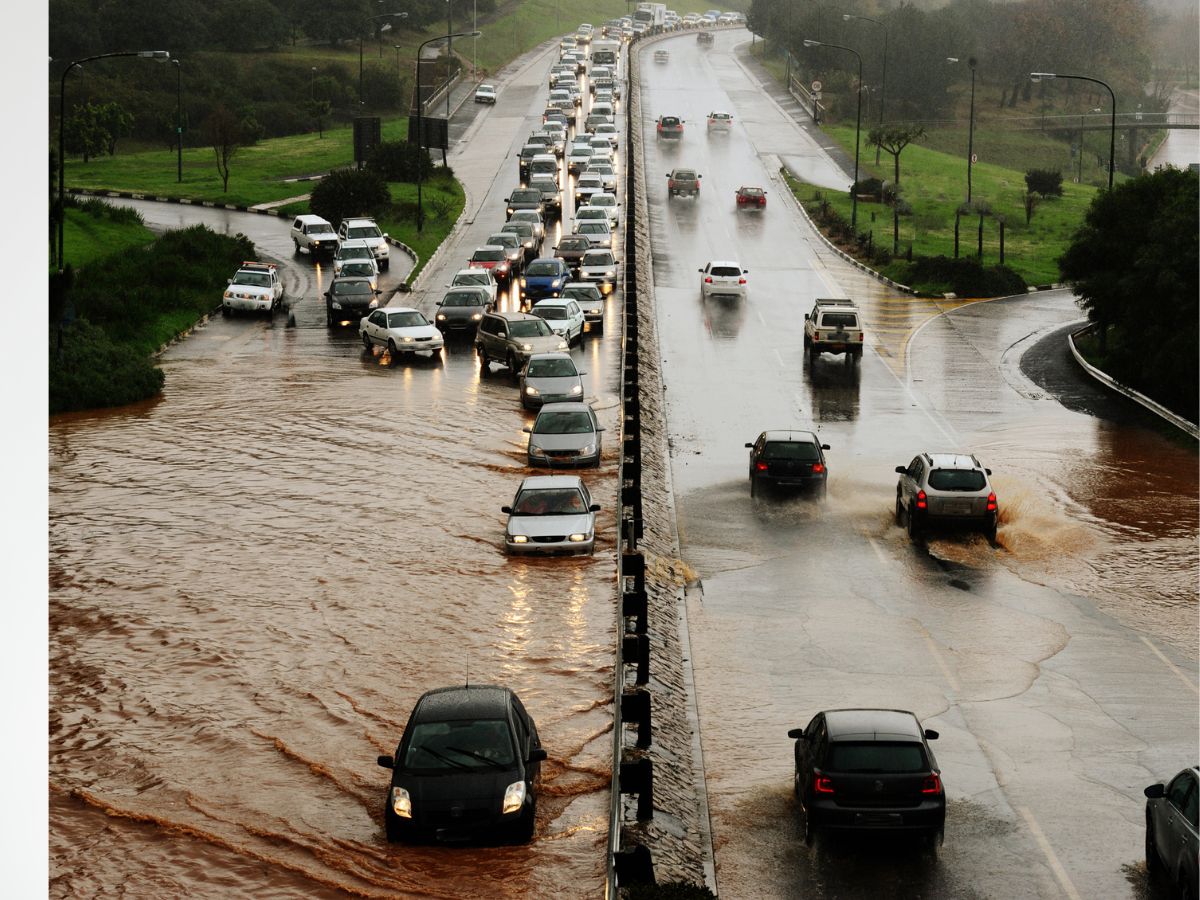
“Just when things seemed to be getting back to normal for the events industry, it started raining and hasn’t stopped,” says Elaine Linnell, General Manager, NZEA.
“It’s devastating for all our members as the cancellation of major events has a knock-on effect which is hitting hard. It also demonstrates the necessity for emergency plans – after all, this is New Zealand and the unexpected can occur at any time thanks to Mother Nature.”

“Deciding on a cancellation is always difficult and takes into account multiple considerations including loss of revenue, disruption to travel plans and other arrangements for ticket holders, difficulty in communicating clearly with all stakeholders, including suppliers, and potential reputational damage (which can result if the event goes ahead in bad weather or is canceled, and the weather reflects).”
But the one overriding concern is the safety of everyone concerned. “Cancellations are always a minefield and it’s upsetting for everyone,” Linnell says. “That’s why having a plan is essential, whether you’re organizing Elton John, or running the local Jazz in the Park.”
The NZEA’s top tips include:
1. have a plan
Always plan for the possibility of cancellation or postponement. If the weather changes, you’ll be ready to communicate effectively with vendors, suppliers, ticket holders and even transport providers. Health and safety is paramount, and communicating plans early helps everyone understand what needs to happen. Working together is key; arrange an alternate date ahead of the planned fixture if possible, and include venues, talent, and suppliers in the planning for the second calendar entry.
2. Get insured
Loss of profits is among the biggest concerns with event cancellations or postponements. A lot of work goes into every event, and delaying or stopping the show is a huge waste of effort. An insurance policy provides some peace of mind, with several companies available to cover your event. Organize well in advance of your fixture.
3. Communication is key (from start, to finish, with everyone)
Well ahead of your event, be sure to include cancellation clauses in all vendor/supplier/talent contracts so everyone knows what to expect. If a cancellation is necessary, prompt and efficient communication across your supply chains is just as important as fast and efficient communication with your ticket holders.
Update your website and social media platforms, send emails and/or text messages, and send push notifications on the event app (if applicable). Get everyone on board with a consistent message: your talent, suppliers and vendors will get the word out. Answer their questions and be specific. People want reasons for cancellation or postponement, they want to know about refunds, and they want information about new dates, times and venues.
4. Provide clear reasons for cancellation or postponement
Before sending any messages, clarify why the event isn’t going ahead. Severe weather is a safety hazard; wind and flooding can compromise the venue, interrupt transport, and crowd control can become difficult or impossible. Explain ‘why’ concisely so everyone understands the necessity for action with safety as the top priority.
5. Reflect and assess
Regardless of whether the cancellation or postponement went well or not, take the opportunity to evaluate your response. Determine what went right and why with the same vigour as assessing what went wrong. Use it as a learning experience; we can’t prevent natural disasters or significant weather events, but we can change how we respond to them. Include suppliers and vendors in your assessment, and even consider reaching out to ticketholders with a follow-up survey. Your customers have views and expectations, understanding them is important to help create a better customer experience, even if the weather has ruined the fun.
“Planning ahead is the name of the game,” says Linnell. “Nobody wants to see an event canceled, but we all want to get home safely and we all have to accept that we live in an unpredictable world. Bad things do happen, but that’s how we deal with them that determines our success.”

Bocuse d’Or Aotearoa team placed 15th in global culinary Olympics –
Denmark has won the Bocuse d’Or with Norway and Hungary coming second and third place respectively in the world’s most high profile cooking competition.
Led by Chef William Mordido, the NZ team placed 15th in our first final participation in the biennial competition, which was held in Lyon, France at the SIRHA Lyon Trade Exhibition centre. Australia placed 18th.
Twenty-four teams consisting of some of the best chefs on the planet were gathered in Lyon at the Olympics of Food. Known to be the most prestigious and difficult culinary competition on Earth, the Bocuse d’Or is an event that makes fine dining an arena sport.
It comes with all the trimmings including uniforms, judges, cheering fans holding flags, bronze-silver-and-gold statuettes, and winners on podiums beaming while their national anthem blares in the speakers. And while there’s glory in winning one of the culinary Oscars, the road to Lyon is a long process that takes passion, dedication, and a strong desire for perfection.
The Kiwi team spent months preparing and fundraising for the competition, engaging creative director and graphic designer Alan Hughes to lead the design process.
“We really wanted to challenge ourselves to create shapes and designs that had not been seen or done before. We were given an international platform so it was our chance to showcase how far we could stretch our creativity,” – says Mordido.
On Day One, Sunday January 23, 12 countries were competing: Norwegian, China, belgium, Moroccan, japan, Chile, New Zealand, Canada, Switzerlandthe UK, sweden, and Sri Lanka. For the first event, the teams had to make a ‘Feed the kids’ menu based on squash, working from starter to dessert in a playful way.
A jury of children aged 10 on average was also present to evaluate the different dishes, which brought some comic relief to the proceedings.
Accor announces Orient Express Silenseas luxury adventure to its portfolio –
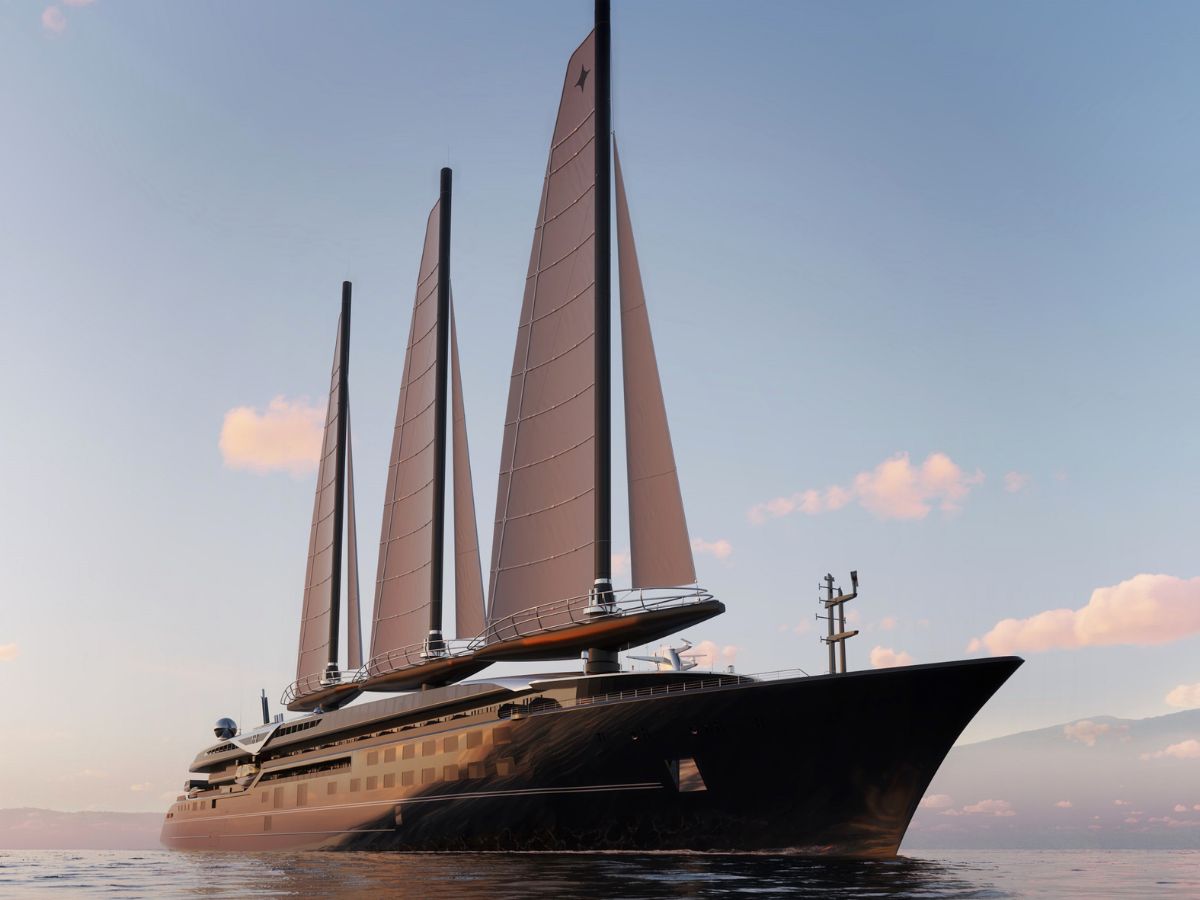
One hundred and forty years after the launch of its first luxury trains, the Orient Express legend continues with the unveiling of plans for the world’s largest sailing ship, Orient Express Silenseas.
This revolution in maritime history is an ambitious undertaking that pushes the limits of what is possible. The result of a unique French partnership between world leader in hospitality Accor, and Chantiers de l’Atlantique, a leading shipbuilding company, this extraordinary sailing yacht of the future with spectacular interiors will set sail in 2026.
“With Orient Express Silenseas, we are beginning a new chapter in our history, taking the experience and excellence of luxury travel and transposing it onto the world’s most beautiful seas.
“This exceptional sailing yacht, with roots in Orient Express’ history, will offer unparalleled service and refined design spaces, reminiscent of the golden age of mythical cruises.
“Innovation is at the heart of this ultra-modern ship that will revolutionize the maritime world with new technology to meet today’s sustainability challenges. It is a boat designed to make dreams come true, a showcase for the best of French savoir-faire.” -Sébastien Bazin, Chairman and CEO, Accor.
“With a signed letter of intent to order two ships, Chantiers de l’Atlantique is proud to herald a new era in the shipbuilding industry with Silenseas.
“This concept, born in our design offices in 2018, is the quintessence of our savoir-faire in the fields of naval architecture, the construction of sophisticated hulls, as well as the design of luxurious spaces.
“In addition, the installation of three SolidSail rigs, a revolutionary 1,500-square-metre unit wind propulsion system, for which we have developed and tested a first prototype, will contribute significantly to the propulsion of the ship. Combined with a hybrid propulsion system running on liquefied natural gas (LNG), Silenseas will become the ship of reference in terms of environmentally friendly operation and design.” -Laurent Castaing, Managing Director, Chantiers de l’Atlantique.
FASCINATED BY GRANDEUR
In 1867, Georges Nagelmackers boarded the transatlantic ships connecting Europe to America and set off on a journey of discovery to the United States. Fascinated by the grandeur of these huge boats, the founder of Orient Express trains explored the luxurious travelers’ suites, with their rich and sumptuous decor, adorned with exceptional marquetry. He experienced the social scene in the restaurants and the unique ambiance of the lounges, libraries and entertainment venues. This sea travel experience would later inspire the 1883 launch of his now legendary train: the Orient Express.
Inspired by the Golden Age of the French Riviera, Orient Express Silenseas will echo the glorious era when writers, artists, painters, princesses and movie stars spent time between Monte-Carlo, the beaches of Saint-Tropez, Cap d’Antibes, Cannes and its famous Croisette and discovered a refinement tinged with exquisite insouciance and joie de vivre, inviting them to extreme escapes.
A 220-metre-long ocean treasure with a tonnage of 22,300 UMS, Orient Express Silenseas will feature 54 Suites measuring on average 70-square-metres, including a monumental 1,415-square-metre Presidential Suite (including a 530-square-metre private terrace), two swimming pools including a lap pool, two restaurants and a speakeasy bar. The singular cruise ship will celebrate the Art of Travel a la Orient Express: the quintessence of luxury, absolute comfort and dreams.
A tribute to artists and culture, Orient Express Silenseas will invite guests to experience incredible shows in its Amphitheater-Cabaret and a private recording studio will give a voice to the most beautiful melodies. This unique travel experience, guided by the winds, will feature spa treatments, meditation sessions and stopover explorations to discover cultural treasures that allow guests to completely unplug from reality and stop time.
Capitalizing on the experience of these experts in ocean racing, Orient Express Silenseas will sail with a revolutionary technological design known as ‘SolidSail’: three rigid sails with a surface area of 1,500 meters each will be hoisted on a balestron rig, with three tilting masts reaching more than 100 meters high, able to ensure up to 100% of the propulsion in suitable weather conditions. This hybrid propulsion formula will combine wind power with a state-of-the-art engine running on liquefied natural gas (LNG) and plans to use green hydrogen once the technology is approved for ocean passenger ships, launching a new, more environmentally friendly vision of sea travel.
The latest feat from the Chantiers de l’Atlantique is a true sailing yacht of the future combining the finest French talents. Renowned architect Maxime d’Angeac will design the interior layout and decor and Nantes-based design company Stirling Design International will handle the exterior architecture. Hetland Maritime also assisted Accor in creating the project and in the ongoing discussions with Chantiers de l’Atlantique. The entire project will be financed up to 70-80% by commercial banks, with the remainder provided by a consortium of equity partners in which Accor will have a minority stake.
ABOUT ORIENT EXPRESS, PART OF ACCOR
Artisan of travel since 1883, the Orient Express sublimates the Art of Travel with its luxury trains, unique experiences, and collections of rare objects. And coming soon: its first hotels around the world, with the opening of Orient Express La Minerva in Rome and Orient Express Palazzo Donà Giovannelli in Venice in 2024. Another project has also been announced in Riyadh, the first city in the Middle East to announce the arrival of an Orient Express hotel. The luxury travel experience will continue with the launch of the Orient Express La Dolce Vita and the return of the legendary Orient Express to railways. www.orient-express.com

Demand is high – No supply –
Opportunity in the outer suburbs
By Gerrick Numan
The inner suburbs, the ‘cool’ areas, have a lot of restaurants, cafes and bars. The demand is high but so is supply. That doesn’t mean another one won’t work, it just means there are opportunities elsewhere.
In some under-serviced outer suburbs, the demand is high and there’s no supply.
People are there, with money, looking to eat out but they have nowhere to go. If your concept is right, your chances of success are higher in the outer suburbs.
Just look at Peach’s Hot Chicken. We designed a venue for them in Panmure, Auckland, an area better known for pawn shops than dining, and they’ve had crazy queues out the door every single night.
Now they’re moving to a venue twice the size down the road. An excellent concept plus low competition has meant a much more profitable restaurant than if they had opened in the inner suburbs.
We’ve done the same for Sumthin Dumplin in Botany and many others.
Rent
Not only is competition lower in the suburbs, so are the rents.
A shop that costs you $80k per year in rent in an inner suburb, can cost $25k in the outer suburbs. That’s $55k in your pocket, immediately. The old real estate saying that you ‘make your money when you buy’ applies to leasing a space for a hospitality business too.
In an industry where margins are slim, lower rents can make a huge difference.
If you do $15k in sales per week, the lower rent means a drop in your annual rent percentage from 10% to 3% – an additional 7% of profit.
Postpandemic
There is less demand for retail spaces. So you will have increased negotiating power with landlords. This could mean a long rent free period or a significant capital contribution from landlords.
You will also be in a good place to negotiate a ‘sale friendly’ lease
Ie a lease that will be attractive to future buyers of your venue (multiple rights of renewal, annual rental increases capped at CPI, no demolition clauses). Get in touch with me any time if you want me to explain these ideas.
There is potential in failed venues.
The financial and emotional impacts of a failed concept on operators are nothing to be taken lightly. But at some point these venues and their unused fit outs and equipment will need to be used again. This can be an excellent opportunity to open a venue, without the massive expense and risk that comes from setting up a kitchen from scratch.
Where to from here?
If you need any help assessing a site, or tweaking your concept, get in touch with me anytime and let’s figure out a way to keep moving forward. www.mille.co.nz