
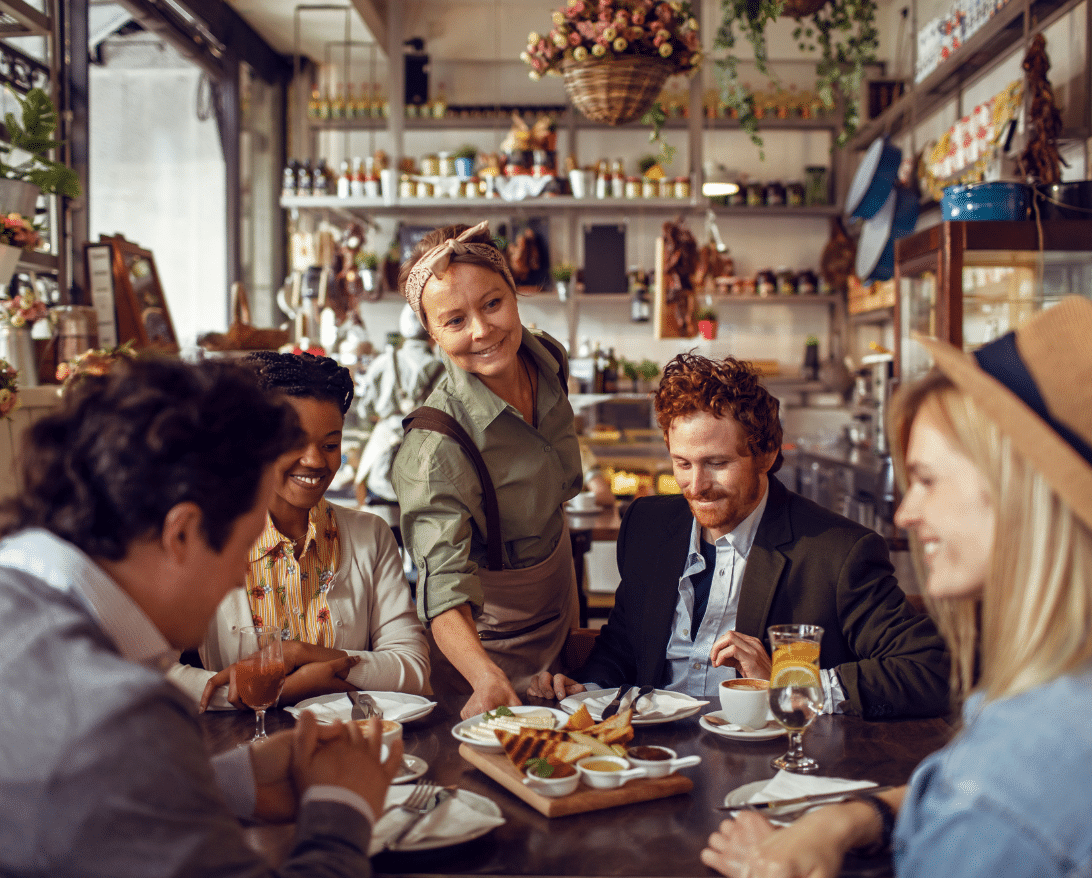
19 March food holidays for your restaurant to celebrate
Did you know 45% of US customers say they’ve tried a new restaurant after seeing a restaurant’s post on social media? That’s why it’s more important than ever to make sure your restaurant is establishing an effective social media strategy to grab customers’ attention. One great way to make your restaurant stand out online is to celebrate national food holidays on social media.
Take a look at these tips on how you can take advantage of food holidays this month and keep scrolling to get the full March calendar.
What are national food holidays?
National food holidays are micro holidays that center around a certain cuisine. They are often celebrated on social media and encourage diners to band together to show appreciation for everything from Oreos (March 6) to hot chicken (March 30). While these holidays don’t warrant a day off, they can still be fun to observe and celebrate. As a restaurant owner, a food holiday is the perfect excuse to offer an irresistible promotion that will encourage diners to place an order.
Why your restaurant should celebrate national food holidays
Everyone loves having something to celebrate, and restaurants can use food holidays to build excitement around their dishes. Food holidays are particularly popular on social media as diners go online to share what cuisine they’re celebrating. Acknowledging a food holiday on social media by using the holiday’s hashtag can instantly make your restaurant relevant to a wider audience.
Food holidays put specific dishes top of mind. When diners are craving waffles on International Waffle Day (March 25), you want them to turn to your breakfast menu to get their fix. Posting about your food can motivate diners to order from your restaurant. In fact, 53% of millennial TikTok users visited a restaurant after seeing it on the app. Incorporating food holidays in your social media strategy incentivizes hungry diners to check out your cuisine.
3 tips for marketing national food holidays
A successful food holiday marketing strategy begins with a strong digital presence. Modern diners flock online to discover new restaurants and place orders. Digital tactics are important for your restaurant marketing strategy.
To make your national food holiday celebrations as effective as possible, tie them into a larger restaurant marketing strategy that looks at the big picture, not just a single opportunity. A restaurant marketing strategy is a formal plan that documents, tracks and analyzes all your marketing efforts and activities.
1. Pile on promotions
Nothing motivates a diner to press ‘order now’ more than a discount. Rolling out promotions not only attracts more customers to your menu, but also encourages loyalty. Diners are more likely to place repeat orders if they think a restaurant has a good deal. In fact, 81% of consumers would switch restaurants if they saw a good deal. Your food holiday promotions can be the first thing that catches a potential customer’s eye.
Here are some promotion ideas that can get diners drooling for your dishes:
- Discount dollar amounts: On National Sloppy Joe Day (March 18), offer $1 off your sloppy sandwiches.
- Discounted items: Celebrate National Pound Cake Day (March 4) by offering 50% off a slice of pound cake when a customer purchases a coffee.
- Discount-themed ingredients: Celebrate National Oreo Day (March 6) by offering 20% off all Oreo flavored menu items.
- Free items with purchase: On National Banana Cream Pie Day (March 2) spread the sweetness by offering a free slice of banana cream pie with every entree.
When you partner with Grubhub, launching promotions is as easy as pie. Restaurants that partner with Grubhub gain access to free-to-use promotional and marketing tools that are proven to increase orders and customers.
With Grubhub’s Promotions and Loyalty Tools, you can:
- Run seasonal promotions to make the most of national food holidays
- Offer your customer the right discount at the right time
- Increase your ROI with our advanced technology and huge volumes of restaurant and customer data
2. Highlight online ordering
Getting customers excited about a food holiday is great, but unless you give them an easy avenue to place an order, all that momentum around your dishes will be lost.
Your restaurant’s website serves as the backbone of your digital presence. Your website should have all things a diner needs to know about your restaurant – this includes your menu, hours, location, story and an online ordering platform. Finding a platform that converts curious diners into satisfied customers can be difficult. That’s why restaurants are turning to Direct to reach more customers, drive online ordering and establish their advertising efforts with zero commission costs.
88% of restaurant operators stated a branded experience is very important for sales. With Direct, your restaurant can create an online ordering web page that’s designed and branded to match your existing restaurant’s look and feel. It can be easily integrated into your existing website (if you have one) or can act as your main site if need be. Learn more about how Direct can drive online ordering.

Once your website is up and running, you want to make sure it’s searchable. When potential diners search your restaurant on Google, your Business Profile is usually the first thing to pop up. Claim your restaurant’s Google Business Profile so that you can make sure it correctly displays your hours, address, pricing and website link. When your Business Profile features the correct info and links, it’s far more likely a customer will place an order or come in to check you out.
3. Get social
Nobody will know your restaurant is celebrating a national food holiday unless you spread the word. That’s where social media comes in. TikTok, Instagram and Facebook are all powerful places to establish a restaurant social media presence.
Looking for some tips to make your restaurant pop on social media? Try these ideas:
- Showcase your dishes by posting delectable photos and videos of them on national food holidays.
- Use trending hashtags like #NationalOreoDay or #NationalPotatoChipDay to reach a larger audience beyond your social media followers.
- Use local hashtags like #BostonFoodie or #NYCeats to connect with customers nearby.
- create a quiz about your dishes to boost engagement with your national food holiday promotions.
- Launch a contest with prizes that relate to your restaurant and die in with your national food holiday promotion.
It’s easy for restaurant owners’ plates to pile up, leaving little time to strategize about marketing. That’s why developing a social media calendar is essential for planning out how you will roll out your promotions.
A social media calendar is a way to organize your upcoming social media posts and promotions by date. Planning posts in advance gives you time to lay out promotions, batch content and solidify your menu to align with your offerings.
Check out these tips on how to market national food holidays on social media.
What social media holidays are coming next?
March brings the first tastes of spring, Mardi Gras beads and shamrocks. March also brings 19 food holidays for your restaurant to celebrate. Your restaurant can reserve a day this month to celebrate flapjacks (March 7), Ravioli (March 20) or Spanish paella (March 26). No matter what cuisine you’re celebrating, it pays to run a food holiday promotion.
Download our Guide to National Food Holidays to learn how to spearhead your promotional marketing and elevate your digital presence. Use your new calendar to create a marketing plan or amplify your existing one. National food holidays could be your next step toward increased sales and a wealth of new customers.
March national food holidays
March is National Noodle Month and National Sauce Month.
- March 1: Mardi Gras
- March 2: National Banana Cream Pie Day
- March 3: National Cold Cuts Day
- March 4: National Pound Cake Day
- March 6: National Oreo Day
- March 7: National Flapjack Day
- March 9: National Meatball Day
- March 10: National Ranch Dressing Day
- March 13: National Chicken Noodle Soup Day
- March 14: National Potato Chip Day
- March 17: Saint Patrick’s Day
- March 18: National Sloppy Joe Day
- March 19: National Corn Dog Day
- March 20: National Ravioli Day
- March 21: National Crunchy Taco Day
- March 23: National Chip and Dip Day
- March 24: National Cheesesteak Day
- March 25: International Waffle Day
- March 26: National Spanish Paella Day
- March 30: National Hot Chicken Day

RANZ reports positive meeting with new PM outlining immediate priorities –
The Restaurant Association, along with other members of the business community, met with the new Prime Minister, Chris Hipkins yesterday morning for the first time to discuss the impact of flooding on North Island hospitality businesses.

Marisa Bidois, CEO of the Restaurant Association of New Zealand said the meeting, which lasted about an hour was “constructive and positive” and it was clear that the Prime Minister was aware of the many challenges faced by the business community, which was encouraging to see.
The Restaurant Association raised immediate priorities with the Prime Minister:
Business communications – Ensuring that the message around staying at home is followed by strong messages around when it is ok to come out again.
Clear communications around road closures and the length of time for repairs were also discussed as vital to getting businesses back up and running again.
Business support – cash flow in the hospitality industry is severely impacted by a downturn of customers or business closure. In the case of the floods 75 per cent of respondents to a Restaurant Association survey had experienced a downturn in revenue since the floods. For an industry still recovering from the impacts of the pandemic this presents further cash flow challenges.
Reviewing planned policies – there is enormous financial pressure on businesses at the moment and reviewing some of the upcoming regulatory changes would be welcomed by businesses. Parking the minimum wage increases set for this year would go some way to supporting businesses dealing with skyrocketing costs; delaying the Fair Pay Agreements process and other policy directing impacting businesses could assist with easing some of the pressure on these businesses.
International communications – ensuring our international communities understand that New Zealand is open for business. We need more messaging calling for workers showing how great it is to work here. We are currently facing a severe skills shortage and competing with other markets for workers.
Immigration policy – Being able to access the labor needed to run our business is imperative to ongoing stability in the industry.
Other issues discussed included interruptions to the supply chain causing shortages of food, insurance contracts not covering financial downturns or damage due to natural disasters along with exponential price increases.
“The rain continued throughout January which culminated with the floods that have come at the very worst time for hospitality businesses, many of whom are still trying to recover from the effects of the pandemic,” said Marisa Bidois.
“The summer months are traditionally a bumper time for hospo, particularly the Auckland Anniversary and Waitangi weekends.
“We’ve been taking calls all week from members looking for support and targeted communication to help them work through the situation and get back and running again.”
“I’m pleased to report that the prime minister was extremely open and receptive to our suggestions and I’m looking forward to working with him and his senior ministers on the important issues facing our industry,” concluded Bidois.

Grand Chateau Tongariro Hotel announces permanent closure –
The Grand Chateau Tongariro will close permanently from Sunday February 5.
The Chateau, located in the Tongariro National Park, has been in consultation with the Department of Conservation (DOC) regarding the renewal of its 30-year lease, which expired in April 2020.
As part of the hotel’s due diligence in preparing to renew the lease, it had specialists conduct site and seismic assessments as part of plans to renovate the building and surrounding infrastructure.
The most recent seismic assessment, however, found that underground shifts over time meant some of the hotel infrastructure no longer met current safety standards.
“This decision has also been influenced by other factors including the significant cost of ensuring long-term site safety from seismic risk, Ruapehu Alpine Lifts (RAL) falling into voluntary administration and related uncertainty over the future of the ski resort upon which the Chateau Tongariro The hotel depends, and off the back of recent poor snow season conditions and pandemic restrictions,” a spokesperson said.
Senior vice president commercial of the Chateau Tongariro Hotel’s parent company, Kevin Peeris, said it’s a “very sad day for our hotel family”.
“Surrounded by the Ruapehu, Ngauruhoe and Tongariro, and its history in Aotearoa New Zealand, it is disappointing for our hotel community that the Chateau Tongariro Hotel chapter will come to an end in February, despite initial plans to invest in its long-term future ,” Peeris said.
He said although the hotel had been given the possibility of an extension to “undertake rectification works” it would’ve been too expensive.
To ensure the safety of those at the hotel, including its 36 staff, the decision has been made to close it.
Peeris said it was disappointing and sad that the iconic hotel would have to shut its doors “despite initial plans to invest in its long-term future”.
“The hotel has been given 25 years with the possibility of an extension of another 10 years to undertake rectification works, however the costs involved in these works, combined with other external factors such as the voluntary administration of Ruapehu Alpine Lifts and the poor snow season , and rebounding tourist numbers from the pandemic means continuing operations is not financially viable.”
Discussions are underway with DOC regarding the handover of the property.
The hotel said it was supporting directly affected staff.
Owners of the Chateau Tongariro Hotel and its sister hotel, Wairakei Resort Taupō, have confirmed they will continue investing in New Zealand, and the Wairakei Resort Taupō and its staff are not impacted by the closure.

Noma announces 2024 closure to enter food lab field –
Noma, the Copenhagen restaurant that helped define a genre of ultra high-end, locally foraged, and culinary groundbreaking cuisine, has announced that it will close its doors in 2024.
After several announcements over the years that Noma was temporarily closing, opening up pop-up locations in Mexico, Japan, or Australia, becoming a pandemic-era burger joint or otherwise reinventing itself, the renowned restaurant has announced it is shutting down regular service.
For good this time. Once the restaurant closes its doors, Noma will host occasional pop-ups and transform into a full-time food lab, which essentially means the newest player in the world of direct-to-consumer food products (like Wild Rose Vinegar and Smoked Mushroom Garum ) is the world’s most famous restaurant.
A Noma spokesperson has said that they do not consider this a closing of the brand. “To continue being noma, we must change,” reads a statement on the restaurant’s website.
“Winter 2024 will be the last season of Noma as we know it.”
The restaurant is known for fantastical and interestingly named dishes like Moldy Egg Tart and Reindeer Heart Tartare, and garnered three Michelin stars in 2021, as well as winning first-place rankings on the World’s 50 Best Restaurants list.
Opened in 2003 by Claus Meyer and René Redzepi, Noma and its culinary team pioneered a style of cooking that came to be known as New Nordic, relying on local ingredients that often have to be painstakingly foraged and prepared. These labor-intensive processes and the punishing schedules needed to execute them simply cannot coexist with fair, equitable and humane work practices, Redzepi told The New York Times. “It’s unsustainable,” he said. “Financially and emotionally, as an employer and as a human being, it just doesn’t work.”
Noma’s announcement comes just months after the restaurant began paying its interns. In October of 2021, the restaurant announced that for the first time, its interns, known as stagiaires or stages in the industry, would accept pay.
In the world of fine dining, interns are rarely paid, and are routinely asked to maintain grueling work hours in exchange for the invaluable “experience” of working at a top restaurant. Because Noma is arguably the most prestigious kitchen in the world, these interns come from around the globe to learn from the most well-regarded chefs in the industry.
A Noma spokesperson said that after the restaurant’s transformation, the intern program will continue. “The transition into Noma 3.0 has no correlation to our paid internship program (which will continue for the next two years and onwards),” they said.
The practice of paying Noma interns has reportedly added $US50,000 in monthly operating expenses to the restaurant’s budget, according to The New York Times.
While Noma—the restaurant—is closing its doors in 2024, the culinary braintrust will be reincarnated in what Redzepi is calling “Noma 3.0.” The Noma test kitchen will develop new products and dishes to sell on an e-commerce platform and occasionally open up as a pop-up restaurant. It’s certainly not the last we’ll be hearing from Redzepi and his team, as they branch out into new-to-them territory. But as Redzepi wrote in the closing announcement, “Serving guests will still be a part of who we are, but being a restaurant will no longer define us.” Sources: Bon Apetit/ Noma/ NY Times

Grand Gateway Hotel owner claims she can’t get a fair trial in Rapid City

The Grand Gateway Hotel at 1721 N. Lacrosse Street in Rapid City.
Matt Gade, Journal staff
One of the owners of the Grand Gateway Hotel, who allegedly sprayed a chemical at protesters, wants her triple assault case moved to another venue, claiming she is unable to get a fair trial in Pennington County because of media coverage.
An attorney representing Connie Uhre, 75, requested Friday that a Pennington County judge move her triple simple assault case to Fall River County, arguing that media coverage and social media posts have tainted the jury pool.
The Grand Gateway Hotel in Rapid City and Uhre received national media attention following racist comments in March 2022, multiple protests against the business and two federal discrimination lawsuits.
“This is pretrial publicity times ten,” Shawn Tornow told Magistrate Judge Scott Bogue Friday afternoon. “It would be unreasonable not to change the venue.”
Tornow submitted a six-page brief on Dec. 14 asking the court for a change of venue accompanied by a 42-page affidavit in an effort to prove that the social media involvement and media interest in the case has made it impossible for Uhre to have a fair trial in Pennington County.
People are also reading…
Connie Uhre’s motion to change the venue of her case to another county.
Shalom Baer Gee
The affidavit included clippings from the Rapid City Journal and other local media, as well as social media content — including a Facebook message apparently to Uhre that states, in part, “I hope every single business you guys own burns to the ground.”
Tornow appeared on behalf of Uhre, who is facing three misdemeanor counts of simple assault after she was arrested on May 27. She faces up to one year in a county jail and a $2,000 fine for each count if convicted. She has appeared in court herself thus far.
In multiple videos from demonstrators at the NDN Collective picket line boycott event, Uhre could be seen getting out of her vehicle in the Grand Gateway Hotel parking lot and spraying at least three demonstrators with Pledge, a cleaning spray. At least one demonstrator was sprayed directly in the face.

Connie Uhre, 75, owner of the Grand Gateway Hotel, is shown spraying a Native American demonstrator with a cleaning product. Uhre was arrested on three counts of simple assault.
Video capture
In one of the videos, Uhre tells the Native American demonstrators that the spray substance is “bug spray.”
The NDN Collective held the protest and boycott in response to comments Uhre made following a shooting on March 19, 2022 at the hotel involving two young Native American men who ultimately resulted in a murder case after the injured man died.
After the shooting, Uhre posted comments on Facebook saying she would “not allow a Native American to enter our business including Cheers (a bar on the property)” because she can’t tell “who is a bad Native or a good Native.” The comments have since been deleted.
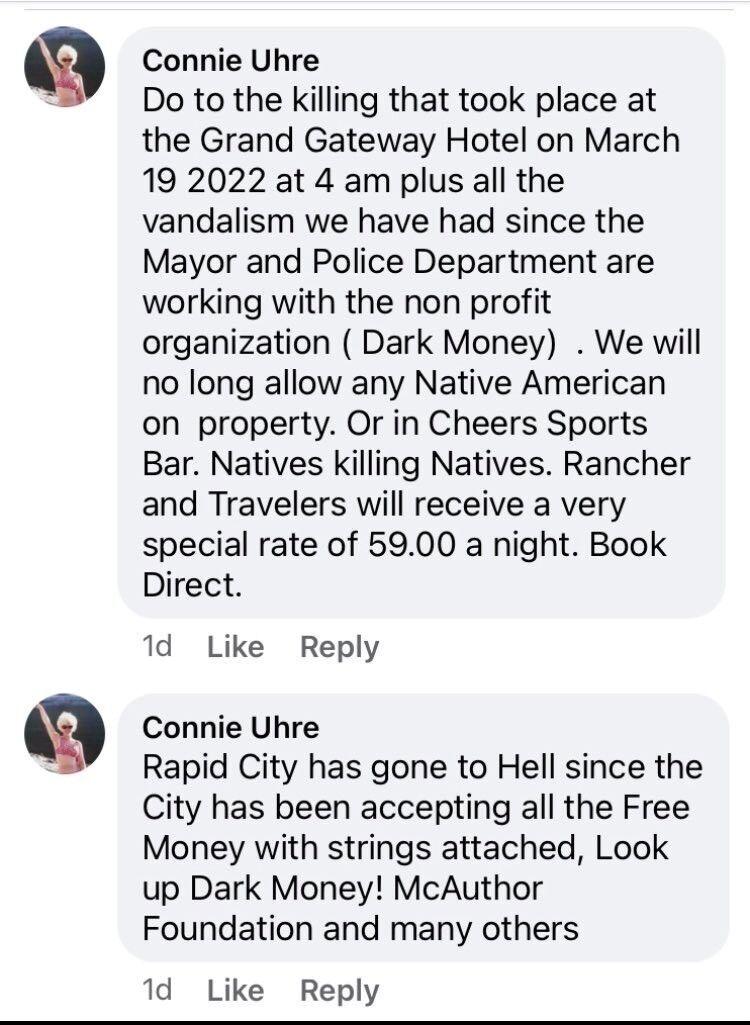

The situation garnered local and national attention and ultimately led to the US Department of Justice filing a federal discrimination lawsuit against the parent company of the Grand Gateway Hotel, the Retsel Corporation. It alleges that Uhre and her son, Nicholas Uhre, discriminated against Native American customers in violation of Title II of the Civil Rights Act of 1964.
The lawsuit alleges that on at least two occasions on March 21 and 22, the defendants turned away Native Americans who sought to book a room in the Grand Gateway.

Katrina Colhoff, of Pine Ridge, holds sage while listening to the speakers at the Andrew W. Bogue Federal building on Wednesday, March 23, 2022 where it was announced that a federal civil rights lawsuit was filed against the Grand Gateway Hotel on North Lacrosse Street for denying services to Native Americans. The rally came just four days after a shooting early Saturday morning at the Grand Gateway Hotel on North Lacrosse Street.
Matt Gade Journal Staff
NDN Collective President/CEO Nick Tilsen announced March 23, 2022 that the organization filed a federal civil rights class action lawsuit against the Retsel Corporation for denying services to Native Americans.
At the time, Tilsen said the NDN Collective sent Sunny Red Bear, then the director of the racial equity campaign for the collective, to the hotel to book a room and she was denied. They then sent the Alberta Eagle director of operations to book rooms on behalf of the organization. He said Eagle was denied and removed from the lobby.
Red Bear, now action organizer at NDN Collective, is one of the alleged victims in the simple assault case against Uhre. She was present in the courtroom on Friday.
She told the Journal that she and the other victims were not notified of the defense’s motion for a change of venue or of the hearing.
“We don’t have a copy of the motion or anything. Just not being informed of what is happening. These are our rights and our rights are still being violated,” she said.
Red Bear also told the Journal that she felt Uhre should have to face the community and that her lawyer didn’t have a solid case for moving the case.
“Social media is a powerful tool, but you can’t tell on social media who’s for it and who’s against it. So there’s gonna be people who are supporting her as well,” Red Bear said. “He just didn’t have anything solid. It was a lot of assumptions being made.”
Tornow added during his argument for the case to be moved to Fall River County that the community takes cues from leadership, citing Major Steve Allender’s public comments following the incident.
Allender was outspoken in his opposition to Uhre’s comments about Native Americans.
“Such statements pitted people and communities against each other, tying race into virtually every community issue and every attempt to address and resolve such issues,” Allender said at the time. “Connie Uhre’s statements are wrong and harmful not only to Native Americans but also to Rapid City businesses and the community at large. Such comments erase the progress that has been made over the last 60 years or so.”
Allender, local businesses, law enforcement and county and tribal officials issued a joint statement condemning Uhre’s comments at a meeting within days of the posts.
“Much work has been done to build a level of trust, to forge relationships and partnerships, and to address major issues involving Rapid City and our Native American community. However, such racist and hateful statements as expressed by a few individuals only reinforces long-term standing feelings of distrust and threatening the relationship of the Rapid City community with its Native American residents and visitors,” a portion of the statement read.
The city of Rapid City, Pennington County, Tribal and business entities condemn recent statements from the family that owns the Grand Gateway Hotel.
The state argued Friday that any issues with prejudice could have worked out during jury selection and coverage spanned the state — meaning a change of venue to Fall River County would not affect the outcome.
Bogue did not make a decision on Friday, stating he would take the motion under advice.
“It’s an interesting issue, the whole question of social media,” he said.
— Contact Shalom Baer Gee at [email protected] —

How to get your restaurant ready for football’s biggest night
With the nation’s biggest pro football event just weeks away on February 12th, it’s time to draw up a game day menu for this year’s festivities. After all, football’s biggest night could make an even bigger impact on your restaurant’s bottom line.
Of the $14.6 billion spent by fans during last year’s game, 79% went toward food and beverages. ¹ A significant part of that spending goes toward restaurant delivery orders — on Grubhub, this January day was one of the most popular days for delivery in 2022 Gear up for game day with these fan favorites as well as a few tips on how to handle the rush of orders that are sure to come your way.
3 tips to win football’s biggest night
As you look forward to the ultimate championship football game, it’s important to come prepared with a plan. Create a solid game day strategy in advance and you can execute it effortlessly when football Sunday rolls around.
1. Create a winning menu
When you’re preparing your delivery menu for the biggest football game of the year, focus on food that’s easy to eat in front of the TV. Start with classic meals that you can eat with your hands: nachos, tacos, soft pretzels, pizza, wings and burgers, for example. You can also help your customers take their tortilla chips to the next level with a selection of delicious dips. Spinach and artichoke dip, beer cheese, Buffalo chicken and guacamole are always crowd favourites.
Fans love to snack when they’re gathering to watch the game, so it doesn’t hurt to be a little indulgent when you’re designing a menu for football’s biggest night. Don’t forget to add a few healthy options, too, especially if your typical menu is centered on fresh, health-conscious dishes. Consider lighter fare such as your chef’s special winter salad, baked chicken fingers, or a gorgeous crudité platter with house-made hummus or dill dip.
Alcohol delivery is also a popular offering during the big football game. Provide your customers with a safe way to enjoy a beer or cocktail by stocking your menu with drinks. Bottled or canned drinks are easy to transport; you can spice up your usual alcohol options with a special seasonal brew.
No matter what you include on your game-day menu, exclusivity is key — when certain dishes are only available on game day, it gives customers extra incentive to order. With Grubhub, it’s a breeze to make your special menu available for delivery during specific times. That way, you can promote the football-friendly menu as a limited-time offering for the big day. This feature helps your kitchen staff prepare for the rush of orders and ensures the menu automatically returns to normal when the game is over.
2. Score specials
Football’s biggest night is a popular time for restaurant delivery, so competition for orders can be steep. After you design a football Sunday menu, it’s also important to think of ways to help your restaurant stand out from the crowd. One option is to offer irresistible game-day specials. Everyone loves a good deal, especially when they’re ordering for a crowd. If you can provide football-friendly meals and a way for diners to save money, you can create an advantage over restaurants that are charging full price.
When customers are ordering delivery, it’s usually because they want to save time. Make their lives even easier by offering game-day packages — create a bundle of dishes and offer them for a fixed price. You might include a variety of appetizers or create a full meal package with an entrée, snacks, and dessert. It’s an easy way to feed a crowd, so customers can organize an impressive football viewing party with minimal effort. Make the package even more appealing by including serving platters, utensils and napkins.
- Advance ordering discounts: Offer a discount for people who place game-day orders in advance. Customers can relax knowing their menu is ready to go, and the extra notice gives your kitchen crew time to plan and prepare certain items before the big day. It also streamlines the ordering process so you can ensure the storeroom is fully stocked.
- Free or discounted items with purchase: Encourage customers to order more by offering a discount on a second item. You can provide a lower price on a dessert with the purchase of a wing platter or create a deal where diners get three dips for the price of two.
- Dollar amount perks: When customers spend a certain amount of money, offer a special perk. Provide free delivery for orders over $100, for example, or send a free dessert when a customer spends $50. Or, consider offering a 10% discount on all orders over $150.
- Football food discounts: Choose a few game snacks and create a limited-time discount. If your wings are popular with diners, offer a selection of wings for 15% off on game day. Another option is to give 10% off your usual super-sized appetizer platter.
Once you select a game-day special, make sure to promote it. You can also get the word out to new and existing customers using the Smart Promotions and Loyalty tools through Grubhub marketing.
3. Go mobile
If your restaurant’s ordering system depends on phone calls or a web-only option, it’s time to set up a mobile ordering system. Customers love the convenience of ordering from an app, especially if it’s one they already use. This is particularly true for millennials — nearly 40% of millennials have ordered delivery or takeout using their smartphones.²
To capture these tech-savvy diners during the most-watched football game of the year, it’s helpful to find a partner such as Grubhub. You can set up your restaurant’s menu within the Grubhub system so it’s available on the website and via the mobile ordering app. When a diner decides to order food for a party or a last-minute game-day gathering, your restaurant will appear as an option. The top-notch ordering experience can build exposure among new customers, increasing the chances that your restaurant will be a go-to for football-game festivities and everyday ordering.
While you’re thinking about mobile menus, consider other ways to reach customers while they’re scrolling on their phones. Promote your special football menu on your social media profiles and send it out to your email list. You can even include a link to your Grubhub menu so diners can order right away.
To give customers even more opportunities to order from your restaurant, expand your web presence with Grubhub Direct. This service enables you to create a branded ordering website that you can link directly from your emails and social media profiles; you can even integrate it into your existing website. Orders through a Direct website are commission-free, so you keep more of the profit. Plus, when you make an update to your Grubhub menu, it automatically updates your ordering website.
Feed hungry fans with Grubhub Delivery
The biggest night of football is fun for fans, but it’s also a lucrative opportunity for your restaurant. By creating a game plan and loading up your delivery menu with delicious snacks, you can increase revenue and keep hungry diners happy. If you’re ready to reach new customers and expand your business, sign up for Grubhub delivery today.
¹National Retail Federation: Super Bowl Spending Survey
²Oracle — Millennials and Hospitality: The Redefinition of Service