
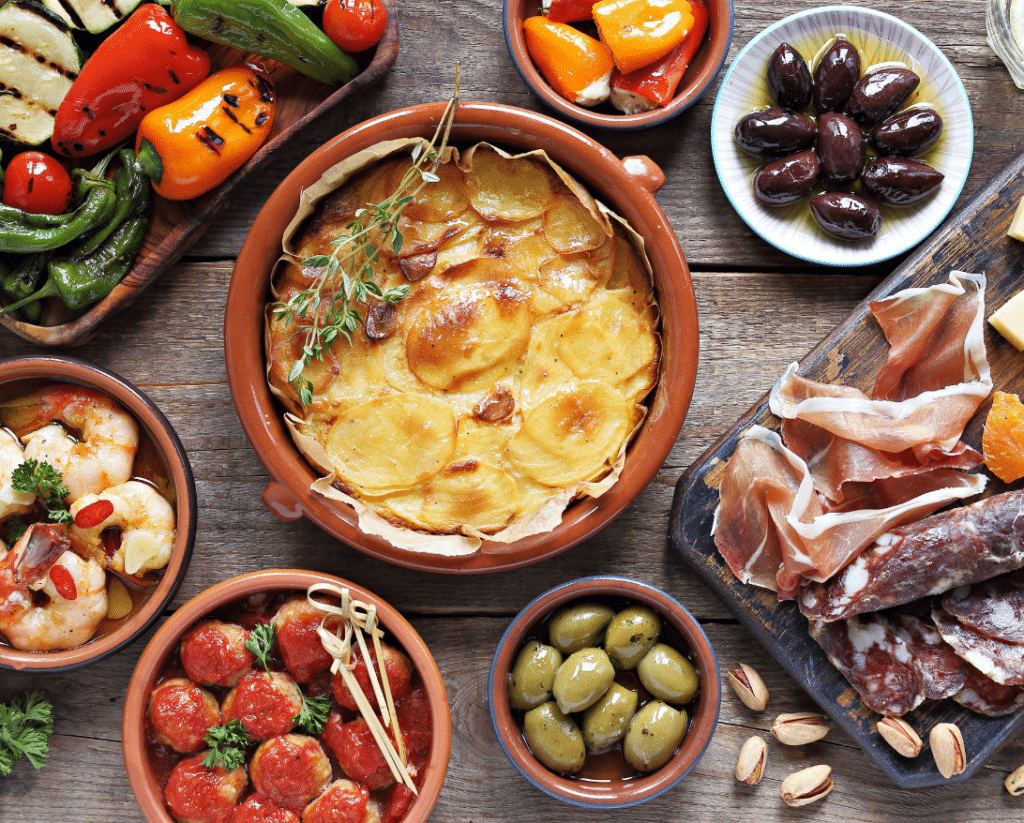
The importance of a multi-lingual restaurant staff
As cities across the United States become increasingly diverse, restaurant owners are adjusting their practices to better serve diners. Bilingual workforces are growing, allowing businesses to cater toward non-English speaking customers. By hiring employees with a strong grasp of Spanish restaurants, you can create a better experience for a wider range of diners.
Why bilingual staff members are an asset to your business
If you run a restaurant in the United States, chances are good that a percentage of your customers are fluent in Spanish. About 41.76 million people speak Spanish at home; next to English, it’s the most common language in the country. Bilingual staff members enable you to communicate with a diverse customer base, making all your diners feel more comfortable and welcome. They give you a distinct competitive advantage — people who speak Spanish as a first language may be more likely to choose your restaurant if they can converse fluently with staff about the dinner menu, wine options and food allergies.
Experts expect Spanish to grow in popularity in the coming decades. While the majority of the country’s Spanish-speaking population has historically been concentrated in nine states, statisticians are seeing a move toward a broader geographic spread. Whether you run a Spanish restaurant in Florida or an American diner in Michigan, bilingual employees can prepare the company for changing demographics.
The most successful restaurants go a step beyond hiring multilingual employees; they train staff members in niche-specific restaurant Spanish vocabulary and explain how Spanish dinner etiquette varies from culture to culture. For example, when serving customers from Spain, the trickiest aspect of service is waiting to deliver the check until it’s requested. Diners from Mexico and Central America, on the other hand, may have different expectations.
Hiring a diverse staff
Hiring bilingual employees can be a challenge, especially if you aren’t fluent in both English and Spanish. Don’t rely on applicants’ self-assessment of language skills — find someone who’s both bilingual and experienced in the restaurant industry. They’ll be able to help you conduct the search and evaluate candidates more effectively.
When you’re hiring new staff, try these best practices:
- Use bilingual job descriptions.
- Advertise on Spanish-language job boards to reach a diverse group of job seekers.
- Ask current bilingual employees for referrals.
- Find a bilingual person to evaluate candidates’ language abilities.
- Switch between both languages in the interview.
- Test interviewees on their food-related Spanish phrases.
- Judge applicants’ Spanish vocabulary with a written test.
As you’re hiring, be mindful of your customers’ cultural background. If most diners speak a Latin American dialect, you might prioritize candidates who learned Spanish in Latin America as opposed to Spain. This strategy helps you find employees who can use precise regional vocabulary. Of course, if you’re serving authentic Spanish cuisine, you might opt for workers who learned the language in Europe.
Restaurant Spanish: important phrases for all team members to know
For many restaurants, it’s not feasible to hire a full bilingual workforce. However, if you have a large Spanish-speaking customer base, consider training your existing staff in a basic Spanish restaurant. Knowing even a few phrases can help servers communicate more efficiently with people who speak limited English.
Into your standard Spanish vocabulary training, start by teaching basic phrases: bienvenidos (welcome), por favor (please), gracias (thank you), buenos días (good morning) and incorporate buenas tardes/noches (good afternoon/evening). Help employees expand their knowledge by hosting language classes or providing on-the-job training with bilingual employees.
At a minimum, staff members should understand key Spanish dinner, lunch, and breakfast words:
- Dinner: la cena
- Lunch: el almuerzo
- Breakfast: el desayuno
- Allergy: He’s allergic
- Table: la mesa
- Half portion: una media ración
- Appetizer: plato de entrada
- Entrée: plato principal, plato fuerte
- Quiero/quieres: I want/you want
- Beef: carne de res
- Chicken: pollo
- Beer: la cerveza
- Soft drink: el fresco
- Coffee: el cafe
- Spicy: picante
- Large: grande
- Small: pequeña
- Still water/sparkling water: agua sin gas/agua con gas
- Wine: el vino
- Plate: elplato
- Fork: el tenedor
- Knife: el cuchillo
- Spoon: la cuchara
- Glass: copa/vaso
- Bill/check: la cuenta
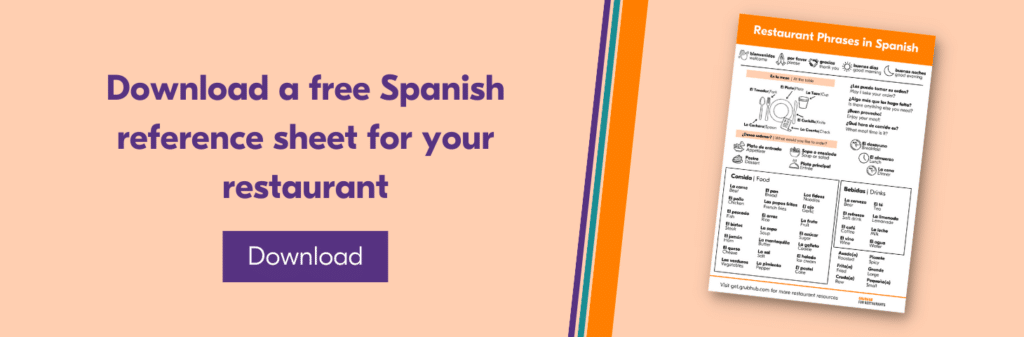
Navigating a multilingual kitchen
When you start introducing multiple languages into a restaurant kitchen, you can expect an adjustment period as staff from different linguistic backgrounds learn to communicate. Whether you’re running a Spanish restaurant or you simply have a diverse staff, a few communication and inclusivity best practices can create a more welcoming environment for everyone on the team:
- Promote language learning on the job.
- Offer language training in both English and Spanish.
- Establish a no-tolerance policy for insults or bullying.
- Encourage workers to share their languages and cultures.
- Discuss specific vocabulary for authentic Spanish cuisine and Latin American food.
- Bring in translators for performance reviews and training sessions.
- Offer multiple channels for employee feedback to accommodate everyone.
- Take employee feedback seriously.
A company culture that prioritizes connections and celebrates employees’ unique backgrounds tends to feel positive and inclusive for everyone; it helps workers feel safe and reduces employee turnover.
Your restaurant manager play a big role — other employees will look to them for behavioral clues. To help managers navigate a bilingual kitchen more effectively, consider sending them for immersive language training. They might not become fluent overnight, but the extra language skills will go a long way toward breaking down communication barriers and enabling a free flow of ideas. It takes time and effort to build a bilingual restaurant workforce, but the investment can pay off significantly. When you provide services in multiple languages, it’s easier to attract a broader range of customers and build a foundation for long-term success. Need a partner to help your restaurant grow? Sign up for Grubhub today to reach more customers.

InterContinental Hotels Group (LON:IHG) Lowered to Sell at Redburn Partners
 Redburn Partners lowered shares of InterContinental Hotels Group (LON:IHG – Get Rating) to sell a rating in a research note issued to investors on Tuesday morning, reports Marketbeat Ratings.
Several other equity analysts have also recently issued reports on the company. Jefferies Financial Group lifted their price target on InterContinental Hotels Group from GBX 5,500 ($67.54) to GBX 6,200 ($76.14) and gave the company a buy rating in a research report on Wednesday, January 25th. JPMorgan Chase & Co. reduced their price objective on InterContinental Hotels Group from GBX 6,200 ($76.14) to GBX 6,000 ($73.68) and set a neutral rating for the company in a research report on Wednesday, February 22nd. Deutsche Bank Aktiengesellschaft reaffirmed a buy rating and issued a GBX 5,520 ($67.79) price target on shares of InterContinental Hotels Group in a research report on Tuesday, November 22nd. Barclays lowered InterContinental Hotels Group to an equal weight rating in a research note on Monday, March 6th. Finally, Peel Hunt reiterated a hold rating and issued a GBX 5,750 ($70.61) price objective on shares of InterContinental Hotels Group in a research note on Tuesday, February 21st. One equity research analyst has rated the stock with a sell rating, six have been given a hold rating and five have issued a buy rating to the stock. According to MarketBeat.com, the company has an average rating of Hold and a consensus target price of GBX 5,750 ($70.61).
InterContinental Hotels Group Stock Up 1.8 %
LON:IHG opened at GBX 5,384 ($66.12) on Tuesday. The company has a market cap of £9.43 billion, a PE ratio of 3,130.23, a P/E/G ratio of 0.77 and a beta of 0.98. InterContinental Hotels Group has a 52 week low of GBX 4,174 ($51.26) and a 52 week high of GBX 5,796 ($71.18). The business’s 50 day moving average is GBX 5,561.12 and its two-hundred day moving average is GBX 4,996.47.
InterContinental Hotels Group Increases Dividends
The firm also recently announced a dividend, which will be paid on Tuesday, May 16th. Stockholders of record on Thursday, March 30th will be issued a $0.95 dividend. This is an increase from InterContinental Hotels Group’s previous dividend of $0.44. This represents a dividend yield of 1.4%. The ex-dividend date of this dividend is Thursday, March 30th. InterContinental Hotels Group’s payout ratio is presently 6,744.19%.
Insider Transactions at InterContinental Hotels Group
In other news, insider Paul Edgecliffe-Johnson sold 21,094 shares of the business’s stock in a transaction that occurred on Tuesday, February 21st. The stock was sold at an average price of GBX 5,521 ($67.80), for a total value of £1,164,599.74 ($1,430,185.12). 4.33% of the stock is owned by company insiders.
InterContinental Hotels Group Company Profile
(Get Rating)
InterContinental Hotels Group PLC owns, manages, franchises, and leases hotels in the Americas, Europe, Asia, the Middle East, Africa, and Greater China. The company operates hotels under the Six Senses, Regent, InterContinental Hotels & Resorts, Vignette Collection, Kimpton Hotels & Restaurants, Hotel Indigo, EVEN Hotels, HUALUXE, Holiday Inn, Holiday Inn Express, Holiday Inn Club Vacations, avid, Staybridge Suites, Atwell Suites, Candlewood Suites, voco, and Crowne Plaza.
Featured Stories
Receive News & Ratings for InterContinental Hotels Group Daily – Enter your email address below to receive a concise daily summary of the latest news and analysts’ ratings for InterContinental Hotels Group and related companies with MarketBeat.com’s FREE daily email newsletter.
:quality(70)/cloudfront-us-east-1.images.arcpublishing.com/adn/H5R2GFFI5BG7BBLPB6BD2GZ5OM.jpg "Hotel WiFi can be terrible. Here are some tips to deal with it.")
Hotel WiFi can be terrible. Here are some tips to deal with it.
:quality(70)/cloudfront-us-east-1.images.arcpublishing.com/adn/H5R2GFFI5BG7BBLPB6BD2GZ5OM.jpg)
Maybe you’ve experienced road warrior panic, as I did last week.
I was traveling for work and during one important video call in my hotel room, the WiFi flaked out and we disconnected. Early the next morning, my laptop kept getting booted off the in-room internet while I was trying to meet a deadline.
I was sleepy, still in my pajamas and stressed.
Crummy WiFi in your hotel room isn’t the world’s most pressing problem. But when you pay for a home (and an office) away from home, you expect some comforts: a comfortable bed, a hot shower and reliable internet access.
You can’t fix the internet in your hotel. But you are not completely powerless over that flaky hotel WiFi.
Why is the internet often terrible in hotels?
It’s complicated to spread internet access to all rooms, and hotels haven’t typically treated WiFi as a priority.
Many hotels know their guests expect internet access, but that doesn’t mean it has to be any good. Hotels’ internet equipment and software may not have kept up with your love of video streaming, Zoom calls and other data-hogging activities.
“They didn’t necessarily invest in the best WiFi,” said David Henry, president and general manager of connected home products and services at Netgear, which makes internet equipment.
Hotels are also stuffed with WiFi-blocking obstacles such as walls, electrical equipment, and other humans all sharing limited internet bandwidth.
That’s not an excuse, though. It’s also tricky to pipe hot water to 100 rooms of people taking showers at the same time. You don’t put up with balky plumbing, and you shouldn’t accept unreliable internet.
What you can do: Try to move around
If you’ve been having trouble, experiment to see if some parts of your hotel room have a stronger internet connection. On my flaky video call, it seemed to help when I moved away from the window.
Parking yourself in an uncrowded hotel lobby or business center with a separate internet connection might be a step up from the in-room WiFi shared among 50 rooms.
Some hotels offer basic internet service included in the room price and speedier WiFi if you pay extra. I hate this, but a couple of internet experts said the paid tier might be a good bet.
If most people don’t pay for the zippy service and you do, then you’ll be using a less crowded internet lane.
Ask for help
Sascha Meinrath, a telecommunications professor at Penn State University, suggested asking hotel staff (nicely) if you can switch rooms.
He said that hotels may set aside rooms for loyal guests or VIPs, and internet service is likely to be better there. I’m not bold enough to ask for an upgrade, but you could try.
Front desk staff are not your tech support, but it might also be worth asking them about your in-room WiFi troubles. They might know areas of the hotel with better internet service.
Use your phone as a WiFi hotspot
Depending on your mobile service plan, you may be able to use your phone to beam WiFi to your laptop.
You may need to ask your phone provider or look up instructions for using your phone as an internet hotspot. (Here are FAQs from Verizon, AT&T and T-Mobile.)
This isn’t a great solution if you travel a lot. Using your phone as a WiFi hub chugs through data and your battery, you might be charged extra and the phone company may slow down your connection.
You can also buy dedicated mobile hotspots, although that adds another phone bill to your budget.
Don’t keep crummy hotel WiFi a secret
Not everyone cares about the same hotel amenities. Having a pool at the hotel might be important to you, and it isn’t for me. Unreliable WiFi is a dealbreaker for me and maybe not for you.
But if quality internet service matters to you, let the hotel know in customer feedback and reviews.
“The ball is in the court of the consumer to elevate the importance to the hotel operators,” Henry said.
Travel websites aren’t necessarily helpful in empowering you.
After my hotel stay, I wanted to see if other people complained about the hotel’s balky WiFi on sites including Hotels.com and Travelocity. It was almost impossible to shift through reviews for specific amenities or terms like “WiFi.”
And while those travel websites tend to list whether a hotel offers internet service and whether it costs extra, they don’t appear to assess the quality.
Expedia Group, which owns travel websites including Expedia, Hotels.com and Travelocity, said search results on Hotels.com include a “traveler experience” filter for properties with “business friendly” amenities including WiFi. You can also choose to read only reviews written by business travelers. I didn’t find these options helpful.
After I checked out of my WiFi dead zone hotel, it emailed me a feedback survey. I usually ignore those things. This time I responded and said I probably wouldn’t stay in the hotel again because I couldn’t rely on the WiFi.
I felt like I did my small part to help future pajama-clad guests trying to meet work deadlines.
One tiny win
I love rules. Here’s my colleague Chris Velazco’s golden rule for gadgets:
“If it isn’t seriously broken, and you got whatever it was less than two years ago, don’t even think about replacing it.”
For phones both new and old, repairs might be a good return for your investment, Chris says. You might spend $100 at a repair shop having your battery replaced or more to fix your busted screen. That’s not cheap, but it’s a bargain compared to the cost of a new device.
Shira Ovide writes The Washington Post’s The Tech Friend, a newsletter about making your technology into a force for good. She has been a technology journalist for more than a decade and writes for a tech newsletter at the New York Times.

How Restaurants Should Be Using Sustainable Food Containers
As younger, environmentally conscious diners become a majority of the food-industry customer base, many restaurants are making sustainability a top priority. To-go containers are a key focus — disposable packaging is a significant contributor to commercial waste. The right sustainable products can help you protect the environment while maintaining food quality.
Why sustainability matters
Increasing restaurant sustainability is one way to reduce your impact on the environment, especially when it comes to takeout containers. According to the EPA, containers and packaging are responsible for more than 23% of all the trash that goes to landfills in the United States. By switching to compostable, reusable, or recyclable to-go container alternatives, you can minimize your ecological footprint.
Your bottom line will also benefit — after all, customers care about sustainability. Millennials and Gen Z diners, in particular, are likely to pay attention to your company’s environmental practices. In fact, 71% of millennials and 75% of Gen Z consumers consider sustainability when making purchasing decisions. As these two generations wield $65 billion and $100 billion in purchasing power, respectively, paying attention to their preferences can give you a competitive advantage. If you’re currently sending out food in plastic containers with clear lids, it could be time to rethink your restaurant’s sustainability practices.
Sustainability made simpler
Sometimes, boosting restaurant sustainability is as simple as choosing different to-go containers and lids. Start by considering your use of plastic; it’s one of the biggest contributors to ocean pollution and accounts for 12.2% of solid waste. While it may not be feasible to completely eliminate plastic packaging, reducing your usage can help.
You might also consider joining Grubhub in the CutOutCutlery campaign, which is designed to help address the issue of plastic waste in the restaurant industry. The aim is simple — by requiring that customers opt in to receive plastic cutlery with their food, you can help reduce the amount of utensils that are thrown out unused. It’s an easy action, but it can go a long way toward reducing the 40 billion pieces of disposable cutlery American diners use each year.
When you partner with Grubhub for delivery orders, it’s easier than ever to be sustainable. Each order automatically defaults to a no-cutlery setting, cutting back on plastic waste immediately.
Some additional ways to increase sustainability in your restaurant include:
- Educate. Let customers know what they can do with their takeout containers when they’re done eating. Depending on the container, this might include recycling them or reusing them as food storage.
- Reduce. Streamline your packaging and use disposable items to minimize waste. While you’re at it, you might adjust portion sizes or kitchen practices to reduce food waste.
- Go local. Incorporate locally sourced food into your menu whenever possible; it requires less fuel, produces fewer emissions and supports the local economy.
- Recycle. For convenience, offer on-site recycling to help customers separate their plastic, paper, food scraps and landfill waste.
If you decide to implement a recycling program, make sure you understand what each recycling symbol means. The most recognizable symbol features a triangle made with three arrows. It indicates that the item can be recycled, and the number in the center explains how. If you don’t see this symbol on paper or plastic products, they may not be recyclable.
You may also see symbols that indicate a product is compostable or biodegradable. Compost symbols vary; some feature a circle with an apple core in the center, while others look like a ribbon loop with leaves at one end. Biodegradable products often feature a triangle or circle made of leaves.
What are the best to-go containers for restaurant delivery?
When you’re choosing the best takeout container for your restaurant, sustainability is a top factor. The most sustainable food containers are compostable or biodegradable; they’re usually made from compostable paper, sugarcane, wheat straw or bamboo. Recyclable paper, plastic, or aluminum boxes and hot cups are the next best solution.
Make sure to consider other factors, including:
- durability. Your container should be strong enough to support the weight of the food without sagging or collapsing. For heavy, wet items, a container with a clear lid is often a sturdy option.
- Sizing. To-go containers should be sized to fit the portion. Go too big and your servings will look small; too small and the contents will be challenging to eat without spills.
- Loose lids. The lid should fit tightly, even when the package shifts during transit.
- Branding. Customize takeout containers with branding to support your marketing efforts. Depending on your delivery and takeout volume, you might order preprinted packages or personalize them with a stamp.
The best takeout containers fulfill each of these categories. You can order them from restaurant wholesalers. If sustainability is a top priority, work with a sales representative to identify boxes that are both secure and environmentally friendly.
How can you package food for delivery to ensure quality?
After you choose to-go containers, it’s important to train your kitchen staff in proper food packaging. When everyone in your restaurant understands best practices, it helps ensure each meal arrives in good condition.
As you’re packaging food, follow these steps:
- Separate hot and cold items. Keeping them in separate bags makes it easy to maintain the correct temperature in transit. Use insulated bags to help keep hot foods hot during delivery.
- Package liquids carefully. Choose containers with tight lids, and ensure they’re secure before packing them. Use cup carriers for extra stability, and make sure glass bottles are protected.
- Follow alcohol delivery rules. For beverage delivery, make sure to label drinks as alcoholic and package them in a separate container. Clear labels keep you compliant and make it easier for delivery drivers to follow local laws.
- Vent fried foods. Keep fried items crispy by choosing vented boxes that let out condensation.
- Labels and seals. Give customers extra confidence by sealing plastic and paper food containers to ensure food safety. It’s also a good idea to label hot liquids to prevent spills and injuries to both delivery drivers and diners.
Partner with Grubhub for sustainable food delivery
Safe packaging is the first step; it’s also important to work with a reliable delivery partner. At Grubhub, our platform optimizes punctuality and efficiency to maximize food quality. Drivers can pick up orders within minutes of preparation, and delivery zone boundaries ensure meals arrive quickly. With the integrated utility opt-in, sustainability is built into the process.
Sign up for Grubhub today to start serving sustainable customers.

Passionfruit – a survival story –
The 2023 passionfruit crop has survived the devastation of Cyclone Gabrielle with the country’s small team of commercial growers based in sub-tropical areas such as Northland, the Bay of Plenty and Taranaki pleased to deliver the seasonal delights to consumers.
Passionfruit is a labor-intensive crop that requires careful management throughout the growing season.
Debbie Baxter, President of the New Zealand Passionfruit Growers Association, says this season has been a particularly challenging one for growers.
“Like many other growers, we faced difficult weather conditions throughout the season. Many of our growers were affected by the severe frost in October and the vines have taken some time to bounce back from that,” he says.
“While we haven’t lost a large amount of fruit, the lack of sunshine hours this summer has delayed production by as much as four weeks in certain areas.”
Baxter notes that get passionfruit to customers is a delicate balance that requires a lot of care and expense.
“Growing passion fruit is a real labor of love. High costs are incurred from pruning and daily picking for months. Passionfruit vines are prone to disease, and, despite careful management, we have a high rate of replacement for plants that have died. In the past year alone, some of our growers lost 100 percent of their vines, while others left the industry altogether,” says Baxter.
Plant & Food Research Principal Scientist and 5+ A Day Charitable Trust spokesperson, Dr. Carolyn Lister says that passionfruit provides significant nutritional value for their size.
“The cost of two passionfruit equals to a cup of coffee – but at the same price, passionfruit delivers the nutritional benefits of dietary fiber to keep your gut healthy, and powerful antioxidants such as vitamins C and E to support your immune system. Plus, their intense sweet and tangy flavor is unbeatable,” she says.
5+ A Day suggests that passionfruit is perfectly scooped out and eaten as is or added to a wide range of sweet and savory dishes.
Passion fruit can add a tropical twist to salads. Add passionfruit pulp to a dressing for a classic green salad or mix the pulp with chunks of cucumber and peach, add baby spinach and cherry tomatoes and drizzle it with chilli and lemon for a deliciously sweet and spicy combination.
Make the most of this season’s passionfruit which are in stores from March through to September by trying out some of the tasty recipes on the 5+ A Day website, www.5aday.co.nz, or by following on social media channels for more great how to use this tropical flavor bomb.

Humble rescued cauli becomes ice cream from HELL –
It’s cauliflower but not as you know it – the humble vegetable is the hero ingredient in HELL’s newest plant-based offering, a unique ice cream made by Kiwi start-up EatKinda.
Launching nationwide across HELL’s 77 stores in Strawberry Swirl and Mint Choc Bikkie flavours, the ice cream is believed to be the world’s first of its kind being made commercially. It includes the use of cauliflower which would otherwise go to waste purely for cosmetic reasons.

EatKinda is the brainchild of Jenni Matheson and Mrinali Kumar. The duo has gone from making ice cream on their kitchen bench to scaling up to commercial production to take their products nationwide with HELL.
A passionate vegan of more than 20 years, Matheson first came up with her cauliflower ice cream recipe while looking to use up vegetables from her garden.
“After initially trying pumpkin and other vegetables I had grown, it quickly became clear that cauliflower was the perfect base. It has a beautiful texture without an overpowering taste, meaning you can create flavors easily,” she says.
Matheson took her recipe for a start-up weekend in Taranaki in 2020, where she met Kumar, who was completing a Bachelor of Food Technology at Massey University. EatKinda was soon born, making a premium ice cream that is creamy, delicious and, most importantly, plant-based.
Kumar says they use “rescued” cauliflower for their ice cream whenever possible, a deliberate decision given a large amount of New Zealand’s crops don’t even make it to the shelves.
“Apart from cosmetic imperfections, such as being the wrong size, an odd color, or not pretty enough for the supermarkets, the cauli we use is completely fine to eat. We source it from suppliers including Perfectly Imperfect, a social enterprise that saves cosmetically imperfect food from rotting in the ground. It’s a win-win for everyone,” she says.
Callum Davies, founder of HELL and equally passionate about plant-based alternatives, says the team was amazed by how delicious the cauliflower ice cream was when they tasted it.
“It sounds like it will be good for you but not tasty – yet we were blown away and knew we had to offer it to our customers. We’re always pushing the envelope in offering plant-based alternatives and think people will be just as in love with it as we are. It’s a pretty sweet aftertaste knowing that it’s dairy-free and uses rescued cauliflower,” he says.
Ben Cumming, CEO of HELL, says sustainability is one of the brand’s core values, which is why it’s important for them to support companies like EatKinda as they tackle issues around climate change and food waste.
“We’ve always been big on plant power – from our Burger Pizza using Impossible Beef to the recent Steak & Cheese Pie Pizza using Fable Steak (a mushroom alternative). For us, it’s about showing amazing plant-based alternatives and showing people that being kinder to the planet doesn’t mean compromising on taste.
“While we have very little food waste in our own HELL kitchens, it is a significant issue for the wider food industry, so we are thrilled to support EatKinda’s work in addressing that by adding their ice cream to our menu,” he says.
EatKinda wants to revolutionize the ice cream industry – changing how science and technology are used in the primary sector to create sustainable and animal-free sweet treats. Davies says HELL has been working closely with Matheson and Kumar to ready them for nationwide expansion, something he is familiar with after opening the first HELL store in Kelburn 27 years ago.
“It’s really hard building a business and a brand from nothing, so we are stoked we can share our knowledge and experience with other generations of Kiwi businesses. After hearing EatKinda’s story and tasting the ice cream, it was an easy decision for us to work with them to launch through our network and help take their business to the next stage,” he said.

The Sicilian Hotel Where ‘White Lotus’ Was Filmed Is Currently Offering a 25% Off Deal
Head to the dreamy location for a bit of a discount — drama not included.
” src=”https://s.yimg.com/ny/api/res/1.2/_kWHP9zKsk3T64UabvdmMA–/YXBwaWQ9aGlnaGxhbmRlcjt3PTk2MDtoPTY0MA–/https://media.zenfs.com/en/travel.travelleisure.com/782480a1e69d6d5e7bd9348409d9e139″ class=”caas-img”/>
Looking to experience The White Lotus IRL? Well, it just got a bit cheaper.
The San Domenico Palace, A Four Seasons Hotel, which was the hotel used as the setting for season 2 of the hit HBO show, in Sicily, Italy, is running a promotion offering 25 percent off of certain rates and packages.
Located in Sicily, on a hillside overlooking the Ionian Sea, the building was once a convent back in the 14th century, and has been welcoming guests as a hotel since 1896. However, in recent months, TV fans will recognize it as stomping grounds for stars such as Jennifer Coolidge, Adam DiMarco, Tom Hollander, Aubrey Plaza, and others.
” src=”https://s.yimg.com/ny/api/res/1.2/GCqAR9n7f9pQjav_vJTz8A–/YXBwaWQ9aGlnaGxhbmRlcjt3PTk2MDtoPTY0MQ–/https://media.zenfs.com/en/travel.travelleisure.com/d21085b22eaf4d3f77876b78007ed867″ class=”caas-img”/>
Fabio Lovino/Courtesy of HBO
The “Discover Taormina” promotion offers guests 25 percent off the bed and breakfast rate for reservations made at least 14 days in advance. The San Domenico Palace didn’t respond to comments from T+L about the status or updates to the promotion, but has it and several featured offers still listed on their site.
While the hotel is running promotions on various rooms and suites, travelers may want to check the total rate before packing their luggage. A review of the hotel rates shows that a regular room can start at $2400 a night, and the Princess Cecilie Suite starts at $6800 for select dates.
Season 2 of The White Lotus debuted on HBO in October, however in December, the hotel took to Instagram to share why the show’s creator picked it for a filming location.
“After visiting more than 30 different hotels from the South of France to the South of Italy, Mike White and his closest entourage immediately fell in love with San Domenico Palace, a Four Seasons Hotel,” the hotel shared. “‘The hotel itself had the luxury but also this kind of moodiness that was so unique,’” Mr. White said. “’It felt like a place where I could get inspired to come up with something juicy.’”
The hotel is currently closed in preparation for the opening of the spring season, and will re-open on March 14, 2023.
For more Travel & Leisure news, make sure to sign up for our newsletter!
Read the original article on Travel & Leisure.

Ed Sheeran chocolate block up for grabs to support flood victims –
Whittaker’s has announced there are five special ‘Ed-ition’ prize packs up for grabs to raise funds for Auckland flood recovery thanks to support from Ed Sheeran.
Whittaker’s created the ‘Ed Block’ for him last week after he posted to Instagram about New Zealand chocolate.
The ‘Ed Block’ is Whittaker’s classic Five Roll Refined Creamy Milk chocolate with a special edition label. He has now supplied a selfie which features on the blocks, and collaborated with Whittaker’s on the prize packs.
Each prize pack contains a signed Special Ed-ition Ed Block, a signed one-of-a-kind Ed Block t-shirt each with a unique caption, and a year’s supply of Whittaker’s Chocolate.
Chocolate Lovers can bid for the prize packs on TradeMe with 100 per cent of proceeds being donated to Auckland’s flood recovery efforts.
Whittaker’s Brand Manager, Tamra Lindsay, says Whittaker’s are delighted to have Ed’s support in fundraising for the Auckland City Mission – Te Tāpui Atawhai.
“All of the funds raised through our Ed Block auctions will go to the Mission, who will distribute funding, in association with Foundation North – Hapai Pūtua Oranga, to other trusted local community organizations also delivering on-the-ground support to help those in greatest need across the city in the aftermath of the flooding,” says Tamra.
Helen Robinson, Mission CEO – Manutaki says the response from people across the country – and now an international superstar – to support those in our city affected by the floods showing the true spirit and heart of Aotearoa.
“At the Mission, we’re incredibly humbled to have the support of Whittaker’s and Ed! With so many community organizations helping in the aftermath of the flooding, the Mission is taking this fundraising opportunity to support those organizations too so that together we can help as many people as possible,” says Helen.
Light-hearted banter began between Whittaker’s and Ed after he posted to Instagram with the caption “NZ chocolate is actually alright.”
“At Whittaker’s, we couldn’t be happier to hear that Ed had become a chocolate lover and thought we would celebrate by crafting him the perfect treat.”
“Now with a dedicated selfie from Ed himself, we can’t wait to share the special Ed-ition ‘Ed Block’ prize packs with Chocolate Lovers in support of the Auckland flood recovery,” says Tamra.
Head to TradeMe from 11am today to bid for your chance to get your hands on one of the Special Edition ‘Ed Block’ prize packs.
You can also head to the company’s Giveaway page to donate and support the cause outside of bidding on the auctions.