

Restaurant advertisement: growing awareness of your brand
Restaurants rely on local business, which means awareness is everything. Before they can stop in for a meal, customers need to know your establishment exists. That’s the role of marketing and advertising: to build awareness and familiarity in your target audience as a way to boost sales.
Get your brand out there
Marketing is one of the most important aspects of operating a restaurant. An effective marketing strategy helps your business succeed by:
- Building brand awareness and name recognition
- Creating relationships with your target audience
- Distinguishing your restaurant from competitors
- Convincing customers to try your food
- Increasing sales and revenue
The way you market your restaurant also strengthens its brand — the way the public perceives and identifies the business. It’s hard to overestimate the value of a compelling and powerful brand. It builds familiarity, trust, and loyalty in your customers, making them more likely to choose your restaurant over competitors.
What’s the difference between marketing and restaurant advertising? Advertising is one facet of marketing; a restaurant advertisement typically involves promoting your restaurant through paid channels.
How to market your restaurant
The most effective restaurant marketing strategies use a multi-pronged approach. By showing your food and brand on a variety of channels, it’s possible to reach different sectors of your target audience.
This strategy also increases the number of times customers are exposed to your brand. That’s important for the legendary “Rule of Seven,” which states that viewers need to see an ad or marketing campaign seven times before they take action.
As you write a restaurant marketing plan, make sure to include a broad selection of platforms.
1. Email marketing
Email marketing is one of the most valuable forms of marketing for the food industry. You own the email list, which means you can communicate with recipients at any time — without relying on a search engine algorithm or a platform to show your content to followers.
Email is particularly effective for restaurants because it enables you to control when viewers see marketing messages. Want to boost midday sales? Send out an email with the daily lunch specials at 10:30 am, when office workers are starting to think about lunch. Is Mother’s Day coming up? Help customers decide how to celebrate by sending an email announcing a holiday brunch.
2. social media
When diners are trying to pick a restaurant, they often scroll through locations or relevant hashtags on social media to find an appealing option. Social media marketing increases your chances of showing up in those searches.
To build a powerful social media presence for your restaurant, you must capture diners’ attention when they’re ready to buy. This process typically involves:
- Selecting the platforms that are popular among your customers
- Post beautiful food photography and videos
- Humanizing your brand with “behind the scenes” content
- Boosting engagement with content and special discounts
- Including links to your website and online ordering system
It can pay to create accounts for your restaurant on Facebook, Instagram and TikTok. Utilizing a social media calendar can help you post on a consistent cadence.

3. Paid restaurant ads
Advertising usually requires you to pay for placement. Your restaurant advertisement strategy should include both print and digital ads, including:
- Social media advertising. Instagram and Facebook ads can be targeted to reach your ideal customer. You can customize them with photos of food, interiors or employees.
- Google display ads. By joining the Google ad network, you can position your restaurant’s advertisements on participating websites.
- Restaurant billboards. Billboards are essentially supersized print ads that sit in high-traffic areas.
- Print ads in newspapers and magazines. This type of traditional advertising tends to work well for an older demographic.
- Radio ads. Reach customers while they’re driving with paid radio ads that promote your food or special deals.
- Podcast ads. Like radio ads, these promotions are audio-only. They typically appear during podcast breaks. Podcasting is a popular medium for younger listeners.
- Advertising videos. Video promotions often appear in television commercials; you can also use them as display ads on websites and YouTube.
- Direct mail. Send restaurant ads through the physical mail. This is an effective way to stand out from online noise and promote a grand opening, special event or new menu. You can even include discount coupons as an added incentive.
A great restaurant ad is attention-grabbing and easy to understand — viewers should be able to comprehend the message in seconds. In many cases, effective ads use emotions to create fast, powerful connections with customers. Finally, make sure to include a call to action to convince the audience to visit your website, follow you on social media, sign up for the email list or stop by your restaurant.

4. Printmarketing
Digital marketing has gained traction in recent decades, but traditional print marketing can still be a powerful tool. You might create flyers to put up on local billboards or print a brochure to leave at hotels in the area. You can also staple your print marketing materials or special deals for customers’ takeout and delivery order bags. If your restaurant offers catering services, a printed catalog with a food menu can help event planners and wedding venues share your business with clients.
Other types of print marketing include:
- Business cards
- Table tents
- Posters
- Signs
- Bag inserts

5. Content marketing
Content marketing is the process of creating and sharing blog posts, videos and social media content to promote your restaurant. You can include both direct and indirect promotions. A social media post might announce your latest special outright; a blog post could take a more indirect route by sharing a popular recipe or discussing the food scene in your city.
Tips and tricks for marketing a restaurant
No matter what platform you choose, use these restaurant advertising and marketing tips to attract more customers:
- Invest in high-quality photography and video to showcase your food and restaurant in the best light.
- Include deals and discounts to give customers an additional reason to come in.
- Keep an eye on competitors and stay up-to-date with their marketing strategies.
- Engage customers by asking for feedback, particularly on social media.
- Fill out your Google Business profile completely.
- Experiment with advertisements in a variety of locations and refine your strategy to include the ones with the highest response.
How much should you spend on advertising?
Restaurant advertising can be as affordable or as expensive as your budget allows. As a rule of thumb, marketing experts suggest that small businesses spend between 7% and 8% of their revenue on marketing. For most companies, advertising spend should account for no more than 20% of the total marketing budget.
If your restaurant had yearly revenue of $1 million, the marketing budget would be $70,000 to $80,000. Your maximum advertising budget would fall between $14,000 and $16,000.
The actual budget can vary significantly from restaurant to restaurant. Some businesses see a high return on their ads, so they spend more. Others may be more successful with other types of marketing and choose to invest accordingly.
When you’re just starting out, you might want to spend more on paid ads. As soon as your organic marketing strategies catch up — you build a social media following or bring in traffic to blog posts, for example — you can reduce the advertising budget.
Calculating the ROI of your restaurant marketing efforts
At the end of the day, the goal of promotional activities is to bring in new customers and increase food sales. As a restaurant owner, it’s helpful to monitor the return on investment (ROI) of your restaurant marketing and advertising campaigns. The results can help you design a targeted strategy and set an appropriate budget. To calculate the ROI, use this formula:
(sales growth – marketing costs)/marketing costs = ROI
For example, if you spent $1,500 on marketing in a quarter and saw a $5,000 increase in sales during the same period, you would calculate ROI with this equation: ($5,000-$1,500)/$1,500 = 2.33%.
There are no set rules for an acceptable ROI. In general, the higher the ROI, the more successful the strategy. To find the strategies that work best for your restaurant, calculate the ROI for different advertising and marketing campaigns.
As you create a marketing and advertising plan for your restaurant, remember that it’s a process. With trial and error and regular attention, you can develop a refined strategy that brings in customers and increases sales.
Growing your advertising reach with Grubhub
Reaching customers is difficult for any restaurant. That’s why it helps to have a trusted partner like Grubhub by your side. When you list your restaurant on Grubhub Marketplace, you have instant access to 33+ million paying customers. You can run promotions and get access to loyalty tools to advertise your business, grow your brand.
Ready to grow your business? Sign up for Grubhub today.
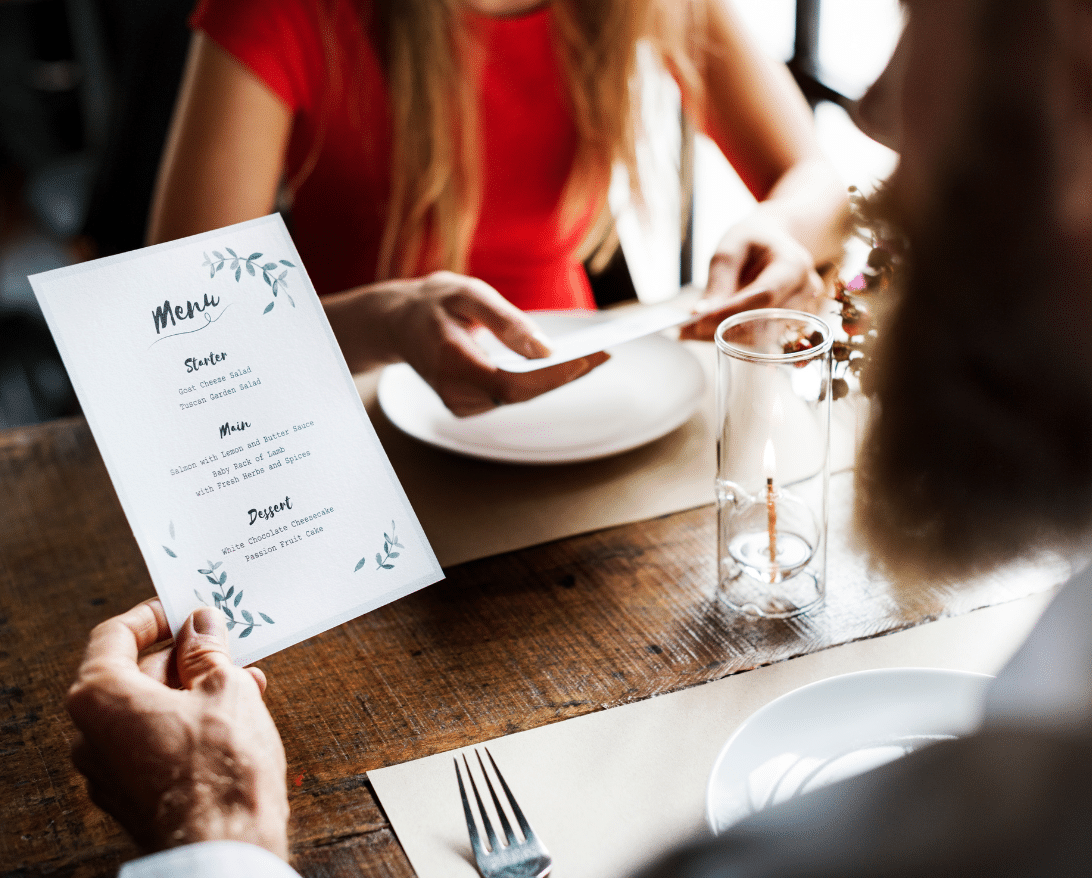
Menu engineering: creating a more profitable food and drink list
When a customer encounters your restaurant in person or online, the menu is the first thing they look for. This simple tool is one of your biggest assets — the design and dish selection affects everything from the average order value to the sales volume for each item. Menu engineering is a data-driven way to create a menu that makes the most of your resources and boosts your bottom line.
What is engineering menu?
Menu engineering is the process of designing and optimizing your restaurant menu in a way that maximizes profitability. The process starts by collecting data for each menu item:
- Calculate food costs
- Identify contribution margin
- Analyze sales data to determine popularity
This data enables you to categorize items based on how popular and profitable they are. With that information, you can create a menu that strategically increases the profit for every diner.
In some cases, the process is as simple as writing a more compelling description or altering the menu design to promote profitable items. For others, you might need to take more drastic steps to increase profits, such as switching to lower-cost ingredients, increasing the price, reducing the portion size or altering the side dishes.
How to calculate your food costs
The first step in menu engineering is calculating food costs for everything in your restaurant menu. To start, write down all the ingredients, including garnishes, condiments and seasonings. Then, assign a quantity to each ingredient and calculate its cost based on the price.
For example, imagine a recipe calls for a 15-ounce can of tomato paste. Your restaurant pays $45 for a case of six cans, which means each can costs $7.50. The recipe makes 25 servings, which means each serving uses $0.30 in tomato paste.
Add up the individual ingredient costs to get the food cost for each dish. Use this data to calculate your contribution margin, or the amount of money you make by selling each dish. To do so, subtract the food cost from the menu price. If you sell a serving of lasagna for $15 and the food costs are $6.50, the contribution margin is $8.50.
You may already have key menu engineering data on hand; many restaurants use food cost percentage and profit margins when setting menu pricing.
Creating a menu to maximize profits
Once you have the food cost and profit margin for each restaurant menu item, it’s time to bring in the sales data. For each item, note the number of sales over a given period. The higher the sales volume, the more popular the item.
Next, use your contribution margin and sales volume to plot each item on a menu engineering matrix. The x-axis should show profitability (contribution margin) from low to high; the y-axis should show popularity (sales volume) from low to high. Based on the placement of items in the matrix, you’ll be able to visualize how they fall into four categories:
- High profitability, high popularity
- Low profitability, high popularity
- High profitability, low popularity
- Low profitability, low popularity

Reworking your menu based on profitability and popularity
Now, it’s time for true restaurant menu engineering: identifying concrete ways to maximize profits in each of your four categories.
1. High profitability, high popularity
The items in this category are the most important — they have high profits, and customers love them. There’s usually no need to make changes to the dishes themselves. Instead, find ways to increase sales by altering the menu design:
- Place items near the top or center of the page or section
- Create a special section defined by a colored box or frame
- Highlight popular dishes with a “customer favorite” icon
- Showcase dishes with food photography
A powerful, visibility-focused menu design can boost profits, even when the price and ingredients stay the same.
2. Low profitability, high popularity
These dishes are popular with customers, but they use high-cost ingredients. To increase the profits, you have a few options; each one comes with benefits and risks.
- Raise menu prices. This strategy maintains the existing quality and taste of the dish and increases profitability. It can be effective if your customers aren’t price-conscious; if diners are on tight budgets, you risk a drop in sales.
- Adjust ingredients. Ask your kitchen staff to swap in cheaper ingredients. If you can do this without changing the flavor and texture of the dish, you can increase your profit while keeping prices the same.
- Change portion sizes. When portions are too big to finish comfortably but not so big that they produce left overs, consider reducing the size. Your customers will still be satisfied, you’ll make more money and you’ll reduce food waste.
- Create more profitable specials. Take your popular dish and add high-profit items to create a special. If customers love a low-profit appetizer, for example, you could create a happy-hour special that includes an appetizer and a cocktail with a high contribution margin.
3. High profitability, low popularity
When you have dishes that are profitable but largely ignored by customers, it’s time to do some digging. To start, offer the item as a freebie to select customers and ask them about their experience. Is the dish too expensive? Is the flavor unappealing? Are they turned off by the ingredients? If so, you can adjust accordingly.
If you find that customers like the food and the price, it’s time to change the menu design. It could be an awareness issue — a problem that’s easily solved by putting the dish in a more prominent position on the page. You can also consider writing an appealing menu description that whets customers’ appetites and explaining why the dish is special. This strategy uses the psychology of menu design to create curiosity and appeal to the senses.
4. Low profitability, low popularity
It might seem alarming to find menu items that have high food costs and low sales volume, but it’s actually a valuable opportunity. After all, this category tells you a great deal about what your customers do and don’t want.
In most cases, your best bet is to remove these items completely. You’ll free up space on the menu and create an opening for new, more popular dishes.
As a restaurant owner, it can be difficult to give up menu items. If you’re passionate about the dish, you can try to salvage it by improving the flavor or using ingredients with higher profit margins.
Get your menu in front of customers
You’ve analyzed menu items and invested in the menu engineering process — now, it’s time to get your new, profit-focused restaurant menu out to customers. For in-house diners, all you need to do is replace old menus with the updated versions. To avoid the costs of printing new menus, you can replace physical copies with a QR code menu. Print the QR code on table tents, stickers and signs so customers can find it easily. Make sure to keep a few paper copies on hand for tech-averse diners.
Keep in mind that many customers check out your menu online before making a reservation or ordering for delivery. To ensure they’re seeing the newest menu, follow these steps:
Do you use a food delivery platform? You’ll also need to update the menu in your profile. Grubhub for Restaurants streamlines the process with a simple update system — edit the menu after closing and it will be visible to customers during the next shift. Any changes you make automatically flow through to your Grubhub Direct branded ordering websites, saving time and ensuring every menu is consistent.
When you’re a restaurant owner, the menu is your most important marketing tool. Menu engineering is an effective way to streamline and refine the menu to ensure every item is pulling its weight. Ready to get your menu in front of more customers? Partner with Grubhub today to gain access to 33+ million hungry diners.
19 June food holidays for your restaurant to celebrate
Did you know 45% of US customers say they’ve tried a new restaurant after seeing a restaurant’s post on social media? That’s why it’s more important than ever to make sure your restaurant is establishing an effective social media strategy to grab customers’ attention. One great way to make your restaurant stand out online is to celebrate national food holidays on social media.
Take a look at these tips on how you can take advantage of food holidays this month and keep scrolling to get the full June calendar.
What are national food holidays?
National food holidays are micro holidays that center around a certain cuisine. They are often celebrated on social media and encourage diners to band together to show appreciation for everything from veggie burgers (June 5) to cannolis (June 16). While these holidays don’t warrant a day off, they can still be fun to observe and celebrate. As a restaurant owner, a food holiday is the perfect excuse to offer an irresistible promotion that will encourage diners to place an order.
Why your restaurant should celebrate national food holidays
Everyone loves having something to celebrate, and restaurants can use food holidays to build excitement around their dishes. Food holidays are particularly popular on social media as diners go online to share what cuisine they’re celebrating. Acknowledging a food holiday on social media by using the holiday’s hashtag can instantly make your restaurant relevant to a wider audience.
Food holidays put specific dishes top of mind. When diners are craving pizza on National Vanilla Milkshake Day (June 20), you want your frosty creation at the center of the celebration. Posting about your food can motivate diners to order from your restaurant. In fact, 53% of millennial TikTok users visited a restaurant after seeing it on the app. Incorporating food holidays in your social media strategy incentivizes hungry diners to check out your cuisine.
3 tips for marketing national food holidays
A successful food holiday marketing strategy begins with a strong digital presence. Modern diners flock online to discover new restaurants and place orders. Digital tactics are important for your restaurant marketing strategy.
To make your national food holiday celebrations as effective as possible, tie them into a larger restaurant marketing strategy that looks at the big picture, not just a single opportunity. A restaurant marketing strategy is a formal plan that documents, tracks and analyzes all your marketing efforts and activities.
1. Pile on promotions
Nothing motivates a diner to press ‘order now’ more than a discount. Rolling out promotions not only attracts more customers to your menu, but also encourages loyalty. Diners are more likely to place repeat orders if they think a restaurant has a good deal. In fact, 81% of consumers would switch restaurants if they saw a good deal. Your food holiday promotions can be the first thing that catches a potential customer’s eye.
Here are some promotion ideas that can get diners drooling for your dishes:
- Discount dollar amounts: On National Smoothie Day (June 21), offer $1 off your smoothies.
- Discounted items: Celebrate National Strawberry Shortcake Day (June 14) by offering 50% off a slice of shortcake when a customer purchases an entrée.
- Discount-themed ingredients: Celebrate Cheese Day (June 4) by offering 20% off all cheesy menu items.
- Free items with purchase: On National Donut Day (June 2) offer a free donut to every customer that orders from your app.
When you partner with Grubhub, launching promotions is as easy as pie. Restaurants that partner with Grubhub gain access to free-to-use promotional and marketing tools that are proven to increase orders and customers.
With Grubhub’s Promotions and Loyalty Tools, you can:
- Run seasonal promotions to make the most of national food holidays
- Offer your customer the right discount at the right time
- Increase your ROI with our advanced technology and huge volumes of restaurant and customer data
2. Highlight online ordering
Getting customers excited about a food holiday is great, but unless you give them an easy avenue to place an order, all that momentum around your dishes will be lost.
Your restaurant’s website serves as the backbone of your digital presence. Your website should have all things a diner needs to know about your restaurant – this includes your menu, hours, location, story and an online ordering platform. Finding a platform that converts curious diners into satisfied customers can be difficult. That’s why restaurants are turning to Direct to reach more customers, drive online ordering and establish their advertising efforts with zero commission costs.
88% of restaurant operators stated a branded experience is very important for sales. With Direct, your restaurant can create an online ordering web page that’s designed and branded to match your existing restaurant’s look and feel. It can be easily integrated into your existing website (if you have one) or can act as your main site if need be. Learn more about how Direct can drive online ordering.

Once your website is up and running, you want to make sure it’s searchable. When potential diners search your restaurant on Google, your Business Profile is usually the first thing to pop up. Claim your restaurant’s Google Business Profile so that you can make sure it correctly displays your hours, address, pricing and website link. When your Business Profile features the correct info and links, it’s far more likely a customer will place an order or come in to check you out.
3. Get social
Nobody will know your restaurant is celebrating a national food holiday unless you spread the word. That’s where social media comes in. TikTok, Instagram and Facebook are all powerful places to establish a restaurant social media presence.
Looking for some tips to make your restaurant pop on social media? Try these ideas:
- Showcase your dishes by posting delectable photos and videos of them on national food holidays.
- Use trending hashtags like #NationalCheeseDay or #NationalDonutDay to reach a larger audience beyond your social media followers.
- Use local hashtags like #BostonFoodie or #NYCeats to connect with customers nearby.
- create a quiz about your dishes to boost engagement with your national food holiday promotions.
- Launch a contest with prizes that relate to your restaurant and die in with your national food holiday promotion.
It’s easy for restaurant owners’ plates to pile up, leaving little time to strategize about marketing. That’s why developing a social media calendar is essential for planning out how you will roll out your promotions.
A social media calendar is a way to organize your upcoming social media posts and promotions by date. Planning posts in advance gives you time to lay out promotions, batch content and solidify your menu to align with your offerings.
Check out these tips on how to market national food holidays on social media.
What social media holidays are coming next?
June signals the start of summer where customers are eager to celebrate everything from veggie burgers (June 5) to ice cream cake (June 27). June also brings Pride Month, Juneteenth and Father’s Day. Last year, over 450,000 orders were placed on Father’s Day. Is your restaurant prepared for this top ordering holiday? No matter what cuisine you’re celebrating, it pays to run a food holiday promotion.
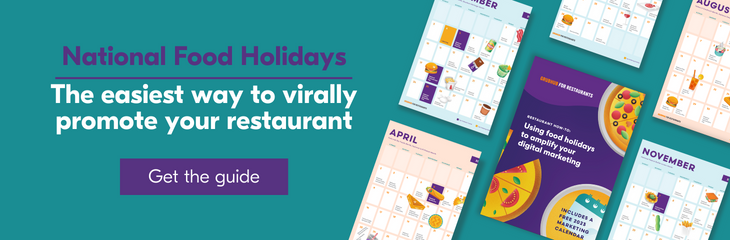
Download our Guide to National Food Holidays to learn how to spearhead your promotional marketing and elevate your digital presence. Use your new calendar to create a marketing plan or amplify your existing one. National food holidays could be your next step toward increased sales and a wealth of new customers.

June national food holidays
June is National Soul Food Month and National Steakhouse Month.
- June 2: National Donut Day
- June 3: National Egg Day
- June 4: National Cheese Day
- June 5: National Veggie Burger Day
- June 6: National Churros Day
- June 7: National Chocolate Ice Cream Day
- June 9: National Strawberry Rhubarb Pie Day
- June 10: National Egg Roll Day
- June 11: National Corn on the Cob Day
- June 12: National Falafel Day
- June 14: National Strawberry Shortcake Day
- June 16: National Cannoli Day
- June 18: Father’s Day
- June 20: National Vanilla Milkshake Day
- June 21: National Smoothie Day
- June 22: National Onion Ring Day
- June 24: National Pralines Day
- June 26: National Chocolate Pudding Day
- June 27: National Ice Cream Cake Day

A 5-star restaurant kitchen cleaning checklist
Next to cooking, cleaning is the most important process in your restaurant. Rigorous cleaning and sanitization helps kill bacteria, which prevents a variety of contact and food-borne illnesses. When the procedure is compliant with federal, state and local food codes, it’s easier to maintain a high restaurant health score, even after a surprise health inspection.
Cleanliness also benefits your bottom line — when diners can enjoy their meals in a fresh, spotless setting, they’re more likely to give you positive reviews and repeat business.
Need help with consistency and accountability? Try standardizing the process with a restaurant cleaning checklist. That way, employees don’t need to rely on memory after a long shift; they can simply work through the list and sign off on each task.
Front-of-house cleaning checklist
The commercial kitchen is often the focus of a restaurant cleaning procedure, but the front-of-house matters, too. Because this is the only part that restaurant customers see, it shapes their opinion of your business. For most establishments, it makes sense to separate the cleaning procedure into daily, weekly and monthly tasks. This ensures high-contact areas are always fresh; it also prevents dirt buildup, so deep-cleaning days are easier.
Before you start, make sure to have common cleaning supplies on hand:
- Cleaning gloves
- Surface cleaner
- Disinfectant spray
- Cleaning cloths
- Sponges
- Paper towels
- Glass cleaner
- Brooms
- Vacuum
- Fool
- Buckets
- Floor cleaners
- Scrub brushes
- Garbage bags
- degreasing solution
Daily front-of-house restaurant cleaning checklist
During each shift, perform these tasks as needed:
- Wipe down and sanitize tables, counters and seats
- Clean and sanitize bathrooms
- Sweep or vacuum floors
- Wipe food and drink off of the menu
- Wipe down condiments
At the end of the day, do the following:
- Clean and sanitize tables, counters and seats
- Clean and sanitize bathrooms
- Clean and sanitize railings and door handles
- Clean and sanitize menus
- Sweep and mop hard floors
- Vacuum rugs and carpeted areas
- Clean streaks, fingerprints and smudges from windows
- Refill disposable supplies
- Wipe down walls if needed
- Take out the trash
- Take out recycling
- Sanitize recycling containers
- Send dirty linens to the laundry
Weekly front-of-house restaurant cleaning checklist
- Clean and sanitize doors
- Wash windows
- Wash mirrors
- Dust light fixtures
- Dust decor and signs
- Deep-clean toilets and sinks
- Dust liquor bottles behind the bar, if applicable
- Clean draft lines, if applicable
Monthly front-of-house restaurant cleaning checklist
- Deep-clean all bathrooms
- Clean and dust light fixtures
- Clean and dust ceiling fans
- Vacuum all carpet thoroughly
Back-of-house cleaning checklist
Cleaning a commercial kitchen requires constant attention — in this fast-paced environment, it’s best to clean regularly throughout the day to prevent big messes. In the process, you’ll increase food safety and reduce the risk of cross-contamination and food-borne illness. Regular cleaning can also improve restaurant kitchen safety, which protects your employees and your business.
As with front-of-house cleaning, there are some tasks you should do every day. Others, you can do every week or month. To help your staff clean efficiently, stock up on these key cleaning supplies:
- Cleaning cloths
- Steelwool
- Scrub brushes
- Fool
- Brooms
- Cleaning gloves
- degreasing spray
- Disinfectant spray
- Surface cleaner
- Commercial floor cleaning solutions
- Commercial dishwasher detergent
- Dish detergent
- hand soap
- hand sanitizers
Daily restaurant kitchen cleaning checklist
During the day, keep the kitchen clean by running through this restaurant cleaning checklist as often as necessary:
- Wash hands frequently
- Clean surfaces before switching foods or dishes
- Clean and sanitize food-prep areas after preparing raw meat
- Wipe up messes
- Clean and dry spills on the floor
- Scrape the griddle
- Brush the grill
- Move utensils and dishes to the dishwashing area between tasks
- Package ingredients safe for storage
- Mark ingredients and prepared dishes with the date
- Run the dishwasher
At the end of the shift or the day, do the following:
- Clean and sanitize counters and food-prep areas
- Clean and disinfect cutting boards
- Degrease and wipe down appliances
- Clean the surface of the ice machine
- Clean and sanitize sinks
- Clean the grill, griddle, range and fryer
- Empty drip trays
- Filter the oil in the fryer
- Clean and sanitize handles and knobs
- Send all dishes, pots and utensils for dishwashers
- Put away clean items
- Send uniforms, aprons and towels to the laundry
- Clean floor mats
- Clean beverage-dispenser heads
- Take out the garbage
- Sweep and mop the floors
Weekly restaurant kitchen cleaning checklist
- Go through inventory and dispose of expired items
- Delime sinks, faucets and coffee makers
- Clean coolers and refrigerators
- Clean ovens
- Boil out the fryer
- Switch out the oil in the deep fryer
- Wipe down vent hoods
- Pour drain cleaner in floor and sink drains
Monthly restaurant kitchen cleaning checklist
- Clean vent hoods and fans
- Clean behind major appliances
- Clean and sanitize the interior of the ice machine
- Empty and clean the grease traps
- Wash the walls and ceiling
- Deep clean the floors
- Clean and sanitize inside refrigerators and freezers

7 Restaurant cleaning tips
Every restaurant will have a slightly different commercial cleaning checklist — a takeout sandwich shop requires a different process than a family pizza place. As you design and implement a custom procedure, use these tips to improve everyday cleanliness.
- Encourage frequent handwashing
Ask your staff to wash their hands regularly to prevent the spread of germs. At a minimum, they should wash before and after preparing food, after coming back from a break or the bathroom and after handling potentially dangerous foods such as raw meat. It’s also important to wash your hands after touching garbage, coughing, sneezing or blowing your nose. According to the CDC, the process should involve at least 20 seconds of scrubbing with soap.
- Follow the state food code
In most states, health inspectors visit restaurants one or more times per year and any time someone makes a complaint. To make sure you’re prepared, design your restaurant cleaning checklist to match your state’s food code; the city or county health department can provide a local inspection standards guide.
- Store foods quickly and correctly
Don’t leave ingredients or cooked food on the counter — instead, put them in the refrigerator quickly. By keeping the food below 40 degrees Fahrenheit, you can prevent the growth of harmful bacteria. And when foods are off the counter and safely in storage, they’re less likely to be cross-contaminated. This can help you limit food waste.
- Store cleaning supplies safely
When storing cleaning chemicals, consider your kitchen layout. Your storage area should be located away from heat, food-prep and storage areas and air intake vents. Ideally, choose a space with ventilation to prevent the buildup of fumes. Keep your restaurant kitchen cleaning checklist in mind, and place items when workers can get to them without interrupting the rest of the team.
- Delegate cleaning tasks
One of the best ways to clean a restaurant is to spread out the tasks. When everyone knows exactly what they’re responsible for, your team is less likely to skip steps. Consider creating individual commercial kitchen cleaning checklists for different employees or teams to streamline the process.
- Focus on daily cleaning
When your employees clean the kitchen and front-of-house on a daily basis, it’s easier to prevent dirt, dust and grease build-up. Over time, small cleaning tasks become a habit that’s tightly woven into your regular workflow.
- Minimize cell phone use
Cell phones are covered in bacteria — in fact, the University of Michigan found that phones are often 10 times dirtier than the average toilet seat. To prevent employees from transferring germs from their phones to food or appliances, ask them to minimize phone use while on the job. If they must touch the phone, ask them to wash their hands afterwards.
The importance of a clear cleaning checklist
A restaurant cleaning checklist is a simple tool, but it can transform your kitchen and front-of-house operations. When employees have a clear list of duties, they never need to wonder what’s been done; it’s easy to identify outstanding daily cleaning tasks at a glance.
This process benefits your restaurant by:
- Standardizing a compliant cleaning process
- Ensuring key areas are cleaned regularly
- Improving food safety
- Helping new employees contributing effectively
- Reducing the risk of missed cleaning tasks, even during busy shifts
- Holding employees accountable for assigned tasks
- Tracking weekly and monthly cleaning jobs
Without a checklist, it’s easy to skip small jobs — especially during busy shifts. This situation tends to have a snowball effect that affects cleanliness, food safety and the customer experience.
If you’re looking for ways to improve your restaurant’s cleaning process, a checklist is a simple and affordable solution. By designing it to match the state food code and dividing tasks among the kitchen and front-of-house staff, you can create a better system with minimal costs and little to no training.

9 trends in AI in restaurants
Technology is rapidly evolving in businesses, and the restaurant industry is no exception. Restaurateurs are learning that utilizing technology can make their operations smoother, growing their business. Advancements like AI in restaurants have made technology more accessible to businesses, introducing conversational language to make it easier for business owners, staff and customers to interact with technology.
The great thing about AI is that it’s a technology that can cater directly to your business needs. Don’t worry – this isn’t a technology that will take over your business, rather work for you, improving operations and streamlining your kitchen. And even better, with evolutions like ChatGPT, accessing this technology is easier than ever.
Take a look at our tips on how you can implement AI into your business to improve the experience for both your employees and customers.
What is AI?
AI (or artificial intelligence) is the simulation of human intelligence by computer systems. AI uses machine learning and predictive analytics to interact with humans. AI systems have the ability to ingest large amounts of data, look for patterns and correlations and make future predictions or answer questions. AI takes machine learning to the next level by using a variety of techniques to generate creative solutions.
No two restaurants are the same, and the needs of each restaurant owner are different. AI has made working with technology more personalized to each business.
What is ChatGPT?
ChatGPT makes conversing with AI simple. It uses an AI language processing tool to allow for human-like conversations with a chatbot. ChatGPT was created by OpenAI, and taps into the power of Google to spit out answers to user-generated questions. It’s like having your own personal assistant – for free!
The great thing about ChatGPT is that it’s moldable. You can be as specific or vague as you want, performing endless tasks like dishing up food industry trends or writing your menu descriptions. You can specify the format you want the program to deliver (like a social media caption) and limit the amount of content it will produce (like asking it to use 200 characters).
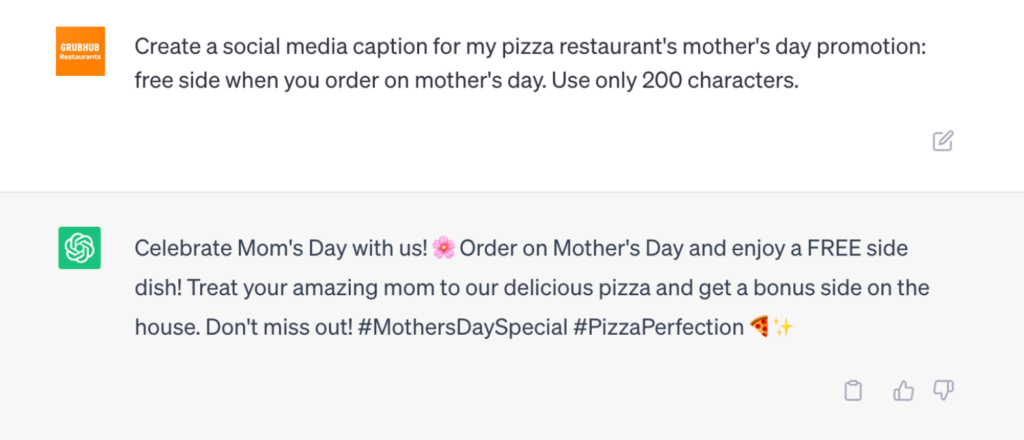
Don’t know what to ask ChatGPT? Ask them the best way to use ChatGPT for restaurants. For example, if you type “What are good questions to ask you about running my restaurant?” ChatGPT will respond with a list of questions you can explore like “What are some effective strategies for managing food costs in a restaurant?” or “What are some best practices for hiring and training restaurant staff?” Plug in those questions and ChatGPT will instantly serve you an in-depth answer.
Get started with ChatGPT by creating your free account.
Why should restaurants implement AI?
Working in the restaurant industry is chaotic, and turning to technology like AI can help make daily operations smoother. Using AI tools can help make your most ambitious restaurant ideas a reality.
AI integrations have helped restaurants by:
- Improving efficiency and accuracy. AI eliminates the risk of human error, increasing your accuracy to improve efficiency.
- Streamline Labor. AI can help complete restaurant tasks, reducing your labor costs and curbing employee turnover.
- Making smarter decisions. AI analyzes restaurant information and data to help you make more informed business decisions based on industry trends and your restaurant’s performance.
- Creating content. ChatGPT can write menu descriptions, social content and marketing materials for your restaurant.
- Cutting costs. AI can help you analyze your spending and finances to improve your ROI.
- Customize the customer experience. AI can allow for menu customization to allow your diners to have more control over their dishes and experience.
- Growing customer base. AI has helped restaurants grow their customer base by finding new diners and improving their reputation by responding to customer inquiries and creating engaging content.
9 ways to use AI in your restaurant
Ready to give AI a shot? Here are some ways you can utilize AI in your restaurant.
1. Phone operations
With the help of voice assistants, AI can talk directly to your customers and become your personal phone assistant. Answering phones requires employee labor, and if you grow your business, it can be difficult to always be on the line. In a Popmenu survey, 83 percent of customers will move on and find another restaurant if they try to call and get voicemail more than once. Enabling AI phone technology can allow you to care for your customers without the extra labor.
Tools like SoundHoud allow you to customize your phone system’s answers to talk with customers to answer questions and take orders. You can customize your AI phone answering to take reservations, answer frequent questions and take messages.
2. Take orders
Self-service ordering is rising in popularity. It makes the process easier for customers who can easily see all the menu options at their fingertips, and it helps staff avoid wasting time taking orders. AI makes online ordering even easier by reacting to customer behavior and predicting their next move.
Fast casual restaurants have been some of the first businesses to embrace AI ordering. Taco Bell’s in-store kiosks use AI to identify up-sale opportunities based on the customer’s order, and McDonald’s opened their first completely digital restaurant in Texas.
Not all AI integrations are a total robot takeover, and there are simple ways you can use AI to help with customer orders.
POS integration is one of the most common AI tools restaurateurs use. These tools help simplify order and menu management by connecting your different POS systems. This way you can keep track of orders, inventory and staff all from one place.
3. Get industry insights
Keeping up with the ever changing restaurant industry is difficult, especially as customer habits and tastes change. AI is a great tool for gathering and sorting through trend information. ChatGPT taps into the power of Google, making research simple. Try asking ChatGPT questions about the restaurant industry to get insight into customer cravings.
What kinds of questions should you try asking ChatGPT?
- What are the top ordered restaurant foods?
- What fruits and vegetables are in season right now?
- What is the most popular way to serve chicken?
- What are the top ordered dinner foods?
4. Enhance your menu
Research shows that menus with images and dish descriptions resonate better with customers. Now, you can create the perfect menu with the help of AI. You can use ChatGPT to generate menu text by asking them to create a one-sentence description of your dishes. Looking for menu photo tips for your cuisine? Ask ChatGPT for help on composition and style. Wondering what recipes are in season? Ask ChatGPT what’s trending.
AI’s influence in menu engineering doesn’t stop there. Technology has enabled restaurants to get a better handle on their inventory. Solutions like ClearCOGS offer a kitchen ingredient management system that can keep track of your inventory to help you plan food preparation and ordering.
5. Analyze data
Odds are you have many types of restaurant technology in your restaurant, and some of these systems are collecting valuable data. Take Grubhub, for example. Our platform collects data on your customers, and serves it up to you in our Customer Insights dashboard.
Digging into data is one of the best ways to understand your customers, staff, supplies and overall business. Don’t bite off more than you can chew by trying to dig through this data on your own. You can use AI to analyze data, segment customers, organize information and find insights.
Want to create a targeted marketing campaign? Copy and paste your customer data into ChatGPT and ask them to pull out repeat customers. You can then create marketing materials specifically tailored to this customer base.
Let’s say you want to understand your customers’ impressions of your restaurant. You can copy and paste the reviews into ChatGPT and ask it to look for the main trends. You’ll then get insight into the general sentiment of your customers to help make adjustments to make their experience more positive.
You can also use AI to track operational data from your restaurant. AI can help you analyze busy and quiet business hours so you can adjust your staffing accordingly.
6. Keep track of finances
When it comes to keeping track of your finances, you only want to use technology you can trust. With POS integration, you can search and find fraudulent or inconsistent transactions, look at purchasing data and understand transaction trends. With this info, you can better prepare your inventory and adjust prices based on the Cost of Goods Sold (COGS).
You can use AI to unpack your restaurant’s finances. ChatGPT can help you analyze your pricing menu so that you can competitively price your items. You can ask ChatGPT the average price of a specific menu item, or how much specific ingredients cost in different seasons.
7. Organize operations
As a restaurant owner, you have a lot on your plate. Relieve some stress by allowing AI to take care of tedious tasks. As we’ve mentioned, POS integration can be a lifesaver for restaurant owners by tapping into AI to streamline operations.
Turning to technology to handle these tasks that could take employee hours gives your staff back valuable time they can invest in other areas of your business. AI tools can help you schedule employees based on busy times so that you’re prepared to handle a rush. You can also use your POS system to keep track of inventory so you can get 86 items as soon as they run out.
AI can help you make informed decisions about your restaurant, predict inventory changes, customer trends and employee needs so you can stay on top of your business.
AI can also help you communicate with your employees. Need help creating onboarding materials for your staff? ChatGPT can write it for you. Just ask it to write a training guide for a certain position.

8. Create marketing materials
Without marketing, customers won’t know about your restaurant. But with marketing campaigns getting more creative, it can be hard to come up with ideas that stand out. That’s where AI can come in – generating ideas and copy for all your marketing needs.
A good marketing campaign covers all bases: social media, email, website and paper inserts. ChatGPT can help you write copy that is optimized for each platform. Let AI help you create targeted marketing materials that resonate with your customers.

Social media marketing is one of the best ways to reach customers directly, but coming up with what to post can be overwhelming. AI can help you create content, write captions and understand trends. You can use ChatGPT to come up with social media captions, hashtags and respond to comments and messages.
9. Improve the customer experience
Finding and attracting new customers is difficult for any restaurant. You can use AI to help you interact with customers to ensure they have a positive experience with your business.
Responding to reviews is a tedious yet necessary task to keep your customers satisfied. Solutions like Chatmeter have made understanding and interacting with customers easier by compiling all the online conversations about your brand.
AI can also help you craft a response to negative reviews. Timeliness for responding to these reviews is key to showing a customer you care. If a customer writes a review on your website claiming that their service was poor, you can ask ChatGPT to craft a response.

AI features on online ordering tools remember a customer’s history to customize featured offerings based on their behavior. When a customer orders from your restaurant on Grubhub Marketplace, the platform will remember their preferences when they come back to order again. This technology helps make restaurant visits more consistent, prompting repeat customers to continue ordering.
Grow your restaurant technology with a trusted partner by your side
Embracing the latest trends in restaurant technology can help grow your business. Innovations like AI give restaurants the power to streamline their owners’ operations and customize their customer experience. POS tools have made embracing new technologies even easier by improving how restaurants manage orders, inventory and customer data.
No matter how you plan on tapping into AI tools at your restaurant, there’s no doubt that this technology is here to stay. Why not get ahead of the trend?
Ready to grow your business and attract new customers? Partner with Grubhub today to tap into the latest in restaurant technology.
Park Hotels & Resorts Inc. (NYSE:PK) Shares Sold by Dimensional Fund Advisors LP
 Dimensional Fund Advisors LP decreased its holdings in Park Hotels & Resorts Inc. (NYSE:PK – Get Rating) by 4.9% in the fourth quarter, according to its most recent filing with the Securities and Exchange Commission (SEC). The institutional investor owned 2,908,699 shares of the financial services provider’s stock after selling 148,720 shares during the quarter. Dimensional Fund Advisors LP’s holdings in Park Hotels & Resorts were worth $34,293,000 as of its most recent SEC filing.
A number of other institutional investors have also recently made changes to their positions in the business. Treasurer of the State of North Carolina boosted its position in shares of Park Hotels & Resorts by 1.3% in the 4th quarter. Treasurer of the State of North Carolina now owns 96,741 shares of the financial services provider’s stock worth $1,141,000 after purchasing an additional 1,230 shares in the last quarter. HighTower Advisors LLC raised its stake in Park Hotels & Resorts by 35.9% in the 4th quarter. HighTower Advisors LLC now owns 25,685 shares of the financial services provider’s stock worth $305,000 after acquiring an additional 6,790 shares during the last quarter. Coombe Bender & Co LLC raised its stake in Park Hotels & Resorts by 2.3% in the 4th quarter. Coombe Bender & Co LLC now owns 269,042 shares of the financial services provider’s stock worth $3,172,000 after acquiring an additional 6,082 shares during the last quarter. Van ECK Associates Corp raised its stake in Park Hotels & Resorts by 79.9% in the 4th quarter. Van ECK Associates Corp now owns 23,250 shares of the financial services provider’s stock worth $274,000 after acquiring an additional 10,326 shares during the last quarter. Finally, Russell Investments Group Ltd. raised its stake in Park Hotels & Resorts by 2.4% in the 4th quarter. Russell Investments Group Ltd. now owns 482,138 shares of the financial services provider’s stock worth $5,684,000 after acquiring an additional 11,212 shares during the last quarter. Institutional investors and hedge funds own 89.42% of the company’s stock.
Wall Street Analyst Weigh In
A number of equity analysts recently issued reports on the company. Truist Financial raised their target price on Park Hotels & Resorts from $19.00 to $20.00 in a research note on Tuesday, May 2nd. Deutsche Bank Aktiengesellschaft lifted their price objective on Park Hotels & Resorts from $20.00 to $21.00 in a research note on Tuesday, May 2nd. TheStreet upgraded Park Hotels & Resorts from a “d+” rating to a “c” rating in a research note on Wednesday, February 22nd. Morgan Stanley reduced their price objective on Park Hotels & Resorts from $14.00 to $13.00 and set an “equal weight” rating for the company in a research note on Monday, April 17th. Finally, Wells Fargo & Company cut Park Hotels & Resorts from an “overweight” rating to an “equal weight” rating and dropped their target price for the company from $17.00 to $12.50 in a research report on Thursday, March 30th. Eight investment analysts have rated the stock with a hold rating and one has assigned a buy rating to the company. According to data from MarketBeat.com, the stock currently has a consensus rating of “Hold” and an average target price of $17.55.
Park Hotels & Resorts Trading Up 0.4 %
PK stock opened at $12.99 on Friday. The company has a current ratio of 3.05, a quick ratio of 3.05 and a debt-to-equity ratio of 1.09. Park Hotels & Resorts Inc. has a 12-month low of $10.70 and a 12-month high of $19.47. The stock has a market cap of $2.80 billion, a price-to-earnings ratio of 11.70, a PEG ratio of 0.70 and a beta of 1.95. The business’s 50-day moving average is $12.46 and its 200 day moving average is $12.70.
Park Hotels & Resorts (NYSE:PK – Get Rating) last issued its earnings results on Monday, May 1st. The financial services provider reported $0.15 earnings per share for the quarter, missing the consensus estimate of $0.32 by ($0.17). The company had revenue of $648.00 million for the quarter, compared to analyst estimates of $617.04 million. Park Hotels & Resorts has a return on equity of 5.90% and a net margin of 9.44%. The company’s revenue for the quarter was up 35.3% on a year-over-year basis. During the same quarter in the prior year, the firm earned $0.08 earnings per share. On average, sell-side analysts anticipate that Park Hotels & Resorts Inc. will post 1.93 EPS for the current fiscal year.
Park Hotels & Resorts Cuts Dividends
The business also recently announced a quarterly dividend, which was paid on Monday, April 17th. Stockholders of record on Friday, March 31st were issued a dividend of $0.15 per share. This represents a $0.60 annualized dividend and a dividend yield of 4.62%. The ex-dividend date of this dividend was Thursday, March 30th. Park Hotels & Resorts’s dividend payout ratio is currently 54.05%.
Park Hotels & Resorts Profile
(Get Rating)
Park Hotels & Resorts, Inc operates as a real estate investment trust, which owns and operates hotels and resorts. It operates through the Consolidated Hotels and Unconsolidated Hotels segments. Its portfolio of hotels and resorts includes the Waldorf Astoria Hotels and Resorts, Conrad Hotels & Resorts, Hilton Hotels & Resorts, DoubleTree by Hilton, Embassy Suites by Hilton, Hilton Garden Inn, Hampton by Hilton, and Curio.
Recommended Stories
Want to see what other hedge funds are holding PK? Visit HoldingsChannel.com to get the latest 13F filings and insider trades for Park Hotels & Resorts Inc. (NYSE:PK – Get Rating).
Receive News & Ratings for Park Hotels & Resorts Daily – Enter your email address below to receive a concise daily summary of the latest news and analysts’ ratings for Park Hotels & Resorts and related companies with MarketBeat.com’s FREE daily email newsletter.

New York lawmaker connected to nonprofit accused of lying about homeless vets being pushed out of hotel for migrants says he’s no longer affiliated with
CNN
—
A New York state assemblyman and former volunteer spokesperson for the nonprofit was accused of lying about homeless veterans being pushed out of a hotel to make room for migrants is no longer affiliated with the foundation, he told CNN.
Republican State Assemblyman Brian Maher said in a statement to CNN he was devastated and disheartened” to learn claims homeless veterans were pushed out of the hotel to make room for migrants were false.
On Friday, CNN reported two homeless men said they were part of a group of 15 who were offered money to pose as veterans and said they were asked to leave the Crossroads Hotel in Newburgh, New York. They claimed Sharon Toney-Finch, a non-profit leader who houses the homeless, was the person who allegedly offered the money and never paid up.
Toney-Finch is the founder and chairman of the Yerik Israel Toney Foundation, which helps veterans in need of living assistance. On Friday, she denied the allegations to CNN, saying she had never offered money to homeless men to say they had to leave the hotel.
CNN reached out to Toney-Finch on Saturday regarding Maher’s statement and did not receive an immediate response.
The situation elevated tensions between the area and New York City, as earlier this week a New York state Supreme Court judge granted a temporary restraining order blocking New York City Mayor Eric Adams’ plan to send asylum seekers to Orange County, where Newburgh is located.
Maher said in his statement Saturday, “I am devastated and disheartened upon a conversation with Sharon Toney-Finch at approximately 3:15 pm Thursday, May 18, where I learned that the information regarding the YIT Foundation about homeless veterans being displaced is false. Their gross misrepresentation of the facts surrounding our homeless veterans is appalling.”
“The YIT Foundation purports to protect and support veterans, but the dishonest claims and fabrication of the facts by YIT does enormous harm to our homeless veterans by creating mistrust,” the statement continued.
On Friday, Toney-Finch said, “I never promised to pay anybody,” adding that she only told Maher that she had homeless veterans who were displaced, not that it was because of asylum seekers.
Maher, who was a volunteer spokesperson for the nonprofit, said he is “no longer affiliated in any capacity with YIT nor offering it any more of my help.”
The state assemblyman called for an investigation into the nonprofit by the New York State Attorney General’s office and the Orange County District Attorney “based on the new information that came to light today,” his statement said.
A spokeswoman for New York State Attorney General Letitia James told CNN Friday the office is reviewing the details of the incident to determine whether they will open a formal investigation.
“While I believed Sharon was telling the truth, I would like to apologize to those who have been negatively impacted since this news broke,” Maher wrote in the statement.

How to grow a restaurant’s social media following
Food is everywhere on social media. Spend just a few minutes scrolling and you’ll see restaurants, private chefs and food bloggers showing off their latest creations. It’s easy to see why — highly visual platforms such as Instagram, TikTok and Pinterest are the perfect place to display mouthwatering dishes. If you’re not using social media marketing for your restaurant, it’s time to get posting.
Why is social media marketing important for restaurants?
Social media is critical for your restaurant marketing plan — after all, it’s where your customers are spending time. According to the Pew Research Center, 72% of American adults use at least one social media platform. People between the ages of 18 and 49 are particularly active; more than 80% of this age group use social media regularly. The majority of users visit their preferred platforms at least once every day.
Your customers aren’t just connecting with friends; they’re using social media to search for potential restaurants and make purchasing decisions. An MHG study found that 45% of American diners have decided to try a restaurant because they saw one of its posts on social media.
Building a social media presence takes time, even if you use a social media management company, but it can have a significant impact on your business. The benefits of social media marketing for both large and small restaurants include:
- Increased brand awareness and brand recognition
- Creating a stronger brand identity
- Converting followers into customers
- Building customer loyalty
- Expanding your audience
- Building social proof
How to choose the right platform
If you’re like most restaurant owners, you don’t have time to maintain profiles on every major social media platform. To maximize your ROI, all you need to do is choose the platform where your target audience is most active. Later, you can expand to other social media channels.
Facebook is the largest social media platform across all age groups, according to Gallup research. About 60% of all Americans aged 18-34 and 55+ use the service daily or weekly, in addition to 66% of people 35-54 years old. No matter your target audience, a Facebook page is a must.
Many users see Facebook as an extension of a brand’s website; they come to check current opening hours, see daily specials and look at the menu. Facebook also allows you to receive reviews, add links, post content and even answer FAQs via chat, so it’s an ideal place to build a community.
Instagram is primarily a photo and video-sharing app. The platform is almost entirely visual, so it’s the perfect place to show off your best food photography. Instagram is an effective discovery engine; use appropriate hashtags and location tags to help people find your content. Instafoodies is a growing community, and sharing delectable photos and videos of your cuisine is a sure way to grow a following.
If your audience is between the ages of 18 and 54, Instagram is particularly useful. Gallup finds that the majority of this age group logs in daily or weekly. Customers 55 and older are less active on the app.
TikTok
If you have the resources to film and create short videos, TikTok can be a valuable digital marketing channel for your restaurant. This relatively young video platform is effective at delivering your content to new users, so it’s a good way to reach a bigger audience. To get the most value and exposure, keep up with trending video styles and sounds.
TikTok is a good way to reach younger diners. About 33% of people aged 18-34 use the platform frequently. According to Gallup, it’s also growing in popularity with millennials; 23% of people between the ages of 35 and 54 use the platform.
Twitter is a useful social media marketing tool if you’re ready to engage with the community. The fast-moving feed has a limited character count, so you can share short, easily digestible bits of information. Make sure to allocate time to respond to comments, answer questions, and join in on discussions — Twitter is all about conversations.
Twitter is on par with TikTok when it comes to usage, but those stats are likely to change as TikTok grows. Currently, the platform is used daily or weekly by 36% of people aged 18-34 years, 23% of people aged 35-54 and 13% of adults aged 55 or older.
Social media marketing tips and tricks
Restaurant social media marketing is flexible. If one post type doesn’t work, you can adjust your social media strategy quickly and cheaply. As a restaurant owner, it’s a good idea to stick to these best practices:
- Stay professional, but establish a unique voice
- Track analytics to identify the best-performing content
- Engage your audience
- Keep up with the latest trends
- Use hashtags to join the conversation
1. Create a consistent brand voice
Every time you post on a social media account, use a similar style and tone. Consistency gives your restaurant a distinct personality, which attracts customers and builds familiarity.
If you’re not sure where to start, imagine your restaurant is a person. How would it speak? Would it use slang, or would it be more formal? It’s also helpful to consider the words and tone your target audience will respond to.
2. Share rewards, discounts and limited-time offers
Give your social media followers a reason to visit your restaurant by offering special deals and offers. Add a promo code for online orders, or invite people to follow your profile to get a discount when dining in. You can run promotions during happy hours, food holidays or even slow days of the week.
3. Host a social media contest to build customer loyalty
Social media algorithms reward engagement; if your posts get a high volume of likes, comments and shares, the platform is more likely to show future content to more people. Contests are a fun way to generate more leads and encourage viewers to follow, create user-generated content and interact with your profile.
keep it simple; you can post a photo and host an informal caption contest, ask people to post their best food photos, or invite followers to name your newest menu item. Offer a prize that boosts business, such as a free meal or branded merchandise. Make sure to cross-promote your social media marketing contest on other channels.
4. Deliver an authentic social media presence
Modern social media users are exceptionally savvy — they respond best to authenticity and enthusiasm. To build stronger connections, showcase the human side of your restaurant. Offer a behind-the-scenes peek into the kitchen, introduce your staff, and explain the meaning behind your restaurant logo. You can also hop on the “no gatekeeping” trend by sharing recipes and cooking tricks.
5. Establish a healthy cadence
A regular posting schedule is essential for social media brand-building; it ensures a steady flow of content. Aim to post at least three times per week, or more if you have the resources.
Consider creating a content calendar to plan posts in advance. That way, you can write content and take photos whenever you have free time. On posting day, all you have to do is hit the “publish” button. Facebook and Instagram even allow you to schedule future posts on the platform.
6. Reach out to an influencer
Influencer social media marketing is a great way to get your restaurant in front of a new social network. The process is simple: You pay food bloggers and social media personalities to promote your brand to their followers. Stick to people in your area, and don’t be afraid to work with micro influencers; their followings are often small but highly engaged.
7. Try a little video marketing
Video is the most popular and highest-performing social media in 2023, according to HubSpot’s The State of Marketing report. Engagement is particularly high on the short-form videos you’ll find on TikTok and Instagram reels. Try posting cooking tutorials, recipes or even beautiful clips of your top-selling menu items.
8. Respond to online reviews
Social media platforms are public forums; take advantage of that visibility by responding to negative reviews. When you’re professional, friendly and transparent, it builds trust and strengthens relationships. While you’re at it, leverage customer feedback to boost engagement and improve your operations.
9. Showcase menu updates
Social media is one of the most direct channels to reach customers. Instagram and Facebook are often the two common platforms diners check to get updates on your restaurant. Posting about your menu updates, restaurant announcements or seasonal changes can get your latest news to your customers in real time. Letting customers know about your restaurant’s changes can help drum up excitement and give diners a reason to place an order.
10. Increase takeout and delivery sales by promoting online ordering
Customers often scroll through social media when they’re trying to choose a restaurant for lunch or dinner. If they see something that appeals to them, they’re likely to order right away. Make it easier by promoting your online ordering options in your posts. Update your social media profile with links to your online ordering website and partner delivery apps. If you’re posting on Twitter or your Facebook page, you can include a clickable link in the post itself.
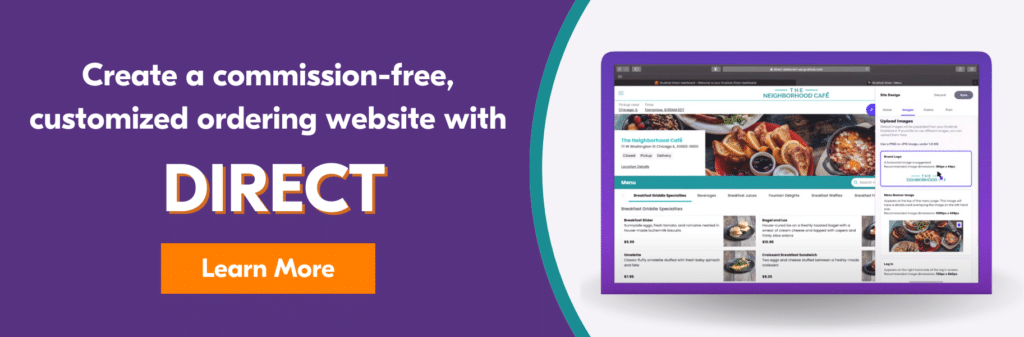
If you don’t currently have a way for customers to order online, Grubhub Direct is an easy way to build a branded, commission-free ordering website. The Direct Success Playbook can help you increase orders, create special promotions, and improve your marketing.
Social media marketing is a cost-effective way to get your restaurant in front of hungry diners. Start small, post regularly, and don’t be afraid to experiment — it’s a great way to find out what content resonates best with your audience.
Use social media to build a loyal following and increase your restaurant’s sales
Social media is a great marketing tool to help you reach new customers, build a fan base, and increase your restaurant’s sales. From promoting a dine-in special to using commission-free direct ordering links from Grubhub for Restaurants, social media can help increase your restaurant’s sales and build a restaurant brand.
Need a partner to help get your menu in front of more paying customers? Partner with Grubhub today to reach 33+ hungry diners and grow your business.