
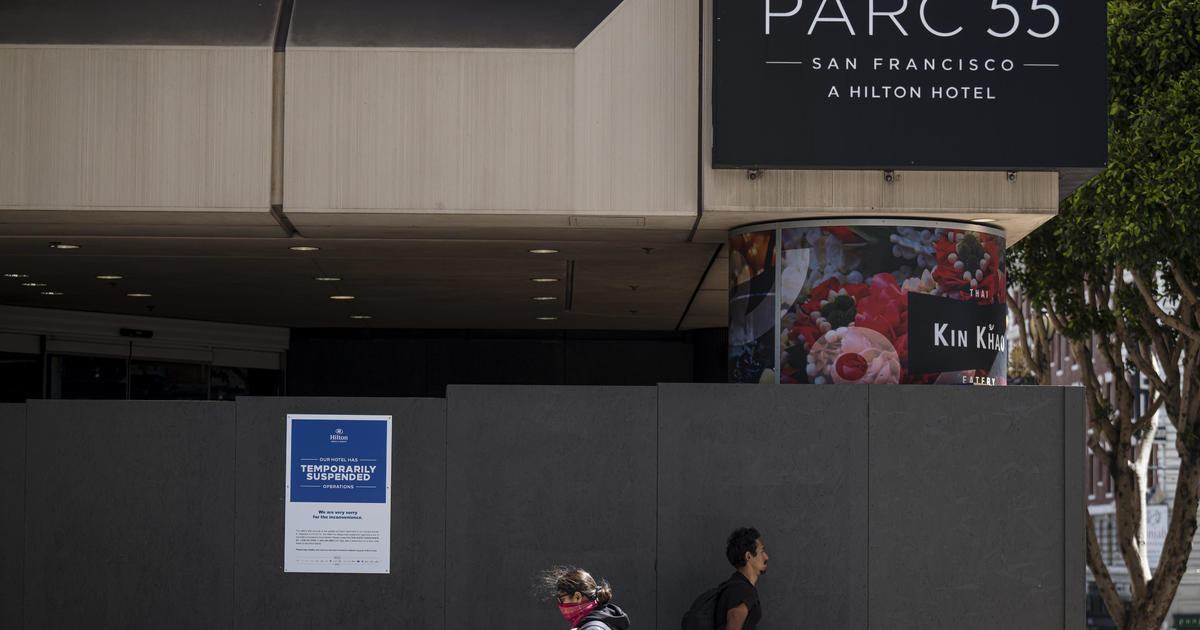
A major hotel chain abandons San Francisco, blaming the city’s “clouded” future
Park Hotels & Resorts, one of the nation’s largest hotel real estate investment trusts, is pulling out of two hotels in downtown San Francisco, saying it lacks confidence in the city’s ability to overcome “major challenges.”
Park Hotels said that it has stopped making payments toward a $725 million loan backed by two of its San Francisco properties, the 1,921-room Hilton San Francisco and the 1,024-room Parc 55 San Francisco.
Both hotels are located near the Moscone Center, a conference venue that prior to the pandemic drew throngs of professionals to the area. San Francisco hasn’t fully recovered since COVID-19 shut down the economy in 2020, with many office buildings still largely empty as workers continue to work remotely. A rash of thefts last year and rising homelessness have caused some retailers to pull out of the city.
Thomas J. Baltimore, Jr., the chairman and CEO of Park Hotels, cited empty offices and reduced business travel as factors that have made owning the hotels untenable.
“Now more than ever, we believe San Francisco’s path to recovery remains clouded and elongated by major challenges,” Baltimore said in a statement this week.
He said the city’s challenges include: “record high office vacancy; concerns over street conditions; lower return to office than peer cities; and a weaker than expected citywide convention calendar through 2027 that will negatively impact business and leisure demand and will likely significantly reduce compression in the city for the foreseeable future.”
Both properties are expected to be removed from Park Hotels’ portfolio, which includes 46 hotels and resorts with more than 29,000 rooms.
Hit to business travel
Prior to the pandemic, San Francisco was a magnet for business travel. But since the crisis, event bookings have slowed down and foot traffic has receded.
In 2022, San Francisco will experience the steepest drop in revenue from business travel of any major metro area, according to data from the American Hotel & Lodging Association (AHLA). Revenue plunged nearly 69%, or $1.68 billion, compared to 2019.
To be sure, some businesses are still turning to the city for events, with JPMorgan holding its annual health care conference this year in the Union Square neighborhood after a two year pandemic-related hiatus. But other firms have canceled events, deterred in part by street conditions like graffiti and homelessness.
And some retailers have closed their San Francisco locations, citing crime and other issues. Whole Foods in April temporarily closed one of its flagship stores just a year after it opened, citing concerns that crime in the area was endangering its staff. Other retailers that have announced downtown closures include Nordstrom, Anthropologie and Office Depot, according to local station KRON.

Restaurant advertisement: growing awareness of your brand
Restaurants rely on local business, which means awareness is everything. Before they can stop in for a meal, customers need to know your establishment exists. That’s the role of marketing and advertising: to build awareness and familiarity in your target audience as a way to boost sales.
Get your brand out there
Marketing is one of the most important aspects of operating a restaurant. An effective marketing strategy helps your business succeed by:
- Building brand awareness and name recognition
- Creating relationships with your target audience
- Distinguishing your restaurant from competitors
- Convincing customers to try your food
- Increasing sales and revenue
The way you market your restaurant also strengthens its brand — the way the public perceives and identifies the business. It’s hard to overestimate the value of a compelling and powerful brand. It builds familiarity, trust, and loyalty in your customers, making them more likely to choose your restaurant over competitors.
What’s the difference between marketing and restaurant advertising? Advertising is one facet of marketing; a restaurant advertisement typically involves promoting your restaurant through paid channels.
How to market your restaurant
The most effective restaurant marketing strategies use a multi-pronged approach. By showing your food and brand on a variety of channels, it’s possible to reach different sectors of your target audience.
This strategy also increases the number of times customers are exposed to your brand. That’s important for the legendary “Rule of Seven,” which states that viewers need to see an ad or marketing campaign seven times before they take action.
As you write a restaurant marketing plan, make sure to include a broad selection of platforms.
1. Email marketing
Email marketing is one of the most valuable forms of marketing for the food industry. You own the email list, which means you can communicate with recipients at any time — without relying on a search engine algorithm or a platform to show your content to followers.
Email is particularly effective for restaurants because it enables you to control when viewers see marketing messages. Want to boost midday sales? Send out an email with the daily lunch specials at 10:30 am, when office workers are starting to think about lunch. Is Mother’s Day coming up? Help customers decide how to celebrate by sending an email announcing a holiday brunch.
2. social media
When diners are trying to pick a restaurant, they often scroll through locations or relevant hashtags on social media to find an appealing option. Social media marketing increases your chances of showing up in those searches.
To build a powerful social media presence for your restaurant, you must capture diners’ attention when they’re ready to buy. This process typically involves:
- Selecting the platforms that are popular among your customers
- Post beautiful food photography and videos
- Humanizing your brand with “behind the scenes” content
- Boosting engagement with content and special discounts
- Including links to your website and online ordering system
It can pay to create accounts for your restaurant on Facebook, Instagram and TikTok. Utilizing a social media calendar can help you post on a consistent cadence.

3. Paid restaurant ads
Advertising usually requires you to pay for placement. Your restaurant advertisement strategy should include both print and digital ads, including:
- Social media advertising. Instagram and Facebook ads can be targeted to reach your ideal customer. You can customize them with photos of food, interiors or employees.
- Google display ads. By joining the Google ad network, you can position your restaurant’s advertisements on participating websites.
- Restaurant billboards. Billboards are essentially supersized print ads that sit in high-traffic areas.
- Print ads in newspapers and magazines. This type of traditional advertising tends to work well for an older demographic.
- Radio ads. Reach customers while they’re driving with paid radio ads that promote your food or special deals.
- Podcast ads. Like radio ads, these promotions are audio-only. They typically appear during podcast breaks. Podcasting is a popular medium for younger listeners.
- Advertising videos. Video promotions often appear in television commercials; you can also use them as display ads on websites and YouTube.
- Direct mail. Send restaurant ads through the physical mail. This is an effective way to stand out from online noise and promote a grand opening, special event or new menu. You can even include discount coupons as an added incentive.
A great restaurant ad is attention-grabbing and easy to understand — viewers should be able to comprehend the message in seconds. In many cases, effective ads use emotions to create fast, powerful connections with customers. Finally, make sure to include a call to action to convince the audience to visit your website, follow you on social media, sign up for the email list or stop by your restaurant.

4. Printmarketing
Digital marketing has gained traction in recent decades, but traditional print marketing can still be a powerful tool. You might create flyers to put up on local billboards or print a brochure to leave at hotels in the area. You can also staple your print marketing materials or special deals for customers’ takeout and delivery order bags. If your restaurant offers catering services, a printed catalog with a food menu can help event planners and wedding venues share your business with clients.
Other types of print marketing include:
- Business cards
- Table tents
- Posters
- Signs
- Bag inserts

5. Content marketing
Content marketing is the process of creating and sharing blog posts, videos and social media content to promote your restaurant. You can include both direct and indirect promotions. A social media post might announce your latest special outright; a blog post could take a more indirect route by sharing a popular recipe or discussing the food scene in your city.
Tips and tricks for marketing a restaurant
No matter what platform you choose, use these restaurant advertising and marketing tips to attract more customers:
- Invest in high-quality photography and video to showcase your food and restaurant in the best light.
- Include deals and discounts to give customers an additional reason to come in.
- Keep an eye on competitors and stay up-to-date with their marketing strategies.
- Engage customers by asking for feedback, particularly on social media.
- Fill out your Google Business profile completely.
- Experiment with advertisements in a variety of locations and refine your strategy to include the ones with the highest response.
How much should you spend on advertising?
Restaurant advertising can be as affordable or as expensive as your budget allows. As a rule of thumb, marketing experts suggest that small businesses spend between 7% and 8% of their revenue on marketing. For most companies, advertising spend should account for no more than 20% of the total marketing budget.
If your restaurant had yearly revenue of $1 million, the marketing budget would be $70,000 to $80,000. Your maximum advertising budget would fall between $14,000 and $16,000.
The actual budget can vary significantly from restaurant to restaurant. Some businesses see a high return on their ads, so they spend more. Others may be more successful with other types of marketing and choose to invest accordingly.
When you’re just starting out, you might want to spend more on paid ads. As soon as your organic marketing strategies catch up — you build a social media following or bring in traffic to blog posts, for example — you can reduce the advertising budget.
Calculating the ROI of your restaurant marketing efforts
At the end of the day, the goal of promotional activities is to bring in new customers and increase food sales. As a restaurant owner, it’s helpful to monitor the return on investment (ROI) of your restaurant marketing and advertising campaigns. The results can help you design a targeted strategy and set an appropriate budget. To calculate the ROI, use this formula:
(sales growth – marketing costs)/marketing costs = ROI
For example, if you spent $1,500 on marketing in a quarter and saw a $5,000 increase in sales during the same period, you would calculate ROI with this equation: ($5,000-$1,500)/$1,500 = 2.33%.
There are no set rules for an acceptable ROI. In general, the higher the ROI, the more successful the strategy. To find the strategies that work best for your restaurant, calculate the ROI for different advertising and marketing campaigns.
As you create a marketing and advertising plan for your restaurant, remember that it’s a process. With trial and error and regular attention, you can develop a refined strategy that brings in customers and increases sales.
Growing your advertising reach with Grubhub
Reaching customers is difficult for any restaurant. That’s why it helps to have a trusted partner like Grubhub by your side. When you list your restaurant on Grubhub Marketplace, you have instant access to 33+ million paying customers. You can run promotions and get access to loyalty tools to advertise your business, grow your brand.
Ready to grow your business? Sign up for Grubhub today.

9 trends in AI in restaurants
Technology is rapidly evolving in businesses, and the restaurant industry is no exception. Restaurateurs are learning that utilizing technology can make their operations smoother, growing their business. Advancements like AI in restaurants have made technology more accessible to businesses, introducing conversational language to make it easier for business owners, staff and customers to interact with technology.
The great thing about AI is that it’s a technology that can cater directly to your business needs. Don’t worry – this isn’t a technology that will take over your business, rather work for you, improving operations and streamlining your kitchen. And even better, with evolutions like ChatGPT, accessing this technology is easier than ever.
Take a look at our tips on how you can implement AI into your business to improve the experience for both your employees and customers.
What is AI?
AI (or artificial intelligence) is the simulation of human intelligence by computer systems. AI uses machine learning and predictive analytics to interact with humans. AI systems have the ability to ingest large amounts of data, look for patterns and correlations and make future predictions or answer questions. AI takes machine learning to the next level by using a variety of techniques to generate creative solutions.
No two restaurants are the same, and the needs of each restaurant owner are different. AI has made working with technology more personalized to each business.
What is ChatGPT?
ChatGPT makes conversing with AI simple. It uses an AI language processing tool to allow for human-like conversations with a chatbot. ChatGPT was created by OpenAI, and taps into the power of Google to spit out answers to user-generated questions. It’s like having your own personal assistant – for free!
The great thing about ChatGPT is that it’s moldable. You can be as specific or vague as you want, performing endless tasks like dishing up food industry trends or writing your menu descriptions. You can specify the format you want the program to deliver (like a social media caption) and limit the amount of content it will produce (like asking it to use 200 characters).
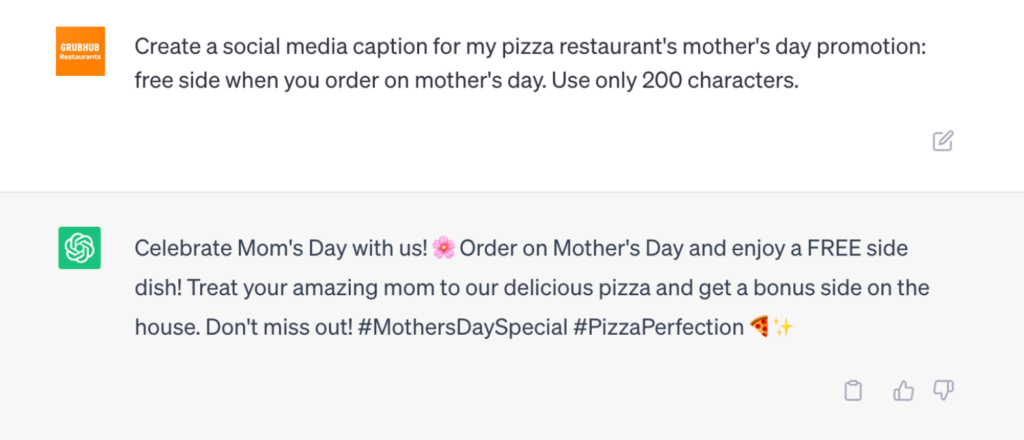
Don’t know what to ask ChatGPT? Ask them the best way to use ChatGPT for restaurants. For example, if you type “What are good questions to ask you about running my restaurant?” ChatGPT will respond with a list of questions you can explore like “What are some effective strategies for managing food costs in a restaurant?” or “What are some best practices for hiring and training restaurant staff?” Plug in those questions and ChatGPT will instantly serve you an in-depth answer.
Get started with ChatGPT by creating your free account.
Why should restaurants implement AI?
Working in the restaurant industry is chaotic, and turning to technology like AI can help make daily operations smoother. Using AI tools can help make your most ambitious restaurant ideas a reality.
AI integrations have helped restaurants by:
- Improving efficiency and accuracy. AI eliminates the risk of human error, increasing your accuracy to improve efficiency.
- Streamline Labor. AI can help complete restaurant tasks, reducing your labor costs and curbing employee turnover.
- Making smarter decisions. AI analyzes restaurant information and data to help you make more informed business decisions based on industry trends and your restaurant’s performance.
- Creating content. ChatGPT can write menu descriptions, social content and marketing materials for your restaurant.
- Cutting costs. AI can help you analyze your spending and finances to improve your ROI.
- Customize the customer experience. AI can allow for menu customization to allow your diners to have more control over their dishes and experience.
- Growing customer base. AI has helped restaurants grow their customer base by finding new diners and improving their reputation by responding to customer inquiries and creating engaging content.
9 ways to use AI in your restaurant
Ready to give AI a shot? Here are some ways you can utilize AI in your restaurant.
1. Phone operations
With the help of voice assistants, AI can talk directly to your customers and become your personal phone assistant. Answering phones requires employee labor, and if you grow your business, it can be difficult to always be on the line. In a Popmenu survey, 83 percent of customers will move on and find another restaurant if they try to call and get voicemail more than once. Enabling AI phone technology can allow you to care for your customers without the extra labor.
Tools like SoundHoud allow you to customize your phone system’s answers to talk with customers to answer questions and take orders. You can customize your AI phone answering to take reservations, answer frequent questions and take messages.
2. Take orders
Self-service ordering is rising in popularity. It makes the process easier for customers who can easily see all the menu options at their fingertips, and it helps staff avoid wasting time taking orders. AI makes online ordering even easier by reacting to customer behavior and predicting their next move.
Fast casual restaurants have been some of the first businesses to embrace AI ordering. Taco Bell’s in-store kiosks use AI to identify up-sale opportunities based on the customer’s order, and McDonald’s opened their first completely digital restaurant in Texas.
Not all AI integrations are a total robot takeover, and there are simple ways you can use AI to help with customer orders.
POS integration is one of the most common AI tools restaurateurs use. These tools help simplify order and menu management by connecting your different POS systems. This way you can keep track of orders, inventory and staff all from one place.
3. Get industry insights
Keeping up with the ever changing restaurant industry is difficult, especially as customer habits and tastes change. AI is a great tool for gathering and sorting through trend information. ChatGPT taps into the power of Google, making research simple. Try asking ChatGPT questions about the restaurant industry to get insight into customer cravings.
What kinds of questions should you try asking ChatGPT?
- What are the top ordered restaurant foods?
- What fruits and vegetables are in season right now?
- What is the most popular way to serve chicken?
- What are the top ordered dinner foods?
4. Enhance your menu
Research shows that menus with images and dish descriptions resonate better with customers. Now, you can create the perfect menu with the help of AI. You can use ChatGPT to generate menu text by asking them to create a one-sentence description of your dishes. Looking for menu photo tips for your cuisine? Ask ChatGPT for help on composition and style. Wondering what recipes are in season? Ask ChatGPT what’s trending.
AI’s influence in menu engineering doesn’t stop there. Technology has enabled restaurants to get a better handle on their inventory. Solutions like ClearCOGS offer a kitchen ingredient management system that can keep track of your inventory to help you plan food preparation and ordering.
5. Analyze data
Odds are you have many types of restaurant technology in your restaurant, and some of these systems are collecting valuable data. Take Grubhub, for example. Our platform collects data on your customers, and serves it up to you in our Customer Insights dashboard.
Digging into data is one of the best ways to understand your customers, staff, supplies and overall business. Don’t bite off more than you can chew by trying to dig through this data on your own. You can use AI to analyze data, segment customers, organize information and find insights.
Want to create a targeted marketing campaign? Copy and paste your customer data into ChatGPT and ask them to pull out repeat customers. You can then create marketing materials specifically tailored to this customer base.
Let’s say you want to understand your customers’ impressions of your restaurant. You can copy and paste the reviews into ChatGPT and ask it to look for the main trends. You’ll then get insight into the general sentiment of your customers to help make adjustments to make their experience more positive.
You can also use AI to track operational data from your restaurant. AI can help you analyze busy and quiet business hours so you can adjust your staffing accordingly.
6. Keep track of finances
When it comes to keeping track of your finances, you only want to use technology you can trust. With POS integration, you can search and find fraudulent or inconsistent transactions, look at purchasing data and understand transaction trends. With this info, you can better prepare your inventory and adjust prices based on the Cost of Goods Sold (COGS).
You can use AI to unpack your restaurant’s finances. ChatGPT can help you analyze your pricing menu so that you can competitively price your items. You can ask ChatGPT the average price of a specific menu item, or how much specific ingredients cost in different seasons.
7. Organize operations
As a restaurant owner, you have a lot on your plate. Relieve some stress by allowing AI to take care of tedious tasks. As we’ve mentioned, POS integration can be a lifesaver for restaurant owners by tapping into AI to streamline operations.
Turning to technology to handle these tasks that could take employee hours gives your staff back valuable time they can invest in other areas of your business. AI tools can help you schedule employees based on busy times so that you’re prepared to handle a rush. You can also use your POS system to keep track of inventory so you can get 86 items as soon as they run out.
AI can help you make informed decisions about your restaurant, predict inventory changes, customer trends and employee needs so you can stay on top of your business.
AI can also help you communicate with your employees. Need help creating onboarding materials for your staff? ChatGPT can write it for you. Just ask it to write a training guide for a certain position.

8. Create marketing materials
Without marketing, customers won’t know about your restaurant. But with marketing campaigns getting more creative, it can be hard to come up with ideas that stand out. That’s where AI can come in – generating ideas and copy for all your marketing needs.
A good marketing campaign covers all bases: social media, email, website and paper inserts. ChatGPT can help you write copy that is optimized for each platform. Let AI help you create targeted marketing materials that resonate with your customers.

Social media marketing is one of the best ways to reach customers directly, but coming up with what to post can be overwhelming. AI can help you create content, write captions and understand trends. You can use ChatGPT to come up with social media captions, hashtags and respond to comments and messages.
9. Improve the customer experience
Finding and attracting new customers is difficult for any restaurant. You can use AI to help you interact with customers to ensure they have a positive experience with your business.
Responding to reviews is a tedious yet necessary task to keep your customers satisfied. Solutions like Chatmeter have made understanding and interacting with customers easier by compiling all the online conversations about your brand.
AI can also help you craft a response to negative reviews. Timeliness for responding to these reviews is key to showing a customer you care. If a customer writes a review on your website claiming that their service was poor, you can ask ChatGPT to craft a response.

AI features on online ordering tools remember a customer’s history to customize featured offerings based on their behavior. When a customer orders from your restaurant on Grubhub Marketplace, the platform will remember their preferences when they come back to order again. This technology helps make restaurant visits more consistent, prompting repeat customers to continue ordering.
Grow your restaurant technology with a trusted partner by your side
Embracing the latest trends in restaurant technology can help grow your business. Innovations like AI give restaurants the power to streamline their owners’ operations and customize their customer experience. POS tools have made embracing new technologies even easier by improving how restaurants manage orders, inventory and customer data.
No matter how you plan on tapping into AI tools at your restaurant, there’s no doubt that this technology is here to stay. Why not get ahead of the trend?
Ready to grow your business and attract new customers? Partner with Grubhub today to tap into the latest in restaurant technology.

American Hotel Income Properties REIT (OTCMKTS:AHOTF) Price Target Raised to C$3.00 at National Bank Financial
 American Hotel Income Properties REIT (OTCMKTS:AHOTF – Get Rating) had its price objective hoisted by National Bank Financial to C$3.00 in a research report released on Monday morning, The Fly reports.
Separately, Scotiabank dropped their price objective on American Hotel Income Properties REIT from C$3.75 to C$3.50 in a report on Tuesday, March 7th.
American Hotel Income Properties REIT Stock Performance
AHOTF opened at $1.90 on Monday. American Hotel Income Properties REIT has a one year low of $1.69 and a one year high of $3.06. The business’s 50-day simple moving average is $1.84 and its 200-day simple moving average is $1.97.
About American Hotel Income Properties REIT
(Get Rating)
American Hotel Income Properties REIT LP engages in investing in hotel real estate properties. Its long-term objectives are to: increase the value of its hotel properties through operating excellence, active asset management and invest in value-added capital expenditures, expand its hotel portfolio through acquisitions on an accretive basis, and increase unitholder value and distributions to unitholders .
See Also

Receive News & Ratings for American Hotel Income Properties REIT Daily – Enter your email address below to receive a concise daily summary of the latest news and analysts’ ratings for American Hotel Income Properties REIT and related companies with MarketBeat.com’s FREE daily email newsletter.

US hotels set for earnings bump from robust travel even as costs weigh By Reuters
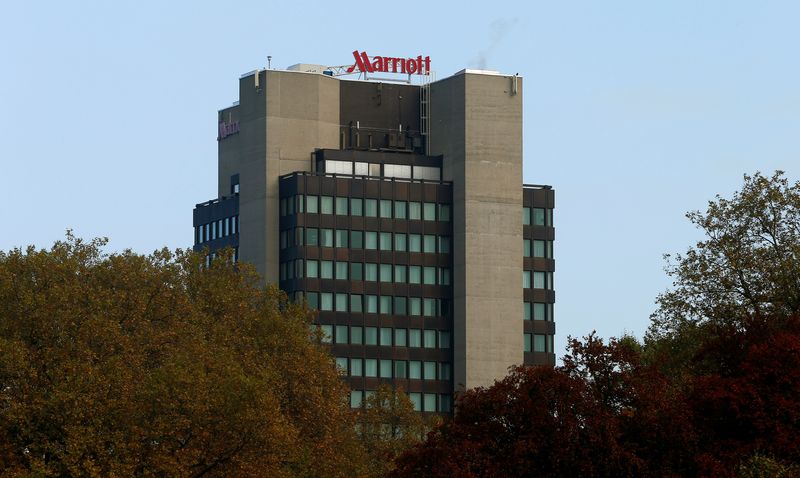
© Reuters. FILE PHOTO: Company’s logo is seen on the Marriot hotel in Zurich, Switzerland October 27, 2016. REUTERS/Arnd Wiegmann
By Priyamvada C
(Reuters) – US hotel operators are expected to post a rise in first-quarter profit even as they pour in money to lure travelers to make bookings directly through their websites, instead of turning to travel agencies.
While bookings have been getting a boost from increased business and leisure travel, the investments in hotels have made to reduce their reliance on online travel agencies (OTAs), which tend to have higher marketing budgets, is eating into the gains.
Last year, US hotels received about $49 billion from online direct bookings and $57 billion from OTA bookings, according to travel market research firm Phocuswright.
“During uncertain economic times, when travelers are looking to stretch their dollars as far as possible, OTAs can help drive demand,” Phocuswright’s senior analyst Madeline List said.
THE CONTEXT
In recent years, hospitality giants like Marriott International (NASDAQ:) Inc and Hilton Worldwide Holdings (NYSE:) Inc. have doubled down on their own loyalty programs as they attempt to spend less on commissions and other costs related to third party businesses.
Through these programs, the hotels promise exclusive perks to customers in the form of redeemable points for stays at specific hotels in their franchise, among other travel benefits.
However, in the face of an uncertain economy, travelers have increasingly relied on OTAs like Booking Holdings (NASDAQ:) Inc, which give them a wider range of choices and prices to book from, alongside incentives like advance cancellation, as opposed to upfront payments .
“When the economy is weak and hotels may not be getting as much business from traditional sources as corporate travel or meetings and conventions, they become that much more reliable on online travel agencies,” Atmosphere Research Group’s travel industry analyst Henry Harteveldt said.
GRAPHIC: Hotel bookings through online intermediaries https://fingfx.thomsonreuters.com/gfx/buzz/akveqxqbwvr/Hotels.png
THE FUNDAMENTALS
* Analysts expect Marriott’s revenue to rise 28.8% to $5.4 billion when it reports results on May 2; earnings per share is estimated to be $1.84
* Analysts expect Hilton’s revenue to rise 28% to $2.2 billion when it reports results on April 26; earnings per share is estimated to be $1.13
* Analysts expect Booking’s revenue to rise 40% to $3.8 billion when it reports results on May 4; earnings per share is estimated to be $10.67
GRAPHIC: US travel operator’s stock performance https://fingfx.thomsonreuters.com/gfx/buzz/zjvqjoewkpx/US%20hotel%20operators%20stocks.png
WALL STREET SENTIMENTS
* For Marriott, six of 23 brokerages rate the stock “buy” or higher, 16 “hold” and one “sell” or lower, as per Refinitiv data
* For Hilton, nine of 22 brokerages rate the stock “buy” or higher and 13 “hold”, as per Refinitiv data
* For Booking, 19 of 33 brokerages rate the stock “buy” or higher, 13 “hold” and one “sell” or lower, as per Refinitiv data

Why is Security Critical for a Booking Engine?
In today’s digital age, cybersecurity is a major concern for any online business. Hotels and other hospitality businesses are no exception. The hospitality industry has seen a surge in online bookings in recent years, and with the increase in bookings, the risk of security breaches has also increased. This is why it is crucial to ensure that your booking engine is secure and that your guests’ data is protected.
So, why is security critical for your booking engine? Let’s take a closer look.
Protecting Your Guests’ Data
The most critical aspect of any booking engine is the protection of your guests’ data. A secure booking engine will protect your guests’ personal and financial information from being accessed by unauthorized individuals or hackers. This includes everything from their name and address to their credit card details.
With the rise of cybercrime, protecting your guests’ data has never been more important. Data breaches can result in significant financial losses and damage to your reputation. Not only can they lead to legal action, but they can also cause your guests to lose trust in your business.
Compliance with Industry Standards
The hospitality industry has strict data protection laws and regulations that must be followed. This includes the Payment Card Industry Data Security Standard (PCI DSS), which outlines the security standards that all businesses that accept credit card payments must adhere to. Failure to comply with these standards can result in significant fines and legal action.
A secure booking engine will be fully compliant with these standards, ensuring that your business is protected from legal action and financial penalties.
Preventing Fraudulent Bookings
Fraudulent bookings can be a significant problem for hotels and other hospitality businesses. They can result in lost revenue, damage to your reputation, and even chargebacks. A secure booking engine can help prevent fraudulent bookings by using various fraud detection tools and techniques.
These tools can help detect and prevent credit card fraud, chargebacks, and other fraudulent activities. This will not only protect your business from financial losses, but it will also help maintain the trust of your guests.
Maintaining Your Reputation
Finally, security is critical to maintaining your reputation. Guests expect their personal and financial information to be protected when booking online. A security breach can result in negative publicity and damage to your reputation. This can lead to a decrease in bookings and revenue, as guests may be reluctant to book with your business.
By ensuring that your booking engine is secure, you can maintain the trust of your guests and protect your reputation in the long term.
Conclusion
In conclusion, security is critical for any booking engine. It is essential to protect your guests’ data, comply with industry standards, prevent fraudulent bookings, and maintain your reputation. By choosing a secure booking engine and taking the necessary precautions, you can protect your business from the risks of cybercrime and maintain the trust of your guests.
Restaurant Logo Ideas | Grubhub for Restaurants
Your restaurant’s logo is the most recognizable and influential part of your restaurant’s brand — it helps your company stand out in a crowd and creates a strong connection with customers. Logos create a visual and emotional tie between customers and their favorite brands. If you ask the average diner what a McDonald’s logo looks like or what colors the Domino’s logo has, they probably can answer at the drop of a hat. Creating a logo that resonates with customers can help make your restaurant more recognizable, keeping your brand on customers’ minds.
If your logo is ready for a refresh, it’s helpful to start by browsing popular restaurant logo ideas. When you can pinpoint why certain designs are successful, it’s easier to create a logo that elevates your company’s visual branding.
Restaurant branding: what makes it important?
Branding is the way you convey your restaurant’s identity and distinguish it from competitors. A brand consists of multiple components, including its values, visual identity, messaging, and unique selling proposition.
The visual identity of a brand — the fonts, colors, and graphics that represent the company — helps shape the public perception of your restaurant. Done well, these elements can create a positive impression even before diners take their first bite. Done poorly, they can turn off customers and prevent them from giving your food a chance.
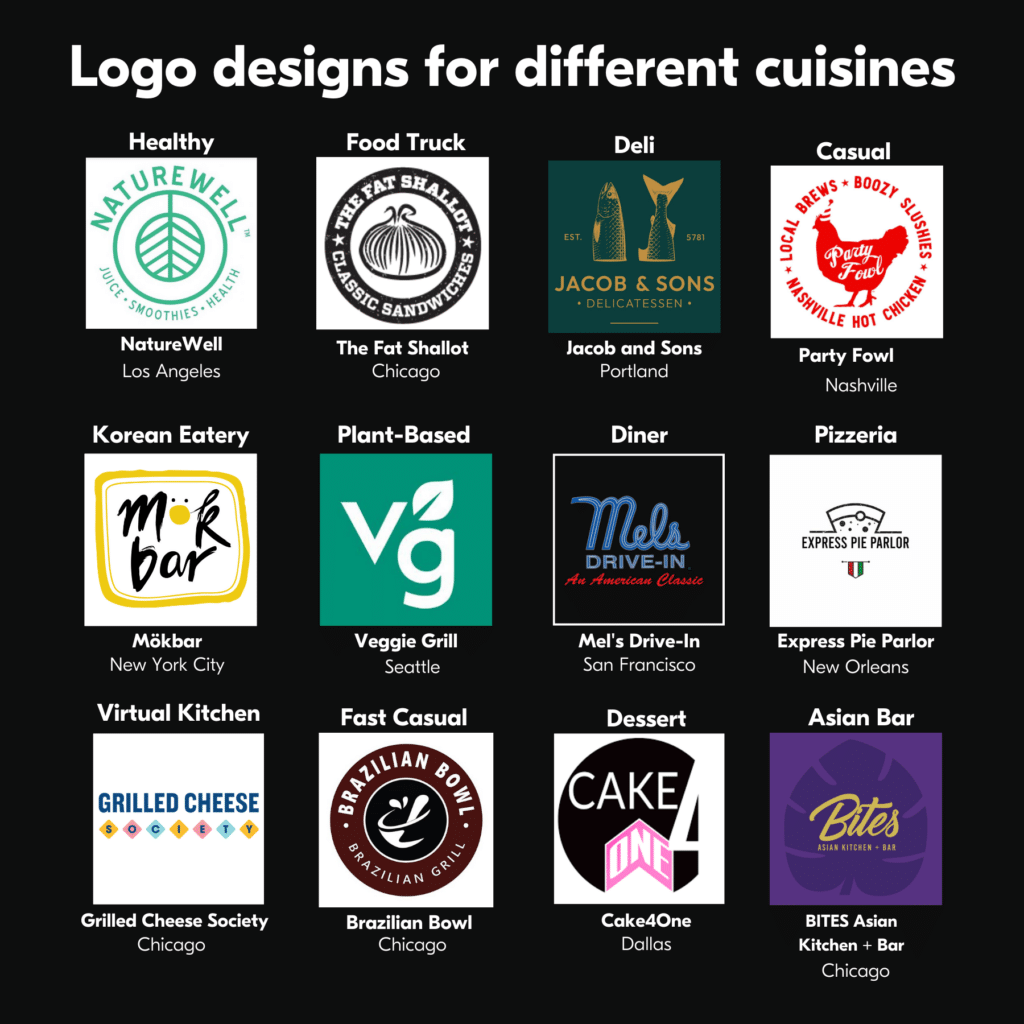
Branding also helps potential customers understand your business. Your logo, in particular, provides clues about the style and type of food you serve. That’s why vegan and vegetarian restaurants often use leaf imagery and shades of green; because these elements are associated with fresh, healthy and natural food, they signal that a restaurant serves plant-based cuisine. Likewise, fine-dining restaurant logo designs tend to use delicate fonts and sparse, abstract imagery to convey exclusivity and elegance.
A strong logo is essential to building brand awareness — the extent to which the public is familiar with your restaurant’s name and visual identity. Think about the biggest brands in the world; chances are, you can picture their logos immediately. That’s because they’re distinctive, simple, and tied strongly to the company’s identity.
When you’re looking for ways to boost your digital restaurant branding strategy, a great logo is a must. With the prevalence of logo makers and logo templates, creating a stunning design has never been more accessible.
Key elements of good logo design
Logos might seem simple, but the graphic design process is surprisingly detailed. Whether you’re using a restaurant logo maker or working with a marketing agency, make sure to keep these rules in mind:
- Keep it simple. Your logo will be published in a wide variety of sizes across both digital and print mediums. Minimal detailing makes it easier to read, even at the smallest sizes.
- Make it striking. The most memorable restaurant logos use at least one bold element. The McDonald’s logo, with its oversized “M” and bright yellow and red color scheme, is a good example.
- stay with the times. There’s a reason restaurant logos change over time — they need to keep up with changing customer preferences for design and style. The best logos feel contemporary, but not trendy.
- Be original. It’s easy to fall back on cliches or copy existing logos, but originality can help your business stand out from the crowd.
- Follow design rules. Stick to two critical principles of good restaurant logo design: balance and proportion. Logos that are off-balance or disproportionate tend to make customers feel uncomfortable.
Most logos have two key parts: the wordmark and the mark. The wordmark consists of the logo’s text — usually, the name of your restaurant. The mark, which is also called the logomark, is the graphical element. It might be an image, an icon or a shape. On the Taco Bell logo, the mark is the brand’s iconic bell.
Keep in mind that some logos use a wordmark only. When that happens, the designer typically selects an eye-catching font to help the logo stand out. Your design might also include a tagline or a frame.
4 restaurants logo ideas
Graphic designers tend to use a few similar patterns when creating restaurant logos. As you’re searching for restaurant branding inspiration, consider these four tried-and-true layout ideas:
- Wordmark only. Simple and clean, these logos are the easiest to make; just select a font and add color. This style is popular with upscale restaurants such as Noma and The Wolseley.
- Separate wordmarks and marks. This type of logo features the name of your restaurant below or to the right of a graphic mark. An example is the Dunkin’ Donuts logo, which features a cup of coffee positioned next to the stacked brand name.
- Wordmark framed by graphic. For a strong visual statement, frame your restaurant name with your mark. Arby’s logo follows this pattern; the name sits in the center of a cowboy hat.
- Wordmarks with taglines. If your tagline is essential to your food business’s brand, this option can help you incorporate it elegantly. Make sure to create a hierarchy by placing the tagline below the restaurant name in a smaller font. Most brands use this format sparingly; occasionally, you’ll see the McDonald’s logo paired with “I’m lovin’ it” or the Papa John’s logo positioned above “Better ingredients. Better Pizza.”
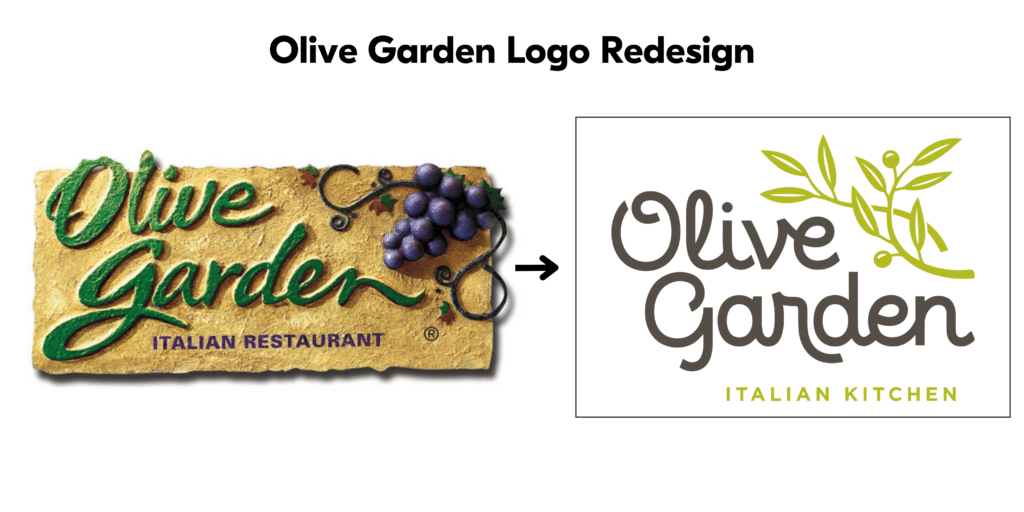
When restaurants rebrand, their new logos can attract a great deal of attention. Olive Garden is a prime example — their 2014 logo redesign revealed a cleaner, more modern look that marked a significant departure from the dated, overly detailed original. Starbucks has also evolved its logo over the years to keep up with changing design styles, all while maintaining an instantly recognizable visual identity and consistent imagery.
Tips for making a restaurant logo
As you create a logo design for your restaurant, choose each element carefully. The fonts, colors and graphics you choose will affect how customers view your brand.
Font selection, in particular, is critical. To start, pick an option that’s easy to read, even at small sizes. Then, look for styles that represent the personality of your restaurant. It’s usually best to avoid polarizing fonts that elicit strong negative reactions, such as Papyrus and Comic Sans.
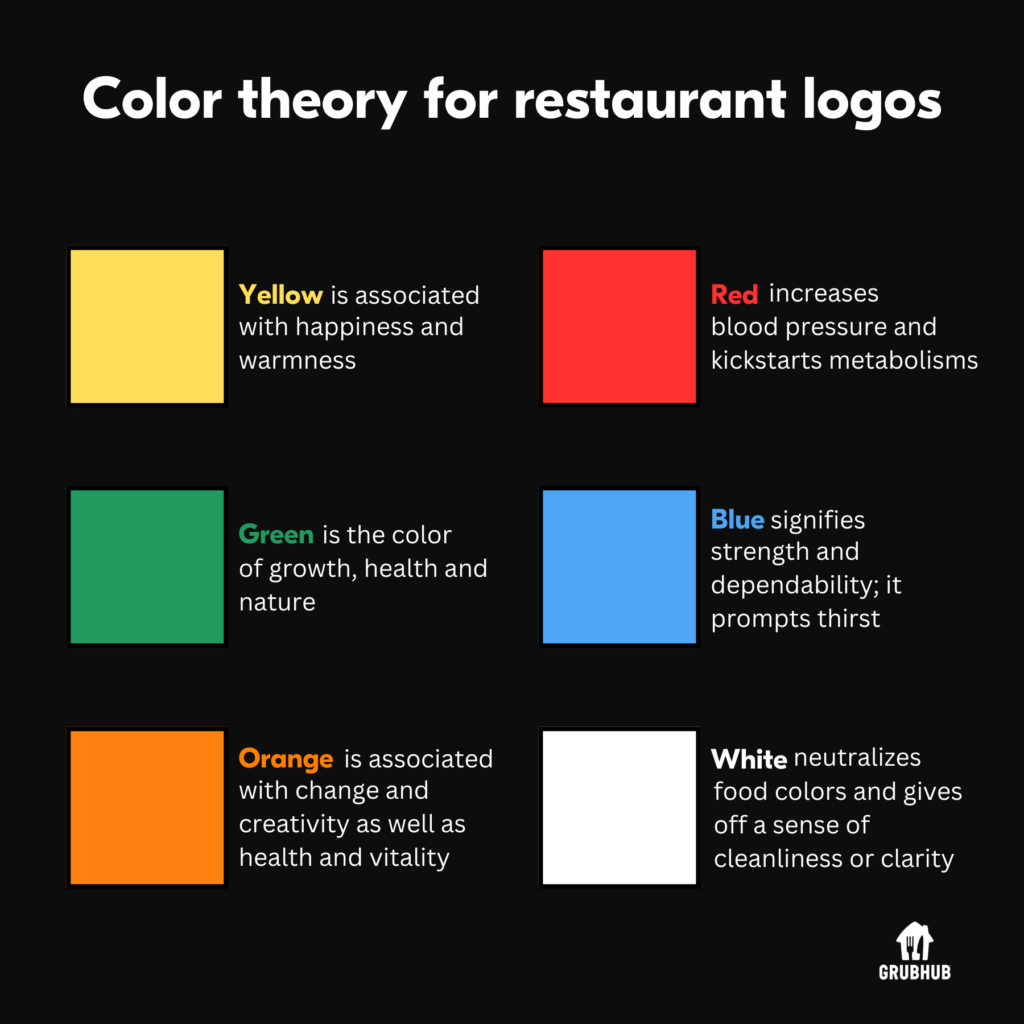
Logo colors are important because they’re tied to both emotions and stereotypes. Seafood restaurants often use blue because of its association with the ocean. Mexican restaurants often use orange and yellow; these warm shades hint at spicy food and colorful cultural imagery. Red is a popular color among fast-food restaurants because it’s powerful, it’s energetic, and it stands out in a crowded environment.
When it comes to graphics, proceed with caution. The best logos stick to simplified silhouettes that relate directly to the brand. The Sonic logo, for example, features shapes that hint at a vintage drive-in sign.
Finding the right placement for your restaurant logo
Before you finalize the graphic design of your logo, make sure it will work on different marketing channels. After all, you’ll want to place it in multiple locations to reinforce your restaurant branding. At a minimum, it should appear on:
- Print and digital menus
- Restaurant signage
- Business cards
- Printed brochures, coupons, and flyers
- Social media profiles
- staff uniforms
- Professional e-mail signatures
- Business merchandise
- Restaurant website
- Branded delivery websites from services such as Grubhub Direct
- Food delivery apps
Your logo plays a big role in the way the public sees your restaurant. By spending the time to create a strong design and placing it prominently on all key marketing materials, you can build stronger brand awareness and keep your company at the top of customers’ minds.
Are you ready to get your logo in front of more customers? Partner with Grubhub today to help market your brand and drive more orders to your restaurant.

How women owned restaurants are shaking up the industry
There are thousands of restaurants across the country cooking up breakfast bites, lunch break essentials, late night cravings and everything in between. All of these restaurants cannot function without creative chefs who are dedicated to cooking up something special – but did you know that only 24% of chefs are women?
Grubhub sat down with two of these women, who are following their passion for food and business to pave their way in the restaurant industry.
Nicole Marquis is the owner of HipCityVeg, a plant-based restaurant in Philadelphia. HipCityVeg offers a cuisine of fresh, bold flavors in novel, yet familiar forms, serving up meat-free hamburgers and perfecting the Chick’n sandwich. Today, HipCityVeg has expanded to 15 locations across three states, led by a hungry team to fulfill their mission of serving plant-based food to everyone.
Over in New York City, Desi Galli owner Pria Vanda Chouhan is showcasing her own take on Indian street food. Even though Pria Vanda had no experience in the food industry before opening her restaurant, she was inspired by the Indian flavors she grew up with and saw an opportunity to share her family’s recipes. Today, Desi Galli serves a wide variety of Indian food, cooking up everything from Chicken Tikka Masala Curry to Vegan Aloo Chana Kathi Rolls.
Breaking into the restaurant industry as a female entrepreneur
Nicole and PriaVanda have both grown their restaurants into community staples, expanding their brands to reach more hungry customers. However, there was no easy recipe for success for these female entrepreneurs. That was something they had to cook up on their own.
Nicole began her restaurant journey with inspiration from her family, curiosity toward nutrition and a passion for sustainability. Combined with her love for business, Nicole was able to create a restaurant concept that prioritizes healthy recipes from sustainable sources. Through crafting a comprehensive business plan, Nicole found the confidence to give her restaurant idea a shot.
“90% of what I was doing when I first started I didn’t know,” Nicole admits. “I had to learn from experience. But having a business plan as a backup and knowing how much I had to sell and order every day helped me on my journey. Plan and prepare. You will give yourself confidence with that.”
As her restaurant grows, Nicole finds comfort in her mission.

Having a mission that’s greater than just numbers is really important. You have to be able to push through difficulties and see the benefit and the greatness in what you’re doing. That comes from your mission.
Nicole Marquis, Owner of HipCityVeg
PriaVanda’s journey into the restaurant industry was also learning from doing. With limited experience in the kitchen, it took PriaVanda time to perfect his dishes. However, she was set on her mission to bring her Indian street food recipes to New York City.
“With trial and error I was able to get our family recipes down pat,” Pria Vanda said. “I was onto something that New York wasn’t offering a decade ago. We found our niche.”
Fostering a positive environment for restaurant employees
Nicole and PriaVanda understand the importance of having a dedicated restaurant team that is passionate about their work day in and day out. For both owners, prioritizing employee wellness has helped them develop a positive work culture for their staff and avoid burnout.
“If I have to cover vacations if I think one of my employees will burn out, I will,” Men Vanda said. “When we started out, we were a team of three. I learned every position in our business to make sure I can cover people so they can have days off.”
Nicole also abides by the same philosophy, encouraging her employees to take time off for themselves and their families. Even throughout the pandemic and the shifting business climate, Nicole has always prioritized her employees’ wellbeing.
“What’s been so helpful for us is communication,” Nicole said. “Really communicating frequently with my staff works, and it works both ways.”
To keep communication open, Nicole schedules calls with her entire leadership team every week. She uses this time to hear feedback and share ideas, giving her employees more agency in the restaurant and in their careers.
“A service business is all about the people,” Nicole said. “Investing in them is essential.”
Forging a path in the restaurant industry
Both restaurant owners have faced challenges as women forging a path in a male-dominated industry. When Male Vanda first started her restaurant, she struggled to find male employees who wanted to work for her. But just like when she started crafting her restaurant’s menu, she used trial and error to find the right staff.
“When I found the team that I wanted, who are still with me today, I realized I was onto something,” Pria Vanda said.
The challenges didn’t stop there. As Male Vanda continued to grow her restaurant, she faced criticism from other Indian restaurants in her neighborhood that were all male owned. Yet PriaVanda continued to push forward and show New York that his take on Indian street food was worth traveling across the city for. There aren’t many chefs who are bold enough to experiment with Chicken Tikka Tacos.

I found my niche, and I was making my mark in the city. That’s how I earned respect. Making a superior product in my niche.
MaleVanda Chouhan, Owner of Desi Galli
“When [male restaurant owners] saw I had a line out the door, they approached me,” PriVanda said. “I found my niche, and I was making my mark in the city. That’s how I earned their respect. Making a superior product in my niche.”
Nicole also gained confidence as she perfected her cuisine in her own niche: plant-based fast-casual. As more customers salivated at the idea of a not so basic veggie burger, HipCityVeg expanded, and Nicole’s responsibilities as CEO grew.
“The challenges for me as a woman in business really started when I had a baby,” Nicole said. “Businesses aren’t always built around families. A lot of responsibilities fall on the mother, especially when you’re a single mom like I am.”
But Nicole was not deterred. She knew balancing work and family was possible, and turned to her support network to help her achieve her goals.
“I believe I am more of an effective CEO now that I’m a mother,” Nicole said. “People will expect you to work the same way you did when you were not a mom. But I’ve learned it’s okay to compartmentalize to balance both.”
Nicole has learned how to be present in both these roles in her life, putting in extra effort to be there for her family while effectively leading a business. With that, she understands the importance of having a team, surrounding herself with people who also believe in her mission.
“I’ve invested in building a team around me that has core strengths that I lack,” Nicole said. “Having a team also means that I’m not afraid to ask for help. I know that we are stronger together.”
Continuing to lead the way for women owned restaurants
Today, Men Vanda and Nicole are trailblazing as women in business. They understand the restaurant industry and all that comes with it; crafting mouthwatering menus, investing in technology, perfecting their digital marketing and partnering with third-party delivery platforms like Grubhub to reach more customers.
Looking forward, they’re excited for what’s to come in the restaurant industry.
“I think 2023 is going to be our best year yet,” PriaVanda said. “Things are changing for Indian cuisine, especially street food. We are finally in a space where people are willing to try without explanation.”
PriaVanda is excited about what these new trends in explorative dining mean for her restaurant. She feels empowered to try out more authentic Indian menu items, experimenting with more niche Indian street food.
Nicole is also looking into the future of her restaurant with optimism. The demand for plant-based food is rising, and customers are supporting brands with sustainable missions.
“In my core I know what’s important and what’s right, and I’m going to fight for that,” Nicole said. “And from that higher purpose comes motivation and innovation. There’s so much more in store for fast-casual plant-based restaurants.”
– – –
Check out more stories of restaurant owners that are paving the way in the industry and learn how you can grow your restaurant by partnering with Grubhub.