

7 Tips to help prepare for restaurant patio season
As the temperature rises, diners start looking for ways to enjoy their meals in the sunshine. If your restaurant doesn’t have an outdoor dining area, now’s the time to build one — a patio helps you adapt to warmer weather and increase profitability during one of the busiest times of the year. With the right restaurant patio ideas, you can transform any space into a beautiful, breezy retreat.
How can a patio benefit my restaurant?
Customers love al fresco dining — it’s a chance to enjoy the fresh air and make the most of warm weather. This is particularly true for people with kids; outside, parents don’t need to worry as much about keeping the little ones quiet. A patio is a great way to attract these sun-seeking diners, all while continuing to serve people who prefer to eat inside.
On a practical level, patios expand your restaurant’s seating capacity and enable you to serve more diners. If your city sees an increase in foot traffic during the summer months, this is an effective way to reduce wait time and increase revenue. In fact, research shows that an outdoor patio can increase gross profits by up to 65%.
A patio can also help you keep up with competitors. In a 2023 National Restaurant Association survey, 90% of restaurant owners with outdoor dining are planning to keep it. That’s because customers are demanding it; about 82% of diners would like to see growth in outdoor seating options, and 75% of adults feel safer when dining out.
When your patio is attractive and visible from the street, it serves as an advertisement for your restaurant. Add live music and a special seasonal menu to intensify the impact — the festive atmosphere draws in new patrons and encourages them to stay for after-dinner drinks.
10 tips for making the most of patio season
Whether you have a small dining area next to the street or a rooftop patio with breathtaking views, there are a few things you can do to get the most from your outdoor space.
1. Check local laws and regulations
If your restaurant doesn’t already have a dedicated outdoor dining space, check state and local laws before construction starts. Many areas regulate factors such as patio capacity, location, enclosure, signage and proximity to the restaurant. You’ll likely need to get special permits, especially if you’re planning to build an outdoor bar or other new structures.
That’s not all — local laws will also affect your patio’s smoking policy and your ability to serve alcohol outdoors. If you’re thinking about hosting live music, check the local noise ordinances. Finally, look into laws and regulations regarding pet policies at restaurants; certain states allow it, but you may need to establish rules regarding leashes, hand-washing and waste management.
2. Deck out your patio with the latest decor
The look and feel of your patio has a direct impact on the customer experience. Ideally, your outdoor space should feel like an extension of the indoor dining room but with a slightly more casual vibe. If your restaurant has a romantic atmosphere, for example, you might recreate the effect outside with hurricane candles and white string lights.
As you consider restaurant patio ideas, look for ways to incorporate the latest restaurant decor trends:
- Comfortable mix-and-match outdoor furniture
- Bold lettering and murals
- Photogenic backgrounds for social media
- Warm, comforting tones
- Lush greenery
3. Keep your furniture flexible
Maximize patio space with lightweight, stackable patio furniture. When employees can move tables and chairs easily, they can adjust the seating to accommodate large groups, private events or live music.
Of course, comfort should also be a top priority. Avoid patio chairs that are too delicate; small, hard seats or flimsy frames can be uncomfortable for guests. Instead, look for wide, deep seats that work for a range of body sizes and table styles that hold food easily.
4. Establish ambiance with decorative lighting
Lighting sets the mood; it’s a critical aspect of restaurant patio design. Choose lights that match your restaurant’s aesthetics and atmosphere. Options include:
- Wall sconces
- String lights
- LED strip lights
- Hanging lanterns or pendants
- Globe lights in planters
- Landscape spotlights
- Tiki torches
Aim to fill the space with lighting that isn’t too bright or too dark — while sitting in their chairs, guests should be able to read the menus clearly.
5. Embrace your greenery
Plants are a perfect fit for an outdoor dining area; greenery enhances the natural vibe of the patio and brings life to an urban space. You can also use plants to beautify the commercial patio enclosure, create private dining areas, or conceal fixtures unsightly. Some plants can even repel mosquitoes, which creates a better patio dining experience.
When choosing greenery, consider the required upkeep. Sturdy, low-maintenance plants can stand up to heavy traffic and reduce the workload for your staff.
6. Prepare for inclement weather
Get more use from your patio by preparing the space for different weather conditions. Large patio umbrellas or sun sails provide shade on hot days and light rain protection when it’s drizzling. If space allows, you can also create shade and ambiance with a pergola covered in climbing vines.
To encourage guests to dine outdoors regardless of the weather, invest in temperature-control devices. Roofline fans can create ample airflow, and standing outdoor heaters add just the right amount of warmth on cool, crisp fall days.
7. Designate an area for pickup and delivery
Is your outdoor dining area located near the restaurant’s main entrance? You may need to establish a separate pickup point — especially if you’re listed on a service like Grubhub Marketplace. By distancing the to-go area from regular restaurant traffic, it’s easier to ensure diners and staff aren’t affected by the influx of pickup orders that come with nicer weather.
8. Create a seasonal menu
A seasonal menu refreshes the dining experience, giving loyal patrons a reason to drop in. It can also set the tone for your patio. If you’re going for a classic summer vibe, you can keep it traditional with burgers, corn dogs, and fried chicken. For a lighter, modern-bistro approach, try creative salads, shareable charcuterie boards, or gourmet nachos. Make sure to put your new menu items into the POS system before the patio space opens for easy ordering.
Don’t forget to update your alcohol menu — delicious, summery drinks are perfect for happy hour or afternoon cocktails. Consider options such as craft beer, sparkling wine, margaritas, and fruit-based mixed drinks.
9. Promote your patio on social media
Your patio should be the star of your summer social media marketing plan. After all, there’s no better marketing tool than a lively, vibrant outdoor space. Show patrons what they can expect with beautiful sunset photos, short clips of live music, or shots of people enjoying Sunday brunch in the sunshine.
Showcase your seasonal menu on social media, too. Post photos of new menu items, or plan your posts to coincide with the latest food trends or food holidays.
10. Hire seasonal staff
Additional seating capacity can increase your business; it also means that you’ll need to hire more staff. Bringing on a few extra servers, bussers and kitchen crew members can prevent your full-time employees from getting stretched too thin. An adequate team can deliver fast, friendly service and maintain a top-notch dining experience for guests dining indoors or in the patio space.
Prepare for patio season with Grubhub
Patio season is an opportunity to bring in first-time diners and build loyalty among existing patrons — and increase profits in the process. Grubhub can help your restaurant reach new customers and showcase your new outdoor dining experience. To start boosting your visibility, join Grubhub today.

A 5-star restaurant kitchen cleaning checklist
Next to cooking, cleaning is the most important process in your restaurant. Rigorous cleaning and sanitization helps kill bacteria, which prevents a variety of contact and food-borne illnesses. When the procedure is compliant with federal, state and local food codes, it’s easier to maintain a high restaurant health score, even after a surprise health inspection.
Cleanliness also benefits your bottom line — when diners can enjoy their meals in a fresh, spotless setting, they’re more likely to give you positive reviews and repeat business.
Need help with consistency and accountability? Try standardizing the process with a restaurant cleaning checklist. That way, employees don’t need to rely on memory after a long shift; they can simply work through the list and sign off on each task.
Front-of-house cleaning checklist
The commercial kitchen is often the focus of a restaurant cleaning procedure, but the front-of-house matters, too. Because this is the only part that restaurant customers see, it shapes their opinion of your business. For most establishments, it makes sense to separate the cleaning procedure into daily, weekly and monthly tasks. This ensures high-contact areas are always fresh; it also prevents dirt buildup, so deep-cleaning days are easier.
Before you start, make sure to have common cleaning supplies on hand:
- Cleaning gloves
- Surface cleaner
- Disinfectant spray
- Cleaning cloths
- Sponges
- Paper towels
- Glass cleaner
- Brooms
- Vacuum
- Fool
- Buckets
- Floor cleaners
- Scrub brushes
- Garbage bags
- degreasing solution
Daily front-of-house restaurant cleaning checklist
During each shift, perform these tasks as needed:
- Wipe down and sanitize tables, counters and seats
- Clean and sanitize bathrooms
- Sweep or vacuum floors
- Wipe food and drink off of the menu
- Wipe down condiments
At the end of the day, do the following:
- Clean and sanitize tables, counters and seats
- Clean and sanitize bathrooms
- Clean and sanitize railings and door handles
- Clean and sanitize menus
- Sweep and mop hard floors
- Vacuum rugs and carpeted areas
- Clean streaks, fingerprints and smudges from windows
- Refill disposable supplies
- Wipe down walls if needed
- Take out the trash
- Take out recycling
- Sanitize recycling containers
- Send dirty linens to the laundry
Weekly front-of-house restaurant cleaning checklist
- Clean and sanitize doors
- Wash windows
- Wash mirrors
- Dust light fixtures
- Dust decor and signs
- Deep-clean toilets and sinks
- Dust liquor bottles behind the bar, if applicable
- Clean draft lines, if applicable
Monthly front-of-house restaurant cleaning checklist
- Deep-clean all bathrooms
- Clean and dust light fixtures
- Clean and dust ceiling fans
- Vacuum all carpet thoroughly
Back-of-house cleaning checklist
Cleaning a commercial kitchen requires constant attention — in this fast-paced environment, it’s best to clean regularly throughout the day to prevent big messes. In the process, you’ll increase food safety and reduce the risk of cross-contamination and food-borne illness. Regular cleaning can also improve restaurant kitchen safety, which protects your employees and your business.
As with front-of-house cleaning, there are some tasks you should do every day. Others, you can do every week or month. To help your staff clean efficiently, stock up on these key cleaning supplies:
- Cleaning cloths
- Steelwool
- Scrub brushes
- Fool
- Brooms
- Cleaning gloves
- degreasing spray
- Disinfectant spray
- Surface cleaner
- Commercial floor cleaning solutions
- Commercial dishwasher detergent
- Dish detergent
- hand soap
- hand sanitizers
Daily restaurant kitchen cleaning checklist
During the day, keep the kitchen clean by running through this restaurant cleaning checklist as often as necessary:
- Wash hands frequently
- Clean surfaces before switching foods or dishes
- Clean and sanitize food-prep areas after preparing raw meat
- Wipe up messes
- Clean and dry spills on the floor
- Scrape the griddle
- Brush the grill
- Move utensils and dishes to the dishwashing area between tasks
- Package ingredients safe for storage
- Mark ingredients and prepared dishes with the date
- Run the dishwasher
At the end of the shift or the day, do the following:
- Clean and sanitize counters and food-prep areas
- Clean and disinfect cutting boards
- Degrease and wipe down appliances
- Clean the surface of the ice machine
- Clean and sanitize sinks
- Clean the grill, griddle, range and fryer
- Empty drip trays
- Filter the oil in the fryer
- Clean and sanitize handles and knobs
- Send all dishes, pots and utensils for dishwashers
- Put away clean items
- Send uniforms, aprons and towels to the laundry
- Clean floor mats
- Clean beverage-dispenser heads
- Take out the garbage
- Sweep and mop the floors
Weekly restaurant kitchen cleaning checklist
- Go through inventory and dispose of expired items
- Delime sinks, faucets and coffee makers
- Clean coolers and refrigerators
- Clean ovens
- Boil out the fryer
- Switch out the oil in the deep fryer
- Wipe down vent hoods
- Pour drain cleaner in floor and sink drains
Monthly restaurant kitchen cleaning checklist
- Clean vent hoods and fans
- Clean behind major appliances
- Clean and sanitize the interior of the ice machine
- Empty and clean the grease traps
- Wash the walls and ceiling
- Deep clean the floors
- Clean and sanitize inside refrigerators and freezers

7 Restaurant cleaning tips
Every restaurant will have a slightly different commercial cleaning checklist — a takeout sandwich shop requires a different process than a family pizza place. As you design and implement a custom procedure, use these tips to improve everyday cleanliness.
- Encourage frequent handwashing
Ask your staff to wash their hands regularly to prevent the spread of germs. At a minimum, they should wash before and after preparing food, after coming back from a break or the bathroom and after handling potentially dangerous foods such as raw meat. It’s also important to wash your hands after touching garbage, coughing, sneezing or blowing your nose. According to the CDC, the process should involve at least 20 seconds of scrubbing with soap.
- Follow the state food code
In most states, health inspectors visit restaurants one or more times per year and any time someone makes a complaint. To make sure you’re prepared, design your restaurant cleaning checklist to match your state’s food code; the city or county health department can provide a local inspection standards guide.
- Store foods quickly and correctly
Don’t leave ingredients or cooked food on the counter — instead, put them in the refrigerator quickly. By keeping the food below 40 degrees Fahrenheit, you can prevent the growth of harmful bacteria. And when foods are off the counter and safely in storage, they’re less likely to be cross-contaminated. This can help you limit food waste.
- Store cleaning supplies safely
When storing cleaning chemicals, consider your kitchen layout. Your storage area should be located away from heat, food-prep and storage areas and air intake vents. Ideally, choose a space with ventilation to prevent the buildup of fumes. Keep your restaurant kitchen cleaning checklist in mind, and place items when workers can get to them without interrupting the rest of the team.
- Delegate cleaning tasks
One of the best ways to clean a restaurant is to spread out the tasks. When everyone knows exactly what they’re responsible for, your team is less likely to skip steps. Consider creating individual commercial kitchen cleaning checklists for different employees or teams to streamline the process.
- Focus on daily cleaning
When your employees clean the kitchen and front-of-house on a daily basis, it’s easier to prevent dirt, dust and grease build-up. Over time, small cleaning tasks become a habit that’s tightly woven into your regular workflow.
- Minimize cell phone use
Cell phones are covered in bacteria — in fact, the University of Michigan found that phones are often 10 times dirtier than the average toilet seat. To prevent employees from transferring germs from their phones to food or appliances, ask them to minimize phone use while on the job. If they must touch the phone, ask them to wash their hands afterwards.
The importance of a clear cleaning checklist
A restaurant cleaning checklist is a simple tool, but it can transform your kitchen and front-of-house operations. When employees have a clear list of duties, they never need to wonder what’s been done; it’s easy to identify outstanding daily cleaning tasks at a glance.
This process benefits your restaurant by:
- Standardizing a compliant cleaning process
- Ensuring key areas are cleaned regularly
- Improving food safety
- Helping new employees contributing effectively
- Reducing the risk of missed cleaning tasks, even during busy shifts
- Holding employees accountable for assigned tasks
- Tracking weekly and monthly cleaning jobs
Without a checklist, it’s easy to skip small jobs — especially during busy shifts. This situation tends to have a snowball effect that affects cleanliness, food safety and the customer experience.
If you’re looking for ways to improve your restaurant’s cleaning process, a checklist is a simple and affordable solution. By designing it to match the state food code and dividing tasks among the kitchen and front-of-house staff, you can create a better system with minimal costs and little to no training.

9 trends in AI in restaurants
Technology is rapidly evolving in businesses, and the restaurant industry is no exception. Restaurateurs are learning that utilizing technology can make their operations smoother, growing their business. Advancements like AI in restaurants have made technology more accessible to businesses, introducing conversational language to make it easier for business owners, staff and customers to interact with technology.
The great thing about AI is that it’s a technology that can cater directly to your business needs. Don’t worry – this isn’t a technology that will take over your business, rather work for you, improving operations and streamlining your kitchen. And even better, with evolutions like ChatGPT, accessing this technology is easier than ever.
Take a look at our tips on how you can implement AI into your business to improve the experience for both your employees and customers.
What is AI?
AI (or artificial intelligence) is the simulation of human intelligence by computer systems. AI uses machine learning and predictive analytics to interact with humans. AI systems have the ability to ingest large amounts of data, look for patterns and correlations and make future predictions or answer questions. AI takes machine learning to the next level by using a variety of techniques to generate creative solutions.
No two restaurants are the same, and the needs of each restaurant owner are different. AI has made working with technology more personalized to each business.
What is ChatGPT?
ChatGPT makes conversing with AI simple. It uses an AI language processing tool to allow for human-like conversations with a chatbot. ChatGPT was created by OpenAI, and taps into the power of Google to spit out answers to user-generated questions. It’s like having your own personal assistant – for free!
The great thing about ChatGPT is that it’s moldable. You can be as specific or vague as you want, performing endless tasks like dishing up food industry trends or writing your menu descriptions. You can specify the format you want the program to deliver (like a social media caption) and limit the amount of content it will produce (like asking it to use 200 characters).
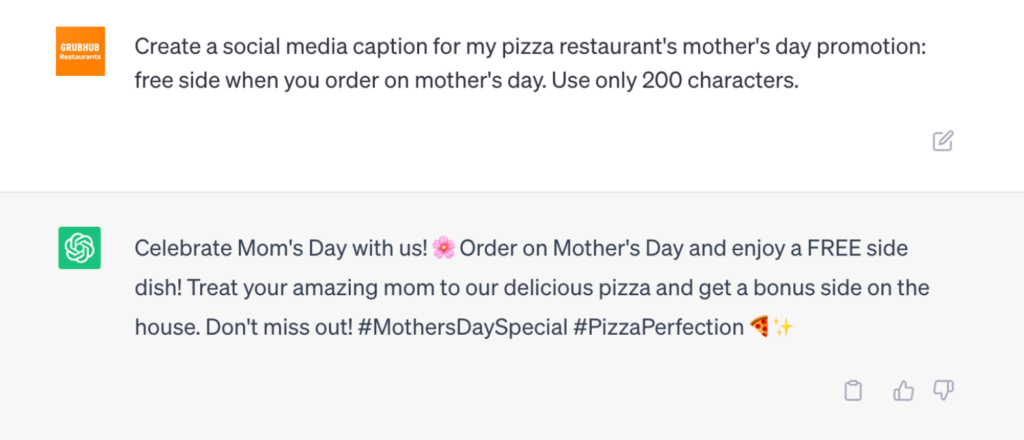
Don’t know what to ask ChatGPT? Ask them the best way to use ChatGPT for restaurants. For example, if you type “What are good questions to ask you about running my restaurant?” ChatGPT will respond with a list of questions you can explore like “What are some effective strategies for managing food costs in a restaurant?” or “What are some best practices for hiring and training restaurant staff?” Plug in those questions and ChatGPT will instantly serve you an in-depth answer.
Get started with ChatGPT by creating your free account.
Why should restaurants implement AI?
Working in the restaurant industry is chaotic, and turning to technology like AI can help make daily operations smoother. Using AI tools can help make your most ambitious restaurant ideas a reality.
AI integrations have helped restaurants by:
- Improving efficiency and accuracy. AI eliminates the risk of human error, increasing your accuracy to improve efficiency.
- Streamline Labor. AI can help complete restaurant tasks, reducing your labor costs and curbing employee turnover.
- Making smarter decisions. AI analyzes restaurant information and data to help you make more informed business decisions based on industry trends and your restaurant’s performance.
- Creating content. ChatGPT can write menu descriptions, social content and marketing materials for your restaurant.
- Cutting costs. AI can help you analyze your spending and finances to improve your ROI.
- Customize the customer experience. AI can allow for menu customization to allow your diners to have more control over their dishes and experience.
- Growing customer base. AI has helped restaurants grow their customer base by finding new diners and improving their reputation by responding to customer inquiries and creating engaging content.
9 ways to use AI in your restaurant
Ready to give AI a shot? Here are some ways you can utilize AI in your restaurant.
1. Phone operations
With the help of voice assistants, AI can talk directly to your customers and become your personal phone assistant. Answering phones requires employee labor, and if you grow your business, it can be difficult to always be on the line. In a Popmenu survey, 83 percent of customers will move on and find another restaurant if they try to call and get voicemail more than once. Enabling AI phone technology can allow you to care for your customers without the extra labor.
Tools like SoundHoud allow you to customize your phone system’s answers to talk with customers to answer questions and take orders. You can customize your AI phone answering to take reservations, answer frequent questions and take messages.
2. Take orders
Self-service ordering is rising in popularity. It makes the process easier for customers who can easily see all the menu options at their fingertips, and it helps staff avoid wasting time taking orders. AI makes online ordering even easier by reacting to customer behavior and predicting their next move.
Fast casual restaurants have been some of the first businesses to embrace AI ordering. Taco Bell’s in-store kiosks use AI to identify up-sale opportunities based on the customer’s order, and McDonald’s opened their first completely digital restaurant in Texas.
Not all AI integrations are a total robot takeover, and there are simple ways you can use AI to help with customer orders.
POS integration is one of the most common AI tools restaurateurs use. These tools help simplify order and menu management by connecting your different POS systems. This way you can keep track of orders, inventory and staff all from one place.
3. Get industry insights
Keeping up with the ever changing restaurant industry is difficult, especially as customer habits and tastes change. AI is a great tool for gathering and sorting through trend information. ChatGPT taps into the power of Google, making research simple. Try asking ChatGPT questions about the restaurant industry to get insight into customer cravings.
What kinds of questions should you try asking ChatGPT?
- What are the top ordered restaurant foods?
- What fruits and vegetables are in season right now?
- What is the most popular way to serve chicken?
- What are the top ordered dinner foods?
4. Enhance your menu
Research shows that menus with images and dish descriptions resonate better with customers. Now, you can create the perfect menu with the help of AI. You can use ChatGPT to generate menu text by asking them to create a one-sentence description of your dishes. Looking for menu photo tips for your cuisine? Ask ChatGPT for help on composition and style. Wondering what recipes are in season? Ask ChatGPT what’s trending.
AI’s influence in menu engineering doesn’t stop there. Technology has enabled restaurants to get a better handle on their inventory. Solutions like ClearCOGS offer a kitchen ingredient management system that can keep track of your inventory to help you plan food preparation and ordering.
5. Analyze data
Odds are you have many types of restaurant technology in your restaurant, and some of these systems are collecting valuable data. Take Grubhub, for example. Our platform collects data on your customers, and serves it up to you in our Customer Insights dashboard.
Digging into data is one of the best ways to understand your customers, staff, supplies and overall business. Don’t bite off more than you can chew by trying to dig through this data on your own. You can use AI to analyze data, segment customers, organize information and find insights.
Want to create a targeted marketing campaign? Copy and paste your customer data into ChatGPT and ask them to pull out repeat customers. You can then create marketing materials specifically tailored to this customer base.
Let’s say you want to understand your customers’ impressions of your restaurant. You can copy and paste the reviews into ChatGPT and ask it to look for the main trends. You’ll then get insight into the general sentiment of your customers to help make adjustments to make their experience more positive.
You can also use AI to track operational data from your restaurant. AI can help you analyze busy and quiet business hours so you can adjust your staffing accordingly.
6. Keep track of finances
When it comes to keeping track of your finances, you only want to use technology you can trust. With POS integration, you can search and find fraudulent or inconsistent transactions, look at purchasing data and understand transaction trends. With this info, you can better prepare your inventory and adjust prices based on the Cost of Goods Sold (COGS).
You can use AI to unpack your restaurant’s finances. ChatGPT can help you analyze your pricing menu so that you can competitively price your items. You can ask ChatGPT the average price of a specific menu item, or how much specific ingredients cost in different seasons.
7. Organize operations
As a restaurant owner, you have a lot on your plate. Relieve some stress by allowing AI to take care of tedious tasks. As we’ve mentioned, POS integration can be a lifesaver for restaurant owners by tapping into AI to streamline operations.
Turning to technology to handle these tasks that could take employee hours gives your staff back valuable time they can invest in other areas of your business. AI tools can help you schedule employees based on busy times so that you’re prepared to handle a rush. You can also use your POS system to keep track of inventory so you can get 86 items as soon as they run out.
AI can help you make informed decisions about your restaurant, predict inventory changes, customer trends and employee needs so you can stay on top of your business.
AI can also help you communicate with your employees. Need help creating onboarding materials for your staff? ChatGPT can write it for you. Just ask it to write a training guide for a certain position.

8. Create marketing materials
Without marketing, customers won’t know about your restaurant. But with marketing campaigns getting more creative, it can be hard to come up with ideas that stand out. That’s where AI can come in – generating ideas and copy for all your marketing needs.
A good marketing campaign covers all bases: social media, email, website and paper inserts. ChatGPT can help you write copy that is optimized for each platform. Let AI help you create targeted marketing materials that resonate with your customers.

Social media marketing is one of the best ways to reach customers directly, but coming up with what to post can be overwhelming. AI can help you create content, write captions and understand trends. You can use ChatGPT to come up with social media captions, hashtags and respond to comments and messages.
9. Improve the customer experience
Finding and attracting new customers is difficult for any restaurant. You can use AI to help you interact with customers to ensure they have a positive experience with your business.
Responding to reviews is a tedious yet necessary task to keep your customers satisfied. Solutions like Chatmeter have made understanding and interacting with customers easier by compiling all the online conversations about your brand.
AI can also help you craft a response to negative reviews. Timeliness for responding to these reviews is key to showing a customer you care. If a customer writes a review on your website claiming that their service was poor, you can ask ChatGPT to craft a response.

AI features on online ordering tools remember a customer’s history to customize featured offerings based on their behavior. When a customer orders from your restaurant on Grubhub Marketplace, the platform will remember their preferences when they come back to order again. This technology helps make restaurant visits more consistent, prompting repeat customers to continue ordering.
Grow your restaurant technology with a trusted partner by your side
Embracing the latest trends in restaurant technology can help grow your business. Innovations like AI give restaurants the power to streamline their owners’ operations and customize their customer experience. POS tools have made embracing new technologies even easier by improving how restaurants manage orders, inventory and customer data.
No matter how you plan on tapping into AI tools at your restaurant, there’s no doubt that this technology is here to stay. Why not get ahead of the trend?
Ready to grow your business and attract new customers? Partner with Grubhub today to tap into the latest in restaurant technology.

How to grow a restaurant’s social media following
Food is everywhere on social media. Spend just a few minutes scrolling and you’ll see restaurants, private chefs and food bloggers showing off their latest creations. It’s easy to see why — highly visual platforms such as Instagram, TikTok and Pinterest are the perfect place to display mouthwatering dishes. If you’re not using social media marketing for your restaurant, it’s time to get posting.
Why is social media marketing important for restaurants?
Social media is critical for your restaurant marketing plan — after all, it’s where your customers are spending time. According to the Pew Research Center, 72% of American adults use at least one social media platform. People between the ages of 18 and 49 are particularly active; more than 80% of this age group use social media regularly. The majority of users visit their preferred platforms at least once every day.
Your customers aren’t just connecting with friends; they’re using social media to search for potential restaurants and make purchasing decisions. An MHG study found that 45% of American diners have decided to try a restaurant because they saw one of its posts on social media.
Building a social media presence takes time, even if you use a social media management company, but it can have a significant impact on your business. The benefits of social media marketing for both large and small restaurants include:
- Increased brand awareness and brand recognition
- Creating a stronger brand identity
- Converting followers into customers
- Building customer loyalty
- Expanding your audience
- Building social proof
How to choose the right platform
If you’re like most restaurant owners, you don’t have time to maintain profiles on every major social media platform. To maximize your ROI, all you need to do is choose the platform where your target audience is most active. Later, you can expand to other social media channels.
Facebook is the largest social media platform across all age groups, according to Gallup research. About 60% of all Americans aged 18-34 and 55+ use the service daily or weekly, in addition to 66% of people 35-54 years old. No matter your target audience, a Facebook page is a must.
Many users see Facebook as an extension of a brand’s website; they come to check current opening hours, see daily specials and look at the menu. Facebook also allows you to receive reviews, add links, post content and even answer FAQs via chat, so it’s an ideal place to build a community.
Instagram is primarily a photo and video-sharing app. The platform is almost entirely visual, so it’s the perfect place to show off your best food photography. Instagram is an effective discovery engine; use appropriate hashtags and location tags to help people find your content. Instafoodies is a growing community, and sharing delectable photos and videos of your cuisine is a sure way to grow a following.
If your audience is between the ages of 18 and 54, Instagram is particularly useful. Gallup finds that the majority of this age group logs in daily or weekly. Customers 55 and older are less active on the app.
TikTok
If you have the resources to film and create short videos, TikTok can be a valuable digital marketing channel for your restaurant. This relatively young video platform is effective at delivering your content to new users, so it’s a good way to reach a bigger audience. To get the most value and exposure, keep up with trending video styles and sounds.
TikTok is a good way to reach younger diners. About 33% of people aged 18-34 use the platform frequently. According to Gallup, it’s also growing in popularity with millennials; 23% of people between the ages of 35 and 54 use the platform.
Twitter is a useful social media marketing tool if you’re ready to engage with the community. The fast-moving feed has a limited character count, so you can share short, easily digestible bits of information. Make sure to allocate time to respond to comments, answer questions, and join in on discussions — Twitter is all about conversations.
Twitter is on par with TikTok when it comes to usage, but those stats are likely to change as TikTok grows. Currently, the platform is used daily or weekly by 36% of people aged 18-34 years, 23% of people aged 35-54 and 13% of adults aged 55 or older.
Social media marketing tips and tricks
Restaurant social media marketing is flexible. If one post type doesn’t work, you can adjust your social media strategy quickly and cheaply. As a restaurant owner, it’s a good idea to stick to these best practices:
- Stay professional, but establish a unique voice
- Track analytics to identify the best-performing content
- Engage your audience
- Keep up with the latest trends
- Use hashtags to join the conversation
1. Create a consistent brand voice
Every time you post on a social media account, use a similar style and tone. Consistency gives your restaurant a distinct personality, which attracts customers and builds familiarity.
If you’re not sure where to start, imagine your restaurant is a person. How would it speak? Would it use slang, or would it be more formal? It’s also helpful to consider the words and tone your target audience will respond to.
2. Share rewards, discounts and limited-time offers
Give your social media followers a reason to visit your restaurant by offering special deals and offers. Add a promo code for online orders, or invite people to follow your profile to get a discount when dining in. You can run promotions during happy hours, food holidays or even slow days of the week.
3. Host a social media contest to build customer loyalty
Social media algorithms reward engagement; if your posts get a high volume of likes, comments and shares, the platform is more likely to show future content to more people. Contests are a fun way to generate more leads and encourage viewers to follow, create user-generated content and interact with your profile.
keep it simple; you can post a photo and host an informal caption contest, ask people to post their best food photos, or invite followers to name your newest menu item. Offer a prize that boosts business, such as a free meal or branded merchandise. Make sure to cross-promote your social media marketing contest on other channels.
4. Deliver an authentic social media presence
Modern social media users are exceptionally savvy — they respond best to authenticity and enthusiasm. To build stronger connections, showcase the human side of your restaurant. Offer a behind-the-scenes peek into the kitchen, introduce your staff, and explain the meaning behind your restaurant logo. You can also hop on the “no gatekeeping” trend by sharing recipes and cooking tricks.
5. Establish a healthy cadence
A regular posting schedule is essential for social media brand-building; it ensures a steady flow of content. Aim to post at least three times per week, or more if you have the resources.
Consider creating a content calendar to plan posts in advance. That way, you can write content and take photos whenever you have free time. On posting day, all you have to do is hit the “publish” button. Facebook and Instagram even allow you to schedule future posts on the platform.
6. Reach out to an influencer
Influencer social media marketing is a great way to get your restaurant in front of a new social network. The process is simple: You pay food bloggers and social media personalities to promote your brand to their followers. Stick to people in your area, and don’t be afraid to work with micro influencers; their followings are often small but highly engaged.
7. Try a little video marketing
Video is the most popular and highest-performing social media in 2023, according to HubSpot’s The State of Marketing report. Engagement is particularly high on the short-form videos you’ll find on TikTok and Instagram reels. Try posting cooking tutorials, recipes or even beautiful clips of your top-selling menu items.
8. Respond to online reviews
Social media platforms are public forums; take advantage of that visibility by responding to negative reviews. When you’re professional, friendly and transparent, it builds trust and strengthens relationships. While you’re at it, leverage customer feedback to boost engagement and improve your operations.
9. Showcase menu updates
Social media is one of the most direct channels to reach customers. Instagram and Facebook are often the two common platforms diners check to get updates on your restaurant. Posting about your menu updates, restaurant announcements or seasonal changes can get your latest news to your customers in real time. Letting customers know about your restaurant’s changes can help drum up excitement and give diners a reason to place an order.
10. Increase takeout and delivery sales by promoting online ordering
Customers often scroll through social media when they’re trying to choose a restaurant for lunch or dinner. If they see something that appeals to them, they’re likely to order right away. Make it easier by promoting your online ordering options in your posts. Update your social media profile with links to your online ordering website and partner delivery apps. If you’re posting on Twitter or your Facebook page, you can include a clickable link in the post itself.
If you don’t currently have a way for customers to order online, Grubhub Direct is an easy way to build a branded, commission-free ordering website. The Direct Success Playbook can help you increase orders, create special promotions, and improve your marketing.
Social media marketing is a cost-effective way to get your restaurant in front of hungry diners. Start small, post regularly, and don’t be afraid to experiment — it’s a great way to find out what content resonates best with your audience.
Use social media to build a loyal following and increase your restaurant’s sales
Social media is a great marketing tool to help you reach new customers, build a fan base, and increase your restaurant’s sales. From promoting a dine-in special to using commission-free direct ordering links from Grubhub for Restaurants, social media can help increase your restaurant’s sales and build a restaurant brand.
Need a partner to help get your menu in front of more paying customers? Partner with Grubhub today to reach 33+ hungry diners and grow your business.
Ghost Kitchens Vs. Virtual Restaurants
Scroll through any major food delivery app and you’re likely to come across restaurants that seem to only exist online. Chances are, they’re ghost kitchens — virtual brands that use delivery platforms like Grubhub to reach hungry diners. Flexible and cost-effective, this business model is an ever-growing trend in the restaurant industry.
Developing a virtual brand is a great way to capture the growing delivery industry. Restaurateurs, chefs, and entrepreneurs will typically launch their virtual brands either through a ghost kitchen or as a virtual restaurant that operates in tandem with their brick-and-mortar concept.
How we talk about virtual brands and delivery-only restaurant concepts can be a bit confusing. The restaurant industry uses terms like ghost kitchen, cloud kitchen, dark kitchen and virtual restaurants when talking about delivery-only restaurant concepts, and all these different terms can make it difficult to understand which model is best for launching your virtual brand.
In this article, you’ll learn the differences between ghost kitchens and virtual restaurants so that you can decide which model will work best for launching your virtual brand.
What’s a ghost kitchen?
A ghost kitchen is a commercial kitchen that makes meals for delivery only. These operations don’t have visible physical presences. Instead, they operate in the digital space. You’ll find their “ghost menus” — menus that are only available for delivery — on food delivery apps. Some even have full-fledged online ordering websites to bring in more business.
Ghost kitchens can operate out of any commercial kitchen. Some use the kitchens in existing restaurants. Others pay for time in standalone commercial kitchens, often sharing the space with caterers and virtual restaurants.
As food delivery has become more popular, so have ghost kitchens. The delivery market in the United States doubled during the pandemic, and it continues to grow even as the restaurant industry returns to normal. Customers have embraced the convenience of apps like Grubhub, creating the perfect environment for virtual restaurants to thrive.
Ghost restaurants vs. traditional establishments
Ghost kitchens and traditional restaurants both create menus and prepare food for individual customers. However, a ghost kitchen lacks the familiar trappings of a typical brick-and-mortar restaurant brand. It doesn’t have a storefront, signs or dining area; there are no front-of-house staff members, and customers can’t stop by to pick up takeout.
If you already operate a restaurant or you’ve always wanted to start one, the ghost kitchen concept is worth considering. The barriers to entry are lower, which means you can get up and running in less time. In fact, many traditional restaurants run ghost kitchens as a way to reach new audiences, try out new dishes or test new dishes.
Before you open a ghost kitchen or add a virtual brand to your restaurant, it’s important to understand what’s involved. You’ll still need to secure funding, find suppliers and obtain permits and licenses. This process might be faster if you already own a restaurant, but it still takes time. Your local health department and business development office can help you understand the rules.
Because ghost kitchen brands don’t have the advantage of a storefront to build awareness, marketing is critical. You can take advantage of your delivery partner’s promotions and loyalty tools to reach new audiences and gain customer reviews. Check out our guide on how to make your virtual restaurant brand irresistible.
Pros and cons of operating a ghost kitchen
Given the costs and risks associated with opening a traditional restaurant, many entrepreneurs consider alternatives such as ghost kitchens and food trucks. As you consider whether a virtual food-service business is right for you, it’s important to take an honest look at the pros and cons.
Pros of operating a ghost kitchen
Some of the reasons people choose to start ghost kitchens rather than physical restaurants include:
- Lower startup costs. With a ghost kitchen, you don’t need to buy property and equipment. Instead, you can lease the space and equipment in an existing licensed commercial kitchen.
- Low operating costs. A ghost kitchen doesn’t require servers, bussers, hosts or bartenders, so you can dramatically reduce labor, hiring, and training costs. Plus, you don’t need to worry about washing customer dishes, maintaining furniture, paying decorators and cleaning a dining area.
- Lower risk. Lower startup costs also mean less risk; if the ghost kitchen doesn’t work out as expected, you’re less invested.
- Maximizes resources. For existing restaurants, a virtual restaurant is a way to get more value from staff and equipment. It helps you increase revenue without investing in additional space.
- Easy experimentation. A ghost kitchen removes the limitations of your current restaurant brand. It’s a safe space to experiment with new food items and cuisines to see what customers respond to. Because the entire operation is digital, you can change up your offerings without reprinting menus.
- Convenient delivery. Food delivery apps are optimized for ghost kitchens, so you can get your food to customers without hiring or managing delivery drivers.
- Low-contact meals. Since the COVID-19 pandemic, diners have been increasingly interested in low-contact food operations. It’s one of the reasons ghost kitchens are so popular — fewer people come into contact with the food.
Cons of operating a ghost kitchen
No business model is perfect, and ghost kitchens also have some drawbacks:
- Limited plating creativity. Because you’re packaging food for delivery, there are several ways to present it beautifully. Instead, you must focus on packaging that keeps the food in good condition while in transit.
- environmental impacts. While ghost kitchens use less energy and materials, they use a higher volume of packaging. If you want to control your environmental impact, you’ll need to find sustainable packaging options.
- tight margins. Restaurants almost always have tight profit margins. With ghost kitchens, you must factor in additional costs for packaging and food delivery fees.
- Challenging brand building. Building brand awareness for a virtual restaurant is often more difficult than it is for traditional restaurants. Because you don’t have a storefront or sign, you have to work harder to reach customers.
If the benefits of ghost kitchens outweigh the cons for your operation, it’s an option worth pursuing. The Grubhub virtual restaurant checklist can help you get started.
Are ghost kitchens the future of the restaurant industry?
Ghost kitchens are likely to be an important part of the restaurant industry in the coming years. While these virtual operations are unlikely to overtake brick-and-mortar restaurants — customers still enjoy the community and connection of in-person dining — they’re gaining a bigger market share.
It’s easy to see why: Virtual restaurants speak directly to the needs and preferences of modern consumers. They’re inherently convenient, allowing diners to use tech trends such as contactless payments, third-party food delivery apps and digital loyalty programs. With the right infrastructure, ghost kitchens can develop sustainable operations that satisfy customers’ desire for eco-friendly dining solutions. Ghost kitchens are here to stay, and if you’re interested in joining the virtual charge it can help to have a partner like Grubhub by your side. Listing your virtual restaurant on Grubhub Marketplace can give your brand instant exposure. As you consider how to expand your existing restaurant or start a new ghost kitchen, explore the ways Grubhub can help you get started.


American Hotel Income Properties REIT (OTCMKTS:AHOTF) Price Target Raised to C$3.00 at National Bank Financial
 American Hotel Income Properties REIT (OTCMKTS:AHOTF – Get Rating) had its price objective hoisted by National Bank Financial to C$3.00 in a research report released on Monday morning, The Fly reports.
Separately, Scotiabank dropped their price objective on American Hotel Income Properties REIT from C$3.75 to C$3.50 in a report on Tuesday, March 7th.
American Hotel Income Properties REIT Stock Performance
AHOTF opened at $1.90 on Monday. American Hotel Income Properties REIT has a one year low of $1.69 and a one year high of $3.06. The business’s 50-day simple moving average is $1.84 and its 200-day simple moving average is $1.97.
About American Hotel Income Properties REIT
(Get Rating)
American Hotel Income Properties REIT LP engages in investing in hotel real estate properties. Its long-term objectives are to: increase the value of its hotel properties through operating excellence, active asset management and invest in value-added capital expenditures, expand its hotel portfolio through acquisitions on an accretive basis, and increase unitholder value and distributions to unitholders .
See Also

Receive News & Ratings for American Hotel Income Properties REIT Daily – Enter your email address below to receive a concise daily summary of the latest news and analysts’ ratings for American Hotel Income Properties REIT and related companies with MarketBeat.com’s FREE daily email newsletter.

InterContinental Hotels Group (LON:IHG) Lowered to Sell at Redburn Partners
 Redburn Partners lowered shares of InterContinental Hotels Group (LON:IHG – Get Rating) to sell a rating in a research note issued to investors on Tuesday morning, reports Marketbeat Ratings.
Several other equity analysts have also recently issued reports on the company. Jefferies Financial Group lifted their price target on InterContinental Hotels Group from GBX 5,500 ($67.54) to GBX 6,200 ($76.14) and gave the company a buy rating in a research report on Wednesday, January 25th. JPMorgan Chase & Co. reduced their price objective on InterContinental Hotels Group from GBX 6,200 ($76.14) to GBX 6,000 ($73.68) and set a neutral rating for the company in a research report on Wednesday, February 22nd. Deutsche Bank Aktiengesellschaft reaffirmed a buy rating and issued a GBX 5,520 ($67.79) price target on shares of InterContinental Hotels Group in a research report on Tuesday, November 22nd. Barclays lowered InterContinental Hotels Group to an equal weight rating in a research note on Monday, March 6th. Finally, Peel Hunt reiterated a hold rating and issued a GBX 5,750 ($70.61) price objective on shares of InterContinental Hotels Group in a research note on Tuesday, February 21st. One equity research analyst has rated the stock with a sell rating, six have been given a hold rating and five have issued a buy rating to the stock. According to MarketBeat.com, the company has an average rating of Hold and a consensus target price of GBX 5,750 ($70.61).
InterContinental Hotels Group Stock Up 1.8 %
LON:IHG opened at GBX 5,384 ($66.12) on Tuesday. The company has a market cap of £9.43 billion, a PE ratio of 3,130.23, a P/E/G ratio of 0.77 and a beta of 0.98. InterContinental Hotels Group has a 52 week low of GBX 4,174 ($51.26) and a 52 week high of GBX 5,796 ($71.18). The business’s 50 day moving average is GBX 5,561.12 and its two-hundred day moving average is GBX 4,996.47.
InterContinental Hotels Group Increases Dividends
The firm also recently announced a dividend, which will be paid on Tuesday, May 16th. Stockholders of record on Thursday, March 30th will be issued a $0.95 dividend. This is an increase from InterContinental Hotels Group’s previous dividend of $0.44. This represents a dividend yield of 1.4%. The ex-dividend date of this dividend is Thursday, March 30th. InterContinental Hotels Group’s payout ratio is presently 6,744.19%.
Insider Transactions at InterContinental Hotels Group
In other news, insider Paul Edgecliffe-Johnson sold 21,094 shares of the business’s stock in a transaction that occurred on Tuesday, February 21st. The stock was sold at an average price of GBX 5,521 ($67.80), for a total value of £1,164,599.74 ($1,430,185.12). 4.33% of the stock is owned by company insiders.
InterContinental Hotels Group Company Profile
(Get Rating)
InterContinental Hotels Group PLC owns, manages, franchises, and leases hotels in the Americas, Europe, Asia, the Middle East, Africa, and Greater China. The company operates hotels under the Six Senses, Regent, InterContinental Hotels & Resorts, Vignette Collection, Kimpton Hotels & Restaurants, Hotel Indigo, EVEN Hotels, HUALUXE, Holiday Inn, Holiday Inn Express, Holiday Inn Club Vacations, avid, Staybridge Suites, Atwell Suites, Candlewood Suites, voco, and Crowne Plaza.
Featured Stories
Receive News & Ratings for InterContinental Hotels Group Daily – Enter your email address below to receive a concise daily summary of the latest news and analysts’ ratings for InterContinental Hotels Group and related companies with MarketBeat.com’s FREE daily email newsletter.

Happy hour menu ideas for your restaurant
There’s nothing like kicking back and relaxing with a cheap drink after a hard day’s work. As most people have returned to in-person activities, the demand for happy hour has risen. Whether you offer a nice selection of wines or are known for your fun cocktails, featuring happy hour discounts is a sure way to get more customers to place an order. It’s 5 o’clock somewhere, right?
When you’re looking for ways to maximize restaurant revenue, happy hour is a cost-effective option — you can start with just a few fun menu ideas and your regularly scheduled staff. This classic afternoon event tends to attract groups, which boosts order value and introduces a wide range of diners to your restaurant.
What’s the point of a happy hour?
Happy hour is a period of time — usually, 2-3 hours in the late afternoon or early evening — when bars and restaurants offer discounted alcoholic drinks and appetizers. The exact times vary by establishment and day of the week but usually fall somewhere between 4 pm and 8 pm on weekdays. Weekend happy hours might start as early as 2 pm
The point of a happy hour is to increase revenue during the slow period between lunch and dinner. It’s particularly effective if you want to attract an after-work crowd; drink specials can bring in professionals who are looking to wind down at the end of a long day.
As an extra incentive, many restaurants offer free cocktail-hour finger foods or deals on appetizers to tide customers over until dinner. Some restaurants create a dedicated menu; others come up with new happy hour ideas every day to give guests a reason to come back.
In addition to increasing foot traffic, happy hour offers several important business benefits for restaurants. You can take advantage of the relaxed atmosphere to try out new cocktail trends and appetizer recipes; it’s a great way to gauge the customer response before you change the permanent menu. You can also feature seasonal offerings on a limited-time menu. When you have a surplus of a kitchen ingredient or type of alcohol, use happy-hour discounts to boost orders and run inventory through faster.
Happy hour menu ideas customers will love
As you plan a happy hour menu, it’s important to decide whether it will be permanent or revolving. Both have advantages — a permanent menu streamlines your ordering and prep processes, but a revolving menu offers more flexibility.
Start with alcoholic beverages; they’re the foundation of a good happy hour. Accommodate a variety of tastes by offering a small selection of discounted beer, wine and mixed drinks. You can still offer the regular menu, of course, but expect happy-hour deals to get the most attention. The drinks you choose will depend on factors that include:
- How easy the drink is to prepare and serve
- Whether the bartender can make a large batch in advance
- Profit margins with the discounted price
- Seasonal trends and flavor preferences
- The popularity of the beverage during regular hours
- Current inventory and bartender preferences
When it comes to food, the best happy hour menu ideas prioritize big flavors and bite-size servings. That way, customers can take the edge off their appetites without filling up before dinner. If you’re serving beer in a casual environment, aim for popular finger foods that are easy to eat: soft pretzels and cheese, nachos, bacon-cream cheese roll-ups, or street tacos, for example. For a restaurant with a more elevated vibe, consider gastropub-style appetizers such as stuffed mushrooms, crostini with goat cheese, or charcuterie platters.
If you’re developing a seasonal menu for your restaurant, consider extending it to happy hour, too. Create dishes that feature local in-season produce, for example, or offer holiday-themed snacks and drinks. In the winter, you might add hot drinks to the menu, such as mulled wine or spiced apple cider.
Looking for ways to boost both food and beverage sales? Experiment with different happy-hour specials to encourage bigger orders:
- Discounted wine or beer flights
- Combo deals for an appetizer and two drinks
- Discount code just for social media followers
- $5 local beer or wine
- Four drinks for the price of three
- Buy one, get one half off the deal on appetizers
What happy hour drinks are trending?
The types of drinks customers turn to quench their thirst often change season to season. However, there are a few drinks that stand out all year round. What were the top ordered alcoholic beverages on Grubhub in 2022?
- Beer: This classic drink is a happy hour must have. Consider offering local brews and seasonal lagers to keep it fresh.
- margaritas: Whether they prefer it with salt or sugar on the ream, there’s no doubt customers can’t get enough of this sweet cocktail. Offer a variety of flavors and let customers dictate if they want it on the rocks.
- Hot Sake: This Japanese specialty has risen in popularity in the past year. Known as ‘okan’ or ‘kanzake’ in Japanese, this stronger drink comes in a variety of flavors and can be served at different temperatures depending on your diners’ liking.
- Piña Colada: Rum, coconut cream and pineapple juice are a dreamy mix of ingredients that many customers can’t turn down. Serve frozen with a slice of pineapple and a maraschino cherry to make diners feel like they’re at the beach all year round.
- White Wine: Wine is also a happy hour must-have. You can serve wine in mini pre-sealed to-go bottles to make your happy hour deal part of your delivery menu.
Happy hour doesn’t only mean spiked drinks. It can pay to offer non-alcoholic beverages at a happy hour discount to include everyone in your afternoon special. What non-alcoholic beverages were customers ordering on Grubhub?
- cola
- Lemon Lime Soda
- Iced Tea
- Iced Coffee
- Thai Iced Tea
Tips for a successful happy hour
Done well, happy hour can be good for your restaurant’s business; it boosts your revenue without excessive labor costs or major menu modifications. To get the most from the event, follow a few happy hour best practices:
- Stick to the same hours every week to set expectations
- Consider profit margins when evaluating happy hour menu ideas and discounts
- Choose finger foods when possible to reduce utility usage and streamline cleanup
- Offer happy hour exclusives to attract your regular lunch and dinner customers
- Ask for guest feedback on new recipes and drinks
- Choose times that fit between your restaurant’s specific rush periods
- Keep customers interested with themes, live entertainment and partnerships
Marketing is essential for a successful happy hour, especially in the first few months. Build excitement by mentioning the times and discounts on your website, in marketing emails and in advertisements. While you’re at it, try sending flyers to nearby businesses. Make sure to promote daily or weekly specials on social media to motivate spur-of-the-moment visits.
To get more customers in on the fun, offer happy hour appetizer specials and alcohol for delivery. It’s easy with Direct — you can build a commission-free branded ordering platform that enables customers to order snacks and drinks to enjoy at the comfort of their home. Your bottom line benefits as well; adding alcohol to your Grubhub menu can boost your average order value by up to $15. When you’re ready to expand your restaurant’s happy hour to your delivery menu, get started with Grubhub today.