

US hotels set for earnings bump from robust travel even as costs weigh By Reuters
© Reuters. FILE PHOTO: Company’s logo is seen on the Marriot hotel in Zurich, Switzerland October 27, 2016. REUTERS/Arnd Wiegmann
By Priyamvada C
(Reuters) – US hotel operators are expected to post a rise in first-quarter profit even as they pour in money to lure travelers to make bookings directly through their websites, instead of turning to travel agencies.
While bookings have been getting a boost from increased business and leisure travel, the investments in hotels have made to reduce their reliance on online travel agencies (OTAs), which tend to have higher marketing budgets, is eating into the gains.
Last year, US hotels received about $49 billion from online direct bookings and $57 billion from OTA bookings, according to travel market research firm Phocuswright.
“During uncertain economic times, when travelers are looking to stretch their dollars as far as possible, OTAs can help drive demand,” Phocuswright’s senior analyst Madeline List said.
THE CONTEXT
In recent years, hospitality giants like Marriott International (NASDAQ:) Inc and Hilton Worldwide Holdings (NYSE:) Inc. have doubled down on their own loyalty programs as they attempt to spend less on commissions and other costs related to third party businesses.
Through these programs, the hotels promise exclusive perks to customers in the form of redeemable points for stays at specific hotels in their franchise, among other travel benefits.
However, in the face of an uncertain economy, travelers have increasingly relied on OTAs like Booking Holdings (NASDAQ:) Inc, which give them a wider range of choices and prices to book from, alongside incentives like advance cancellation, as opposed to upfront payments .
“When the economy is weak and hotels may not be getting as much business from traditional sources as corporate travel or meetings and conventions, they become that much more reliable on online travel agencies,” Atmosphere Research Group’s travel industry analyst Henry Harteveldt said.
GRAPHIC: Hotel bookings through online intermediaries https://fingfx.thomsonreuters.com/gfx/buzz/akveqxqbwvr/Hotels.png
THE FUNDAMENTALS
* Analysts expect Marriott’s revenue to rise 28.8% to $5.4 billion when it reports results on May 2; earnings per share is estimated to be $1.84
* Analysts expect Hilton’s revenue to rise 28% to $2.2 billion when it reports results on April 26; earnings per share is estimated to be $1.13
* Analysts expect Booking’s revenue to rise 40% to $3.8 billion when it reports results on May 4; earnings per share is estimated to be $10.67
GRAPHIC: US travel operator’s stock performance https://fingfx.thomsonreuters.com/gfx/buzz/zjvqjoewkpx/US%20hotel%20operators%20stocks.png
WALL STREET SENTIMENTS
* For Marriott, six of 23 brokerages rate the stock “buy” or higher, 16 “hold” and one “sell” or lower, as per Refinitiv data
* For Hilton, nine of 22 brokerages rate the stock “buy” or higher and 13 “hold”, as per Refinitiv data
* For Booking, 19 of 33 brokerages rate the stock “buy” or higher, 13 “hold” and one “sell” or lower, as per Refinitiv data

Restaurant health scores: preparing for a successful inspection
When customers are choosing where to eat, restaurant health scores are one of the metrics they use to gauge quality and safety. A high score is a vote of confidence that can give your restaurant a competitive advantage. It also helps you avoid fines and maintain positive relationships with local health officials.
What are restaurant health scores?
A restaurant health score is the rating the state or county health department gives your restaurant after an inspection. It tells the public how well you’re complying with local and state food safety laws. In many areas including New York City, restaurants are required by law to post their scores in a high-visibility location.
Health departments set their own grading scales; most use numerical scores or letter grades. Scoring can vary, but it’s always based on the state and local food codes. Usually, A is the highest score and C or D is the lowest.
In most states, county health inspectors visit every food service operation a few times per year and after every customer complaint. Inspections are usually unannounced to preserve the element of surprise.
During an inspection, the official looks for specific violations of state and local laws. For many violations, you’ll be given a short period of time to fix the issue. After that, the inspector makes a follow-up visit to verify you’re meeting compliance requirements.
Health departments don’t always publish a specific acceptable violation limit. Instead, they consider the overall risk to public or environmental health. If an inspector finds a restaurant poses an immediate health hazard, they’ll typically shut it down right away. This might happen due to multiple severe violations or a single large issue, such as a sewage backup. Before it can reopen, the restaurant owner must prove that they’ve corrected all issues. Inspectors may also shut down restaurants after repeated health-code violations.
How to prepare for a health inspection
The best way to prepare for a health inspection is to run a clean, compliant operation — after all, restaurant inspections can happen at any time. Keep in mind that officials determine your inspection score based on the number of violations, including common issues such as:
- Improper hand-washing
- Lack of hair restraints
- Inappropriate food storage temperature
- Cross-contamination
- Inadequate sanitation
- Expired foods
- Infestation of rodents or insects
- Lack of pest control
- Disrepair of restaurant facilities
If it’s been a while since your last inspection date, now is a great time to prepare your restaurant. To avoid violations, run regular self-inspections using this basic health inspection checklist:
- Train staff members in food safety standards.
- Make sure refrigerated foods are stored below 40 degrees Fahrenheit.
- Ensure freezers are at least zero degrees Fahrenheit or lower.
- Choose hot-food holding systems that are 140 degrees Fahrenheit or higher.
- Mark expiration dates and throw out expired foods immediately.
- Keep equipment and facilities in good repair.
- Establish food handling, cleaning and storage practices that prevent cross-contamination.
- Use thermometers to ensure meat is cooked to a safe temperature.
- Set up hand-washing stations and train staff in proper technique.
- Publish and enforce personal hygiene guidelines.
- Install leakproof garbage bins and remove trash frequently.
- Clean all surfaces and equipment thoroughly and regularly.
- Hire a pest-control service for regular visits.
Remember that the laws governing restaurant health scores can vary considerably from state to state. Make sure to check with your local health department for a location-specific checklist.
What’s so important about your restaurant health score?
Your restaurant’s health score is public information; its purpose is to help customers understand your establishment’s food safety standards at a glance. A high score reassures diners that your facilities are safe and clean. A low score is a red flag that erodes public confidence and reduces your revenue.
The health scoring system encourages restaurants to comply with food safety regulations. When more businesses practice safe food handling and storage, it improves public health, reduces the burden on environmental health services and benefits the entire community.
If your score is lower than you’d like, you can take action to boost it. Start with the violations in your last inspection report — identify the root of the problem and implement a permanent solution. Then, use your local health department’s guidelines to improve your kitchen, food service and front-of-house operations. Even small changes, such as standardized hand-washing rules, can help staff members stay compliant and ready for a surprise inspection.
A high restaurant health score is a sure fire way to maintain a positive reputation and stay compliant with local laws. By implementing standard operating procedures for a clean kitchen and safe food handling, you can welcome health inspectors with confidence.
The importance of a multi-lingual restaurant staff
As cities across the United States become increasingly diverse, restaurant owners are adjusting their practices to better serve diners. Bilingual workforces are growing, allowing businesses to cater toward non-English speaking customers. By hiring employees with a strong grasp of Spanish restaurants, you can create a better experience for a wider range of diners.
Why bilingual staff members are an asset to your business
If you run a restaurant in the United States, chances are good that a percentage of your customers are fluent in Spanish. About 41.76 million people speak Spanish at home; next to English, it’s the most common language in the country. Bilingual staff members enable you to communicate with a diverse customer base, making all your diners feel more comfortable and welcome. They give you a distinct competitive advantage — people who speak Spanish as a first language may be more likely to choose your restaurant if they can converse fluently with staff about the dinner menu, wine options and food allergies.
Experts expect Spanish to grow in popularity in the coming decades. While the majority of the country’s Spanish-speaking population has historically been concentrated in nine states, statisticians are seeing a move toward a broader geographic spread. Whether you run a Spanish restaurant in Florida or an American diner in Michigan, bilingual employees can prepare the company for changing demographics.
The most successful restaurants go a step beyond hiring multilingual employees; they train staff members in niche-specific restaurant Spanish vocabulary and explain how Spanish dinner etiquette varies from culture to culture. For example, when serving customers from Spain, the trickiest aspect of service is waiting to deliver the check until it’s requested. Diners from Mexico and Central America, on the other hand, may have different expectations.
Hiring a diverse staff
Hiring bilingual employees can be a challenge, especially if you aren’t fluent in both English and Spanish. Don’t rely on applicants’ self-assessment of language skills — find someone who’s both bilingual and experienced in the restaurant industry. They’ll be able to help you conduct the search and evaluate candidates more effectively.
When you’re hiring new staff, try these best practices:
- Use bilingual job descriptions.
- Advertise on Spanish-language job boards to reach a diverse group of job seekers.
- Ask current bilingual employees for referrals.
- Find a bilingual person to evaluate candidates’ language abilities.
- Switch between both languages in the interview.
- Test interviewees on their food-related Spanish phrases.
- Judge applicants’ Spanish vocabulary with a written test.
As you’re hiring, be mindful of your customers’ cultural background. If most diners speak a Latin American dialect, you might prioritize candidates who learned Spanish in Latin America as opposed to Spain. This strategy helps you find employees who can use precise regional vocabulary. Of course, if you’re serving authentic Spanish cuisine, you might opt for workers who learned the language in Europe.
Restaurant Spanish: important phrases for all team members to know
For many restaurants, it’s not feasible to hire a full bilingual workforce. However, if you have a large Spanish-speaking customer base, consider training your existing staff in a basic Spanish restaurant. Knowing even a few phrases can help servers communicate more efficiently with people who speak limited English.
Into your standard Spanish vocabulary training, start by teaching basic phrases: bienvenidos (welcome), por favor (please), gracias (thank you), buenos días (good morning) and incorporate buenas tardes/noches (good afternoon/evening). Help employees expand their knowledge by hosting language classes or providing on-the-job training with bilingual employees.
At a minimum, staff members should understand key Spanish dinner, lunch, and breakfast words:
- Dinner: la cena
- Lunch: el almuerzo
- Breakfast: el desayuno
- Allergy: He’s allergic
- Table: la mesa
- Half portion: una media ración
- Appetizer: plato de entrada
- Entrée: plato principal, plato fuerte
- Quiero/quieres: I want/you want
- Beef: carne de res
- Chicken: pollo
- Beer: la cerveza
- Soft drink: el fresco
- Coffee: el cafe
- Spicy: picante
- Large: grande
- Small: pequeña
- Still water/sparkling water: agua sin gas/agua con gas
- Wine: el vino
- Plate: elplato
- Fork: el tenedor
- Knife: el cuchillo
- Spoon: la cuchara
- Glass: copa/vaso
- Bill/check: la cuenta
Navigating a multilingual kitchen
When you start introducing multiple languages into a restaurant kitchen, you can expect an adjustment period as staff from different linguistic backgrounds learn to communicate. Whether you’re running a Spanish restaurant or you simply have a diverse staff, a few communication and inclusivity best practices can create a more welcoming environment for everyone on the team:
- Promote language learning on the job.
- Offer language training in both English and Spanish.
- Establish a no-tolerance policy for insults or bullying.
- Encourage workers to share their languages and cultures.
- Discuss specific vocabulary for authentic Spanish cuisine and Latin American food.
- Bring in translators for performance reviews and training sessions.
- Offer multiple channels for employee feedback to accommodate everyone.
- Take employee feedback seriously.
A company culture that prioritizes connections and celebrates employees’ unique backgrounds tends to feel positive and inclusive for everyone; it helps workers feel safe and reduces employee turnover.
Your restaurant manager play a big role — other employees will look to them for behavioral clues. To help managers navigate a bilingual kitchen more effectively, consider sending them for immersive language training. They might not become fluent overnight, but the extra language skills will go a long way toward breaking down communication barriers and enabling a free flow of ideas. It takes time and effort to build a bilingual restaurant workforce, but the investment can pay off significantly. When you provide services in multiple languages, it’s easier to attract a broader range of customers and build a foundation for long-term success. Need a partner to help your restaurant grow? Sign up for Grubhub today to reach more customers.
How to increase restaurant sales with 2022 National Food Holidays
When it comes to marketing, national food holidays and restaurants are the perfect match. Every year, there are hundreds of national food holidays that encourage people across the country to band together and share affection for everyone from
These famously celebratory days are a fantastic opportunity to reach out to new customers while also re-engaging with the people who may be familiar with your restaurant but haven’t visited or ordered take-out in a while.
Seasonal marketing matters
One thing that’s certain is that our world is constantly changing. People’s lives, technology, food ingredients, trends and diner behaviors are forever evolving. And although a business plan may seem constant, restaurants should never forget about their diners’ current reality when it comes to marketing.
That’s why the best chance restaurants will get to be relevant year-round is to connect with their customers in real-time through real-life happenings – like national food holidays. Use our top marketing tips for restaurants and free calendar downloads to help you create entertaining and eye-catching promotions that build your brand and boost your revenue.
How to use the top National Food Holidays of 2023 for your restaurant marketing strategy
To make your national food holiday promotions as effective as possible, tie them into a larger restaurant marketing strategy that looks at the big picture, not just a single opportunity. A restaurant marketing strategy is a formal plan that documents, tracks and analyzes all your marketing efforts and activities.
Use these simple steps to help you implement national food holidays into your marketing strategy today:
Find the food holidays that fit
Incorporating national food holidays into your marketing strategy is a huge opportunity for growth and engagement, but it can also damage your brand if you aren’t careful about which holidays you choose. Every holiday you choose to promote should fit not only your brand but your menu.
For example, it doesn’t make much sense to launch a huge National Hot Dog Day campaign (July 23) if your menu serves classic French cuisine. Start with your own concept and see which food holidays feel like an authentic fit.
Pick your promotions
Food holidays are prime time for freebies and discounts. Nothing motivates a diner to press ‘order now’ more than a discount.
Some offers you may consider running during a national food holiday include:
- Free menu items: Allow customers to redeem a specific free item with their purchase, such as a free chocolate chip cookie (May 16) with every entree
- Free menu selection: Highlight a specific area of your menu, perhaps discounting all your salads for National Kale Day (October 5)
- Dollar-off: Offer a fixed amount of money off for new customers during a national food holiday, giving $1 off everything with fries in honor of National French Fry Day (July 13)
- Percentage off: Choose a fixed percentage off orders during a national holiday, like advertising 20% off all caffeinated drinks on National Coffee Day (September 29)
- Free delivery: If your restaurant offers self-delivery, you can food the bill for all delivery fees during a national holiday, like on National Dessert Day (October 14)
Spread the word
It’s important to use all the channels available to share your national food holiday promotions. When your restaurant joins the Grubhub Marketplace, you get immediate access to powerful marketing and promotional tools to help maximize your sharing and build a loyal fan base.
Social media is also a powerful tool for restaurant owners because it’s immediate. It’s direct and it costs as little or as much as you want. Use organic posts like behind-the-scenes photos to gain traction or use some of your marketing budget to take advantage of paid advertising on platforms like Facebook, TikTok and Instagram.
Remember, the goal is to find ways to build brand awareness, attract new customers, expand your market and nurture customer loyalty.
4 social media posts ideas to promote your 2023 national food holiday campaigns
The key to being successful on social media is making sure you have a presence. In fact, 45% of diners have tried a restaurant because of social media. Creating an eye-catching social media presence can turn curious social media scrollers into satisfied customers.
Here are some ideas on how you can start sharing your national food holiday deals in a smart way that boosts engagement and gets your restaurant noticed.
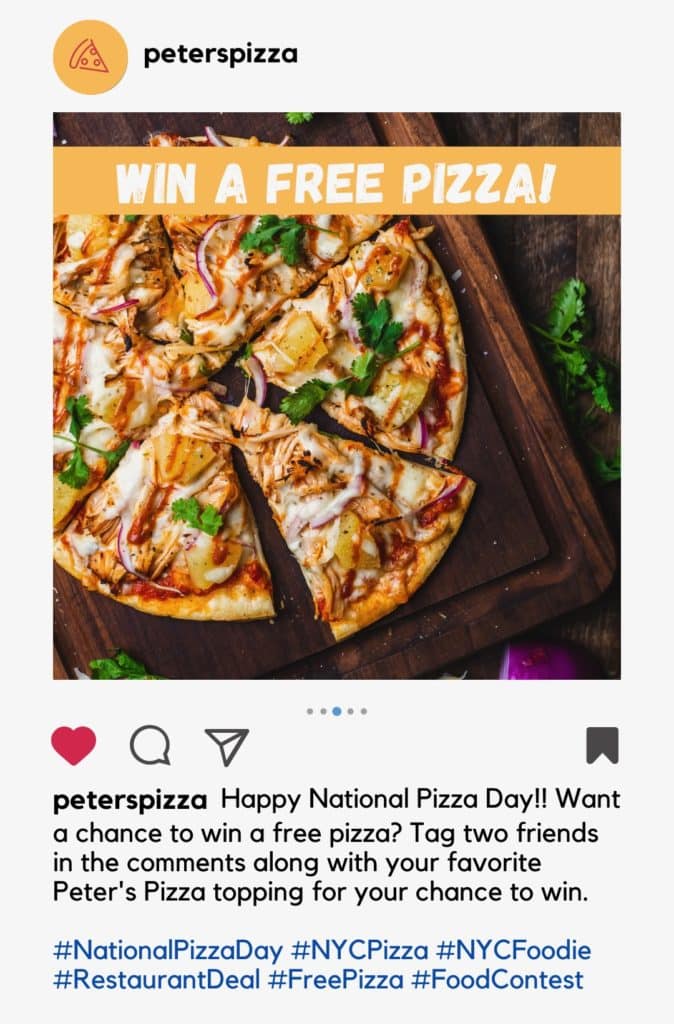
1. Run a social media contest
People love to win stuff. Even if they don’t come out on top, studies show that consumers are more likely to engage with a post if that post is promoting some kind of contest. Contests convert at a rate of 3.7% higher than posts with other non-costed CTAs.
Instagram contests are similarly popular, with contest-related posts getting more than triple the likes and 64 times more comments than other types of posts. That’s a major engagement.
Big Idea: Take advantage by running contests that encourage interaction, such as asking food trivia questions and counting each commented answer as an entry, requiring users to like and share your post to win, or asking followers to tag a friend in your post as part of their entry .
2. Use trending hashtags
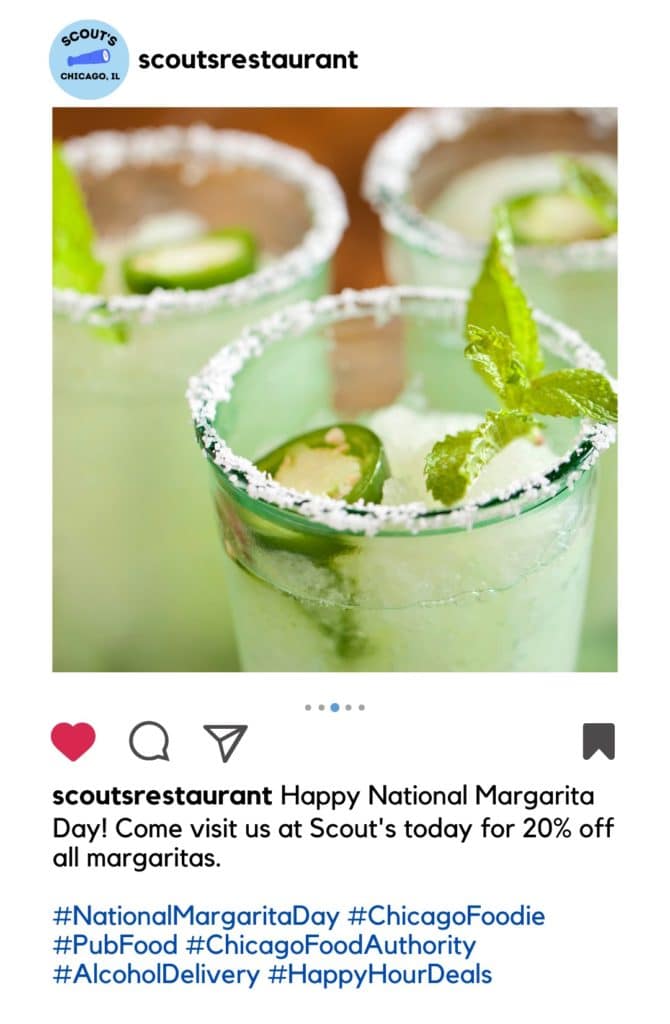
Because national food holidays are a coast-to-coast affair, there are often trending hashtags you can use to ride the wave of popularity and get your restaurant into the national spotlight. Hashtags allow your posts to enter different categories online, bringing your restaurant into people’s social media feeds.
Big Idea: Along with using the obvious national food day hashtags like #NationalMargaritaDay, make sure to also incorporate your restaurant’s city-specific hashtags like #EatAustin, #ChicagoFoodAuthority of #NYCEats. Using these will allow you to tap into the already-there audience you’re looking for.
3. Promote your online ordering site
Most promotions work best when you remove any possible hurdles that stand between your customer and the order button. In the world of online ordering, that means making it as easy as possible for diners to find your menu, put their food on their virtual card, and pay up.
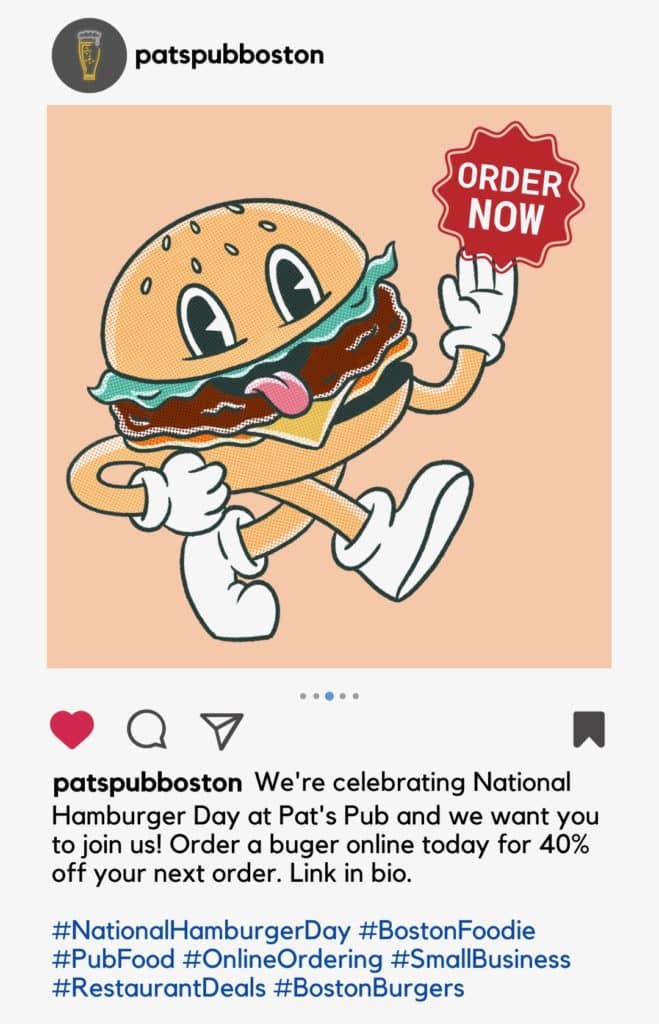
When you share your promotional posts on social media, offering customers the ability to order directly from you can help you drive more sales through your national food holiday campaigns.
Don’t have the ability to take online orders? Grubhub can help! Direct is a commission-free platform designed to help you reach loyal diners and build your online brand. With Direct, you can drive customers to your very own online ordering website, customized just for your restaurant. Read all about how Brooklyn-based Broccolini did just this and more.
Big Idea: Include links to your online ordering site on your social media pages so that you can convert curious scrollers into customers. Make sure you highlight your online ordering site in your captions so that it’s clear how diners can place an order.
4. Highlight your dishes
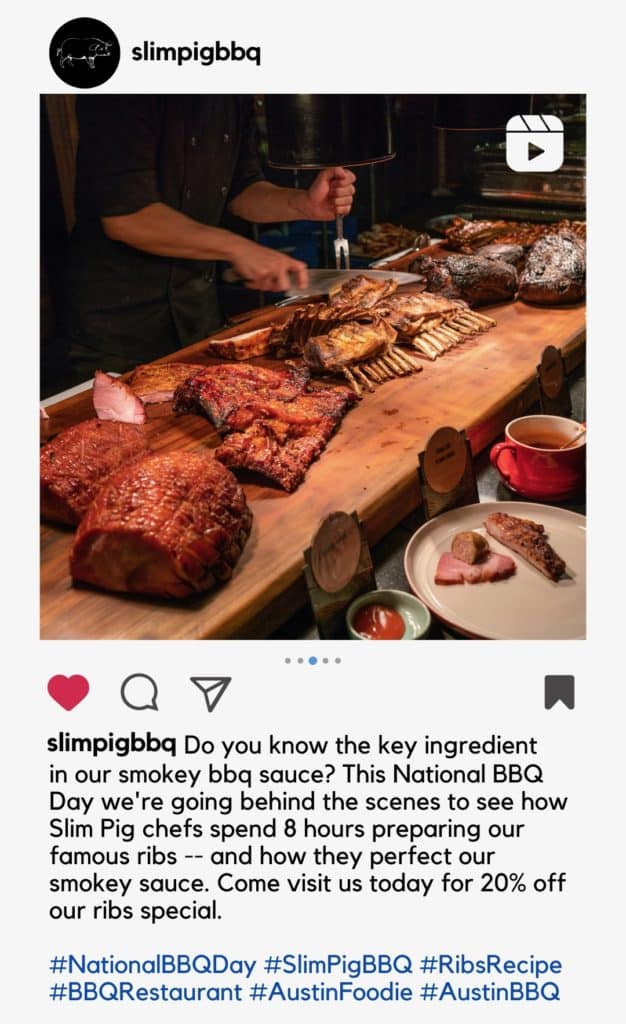
Your food is your pride and joy and what keeps customers coming back for seconds. Making your cuisine the prime feature of your social media profile not only shows off your specialty, but also gets diners’ mouths watering. Nothing gets a diner more motivated to place an order than a juicy photo of a rack of ribs on National Barbecue Day (May 16).
Taking and presenting high quality photos of your food is essential to creating an effective social media presence. When you partner with Grubhub, you can schedule a free photoshoot for your restaurant.
Partnering with micro influencers can help your restaurant gain more exposure. Encourage those who visit your restaurant to post photos of their food online. Delectable food pics can stand out in people’s feeds.
Big ideas: Make sure to feature high quality photos of the dishes you are preparing for national food holidays. You can even give a behind the scenes look into your chef’s meal preparation. Post these photos onto your restaurant’s social media to appeal to diners’ taste buds.
Start your restaurant’s celebration today
The best thing you can do when using national food holidays to promote your restaurant is to create a solid plan. That way, you’re ready and prepared to give your diners the best reason to indulge in your delicious food – daily!
Lucky for you, we’ve already done step one for you. We’ve compiled all the national food holidays in one place and created a complete calendar listing and it’s available to you for FREE to download now.
Use your new calendar to create a new marketing plan or amplify your existing one, and national food holidays could be your next step toward increasing sales and a wealth of new customers.
Already eager to get ready for your next national food holiday promotion? Sign up with Grubhub for Restaurant to access powerful promotion and loyalty tools today!