
What you need to know about tip pooling
Tips are an integral part of the restaurant industry. They motivate employees to provide exceptional service, creating an experience that brings customers back time and again. For employers in many states, tips can also make up the difference between the server minimum wage and the federal minimum wage. If you’re looking for ways to distribute tips more fairly among employees, tip pooling is one option.
What are the tips for pooling?
Tip pooling is a practice where restaurant employees put all or part of their tips into a communal pool. The employer divides the total funds among eligible workers, either equally or using a predetermined ratio. This method is an alternative to tip sharing, where servers and bartenders voluntarily hand over part of their tips to other employees who help with service but don’t receive tips.
As you might guess, tip pooling can be a polarizing tipping method. It’s usually beneficial for employees such as bussers and expediters, but servers who tend to receive higher tips may find the practice unfair. And if certain employees work harder than others, either in perception or reality, tip pooling can create conflict among the staff.
For some employers, tip pools are the most sensible option. Take coffee shops, for example — multiple people are involved in taking orders and making drinks, but customers only tip once. By pooling tips, everyone receives their fair share. The same goes for any counter-serve restaurant where cashiers and kitchen employees work together to prepare orders.
Tip pooling is less common in traditional table service restaurants, but that’s not out of the question. As an employer, you might use this method to promote a collaborative rather than competitive atmosphere. If you’re currently using a tip credit system to satisfy minimum-wage requirements, you can still use a tip pooling system as long as you stay compliant with any applicable laws.
How are pooled tips calculated?
The way you calculate pooled tips depends on local, state and federal laws. All restaurants are subject to the Fair Labor Standards Act (FLSA), which allows employers to mandate a tip pooling arrangement for staff members. If you take a tip credit, the FLSA only permits your tip pool to include employees who traditionally receive tips. When you pay a minimum wage for all employees, you can also include non-tipped workers such as chefs or dishwashers. According to employment law, employers, managers and supervisors may not accept money from a tip pool.
The tip pooling method and timeline you choose also affects the calculation. If you pool tips for each shift and distribute them evenly, the process is simple. Add together all the tips at the end of the shift and divide them by the number of employees working. If the tips total $1,000 and you have 10 employees, each person will receive $100.
When you choose a percentage or points-based system, the process is slightly more complex. Imagine you have two servers that receive 40% each, a host that receives 15% and a busser who gets 5%. For a shift with $1,000 in tips, each server would get $400, the host would receive $150, and the busser would get $50.
Federal tip pooling law requires you to distribute the tip pool by payday at the latest. For card tips, you’re permitted to deduct the credit card company’s transaction fee percentage — unless doing so pushes the employee’s compensation below the minimum wage.
At tax time, your employees must report 100% of the tips they receive. The IRS also monitors employee tips as a percentage of your restaurant’s income. If tips make up less than 8% of your gross receipts, you must make up the difference and split it among tipped employees.
Tip pooling methods to try
Tip sharing is rarely a one-size-fits-all solution; as an employer, you can customize the process to fit your operations and employee preferences. Keep in mind that tip sharing doesn’t require you to pool 100% of tips. If servers and other tipped employees are good at the prospect, consider creating tip pools from 20% to 50% of the total gratuities.
Common tip-splitting methods include:
- Even distribution. The tip pool is split evenly between all employees. This method is useful for bakeries, fast food outlets, coffee shops and counter-serve restaurants where employees work together to prepare orders, serve meals and clean up after customers.
- Percentage-based. Employees receive a percentage of the tip pool based on their contribution to service. Because servers handle the bulk of the customer-facing duties, they typically get a majority of tips. Bussers, hosts and bartenders usually receive smaller percentages.
- Points. This tip-pooling method is similar to the percentage system, except employees receive a certain number of points depending on their role. Add up the points for everyone who’s working, then divide the total tips by the number of points to get a per-point dollar value. The point value changes every shift, helping to account for variations in staffing and order volume.
After you choose a tip-pooling method, you must decide whether to calculate tips at the end of each shift or at the end of the day. Shift-based distribution requires more accounting work on the employer’s side, but it offers fair compensation for employees who work the busiest shifts. You might choose a workday distribution method — where employees receive tips based on the number of hours they work — if you’re open for a limited number of hours or if your orders tend to be stable across shifts.
The pros and cons of pooling tips
Not sure if tip pooling is right for your restaurant? The pros and cons can help you make a decision.
Pros of pooling tips
- All service employees receive tips from the tip pool.
- Employees aren’t penalized when they’re assigned to a low-tipping table.
- Tip pools can encourage teamwork.
Cons of pooling tips
- Tip pooling laws can complicate your tip credit system.
- Employees are compensated equally even if they put in less work.
- It can create conflict between average and high-performing workers.
- Pooling tips adds complexity to employer accounting procedures.
When in doubt, ask your restaurant employees how they feel about pooled tips. Experienced, highly skilled workers may be strongly opposed; if they’re forced to pool tips with new or lower-performing workers, they’ll almost certainly make less money. When employees rotate positions in a counter-serve restaurant, however, the system can benefit the entire team.
Keep employees happy while growing your business
If your employees are happy with it, a tip pool can boost morale across the entire team. But employee appreciation shouldn’t stop there. Taking time to show your employees you appreciate their work will help foster a healthy work environment. Keeping employee practices consistent and fair will help minimize turnover.
Don’t forget to include your delivery tips, too. With Grubhub, you can opt to self-deliver orders within your preferred radius to ensure all tips remain with in-house staff. To learn more or try the system for free, get started with a Grubhub account.
How To Prevent Cross Contamination at Your Restaurant
When you’re running a restaurant, food safety is a top priority. Proper food handling and storage, combined with strict cleaning procedures, can prevent cross-contamination and reduce the risk of food-borne illnesses.
What is cross contamination?
Food cross contamination occurs when unsafe bacteria are transferred from one type of food to another. If someone eats cross-contaminated food that’s not properly cooked, it can cause food poisoning and other health conditions. Typically, contamination occurs as a result of incorrect food-handling procedures — chopping raw chicken and vegetables on the same cutting board without cleaning it, for example.
Certain foods present a high risk for cross contamination. Usually, these ingredients come from animals: eggs, raw meat, raw seafood, raw shellfish and unpasteurized milk are the common culprits.
As you’re improving food safety in your restaurant, it’s important to be aware of the primary types of cross contamination: food-to-food, people-to-food, and object-to-food. In this context, an object can be any piece of equipment in your kitchen, including knives, utensils, cutting boards, counters or even refrigerator shelves.
Situations that can cause cross contamination include:
- Failing to wash your hands after handling risky food
- Failing to wash utensils, equipment, and surfaces
- Undercooking foods with harmful bacteria
- Storing food improperly
- Preparing or storing bacteria-laden food too close to other foods
- Unsafe food-preservation methods
The importance of a safe kitchen
Cross contamination is a critical public health concern for restaurants and commercial kitchens, particularly when you’re handling raw food. By running a safe kitchen, you can help prevent health issues that can arise from foodborne bacteria. Examples include:
- Raw meat. Raw meat can contain harmful bacteria, including E. coli, salmonella, C. perfringens and yersinia. These substances often cause diarrhea, vomiting and stomach cramps, but they can also lead to more serious infections that require hospitalization.
- Raw eggs. Like raw meat, eggs can cross contaminate foods with salmonella, which can cause mild to severe food poisoning.
- Raw seafood. Fish and shell fish can contain bacteria, mercury and other toxins that can affect the entire body.
- Unpasteurized milk. This type of raw milk is sometimes used to make yogurt, soft cheeses and ice cream, but it can contain E. coli, listeria, campylobacter and salmonella. Listeria, in particular, is dangerous for pregnant women; the bacteria can have a traumatic effect on the pregnancy.
- produce. While fruits and vegetables don’t naturally contain harmful bacteria, they can pick it up on the journey from the farm to your restaurant. Leafy greens, for example, are a common carrier of E. coli, which can cause serious infections and kidney failure.
Bacteria aren’t the only substances that can be transferred during cross contamination — allergens can also be a problem. People with serious food allergies must often avoid dishes and ingredients that have been in contact with specific allergens; nuts, dairy and gluten are common triggers. The only safe way to serve a customer with a significant allergy is to prepare their food using separate utensils, equipment, dishes, pots, cleaning implements and ingredients.
Gluten-free food is a particular concern for restaurants because, unlike most bacteria, gluten is a protein that survives the heating and sanitizing processes. Careful handling is a must. For example, gluten-free toast should not be made in a toaster that is also used for regular bread. Even trace amounts in cooked food can cause a severe allergic reaction.
Tips for preventing cross contamination
To prevent cross contamination, your restaurant should develop a set of food safety best practices that support public health. Every employee who interacts with food should follow a few key procedures:
- Wash hands thoroughly with soap before and after working with food.
- Wash hands after touching garbage, bathroom equipment or handles.
- Use separate cutting boards, dishes and utensils for raw meat.
- Maintain safe temperatures while thawing frozen meat.
- Use pasteurized milk instead of raw milk.
- Avoid tasting foods with raw eggs.
- Wash vegetables thoroughly.
- Make sure cooked meats reach a safe internal temperature.
- Use gloves as necessary when handling raw food.
- Don’t undercook eggs and foods that contain eggs.
- Throw away raw meat packaging immediately to contain juices.
- Don’t leave cooked food out at room temperature for more than 2 hours.
- Avoid working in the kitchen when sick.
Safe storage is another important step. Any time you’re storing raw food that’s prone to harmful bacteria, make sure it’s packaged to prevent leaks, and keep it away from other foods to prevent contact. Inhibit bacteria growth by keeping your refrigerator at 40 degrees Fahrenheit or cooler. If you’re reusing cooked, refrigerated ingredients, make sure to use them within 3 or 4 days; after that, the risk for food poisoning increases.
Restaurant kitchens require frequent cleaning — your goal is to remove or kill any bacteria lingering on surfaces or objects. Keep in mind that bacteria can spread easily, so it’s important to clean everything as soon as possible after it comes into contact with bacteria-carrying ingredients. Basic cleaning tips include:
- Wash dishes with hot, soapy water, using a dishwasher whenever possible.
- When drying dishes manually, use a clean towel.
- Disinfect countertops and other surfaces.
- Wash kitchen towels and linens on the hottest available cycle.
The bottom line on cross contamination
Cross contamination is a possibility in every restaurant, whether you sell sandwiches or multicourse meals. To update your operations, analyze your kitchen and front-of-house practices and identify opportunities for improvement. Focus on the touchpoints with a high risk of bacterial spread: raw food preparation, storage and cleaning. Even small adjustments to practices — installing hand-washing stations, for example, or keeping gluten-free food separate — can reduce the presence of harmful bacteria. Work with chefs and kitchen managers to implement new practices, and make sure to train every staff member thoroughly.
Stringent food safety procedures can reduce the risk your restaurant faces, both in the eyes of the public and with government officials. When every staff member adheres to safe practices at all times, it prevents food poisoning incidents. This is critical to maintaining a positive reputation — a single outbreak can be enough to turn off diners and affect your revenue. Consistent safety practices are also the best way to prepare for inspections; that way, you won’t need to worry about health code violations for cross contamination, storage methods, and food temperature.
Improving food safety at your restaurant
When it comes to cross contamination, a proactive approach works best. By adjusting your food-safety practices today, you can preserve the integrity of each ingredient and keep customers safe. At Grubhub, food safety is a top priority. As chefs, we know you’re ensuring your food quality is top notch. Our drivers are committed to keeping your food safe en route to its destination. Looking for a partner to seamlessly get your dishes to hungry customers? Partner with Grubhub today.
Improving Online Ordering With Images
Looking for a sure-fire way to win the attention of Grubhub customers and improve their online ordering experience? Try adding a few images to your restaurant’s menu through the Grubhub for Restaurants platform. Including photos can increase sales of menu items by up to 30 percent – and it’s easy to see why.
From improving order accuracy to giving customers a better idea of what to expect, images can help deliver an online ordering experience that customers are hungry for.
Why great restaurant photography improves diners’ online ordering experience
Integrating images into your restaurant’s online presence greatly improves customer satisfaction.
Take a look at the three pain points that strong restaurant photography has helped resolve:
Greater menu familiarity
While new and exotic dishes are guaranteed to spark curiosity, they likely won’t be a top choice among customers who don’t know what’s in them. Eating is a full sensory experience, and photos can help give diners visual cues that can get their mouths watering. Clear up any confusion about dishes on your restaurant’s menu by including images wherever possible.
Quicker online ordering
Use images to show, not just tell, customers about your restaurant’s offering. Supplementing menu descriptions with appetizing images that can capture the hearts – and stomachs – of customers in just seconds will reduce the time it takes them to place an online order. The faster a customer adds meals to their cart, the less chance that they will change their minds and not place an order.
Higher order accuracy
In addition to providing customers a snapshot of what a dish might look like once it finally arrives, images also give back-of-house staff members a visual guide for putting orders together. By taking a few seconds to compare the image on your restaurant’s menu with the finished product, your staff can ensure no detail – big or small – is overlooked.
Where to feature your restaurant photos
There are many places where your restaurant’s brand will pop up online, and it’s important that strong photos are included in your digital presence. Brush up on our restaurant photography tips if you want to learn more about how to snap professional-grade photos. Take a look at where you can add photos to get more traction online:
Feature your dishes on your restaurant’s menu
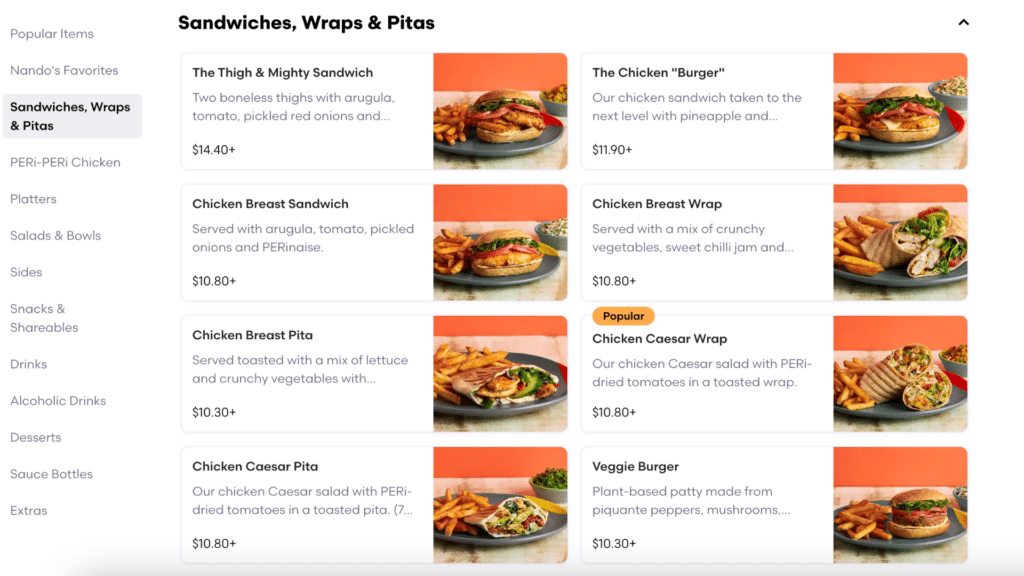
Your restaurant’s online menu is the most important place to feature images of your food. When diners are scrolling through a list of dishes, a jumble of dish descriptions makes it hard for them to navigate your restaurant’s offerings. Restaurants that have already made the switch from fully text menus to photos on their online ordering platforms have seen their conversion rates increase by about 25% on average.
Your menu photos should showcase your food – capturing each dish at its prime. Close up photos of your dishes help capture your creation’s details, giving diners a look into what ingredients are cooked in. Plating is especially important when it comes to menu photos. Take your time arranging each dish and make sure the plate and background are clean. You want your diners’ focus to go straight toward the food.
Nando’s Peri-Peri has perfected their menu photos on Grubhub Marketplace. Highlighting their main dishes along with recommended side pairings helps diners envision what their order will look like.
When you partner with Grubhub, your restaurant can schedule a free photoshoot so you can get professional photos of your cuisine to feature in your digital presence. Already a Grubhub Marketplace partner? Schedule your free photoshoot today or reach out to your Account Advisor to learn more.
Highlight your offerings on your restaurant’s website
90% of customers research a restaurant online before visiting – that’s more than any other type of business. Your website serves as a virtual home base for your restaurant’s brand. It’s often the first place you can make a memorable impression on customers, so featuring irresistible images of your cuisine can motivate diners to place an order.
Your restaurant’s brand begins to form online as soon as a customer search for your cuisine. When a customer searches for your restaurant on Google, your restaurant’s Google Business profile will appear. This profile features basic information about your restaurant including its address, hours, website and ordering platform. Make sure you update your Google Business profile so that customers can easily find out more info about your restaurant.
What types of images should you include on your restaurant’s website? Photos of your food are great to place on your homepage and menu. Crisp images of your cuisine on top of white plates that will showcase the natural colors of your ingredients stand out. Since natural light can help do the same, consider conducting each of your photoshoots near windows. Take a look around your restaurant and snap some photos of your staff in action. It’s also important to include photos of your ambiance so that diners can get a feel of your overall dining experience.
Be selective about what photos you choose to feature. Too many photos can bog down a website’s load time and make it more difficult to navigate. Check out more tips on how to design a successful restaurant website.
A strong restaurant website won’t do much for your bottom line unless you have a clear avenue for diners to place an order. Elements of how to create a seamless online ordering system? Look no further than Direct.
Direct is a commission-free online ordering platform that allows customers to place orders right from your website. Direct makes menu management simple. When you update menu items or add photos on your Marketplace menu, your Direct menu will automatically update to reflect changes. You can bring your restaurant’s brand to life with Direct by easily customizing your site to match your brick and mortar location.
Check out how Naan N Curry used their Direct site to feature their food photography:
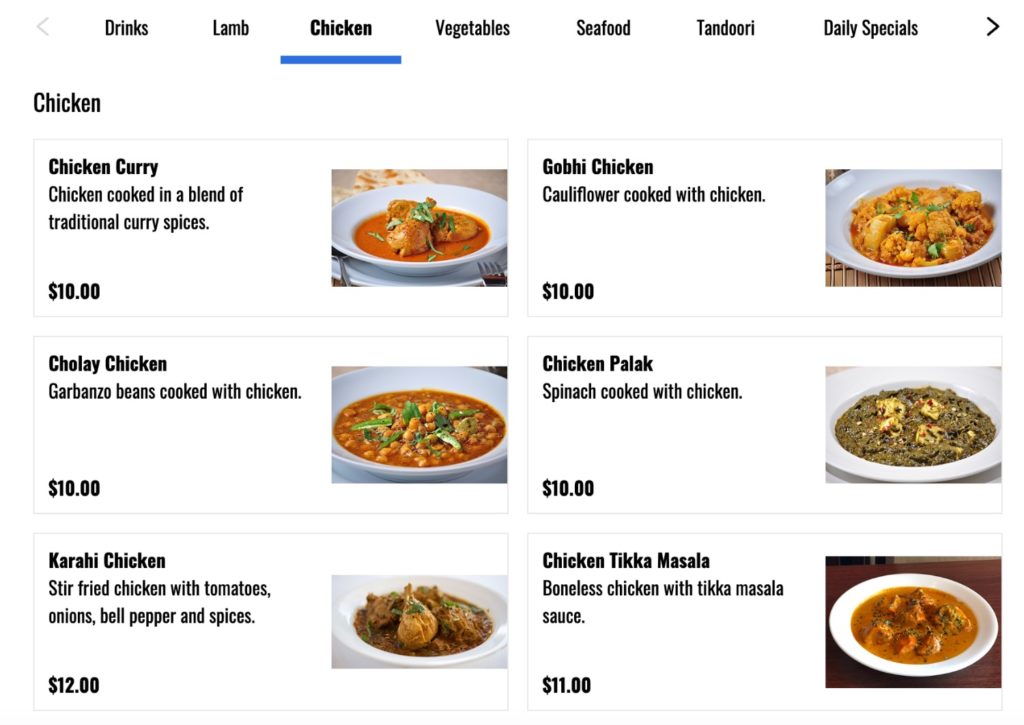
Connect with your diners on social media
Social media is a gold mine for foodies these days. Social media offers the perfect format to tell your restaurant’s story through images – putting your mouth watering food photography center stage. Creating a social media profile for your restaurant can get your food into the digital conversation, and strong food photography can help bring your account to the top.
When it comes to social media, strong photography is key. There’s no one size fits all for social media composition, and cookie cutter posts can blend into customers’ feeds. Mix up the recipe by trying out one of these formats:
- Food features are high resolution, close up images of your dishes. These posts are great for featuring a specific menu item.
- Food films are videos that feature your dishes. Videos tend to perform better on social media apps like Instagram and TikTok, so taking advantage of this feature to show your food in action can draw extra attention from diners.
- Interactive stories is the best way to directly prompt an action from a customer. On apps like Instagram and Facebook, you can post images to your story that will appear at the top of diners’ feeds. With this feature you can directly link to your online ordering website, ask interactive questions or run a contest.
- Behind the scenes photos and videos help your restaurant come to life. You can make a short video showing how your chef whips up a recipe or use a photo slideshow to showcase what your employees like to order.
- Reposts of your followers’ photos of your food can not only connect you with your customers, but also give you more unique content to work with, turning your diners into your PR team. Make sure you get permission from the original creator before you repost any content. You can also collaborate with local micro influencers to expand your reach.
Hashtags are key when it comes to getting your account more exposure. #Foodie has over 200 million posts on Instagram, and #LocalRestaurant has racked up over 300,0000 posts. You can also get in on the local conversation by using hashtags like #AustinFoodie or #NYCeats. Adding trending hashtags to your post allows them to enter different categories online, bringing your restaurant into people’s social media feeds.
Make your restaurant picture perfect with Grubhub by your side
Embellishing your restaurant’s online presence with eye-catching photography can greatly improve your digital brand. Adding them to your website, online menu and social media accounts get customers’ mouths watering, prompting them to place an order.
A picture is worth a thousand words, and a picture of your delectable food is worth the delivery fee for Grubhub’s over 30 million customers. That’s why Grubhub offers a free photoshoot for restaurant partners. Ready to get your mouth watering food in front of hungry diners? Partner with Grubhub today to start taking more orders now.

The 9 most popular restaurant delivery days
Marketing for restaurant delivery is a tricky mix of strategy and timing. Throw in a need for creativity (who’s going to come up with weekly topics and track what’s relevant) and it can be tough for restaurant owners and operators to find time in their busy schedules to find ways to promote their eatery.
But the fact is, marketing remains one of the most important tasks on your to-do list because it’s the easiest way to keep your diners engaged and your restaurant top of mind.
For example, pairing promotions with a boosted social media presence can help generate business and put guests in seats. Or, as this case may be in modern times, directing them towards your online ordering platform so they can score some delivery.
Restaurant delivery is on the rise. More than 18 million orders were placed on Grubhub in 2022, and online ordering is growing 300% faster than in-house dining. By 2024, online food delivery services are projected to become a $32 billion industry. It pays to master your digital ordering strategy now.
Capitalizing on consumer trends can help drive diners to your restaurant.
National holidays with the most orders
It’s all about national holidays – and we don’t just mean Christmas and Fourth of July. National food holidays and unofficial top restaurant delivery days like mega sporting events and primetime for restaurants looking to amplify off-premise orders.
Take a look at the national holidays that bring the most orders to restaurants and learn how you can promote them to capture more hungry diners.
1. New Year’s Day
Nothing lulls regrets from the previous year more than a good hearty meal, according to Grubhub diners. Over 660,000 orders were placed on Grubhub on New Year’s Day in 2022. It can pay to double down on delivery in the new year as many customers don’t want to leave their house on the day off to get a meal. And having a delivery partner like Grubhub can help take the stress of coordinating deliveries off your plate.
The holiday season is a great time to roll out a seasonal menu that incorporates festive favorites. Perfecting a seasonal menu can help make your restaurant stand out as customers tend to appreciate flavors that correspond to the time of year. Consider creating a New Year’s Day brunch menu that can cure any hangover – incorporating comforting favorites like french toast, pancakes, fresh fruit and home fries.
2. Mother’s Day
For decades, Mother’s Day has been the most popular day for people to dine out. The holiday gives a perfect excuse to ditch the home cooking and take mom out for a nice meal. However, in recent years families don’t need to leave their house in order to get a five-star meal for the guest of honor.
Over 616,000 diners decided to get a restaurant meal for mom in 2022. Families are eager to celebrate the ladies in their lives with delicious food that nobody in the house has to cook themselves.
Read our Mother’s Day guide to see the plethora of ways to play into that excitement, including Mother’s Day restaurant specials and promo ideas like tucking kid-friendly extras such as stickers and coloring sheets into delivery bags. Don’t forget to use social media and your email list to let people know what you’ve got planned for the holiday.
3. Martin Luther King Jr. day
Martin Luther King Jr. Day falls on the third Monday of January. This federal holiday honors Dr. King’s legacy of social justice and equity. MLK Day is also a National Day of Service that encourages Americans to volunteer to improve their communities in honor of Dr. King.
While this holiday brings thousands of orders to restaurants, it’s also a time for restaurants to show they care for their communities. Restaurants can take part in the MLK Day of Service by giving back. Patrons tend to support businesses that align with their values, and this National Day of Service is a great opportunity to show what your restaurant stands for.
Consider hosting a food drive by highlighting that your restaurant is a place where people can drop off their food items. Take lead by donating restaurant meals to local food banks. There are many creative ways to give back to your community, and taking initiatives on this National Day of Service can make your restaurant stand out.
4. Presidents Day
Every third Monday in February Americans celebrate Presidents Day to honor those who have served as president in our 246-year history. Whether diners get the day off or not, many spend the day ordering from their favorite restaurants. In fact, over 550,000 customers placed orders on Grubhub last Presidents Day.
Looking for a unique promotion to run on Presidents Day? Try giving a percentage off different president’s favorite foods on your menu. Did you know John Adams started his mornings with hard cider? Or that Thomas Jefferson’s favorite food was mac and cheese? While you may not serve James Garfield’s favorite squirrel stew dish, you can highlight the dishes you do have that past presidents have enjoyed.
5. Labor Day
Labor Day is when we all say goodbye to summer and start looking forward to the crisp breath of fall. Many people are taking a minute to indulge in a last-minute burst of warm weather by barbecuing poolside or taking a picnic to the park or the beach.
Tailor your Labor Day promotions to what customers are already feeling. A farewell to summer celebration allows for tons of great prompt ideas on social media. Imagine brightly colored graphics, snapshots from the restaurant’s summer events, and a few strategic mentions of your Labor Day delivery deals like offering 15% off with a themed code like BYESUMMER.
Make the most of the biggest restaurant delivery days with Grubhub
Partnering with Grubhub gives restaurant owners and operators just like you access to a wide array of tools and educational resources designed to help you maximize engagement, traction and profits.
Grubhub’s promotion and loyalty tools guide you through the process of targeting your ideal customer, using smart marketing and plug-and-play promotions that have seen other Grubhub partners generate an average of 72% more new customers.
With Grubhub Marketplace, your restaurant gets in front of local diners who otherwise may have never heard of your food or who may have forgotten how delicious your menu truly is. Seasonal promotions are an excuse to remind everyone that you’re there, you have something incredible to offer and that they can sample it again at a discount.
What’s the best food delivery service for your restaurant?
Curious which food delivery service is the best? With so many food delivery apps on the market, there are endless potential partners for you to consider. But not all restaurant delivery services offer the same access to potential diners or the same tools to help you scale your business and achieve your goals.
Using the best food delivery service available can help you tap into promotional opportunities such as major holidays.
Here are a few things to consider as you decide which food delivery platform is right for you.
Brand name and customer reach in your area
It’s no use joining a third-party delivery service if it won’t get you in front of the diners that truly matter. With nearly 163 million Americans eating out each week – 64% of the country’s adults – it’s crucial to reach as many potential guests as possible.
Grubhub Marketplace is the largest marketplace of its kind, connecting restaurants with more than 33 million diners eager to find the source of their next delivery order. In fact, 9 out of 10 independent restaurant operators surveyed who use Grubhub agree Grubhub increases the volume of takeout and delivery orders – higher than the competitor average.
To gauge how Grubhub is doing in your area, visit Marketplace and check out nearby restaurants already using Grubhub to see their success for yourself.
Restaurant fees and profit margins
You’re joining a third-party food delivery service to help bolster your profits, don’t hurt them. Some delivery partners are primarily interested in their own bottom line, but Grubhub is invested in joint success, empowering restaurants so we can all share in a more bountiful future.
Grubhub Marketplace offers restaurants three different levels of membership, ranging from Basic to Premium. You control what you pay and which marketing tools you access so you can tailor your investment to the needs of your restaurant.
In addition to reaching your share of those 33+ million diners on Grubhub, you also get a dedicated Account Advisor and access to delivery services so you’re not navigating success on your own.
Your customers, your data
It’s hard to take your online delivery and takeout services up a notch unless you have access to key data points used in strategic decision making.
Direct not only helps you launch your own online ordering site, it also helps generate diner data you can use to fuel your marketing efforts. And it’s all free, with no commissions ever. Just promote your unique food service delivery link and watch as the customer and data roll in.
Delivery boundaries
One way to save on delivery fees is to use your own in-house team. Although this approach won’t work for everyone, restaurants that do have the bandwidth to oversee self-delivery can add that to other delivery service options including Grubhub delivery, supplemental delivery and pickup.
Grubhub delivery is a proven system, too. Nearly 9 out of 10 independent restaurant owners who use Grubhub agree that Grubhub streamlines takeout and delivery order processing, and 77% of consumers surveyed who use Grubhub highly rate Grubhub’s delivery speed.
Make the most of major delivery days with Grubhub
Top restaurant delivery days hold a major promise for restaurants looking for ways to broaden their customer base and increase revenue, but sometimes it takes a strong partner to make those goals a reality.
Partnering with a third-party delivery app gives you access to tools, knowledge and a built-in audience. At Grubhub, that means joining a platform that’s already a proven success. Now it’s your turn.
To experience the power of Grubhub firsthand, sign up today and get ready for your next round of holiday delivery promotions.
19 March food holidays for your restaurant to celebrate
Did you know 45% of US customers say they’ve tried a new restaurant after seeing a restaurant’s post on social media? That’s why it’s more important than ever to make sure your restaurant is establishing an effective social media strategy to grab customers’ attention. One great way to make your restaurant stand out online is to celebrate national food holidays on social media.
Take a look at these tips on how you can take advantage of food holidays this month and keep scrolling to get the full March calendar.
What are national food holidays?
National food holidays are micro holidays that center around a certain cuisine. They are often celebrated on social media and encourage diners to band together to show appreciation for everything from Oreos (March 6) to hot chicken (March 30). While these holidays don’t warrant a day off, they can still be fun to observe and celebrate. As a restaurant owner, a food holiday is the perfect excuse to offer an irresistible promotion that will encourage diners to place an order.
Why your restaurant should celebrate national food holidays
Everyone loves having something to celebrate, and restaurants can use food holidays to build excitement around their dishes. Food holidays are particularly popular on social media as diners go online to share what cuisine they’re celebrating. Acknowledging a food holiday on social media by using the holiday’s hashtag can instantly make your restaurant relevant to a wider audience.
Food holidays put specific dishes top of mind. When diners are craving waffles on International Waffle Day (March 25), you want them to turn to your breakfast menu to get their fix. Posting about your food can motivate diners to order from your restaurant. In fact, 53% of millennial TikTok users visited a restaurant after seeing it on the app. Incorporating food holidays in your social media strategy incentivizes hungry diners to check out your cuisine.
3 tips for marketing national food holidays
A successful food holiday marketing strategy begins with a strong digital presence. Modern diners flock online to discover new restaurants and place orders. Digital tactics are important for your restaurant marketing strategy.
To make your national food holiday celebrations as effective as possible, tie them into a larger restaurant marketing strategy that looks at the big picture, not just a single opportunity. A restaurant marketing strategy is a formal plan that documents, tracks and analyzes all your marketing efforts and activities.
1. Pile on promotions
Nothing motivates a diner to press ‘order now’ more than a discount. Rolling out promotions not only attracts more customers to your menu, but also encourages loyalty. Diners are more likely to place repeat orders if they think a restaurant has a good deal. In fact, 81% of consumers would switch restaurants if they saw a good deal. Your food holiday promotions can be the first thing that catches a potential customer’s eye.
Here are some promotion ideas that can get diners drooling for your dishes:
- Discount dollar amounts: On National Sloppy Joe Day (March 18), offer $1 off your sloppy sandwiches.
- Discounted items: Celebrate National Pound Cake Day (March 4) by offering 50% off a slice of pound cake when a customer purchases a coffee.
- Discount-themed ingredients: Celebrate National Oreo Day (March 6) by offering 20% off all Oreo flavored menu items.
- Free items with purchase: On National Banana Cream Pie Day (March 2) spread the sweetness by offering a free slice of banana cream pie with every entree.
When you partner with Grubhub, launching promotions is as easy as pie. Restaurants that partner with Grubhub gain access to free-to-use promotional and marketing tools that are proven to increase orders and customers.
With Grubhub’s Promotions and Loyalty Tools, you can:
- Run seasonal promotions to make the most of national food holidays
- Offer your customer the right discount at the right time
- Increase your ROI with our advanced technology and huge volumes of restaurant and customer data
2. Highlight online ordering
Getting customers excited about a food holiday is great, but unless you give them an easy avenue to place an order, all that momentum around your dishes will be lost.
Your restaurant’s website serves as the backbone of your digital presence. Your website should have all things a diner needs to know about your restaurant – this includes your menu, hours, location, story and an online ordering platform. Finding a platform that converts curious diners into satisfied customers can be difficult. That’s why restaurants are turning to Direct to reach more customers, drive online ordering and establish their advertising efforts with zero commission costs.
88% of restaurant operators stated a branded experience is very important for sales. With Direct, your restaurant can create an online ordering web page that’s designed and branded to match your existing restaurant’s look and feel. It can be easily integrated into your existing website (if you have one) or can act as your main site if need be. Learn more about how Direct can drive online ordering.

Once your website is up and running, you want to make sure it’s searchable. When potential diners search your restaurant on Google, your Business Profile is usually the first thing to pop up. Claim your restaurant’s Google Business Profile so that you can make sure it correctly displays your hours, address, pricing and website link. When your Business Profile features the correct info and links, it’s far more likely a customer will place an order or come in to check you out.
3. Get social
Nobody will know your restaurant is celebrating a national food holiday unless you spread the word. That’s where social media comes in. TikTok, Instagram and Facebook are all powerful places to establish a restaurant social media presence.
Looking for some tips to make your restaurant pop on social media? Try these ideas:
- Showcase your dishes by posting delectable photos and videos of them on national food holidays.
- Use trending hashtags like #NationalOreoDay or #NationalPotatoChipDay to reach a larger audience beyond your social media followers.
- Use local hashtags like #BostonFoodie or #NYCeats to connect with customers nearby.
- create a quiz about your dishes to boost engagement with your national food holiday promotions.
- Launch a contest with prizes that relate to your restaurant and die in with your national food holiday promotion.
It’s easy for restaurant owners’ plates to pile up, leaving little time to strategize about marketing. That’s why developing a social media calendar is essential for planning out how you will roll out your promotions.
A social media calendar is a way to organize your upcoming social media posts and promotions by date. Planning posts in advance gives you time to lay out promotions, batch content and solidify your menu to align with your offerings.
Check out these tips on how to market national food holidays on social media.
What social media holidays are coming next?
March brings the first tastes of spring, Mardi Gras beads and shamrocks. March also brings 19 food holidays for your restaurant to celebrate. Your restaurant can reserve a day this month to celebrate flapjacks (March 7), Ravioli (March 20) or Spanish paella (March 26). No matter what cuisine you’re celebrating, it pays to run a food holiday promotion.
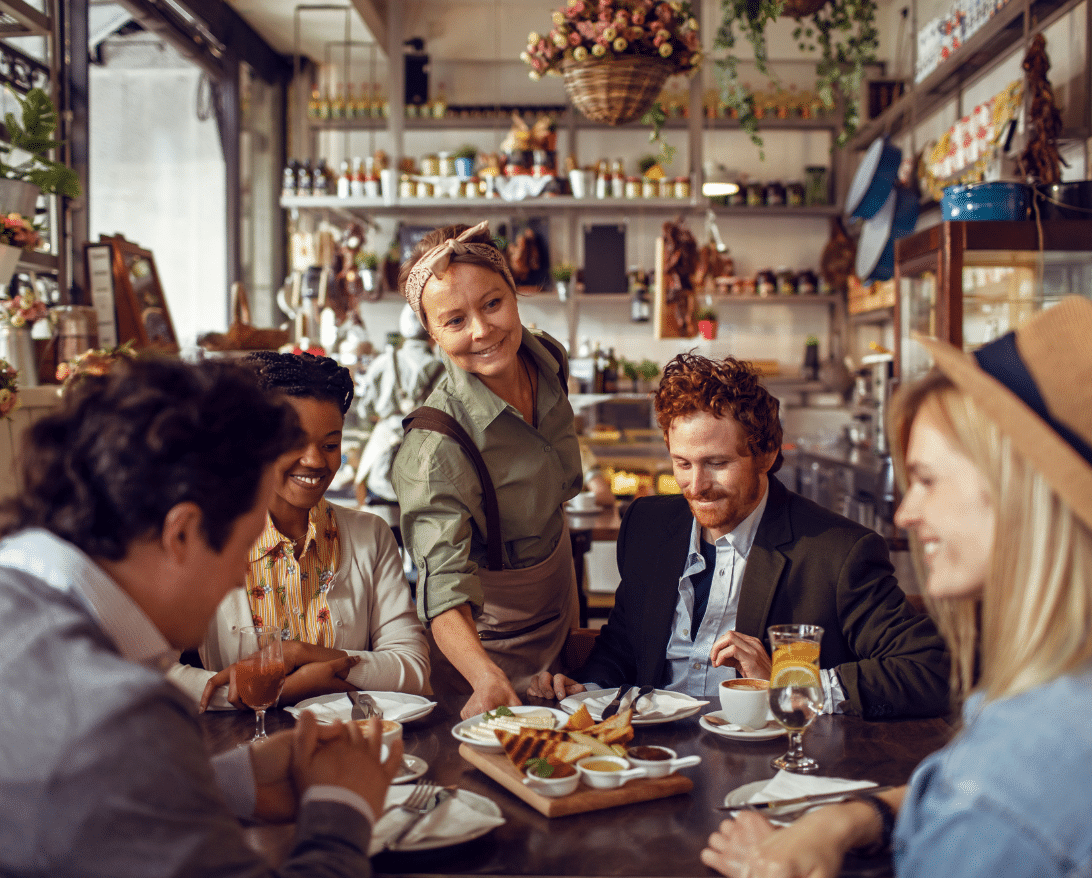
Download our Guide to National Food Holidays to learn how to spearhead your promotional marketing and elevate your digital presence. Use your new calendar to create a marketing plan or amplify your existing one. National food holidays could be your next step toward increased sales and a wealth of new customers.
March national food holidays
March is National Noodle Month and National Sauce Month.
- March 1: Mardi Gras
- March 2: National Banana Cream Pie Day
- March 3: National Cold Cuts Day
- March 4: National Pound Cake Day
- March 6: National Oreo Day
- March 7: National Flapjack Day
- March 9: National Meatball Day
- March 10: National Ranch Dressing Day
- March 13: National Chicken Noodle Soup Day
- March 14: National Potato Chip Day
- March 17: Saint Patrick’s Day
- March 18: National Sloppy Joe Day
- March 19: National Corn Dog Day
- March 20: National Ravioli Day
- March 21: National Crunchy Taco Day
- March 23: National Chip and Dip Day
- March 24: National Cheesesteak Day
- March 25: International Waffle Day
- March 26: National Spanish Paella Day
- March 30: National Hot Chicken Day
How to leverage customer data for your restaurant
Restaurant owners have endless data at their fingertips from a variety of sources — point-of-sale (POS) systems, marketing platforms, inventory trackers and scheduling software, to name a few. But do you know how to use this data to your advantage?
While it might take some time to understand up front, data analytics can help position your business for long-term growth. By learning how to categorize, collect, and use customer information, you can improve your marketing and build stronger customer relationships.
What are the four types of restaurant customer data?
When you start working with customer data for your restaurant, the sheer volume of information can feel overwhelming. It’s helpful to break everything down into categories:
- Identitydata covers basic information about your diners, enabling you to find your key demographics and spot opportunities for audience expansion. It includes things such as a customer’s name, age, birthday, location, ethnicity, gender, phone number and email address. Depending on your restaurant’s goals, your database might also include information about the customer’s family. You can take identity data a step further to add socioeconomic information such as job title, industry and approximate income.
- Engagement data includes details about how, when and how often customers interact with your restaurant. You can collect this information from your POS system or the analytics that are connected to your website, social media platforms or email marketing program. Useful metrics include website traffic, marketing email open rate, behavioral flow, click-through rate and conversions.
- Behavioral data covers the different ways diners engage with your restaurant. It could include order history, average order value, participation in loyalty programs and use of delivery promotions. On a broader scale, this data can also incorporate things such as email newsletter sign-ups and unsubscribes, creating an account on your delivery system and engagement on different types of devices.
- Attitudinal data involves customers’ attitudes toward your restaurant. It helps you track the opinion of your brand across your diners, the public and specific segments of your audience. For restaurants, it might cover the performance of a menu item, customer reactions to a price or feedback about a seasonal dish. This information typically comes from customer surveys, comment cards, online reviews and complaints.
How to capture customer data
Data can help drive everything from marketing to menu design — but first, you have to collect it. There are many ways to capture data; some are automatic, while others require direct input from your customers.
If you’re new to data analysis, it’s often easiest to start with hands-off data-collection solutions. These systems run in the background, gathering information until you’re ready to use it. Popular options include Google Analytics, which gathers website data, and social media analytics to help you track how customers interact with your profiles and posts.
To collect delivery data, try Grubhub Direct, a service that lets you set up a commission-free online ordering website for your business. As soon as your customers start ordering through your Direct site, the system automatically captures details such as order history, average order, purchase frequency and contact information. Since you own the data, you can download it for free, engage with customers directly and build one-on-one relationships.
When your automatic systems are running, try asking your diners for direct feedback — individual reviews tell you exactly what customers think. Request reviews in person, mention it in your marketing emails and make the request via social media. If your restaurant is on the Grubhub platform, customers can leave feedback after every order. With Grubhub Premium, you can even respond to ratings and reviews to build trust and show you’re serious about creating the best experience possible.
You can also encourage reviews by creating a Google Business profile. Customers can upload photos, rate your restaurant and leave comments. The rating is visible when someone comes across your restaurant through a Google or Google Maps search; a high rating can boost engagement and bring in new diners. Make the most of your Business profile by:
The physical activity in your restaurant is another important data source. Capture information by tracking restaurant capacity and orders per hour. Then, use the data to improve operations. When you understand how order volume and dinner numbers fluctuate throughout the day and week, it’s easier to adjust staffing to meet the demand. Efficient scheduling keeps labor costs in check and ensures employees’ workloads are reasonable.
5 tips to take advantage of customer data
Now that you know how to capture customer data, the next step is to use the information to improve your restaurant operations – and ensure customer satisfaction.
1. Create a customer loyalty program
Loyalty programs can help you collect and use customer data. Diners must sign up to participate, so you can record their names, contact information and order history. As you start to create personal records for each customer, use the data to reward and encourage repeat business:
- Track order value and provide a discount coupon after customers spend a certain amount over time.
- Monitor order frequency gaps and use them to trigger an automated “we miss you” email.
- Work with your delivery platform to offer a deal after a certain number of orders.
Check out more strategies for creating a restaurant loyalty program that stands out.
2. Send targeted promotions
Customer data gives you the power to personalize your marketing efforts. If you’re tracking a customer’s orders, for example, it’s easy to identify the items they order frequently. With that information, you can recommend new menu items, create targeted upsell offers or send customized discount coupons for the diner’s favorite meal.
Order times can be helpful, too. If you know a specific customer often comes in for lunch on Friday at noon, you might schedule a marketing email for 10 am to encourage them to choose your restaurant over a competitor.
Data is particularly useful within your delivery system. Use it to suggest items customers might like, offer a special discount for a larger order, or provide a free item with the purchase of another item. Services such as Grubhub Premium make it easy to access both promotion and loyalty tools to increase exposure and maximize the benefit of customer data. For example, if a quesadilla is your most popular item, consider offering a 10% discount to motivate diners to add it to their cart. Learn more about how you can run promotions on Grubhub.
3. Establish contacts
Once you have a customer’s contact information, use it to create and maintain an open line of communication. Put diners’ email addresses into a mailing list, and send out regular newsletters to promote new specials and announce seasonal menus. To prompt people to come in or order delivery, provide exclusive discount codes or special deals. Depending on your target demographic, you can also send coupons in the mail.
Regular contact can boost business returns, but it also keeps your restaurant top of mind. It’s a good way to announce changes that affect customers as well — holiday hours or a new location, for example. When you’re consistent with the frequency and personality of marketing emails, they can help humanize your brand and make diners feel they’re part of a community.
If you need to start collecting email addresses, there are several ways to go about it without seeming pushy. The trick is to find an incentive that’s appealing enough to get guests to hand over their email. Offer a free dessert to people who join your mailing list, invite social media followers to enter a contest, or require an email to sign in to your restaurant’s Wi-Fi.
4. Show appreciation
Tracking individual data helps you understand your customers on a deeper level. In fact, you probably know more about them than their coworkers. Use that data to show your appreciation and build a positive, lasting relationship. Some options include:
- Send a birthday discount code.
- Include a surprise treat for repeat customers.
- Celebrate the sign-up anniversary for loyalty-program members.
- Host an exclusive tasting or thank-you dinner for loyal diners.
No matter how you show thanks, receiving a special discount or bonus can mean a lot to a customer. Take a look at more ways you can show your customers you appreciate their business.
5. Get social
Social media is critical for restaurants — customers use platforms such as Instagram and TikTok to research restaurants and find exciting new dishes. To make sure your posts are getting in front of the right people, analyze customer data to find out where your target customers spend time online.
Different demographics tend to use different platforms. If you want to reach younger people, consider building a presence on TikTok or Instagram. For an older audience, you might want to double down on your Facebook posting strategy. Then, use your profile to build connections:
- Post videos of new dishes or tempting desserts.
- Release food posts when customers are thinking about their next meal.
- Offer discounts for social media followers.
Check out more tips on how to make your social media pop.
Take control of your customer data with Grubhub
At Grubhub, we understand how data can be powerful for restaurants. We’ve looked into customer data and trends to help independent restaurants like you understand your diners. Dive into our Technomic report where we dig into current online ordering trends and tips for independent restaurants. Take a look at Grubhub’s #2022Delivered to get a look into customer’s ordering habits and cuisine preferences.

Customer data is one of the most valuable tools you have to market your restaurant. The right information enables you to personalize marketing, build relationships, and boost loyalty. If you’re ready to streamline your data collection and marketing for delivery customers, try Grubhub today.

How to Incorporate Locally Sourced Food Into Your Menu
More and more diners care about a restaurant’s sustainability practices. According to the 2020 National Restaurant Association Industry Report, 76% of adults said they are more likely to visit a restaurant that offers locally sourced food. If your restaurant doesn’t tap into the locally sourced food movement, you may be missing out on potential customers.
Continue reading to discover ways to integrate locally sourced ingredients into your restaurant’s menu.
What are locally sourced goods?
Locally sourced goods typically refer to food, ingredients or other consumable products that are sourced, purchased or procured within a specific radius distance from where they will be used. This definition varies depending on what people consider local, but to consumers, the label “locally sourced” means that the ingredients are healthier and fresher than other products purchased from farther away.
The push for local food and farm-to-table restaurants has grown in recent years due in part to the desire to support local growers and farmers. Buying from those in your community boosts the economy, creates more jobs and helps support produce growers.
Where can you get locally sourced ingredients?
Buying locally sourced food and ingredients can seem daunting at first, but there are many resources available to help connect you to local farmers and suppliers. Visit your local farmers market to meet farmers or network with farm-to-table restaurants in your area to learn which local suppliers they’ve had success with in the past.
Once you’ve found local farmers and suppliers to work with, focus on establishing a meaningful relationship with them. Small gestures, such as thanking your suppliers and keeping them updated on any changes within your restaurant, can go a long way toward showing suppliers that you value them as a business partner.
The more time you invest in building these relationships, the greater chance you’ll have to receive the ingredients you need. You may even enjoy some unexpected benefits such as the first pick of produce or discounts for your continued loyalty.
Even with close relationships built with farmers, there may still be some difficulties you have to overcome when purchasing locally.
How inflation affects local food prices
When inflation rises, so do food prices. Because it costs more to farm during times of high inflation, farmers must raise their produce prices to balance their return on investment. That means that food inflation may affect whether or not your restaurant can afford to purchase locally.
Even with the topic of food inflation being prevalent, it’s still possible to include locally sourced food in your entrées.
Tips for incorporating locally sourced food into your menu
You don’t have to replace every single item on your menu with locally sourced items or break the bank to include local goods. Here are some ideas for adding ingredients that will boost your local economy:
Start slow and set realistic goals
Sourcing local ingredients can be higher-cost due to working with small suppliers, which means switching your menu overnight to feature these ingredients can be costly. Help ease your restaurant’s transition by setting reachable goals, such as purchasing a small amount of locally sourced ingredients or only buying locally sourced food that is close in cost to your traditional ingredients.
It might also make sense for you to test run incorporating locally sourced ingredients into your menu. Consider featuring a special on your menu or even hosting a weekly local foods night that offers a special entrée made entirely from local ingredients.
Offering locally sourced food for sale as a retail model in your restaurant is also a great way to introduce the concept to your customer base. When indoor dining was shut down in New York during the height of the pandemic, The Council Cafe transformed its storefront restaurant into a local market featuring locally produced bread from Naira Bread in New York.
The Council Cafe’s market supported other local businesses and made locally sourced food accessible to their customer base.
Use locally-sourced food to fuel your seasonal menu items
Sticker shock is often enough to keep many restaurant owners from incorporating locally sourced ingredients into their menus, but it doesn’t have to be costly. By purchasing in-season produce, you can include local ingredients that are both more affordable and of higher quality.
Lighthouse, a farm-to-table restaurant in New York City, has found success in leveraging locally sourced ingredients in its seasonal dishes. The staff even put organic food waste to work by using vegetable and fruit scraps to make compost for their herb garden, which is used to create in-house spice mixes.
While buying locally sourced food can seem expensive at first, being strategic with your menu and using in-season ingredients can help reduce the cost of locally sourced food.
Seek out sustainable seafood from local fishermen
According to the World Wildlife Foundation, fishing is one of the largest contributors to the decrease in ocean wildlife populations. While the actual act of fishing is not terrible for the environment, overfishing — which is when fish are removed from the water faster than the species can replenish — is detrimental to our oceans.
Taking the extra step to seek out sustainable seafood options from local fishmongers is not only the right move for the environment but can also help your restaurant reach new diners. According to the Marine Stewardship Council, 70% of North American shoppers would like to hear more from restaurants about the sustainability of their fish and seafood products.
Fish, a sustainable seafood restaurant based in Sausalito, California, has become a success by creating inventive dishes that feature seasonally caught fish. By purchasing directly from local fishers, Fish can confidently communicate to their customers the exact path the seafood took from the water to their plate.
Attract more customers with a locally sourced menu
Tapping into the local food movement is a great way to grow your customer base and positively impact the environment. You may also be surprised by the health benefits that your customers experience from higher-quality food. According to Virtua Health, fruits and vegetables start to lose their nutrients within 24 hours of being picked, so the fresher your restaurant’s food is, the better it will be for those enjoying it.
Using locally sourced ingredients does not need to be an expensive or time-consuming task for your restaurant. Start by developing relationships with local farmers and fishers, creating seasonal dishes and setting realistic sustainability goals for your restaurant model.
Are you interested in learning more restaurant sustainability tips? Check out 10 restaurant sustainability tips that can help you reduce food waste and improve your restaurant’s profit margins.
Grubhub customers are hungry for restaurants that feature fresh ingredients and sustainable practices. Sign up to become a Grubhub restaurant partner today and be introduced to 33+ million diners who are looking for their next delicious meal.