
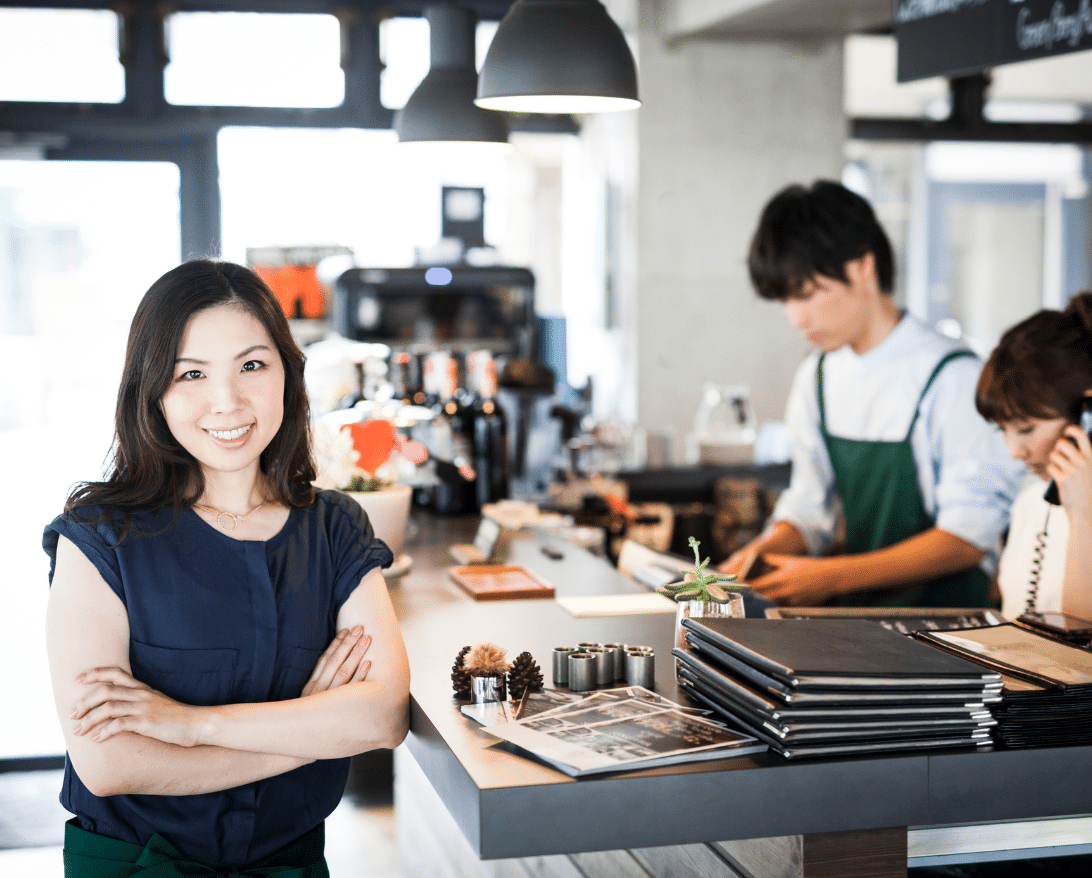
How To Make a Restaurant Schedule
Restaurant scheduling is both an art and a science — it must simultaneously serve the business, satisfy customer demand, and account for employees’ needs. Given the complex factors involved, it’s safe to expect a certain amount of trial and error. Stick with it and you can create a workable restaurant schedule that keeps operations running smoothly and efficiently.
Why is restaurant scheduling important?
Restaurant scheduling creates the framework for your operations. A predictable schedule makes it easier to assign duties, plan deliveries and ensure busy shifts are adequately staffed. It also helps you spread out the workload, ensuring every employee has a chance to work lucrative shifts. That balance is critical, given that hiring is one of the biggest restaurant challenges in 2023; a fair distribution of labor can keep employees happy and boost retention.
The restaurant schedule you choose depends primarily on your business hours. Some common types of schedules are:
- 5-2-2-5. Employees work 12-hour shifts in the pattern of 5 days on, 2 days off, 2 days on, and 5 days off. While the shifts are tiring, this schedule enables employees to work full-time while enjoying long stretches of time off.
- 2-2-3. If your restaurant is open 24 hours a day, this schedule might be the right choice. Employees work 2 days, have 2 days off, and work 3 days. To make it work, you need four separate teams of employees who are willing to work 12-hour shifts.
- 5-4-9. This schedule follows a 2-week pattern and requires a 5-day work week. The first week, an employee works 4 9-hour days and 1 8-hour day. The second week, they work 4 9-hour days and get the fifth day off. You might also see this method called a 9/80 schedule.
- open. With an open-hour schedule, you publish available shifts in advance. Staff members can then sign up to fill the time slots that fit their schedule.
Instead of sticking to a rigid schedule template, many restaurants opt to split longer shifts into two shorter shifts. Instead of one 12-hour shift, you might plan an 8-hour shift and a 4-hour shift, for example. This strategy limits long, stressful work days, which reduces burnout and employee turnover.
How to build a shift schedule
When you’re building a shift schedule for your restaurant, there are a few key components to keep in mind. First, consider whether you’re using a fixed or rotating schedule. In a fixed schedule, employees work the same days and hours each week. With a rotating schedule, employees move through different shifts; that way, everyone has a chance to work busy hours with the biggest potential for tips. It’s also important to determine the shift length and the ratio of work days to days off.
Policies are another key component of employee scheduling. These rules govern the process and help employees understand what to expect. At a minimum, your restaurant should have written policies for:
- Requesting time off
- Claiming shifts (if applicable)
- Swapping shifts or covering for other workers
- Overtime pay and limits
- Back-to-back shifts
- Maximum hours per week
As you’re creating a shift schedule, follow these basic steps:
- Set the shifts. Determine the number of shifts you need and the best length for each one. The shift structure should typically be the same each week — that way, you can simply use a restaurant schedule template to speed up the process — but you might occasionally need to make small changes based on employee availability and special events.
- List duties for each shift. Examine the calendar for the upcoming week to determine what needs to be done during each shift. Include tasks such as kitchen preparation, sidework, training new employees and setting up for special events.
- Estimated diner volume. Examine your reservations log and historical sales data to determine the expected sales volume for each shift. Make sure to check local event calendars; if there’s a festival or conference happening nearby, you may need a larger staff to handle the extra foot traffic.
- Consider employee needs. Check for time-off requests and employee conflicts for the upcoming week to determine who’s available for each shift.
- Assign employees to each shift. Determine how many people you need for each open shift. Schedule more employees for busy periods; keep staffing light for slow periods to save on labor costs and help workers maximize tips. If some of your staff members work on a fixed schedule, this process might simply involve adding extra workers to busy shifts.
Restaurant schedule: tips for happy employees
Fair, consistent staff scheduling is an essential part of a productive restaurant culture. To make sure the process accommodates your employees’ needs, follow these best practices:
- Publish the schedule as early as possible.
- Use scheduling templates for consistency and speed.
- Select a digital format for convenience and accessibility.
- Make sure employees understand scheduling policies.
- Be flexible to account for employees’ life events.
- Ensure shifts are adequately staffed to avoid overwork.
- Consider employees’ skills and preferences when scheduling.
- Use a central communication hub to keep each shift updated.
Keep in mind that it will take time to develop a schedule that works well for your team and business. Restaurant managers should observe employees, watch the time clock and monitor labor data to make sure the process is equitable. For example, a pattern of excessive shift swaps could indicate your current schedule is at odds with employees’ personal commitments. If you notice certain shifts are consistently understaffed, it might be time to recruit new restaurant staff to provide extra coverage and enable a better distribution of labor.
By adapting the restaurant scheduling system to help employees maintain a better work-life balance, you can increase job satisfaction and increase retention. While you work to find the right solution, employee recognition incentives can encourage staff members to be patient and stick with the company.
Useful restaurant schedule software
If you have a sizable workforce and multiple daily shifts, building a restaurant schedule is a time-consuming task. Restaurant scheduling software can speed up the process and free you up to tackle revenue-generating projects. These programs benefit your business by:
- Enabling you to edit the schedule from anywhere
- Forecasting demand using historical labor data
- Generating automatic schedules
- Allowing employees to request changes digitally
- Adjusting automatically to shift swaps and other staff scheduling changes
- Providing customizable notifications for managers and staff
The right software program improves the experience for everyone on your team. Employees can log in at any time to see their schedule, eliminating confusion and allowing for advance planning. Workers can request changes quickly and conveniently, giving you more time to cover open shifts.
A variety of manufacturers offer scheduling software; popular options include Paycor, 7shifts, Jolt and ToastTab. Like Grubhub, many scheduling programs are engineered to integrate with your POS system for a seamless employee experience. Be sure to check compatibility with your delivery and POS programs before you invest; software that works with your existing tech stack helps the process move faster.
Don’t have a delivery platform? Grubhub makes it easy to connect your POS software and restaurant scheduling programs. To try it out, get started today.
How Restaurants Should Be Using Sustainable Food Containers
As younger, environmentally conscious diners become a majority of the food-industry customer base, many restaurants are making sustainability a top priority. To-go containers are a key focus — disposable packaging is a significant contributor to commercial waste. The right sustainable products can help you protect the environment while maintaining food quality.
Why sustainability matters
Increasing restaurant sustainability is one way to reduce your impact on the environment, especially when it comes to takeout containers. According to the EPA, containers and packaging are responsible for more than 23% of all the trash that goes to landfills in the United States. By switching to compostable, reusable, or recyclable to-go container alternatives, you can minimize your ecological footprint.
Your bottom line will also benefit — after all, customers care about sustainability. Millennials and Gen Z diners, in particular, are likely to pay attention to your company’s environmental practices. In fact, 71% of millennials and 75% of Gen Z consumers consider sustainability when making purchasing decisions. As these two generations wield $65 billion and $100 billion in purchasing power, respectively, paying attention to their preferences can give you a competitive advantage. If you’re currently sending out food in plastic containers with clear lids, it could be time to rethink your restaurant’s sustainability practices.
Sustainability made simpler
Sometimes, boosting restaurant sustainability is as simple as choosing different to-go containers and lids. Start by considering your use of plastic; it’s one of the biggest contributors to ocean pollution and accounts for 12.2% of solid waste. While it may not be feasible to completely eliminate plastic packaging, reducing your usage can help.
You might also consider joining Grubhub in the CutOutCutlery campaign, which is designed to help address the issue of plastic waste in the restaurant industry. The aim is simple — by requiring that customers opt in to receive plastic cutlery with their food, you can help reduce the amount of utensils that are thrown out unused. It’s an easy action, but it can go a long way toward reducing the 40 billion pieces of disposable cutlery American diners use each year.
When you partner with Grubhub for delivery orders, it’s easier than ever to be sustainable. Each order automatically defaults to a no-cutlery setting, cutting back on plastic waste immediately.
Some additional ways to increase sustainability in your restaurant include:
- Educate. Let customers know what they can do with their takeout containers when they’re done eating. Depending on the container, this might include recycling them or reusing them as food storage.
- Reduce. Streamline your packaging and use disposable items to minimize waste. While you’re at it, you might adjust portion sizes or kitchen practices to reduce food waste.
- Go local. Incorporate locally sourced food into your menu whenever possible; it requires less fuel, produces fewer emissions and supports the local economy.
- Recycle. For convenience, offer on-site recycling to help customers separate their plastic, paper, food scraps and landfill waste.
If you decide to implement a recycling program, make sure you understand what each recycling symbol means. The most recognizable symbol features a triangle made with three arrows. It indicates that the item can be recycled, and the number in the center explains how. If you don’t see this symbol on paper or plastic products, they may not be recyclable.
You may also see symbols that indicate a product is compostable or biodegradable. Compost symbols vary; some feature a circle with an apple core in the center, while others look like a ribbon loop with leaves at one end. Biodegradable products often feature a triangle or circle made of leaves.
What are the best to-go containers for restaurant delivery?
When you’re choosing the best takeout container for your restaurant, sustainability is a top factor. The most sustainable food containers are compostable or biodegradable; they’re usually made from compostable paper, sugarcane, wheat straw or bamboo. Recyclable paper, plastic, or aluminum boxes and hot cups are the next best solution.
Make sure to consider other factors, including:
- durability. Your container should be strong enough to support the weight of the food without sagging or collapsing. For heavy, wet items, a container with a clear lid is often a sturdy option.
- Sizing. To-go containers should be sized to fit the portion. Go too big and your servings will look small; too small and the contents will be challenging to eat without spills.
- Loose lids. The lid should fit tightly, even when the package shifts during transit.
- Branding. Customize takeout containers with branding to support your marketing efforts. Depending on your delivery and takeout volume, you might order preprinted packages or personalize them with a stamp.
The best takeout containers fulfill each of these categories. You can order them from restaurant wholesalers. If sustainability is a top priority, work with a sales representative to identify boxes that are both secure and environmentally friendly.
How can you package food for delivery to ensure quality?
After you choose to-go containers, it’s important to train your kitchen staff in proper food packaging. When everyone in your restaurant understands best practices, it helps ensure each meal arrives in good condition.
As you’re packaging food, follow these steps:
- Separate hot and cold items. Keeping them in separate bags makes it easy to maintain the correct temperature in transit. Use insulated bags to help keep hot foods hot during delivery.
- Package liquids carefully. Choose containers with tight lids, and ensure they’re secure before packing them. Use cup carriers for extra stability, and make sure glass bottles are protected.
- Follow alcohol delivery rules. For beverage delivery, make sure to label drinks as alcoholic and package them in a separate container. Clear labels keep you compliant and make it easier for delivery drivers to follow local laws.
- Vent fried foods. Keep fried items crispy by choosing vented boxes that let out condensation.
- Labels and seals. Give customers extra confidence by sealing plastic and paper food containers to ensure food safety. It’s also a good idea to label hot liquids to prevent spills and injuries to both delivery drivers and diners.
Partner with Grubhub for sustainable food delivery
Safe packaging is the first step; it’s also important to work with a reliable delivery partner. At Grubhub, our platform optimizes punctuality and efficiency to maximize food quality. Drivers can pick up orders within minutes of preparation, and delivery zone boundaries ensure meals arrive quickly. With the integrated utility opt-in, sustainability is built into the process.
Sign up for Grubhub today to start serving sustainable customers.

March game day promotion ideas for your restaurant
The college basketball tournament is coming. 67 games, 179,560 heart-wrenching, bracket-busting, Cinderella-storytelling minutes of action – and your restaurant can’t miss a single one. With over 10 million people tuning in for each basketball game in 2022 there are endless opportunities to score big this March.
Use these tips on how to grow your business, along with Grubhub, to conveniently offer the delicious food, tasty snacks, refreshing drinks and other essentials your hungry diners need to enjoy every minute of the mania.
How to capture more customers on game days
While the college basketball teams battle it out all month long, fans are eager to build their own brackets and follow their favorite teams to the end. The college basketball tournament tips off on March 14, and in the championship game on April 3. That means you have over 20 days to reach basketball fans and encourage them to include your restaurant in their game day strategy.
1. Offer game day deals
Promotions are the easiest way to bring the fans to your restaurant and a great way to encourage on-premise and off-premise dining. An irresistible deal could influence a diners’ game decision and motivate them to order from your restaurant, especially for those who are balling on a budget.
Is your restaurant listed on Grubhub Marketplace? With Marketplace, your restaurant can easily deploy mouthwatering promotions. You can offer a dollar off or a percentage off an order, or gift your customers with free delivery or a free menu item. You can also use promotions to encourage diner loyalty all tournament long. While diners are watching the game and enjoying delicious food, offer them a deal on their next delivery order to enjoy the next game.
Your game day deals can encourage in-person patronage as well.
Is your restaurant located near a college or university? College basketball is a perfect opportunity to get students to stop by. Offer a student discount for those who show you their student ID. Your restaurant can even host a tournament bracket contest where customers with the closest to perfect brackets win a prize.
If your restaurant is the perfect location for game day viewing, offer deals that will keep customers coming back all month long. Go old school and give out punch cards to diners that they can bring each time they visit your restaurant. After five punches, they can get a drink, an appetizer or even a meal for free. Make sure your restaurant is ready for game day viewing – that means televisions, plenty of seating and a stocked bar. You also want to schedule your staff to cover the game time crowd.
2. Create a special game-day menu items
It’s not just the fans cheering who can have all the fun. Use the tournament to create special game-day food bundles and party packages in your delivery menu on Grubhub. Include restaurant favorites or name each combo after one of the NCAA teams playing. Appetizers are likely to be the winning item, so make sure to prepare for larger volumes of orders.
What menu deals are sure to be a slam dunk?
- Game day basketball are great additions to your take out and delivery menus. Feed a watch party with shareable appetizers and drinks.
- happy hour deals score big during the March tournament. Start your happy hour earlier to align with game schedules.
- Team-themed drinks and dishes not only make your restaurant a big tournament contender, but also give you the opportunity to creatively rebrand your menu items all month long.
Is your restaurant located in a team’s homebase? This year there will be games hosted in over a dozen cities across the country. For the fans who made it to the watch party, offer a free drink if your team wins! Or better yet, if they lose, nothing cures the basketball blues like an ice-cold beer, right?
3. Use alcohol to increase online order sales
There’s no doubt alcohol plays a part in the madness this March. As a restaurant, this is a perfect time to promote your drink offerings.
Offering beverage delivery can be a buzzer beater shot that can put your restaurant on top. What are the top drinks during the March tournament? Beer is a must for any game day menu. Canned hard ciders and seltzers are also popular among fans and are easy to add to a delivery order. It’s also a good idea to offer cocktails – you can get creative and make themed cocktails based on the teams in the tournament. Take a look at more tips on how to optimize your restaurant for beverage delivery.
Adding alcohol and cocktails has become a huge opportunity for restaurants on Grubhub to easily increase the average order volume by a whopping $14-15. Read how restaurants are incorporating the latest to-go cocktail trends in their Grubhub delivery strategy.
4. Encourage online dining engagement
It’s no doubt that in order for restaurants to be successful, a strategic online presence is vital, especially during tournament season. In fact, 52% of March basketball tournament viewers were active on social media during the games last year. Twitter is a big hub for basketball fans, with tournament related topics reaching over 576,000 engagements and 1.57 billion impressions.
Does your restaurant have a winning social media presence? Easily connect with your audience online by taking part in the March mania on social media. If your restaurant has that perfect game-day setup, use social media and your restaurant’s website to promote viewing parties on-premises. Get your diners involved by creating a bracket of your restaurant’s best appetizers for hungry customers to vote on which will be half-off on their game day delivery orders.
Use Canva to find tournament-themed graphics and create shareable content to get your restaurant noticed. Check out more tips on how to grow your social media presence.
No restaurant’s digital presence is complete without online ordering. That’s why many restaurants are turning to Direct, our customizable online ordering site that is completely commission-free. With the ability to download diner data and reach out to those owned customers on their own, Direct restaurants are using this data to target loyal customers and boost their orders.
Promote your online ordering platform and restaurant’s website on your social media to turn curious scrollers into raving fans of your food.
What type of tournament promotions should your restaurant run?
It doesn’t matter what type of restaurant you run, there are opportunities to get in on the March tournament madness. Games start in the early afternoon and stretch into the night, giving more opportunities for restaurants to get in on the tournament.
Bars and pubs are the most popular spots for basketball watch parties. The casual atmosphere, big screen TVs and the flow of alcohol and appetizers make for a perfect spot to watch all the action unfold. If you run one of these establishments, encourage customers to dine in and stay awhile while they watch the game at your restaurant.
If you run a casual or a fast casual restaurant, the tournament is the perfect time to double down on delivery. While you may not have the space to host a watch party, your restaurant can still be the center of at-home gatherings if you offer to-go deals. Want to expand your delivery before tipping off? Partner with Grubhub to get your to-go offerings in front of more customers.
Make this tournament season a slam dunk with Grubhub
No matter what restaurant you run there are dozens of opportunities to get in on the basketball madness this March. 92% of basketball fans said they plan to purchase food from bars or restaurants during the game. Turn customers into loyal fans by giving them opportunities to score delicious deals.
Need a teammate to help your restaurant grow? Partner with Grubhub today.
Restaurant employee onboarding made easy
Regular hiring is a reality for many restaurants. Each time a new employee joins the staff, you must train them and introduce them to your company’s practices. A streamlined, standardized and comprehensive onboarding process can simplify the process, boost retention and enable new employees to work independently in less time.
Employee onboarding: increase retention with proper training
Employee onboarding is the process of orienting, training and integrating new employees into your restaurant. Well done, onboarding helps each new hire feel comfortable and familiar with the company; it also gives them the skills they need to perform their jobs with confidence.
Employees care deeply about proper training. In fact, Gallup research finds that learning opportunities are important to 75% of frontline employees. It’s one of the top priorities for workers — the only factors that rank higher are job growth and pay. Supportive management comes in fourth, so it’s important to hire the right restaurant manager.
Despite the importance of onboarding, only 12% of employees in the United States are satisfied with their companies’ processes.
If you can find a way to beat the statistics and improve workers’ first weeks on the job, it can have far-reaching benefits for your restaurant. In particular, improving onboarding can go a long way toward reducing employee turnover. That’s a big deal, considering 40% of turnover happened during the first year of employment.
Onboarding improves employee retention by building:
- Confidence. Comprehensive onboarding gives workers the tools and skills they need to succeed.
- Clarity. Employees learn exactly what they’re expected to do, so they can perform to higher standards and gauge their progress accurately.
- Culturalunderstanding. Workers get to know the restaurant’s traditions, values, and vibe.
- Relationships. During onboarding, employees create relationships that make the workplace more fun, friendly and welcoming. These bonds help workers feel like they belong.
- Job satisfaction. When workers have strong social bonds and the ability to perform well, they are more likely to be satisfied with their position.
New hire checklist: what to include in your restaurant employee onboarding
A good onboarding process starts well before new hires start work; you can start building a connection right away. The first thing to do with a new restaurant employee is to provide important information. For example, you might send a welcome email that includes the orientation date, an onboarding schedule and a list of documents to bring on the first day. This strategy eliminates uncertainty and sets expectations so that employees can prepare. It also establishes a relationship immediately, which can help reduce the chances that workers will ghost you before they start — something 30% of employees have done.
Phases of the restaurant employee onboarding process include:
- Pre-onboarding (or preboarding). The first step of onboarding begins as soon as the new hire accepts the job offer and ends on their first day. It’s a great time to let the workers know what to expect from their first few days and weeks. At the same time, you should prepare paperwork, uniforms and other documents that help employees understand the company and culture.
- Orientation. This phase starts when the new employee arrives for their first day. It typically includes an orientation session, paperwork signing, setting up digital accounts, a tour of the restaurant and an introduction to the team. You might also educate the new hire on company policies and procedures, including server minimum wage.
- Training. At this point, the employee is ready to start learning their roles and responsibilities. For front-of-house positions, you might pair the new hire with an experienced employee for on-the-job training. Kitchen workers may learn hygiene practices, food preparation, inventory management standards and how to operate equipment, depending on their position.
- Transition and growth. During this stage, the employee transitions into their new job, working independently in their position. Consider assigning each hire a mentor who can offer guidance and advice. It’s important to schedule regular check-ins to answer questions, ask for feedback and identify any outstanding issues.
Every restaurant will have a slightly different onboarding process, depending on their operations. If you own a franchise, you may need to train workers in corporate policies; for fine-dining establishments, you might include educational sessions on table settings, precise serving etiquette and communicating with chefs.
Regardless of your restaurant’s size and style, the best employee onboarding process is both thorough and personal. At the end, new workers should have a clear understanding of their role and how it fits into the overall business model. And most importantly, they should feel welcome and accepted as part of the team.
As you design and execute a unique onboarding program, a new hire checklist can help you cover all the bases:
- Send a welcome email with key dates and information.
- Print new-hire paperwork.
- Prepare employee handbook, job description, and benefits and payroll information.
- Order the employee’s uniform, name tags, and any necessary equipment.
- Create accounts for POS, time-tracking system, and e-mail.
- Plan an orientation session and tour.
- Introduce the employee to the team.
- Offer standalone and on-the-job training.
- Pair the new hire with an existing employee for mentorship.
- Ask for feedback.
- Check in at regular intervals.
Tips for a streamlined onboarding process
A streamlined employee onboarding process can set a positive tone for a new hire. It provides the information they need to know without hours of dry training sessions. To achieve this balance, try establishing onboarding best practices such as:
- Complete paperwork digitally to save time.
- Make sure uniforms, accounts and name tags are ready on the first day.
- Announce the new hire to current employees before the start date.
- Utilize employee onboarding software and on-the-job training to keep workers engaged.
- Offer opportunities to socialize with other employees.
- Explain lingo, table numbering and unique restaurant practices.
- Assign a single point of contact for questions.
- Offer a first-day package with branded merchandise.
- Ask managers to communicate frequently with each new restaurant employee.
Successful restaurants rely heavily on standardized onboarding processes. In-N-Out Burger, for example, uses comprehensive training and transparent levels of development to ensure workers are fully prepared for each role. This system seems to be working — the chain is ranked as the 10th best place to work on Glassdoor, making it the only restaurant in the top 50.
To make your onboarding more successful, use these tips:
- Involve current employees. Ask them what the new employee needs to know, and include the suggestions in the onboarding process. As a bonus, this practice can keep your team engaged and help minimize restaurant employee turnover.
- Be organized and prepared. When your materials and staff are ready for the new hire, they’ll be able to move through the process with ease.
- Showcase restaurant culture. Find ways to integrate new workers into the culture. Invite them to the staff tasting session before dinner service, for example, or ask them to participate in a customer’s birthday celebration.
The importance of new hire training
Training is one of the most important parts of the employee onboarding process — it enables workers to perform their jobs safely, efficiently, and in compliance with the health code. Each new hire should receive a thorough education in the skills and information they need to perform their job. For servers, this might include taking orders, working the POS system and serving meals. A kitchen-crew hire is more likely to need training in your restaurant’s food-prep practices, recipe preparation and stove operations.
Effective training typically involves the entire team. Restaurant managers and existing employees should support new workers by answering questions, offering helpful tips, and gently correcting mistakes. Your human resources team can encourage this type of collaborative behavior with employee recognition programs.
Streamline your restaurant onboarding with Grubhub
A key part of the onboarding process involves training new employees to use your restaurant’s POS technology and online ordering system. Grubhub makes this process quick and convenient by seamlessly integrating with a variety of popular POS systems and creating an intuitive operation that’s easy to learn. As a result, workers can master the procedures for in-house, takeout and delivery orders in less time. If you’re looking for ways to save time, ensure accurate orders, and improve your onboarding system, get started with Grubhub today.
How to increase restaurant sales with 2022 National Food Holidays
When it comes to marketing, national food holidays and restaurants are the perfect match. Every year, there are hundreds of national food holidays that encourage people across the country to band together and share affection for everyone from
These famously celebratory days are a fantastic opportunity to reach out to new customers while also re-engaging with the people who may be familiar with your restaurant but haven’t visited or ordered take-out in a while.
Seasonal marketing matters
One thing that’s certain is that our world is constantly changing. People’s lives, technology, food ingredients, trends and diner behaviors are forever evolving. And although a business plan may seem constant, restaurants should never forget about their diners’ current reality when it comes to marketing.
That’s why the best chance restaurants will get to be relevant year-round is to connect with their customers in real-time through real-life happenings – like national food holidays. Use our top marketing tips for restaurants and free calendar downloads to help you create entertaining and eye-catching promotions that build your brand and boost your revenue.
How to use the top National Food Holidays of 2023 for your restaurant marketing strategy
To make your national food holiday promotions as effective as possible, tie them into a larger restaurant marketing strategy that looks at the big picture, not just a single opportunity. A restaurant marketing strategy is a formal plan that documents, tracks and analyzes all your marketing efforts and activities.
Use these simple steps to help you implement national food holidays into your marketing strategy today:
Find the food holidays that fit
Incorporating national food holidays into your marketing strategy is a huge opportunity for growth and engagement, but it can also damage your brand if you aren’t careful about which holidays you choose. Every holiday you choose to promote should fit not only your brand but your menu.
For example, it doesn’t make much sense to launch a huge National Hot Dog Day campaign (July 23) if your menu serves classic French cuisine. Start with your own concept and see which food holidays feel like an authentic fit.
Pick your promotions
Food holidays are prime time for freebies and discounts. Nothing motivates a diner to press ‘order now’ more than a discount.
Some offers you may consider running during a national food holiday include:
- Free menu items: Allow customers to redeem a specific free item with their purchase, such as a free chocolate chip cookie (May 16) with every entree
- Free menu selection: Highlight a specific area of your menu, perhaps discounting all your salads for National Kale Day (October 5)
- Dollar-off: Offer a fixed amount of money off for new customers during a national food holiday, giving $1 off everything with fries in honor of National French Fry Day (July 13)
- Percentage off: Choose a fixed percentage off orders during a national holiday, like advertising 20% off all caffeinated drinks on National Coffee Day (September 29)
- Free delivery: If your restaurant offers self-delivery, you can food the bill for all delivery fees during a national holiday, like on National Dessert Day (October 14)
Spread the word
It’s important to use all the channels available to share your national food holiday promotions. When your restaurant joins the Grubhub Marketplace, you get immediate access to powerful marketing and promotional tools to help maximize your sharing and build a loyal fan base.
Social media is also a powerful tool for restaurant owners because it’s immediate. It’s direct and it costs as little or as much as you want. Use organic posts like behind-the-scenes photos to gain traction or use some of your marketing budget to take advantage of paid advertising on platforms like Facebook, TikTok and Instagram.
Remember, the goal is to find ways to build brand awareness, attract new customers, expand your market and nurture customer loyalty.
4 social media posts ideas to promote your 2023 national food holiday campaigns
The key to being successful on social media is making sure you have a presence. In fact, 45% of diners have tried a restaurant because of social media. Creating an eye-catching social media presence can turn curious social media scrollers into satisfied customers.
Here are some ideas on how you can start sharing your national food holiday deals in a smart way that boosts engagement and gets your restaurant noticed.
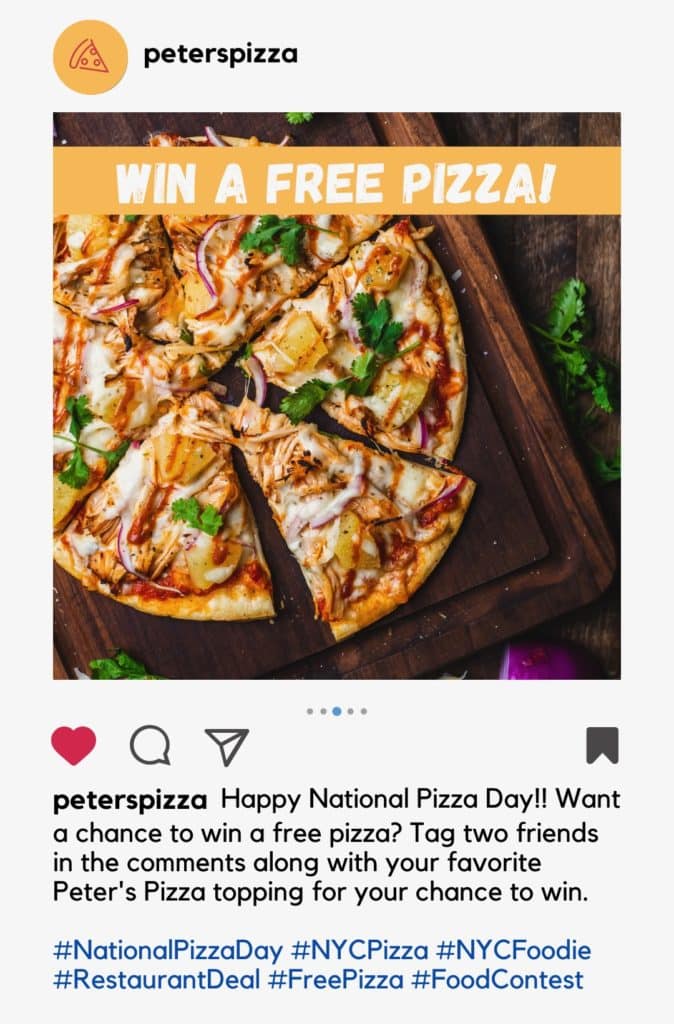
1. Run a social media contest
People love to win stuff. Even if they don’t come out on top, studies show that consumers are more likely to engage with a post if that post is promoting some kind of contest. Contests convert at a rate of 3.7% higher than posts with other non-costed CTAs.
Instagram contests are similarly popular, with contest-related posts getting more than triple the likes and 64 times more comments than other types of posts. That’s a major engagement.
Big Idea: Take advantage by running contests that encourage interaction, such as asking food trivia questions and counting each commented answer as an entry, requiring users to like and share your post to win, or asking followers to tag a friend in your post as part of their entry .
2. Use trending hashtags
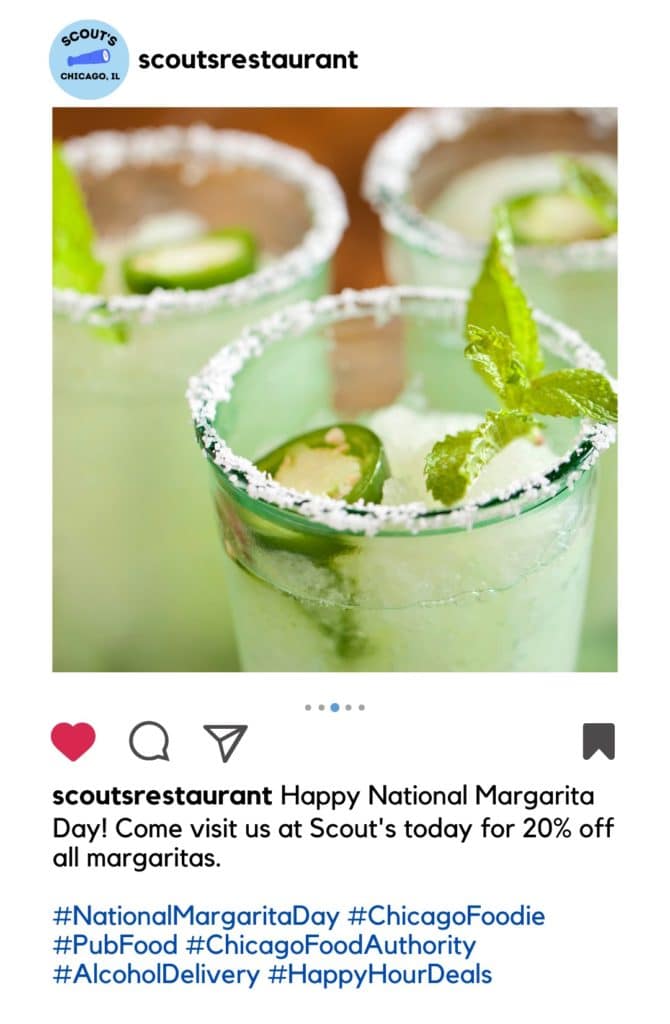
Because national food holidays are a coast-to-coast affair, there are often trending hashtags you can use to ride the wave of popularity and get your restaurant into the national spotlight. Hashtags allow your posts to enter different categories online, bringing your restaurant into people’s social media feeds.
Big Idea: Along with using the obvious national food day hashtags like #NationalMargaritaDay, make sure to also incorporate your restaurant’s city-specific hashtags like #EatAustin, #ChicagoFoodAuthority of #NYCEats. Using these will allow you to tap into the already-there audience you’re looking for.
3. Promote your online ordering site
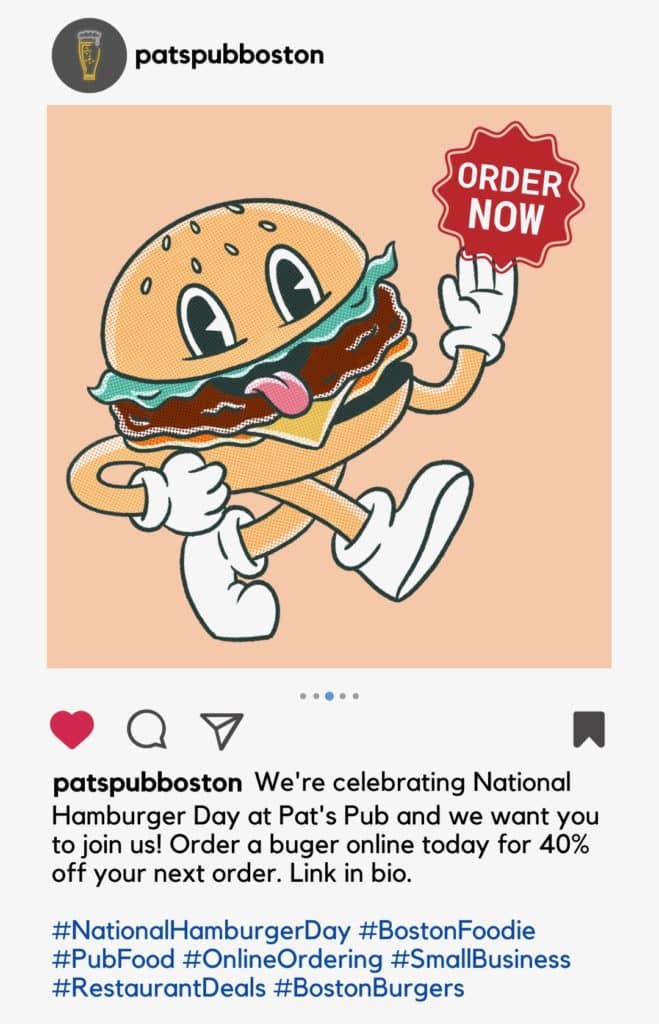
Most promotions work best when you remove any possible hurdles that stand between your customer and the order button. In the world of online ordering, that means making it as easy as possible for diners to find your menu, put their food on their virtual card, and pay up.
When you share your promotional posts on social media, offering customers the ability to order directly from you can help you drive more sales through your national food holiday campaigns.
Don’t have the ability to take online orders? Grubhub can help! Direct is a commission-free platform designed to help you reach loyal diners and build your online brand. With Direct, you can drive customers to your very own online ordering website, customized just for your restaurant. Read all about how Brooklyn-based Broccolini did just this and more.
Big Idea: Include links to your online ordering site on your social media pages so that you can convert curious scrollers into customers. Make sure you highlight your online ordering site in your captions so that it’s clear how diners can place an order.
4. Highlight your dishes
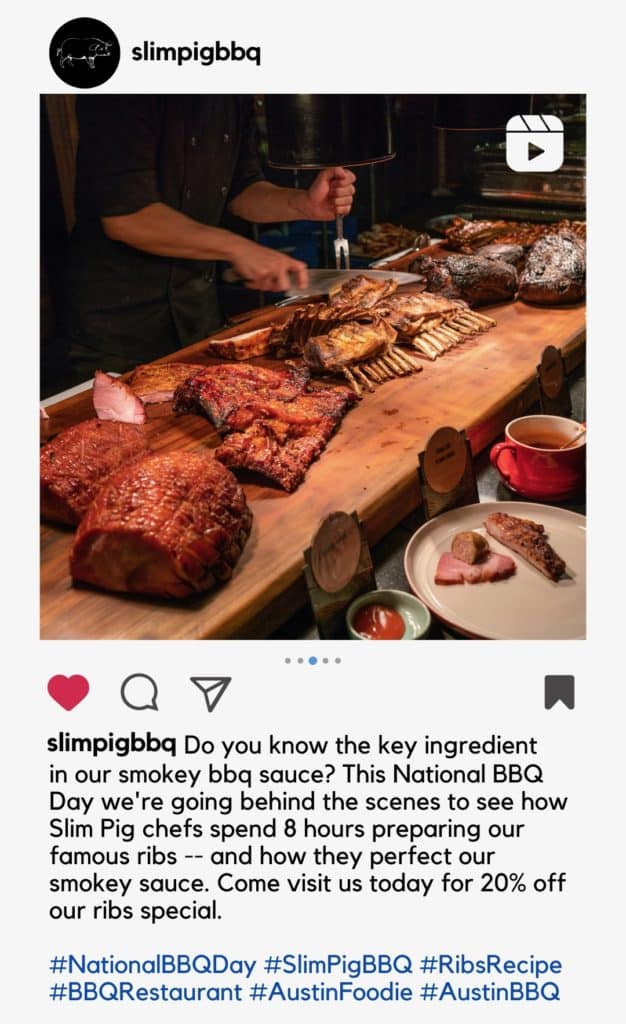
Your food is your pride and joy and what keeps customers coming back for seconds. Making your cuisine the prime feature of your social media profile not only shows off your specialty, but also gets diners’ mouths watering. Nothing gets a diner more motivated to place an order than a juicy photo of a rack of ribs on National Barbecue Day (May 16).
Taking and presenting high quality photos of your food is essential to creating an effective social media presence. When you partner with Grubhub, you can schedule a free photoshoot for your restaurant.
Partnering with micro influencers can help your restaurant gain more exposure. Encourage those who visit your restaurant to post photos of their food online. Delectable food pics can stand out in people’s feeds.
Big ideas: Make sure to feature high quality photos of the dishes you are preparing for national food holidays. You can even give a behind the scenes look into your chef’s meal preparation. Post these photos onto your restaurant’s social media to appeal to diners’ taste buds.
Start your restaurant’s celebration today
The best thing you can do when using national food holidays to promote your restaurant is to create a solid plan. That way, you’re ready and prepared to give your diners the best reason to indulge in your delicious food – daily!
Lucky for you, we’ve already done step one for you. We’ve compiled all the national food holidays in one place and created a complete calendar listing and it’s available to you for FREE to download now.
Use your new calendar to create a new marketing plan or amplify your existing one, and national food holidays could be your next step toward increasing sales and a wealth of new customers.
Already eager to get ready for your next national food holiday promotion? Sign up with Grubhub for Restaurant to access powerful promotion and loyalty tools today!

How to collaborate with micro influencers to grow restaurant sales
Social media can have a big impact on users’ food choices — scroll through Instagram food posts on an empty stomach and you’ll experience the effect for yourself. The power of social media suggestion is so strong, in fact, that it’s a cornerstone of many restaurants’ marketing strategies. One study found that 53% of millennials have eaten or ordered from restaurants after coming across them on TikTok. Social media has a direct influence on diners.
If you run a restaurant, now’s the time to go all in on social media. As you expand your online presence, working with micro-influencers is one way to quickly build a bigger audience and maximize your marketing budget.
What are micro influencers?
A micro influencer is a person who has a small, highly targeted social media following — typically, between 1,000 and 50,000 followers. These influencers build an audience by posting about a specific topic, offering opinions and sharing products or locations.
In the food industry, micro-influencers are often called food bloggers or food influencers. They usually focus on cooking, specific cuisines, outrageous dishes or restaurant reviews. Some people review different desserts, for example, while others focus on the best restaurants in a specific city or region.
The power of the micro influencer lies in the name: influence. Followers value the person’s opinions, perspectives or style. If the influencer shares a positive opinion of a product or a restaurant, it can affect consumer decision-making and result in a surge of sales for the business.
Influencing is such a powerful driver for sales, in fact, that brands regularly drop tens of thousands of dollars on sponsored posts. As a result, successful food influencers have gained millions of followers and six-figure incomes.
If your restaurant’s marketing budget is smaller, you can still integrate a similar strategy — that’s where micro influencers come in. Because they have smaller followings, these online personalities tend to be more affordable, available and flexible. Their audiences are often more loyal and engaged, which can result in a higher ROI.
Of course, paid posts aren’t the only way to get exposure from influencers. They often come to your restaurants and mention your food without being asked. To keep tabs on what people are saying about your restaurant, it’s critical to build a social media presence and monitor brand mentions.
Why partner with food bloggers?
Influencing is the modern version of word-of-mouth advertising. When you partner with food bloggers, you can leverage their network to build brand awareness for your restaurant. Since the review or recommendation is coming from a trusted source, followers may be more receptive to the message.
While you can reach new audiences through your own social media, food bloggers speed up the process. With a single post, you can reach a broad group of people who are already interested in what you have to offer — no targeted advertising required. Influencer marketing fits neatly into your existing social media strategy by driving traffic to your business website, profiles and online ordering platforms.
3 tips to successfully collaborate with food bloggers
Collaborating with food bloggers and micro-influencers can be an effective way to increase your restaurant’s social media reach and engagement. Foodie influencers live and breathe social media, so they understand exactly how to capture their followers’ attention and convince them to buy.
Authenticity is critical — audiences can spot an insincere money grab a mile away. To get the most from a partnership, it’s important to find the right blogger for your brand. Food influencer marketing is most effective when restaurants and influencers feel like a natural, organic match.
1. Build your restaurant’s social media presence
The best way to find food influencers is to meet them where they are — on social media. Before you reach out to bloggers, take time to build a robust and attention-grabbing digital presence. At a minimum, you should have:
Regular posts attract new customers, but they also show influencers you’re online and active. After all, exposure goes both ways; bloggers rely on you to share their posts to form a collaboration.
If you already have an established online presence, take engagement to the next level. Encourage your followers to comment by asking questions, hosting contests, or seeking input about new menu items. Give people (and bloggers) a reason to stop in by posting about specials and followers-only deals. When someone comments, respond; it’s a fun way to humanize the brand and attract influencers who want to work with people rather than a faceless corporation.
Keep in mind that some influencers will order delivery before writing a review. Don’t forget to include a link to your online ordering platform. Convenience matters — if your existing system doesn’t provide a fast, seamless experience, switch to Grubhub Direct to create a branded, commission-free website ordering at no additional cost.
2. Follow trending hashtags and accounts
Social media is all about the trends. To find top influencers, keep an eye out for trending hashtags that food bloggers use to connect with followers. Follow the hashtags to find relevant accounts and engage in the latest discussions. Look for posts with plenty of thoughtful comments; they indicate the audience is highly engaged.
Start with popular restaurant-related tags:
- #Foodie
- #FoodBlogger
- #Foodstagram
- #FoodPhotography
- #GoodEats
- #RestaurantPhotography
If you have an independent restaurant, find micro-influencers by refining your hashtag search with niche terms. For example, if you run a restaurant in Chicago, you could follow #ChicagoRestaurants, #ChicagoFoodie or #ChicagoEats. Do you focus on a specific cuisine? Try hashtags such as #ThaiFood, #PastaLover, #HealthyEats or #ChicagoVegans.
While you’re exploring hashtags, you’ll probably come across accounts that feature restaurants in your city or genre. Follow them and note when they share posts from local bloggers; it’s a great way to spot micro-influencers in your area.
3. Reach out to influencers directly
As soon as you find an influencer who seems like a good match for your restaurant, reach out directly. Request a collaboration, and explain a little bit about your restaurant’s story and vibe. Your message should also explain:
- What you’re looking for: You might want a restaurant review or a menu promotion, for example.
- What you’re offering in return: Few people are willing to work for free. At a minimum, you should offer a free meal or a discount. If you want to work with popular influencers, be prepared to pay.
Don’t be afraid to start with small, local influencers — people with highly relevant, active audiences that can bring big returns for your business. They also receive fewer offers, so you can often start a partnership on a budget. When you’re reaching out to someone with 10,000 or more followers, get in touch by email. People with large audiences get hundreds of DMs, so email is a good way to ensure your message doesn’t get lost in the shuffle.
How to prepare for a food influencer’s visit
Preparation is the key to a successful blogger collaboration. To get ready, follow these steps:
- Choose a good time: Suggest a time when the restaurant is busy but not completely full. The bloggers can get a sense of the vibe, and the staff will have time to provide plenty of attention.
- Focus on presentation: Make sure your table settings, plating, and presentation are top-notch and ready to shine in the influencer’s photos. Consider seating the blogger near a window; the natural light will help the food look its best.
- Agree on a menu in advance: Work with the influencer before the visit and decide whether they’ll be trying a specific dish, selecting from a tasting menu or ordering off the regular menu.
- Prep your staff: Ask servers to be prompt and courteous but not overbearing, and suggest the owners stop by the table to say hello. End the visit on a positive note by thanking the influencer and inviting them back.
Give influencers a reason to celebrate with food holidays
Influencers are always looking for new trends to inspire content. In the restaurant industry, food holidays — days that celebrate a specific food or cuisine — are the perfect fit. Get in on the fun by inviting local influencers to post about your restaurant on a relevant holiday; find a full list on the National Food Holiday calendar. Sweeten the deal by giving them a special discount to include in the post. On National Donut Day, you might host a $1 donut promotion or hand one out for free to every diner.

Your cuisine is a click away with Grubhub
To get the most from your influencer marketing campaign, it’s important to give viewers an easy way to order. That’s where Grubhub Direct comes in. Include your Direct link in your social media profile and the influencer’s post and customers can order while your restaurant is top of mind. To get started and put your restaurant in front of more customers, join Grubhub today.