

Sid brings fresh approach to winter fine dining –
The iconic Sid at the French Café in Symonds Street, Auckland is heading into winter with new menu offerings and options to bring more fun to fine dining.
As well as launching a new winter tasting menu, the celebrated restaurant is introducing a flexible à la carte menu and snack offerings, (pictured below), giving guests more relaxed options.

The restaurant is also taking walk-ins for those wanting to pop in spontaneously for an after-work cocktail or glass of wine with snacks.
Guests can enjoy these impromptu treats in the heated undercover area in the Mediterranean-inspired courtyard or around a brazier fire, also in the popular courtyard and garden area.
For those seeking dining options, the new winter menu is curated by the owner and executive chef Sid Sahrawat and head chef Tommy Hopeis now available.

Split between snacks, entrees ($35), mains ($45), and desserts ($25), it delivers Sahrawat’s signature innovative flavor combinations with glimpses of inspiration from many cuisines.
Sahrawat says he wanted a spontaneous, fun menu that wasn’t limited to one style of cuisine.
“For me, it’s always about pushing the boundaries with flavor combinations to keep it exciting on the palate,” he says.
Sahrawat also pleased to make the restaurant a destination for people to stop in on their way home or before heading out elsewhere for the evening.
“As the restaurant evolves, we want the dining experience to be fun and less stuffy,” he says.
“We are still a relaxed fine dining destination offering first class service, but the staff wants our guests to have fun with the experience, too – this is reflected both in the menu and the ambience of the restaurant.

“Opening up the restaurant for people to just pop in is something we’ve been talking about doing for a long time. The courtyard is our urban oasis and has never looked better with the herb garden, chimney fireplace, brazier fire pit, heaters and fairy lights.
“We can’t wait to make this a more relaxed, fun and accessible destination.”
Those planning to stick around a bit longer to enjoy the new à la carte menu can look forward to sampling the following:
- Snacks: Include a Truffle and gruyere beignet with truffle emulsion; Hot smoked Aoraki salmon croustade, XO, rouille, sesame; and a Parmesan churro with whipped feta, smoked maple and puffed pork crackling.
- Entrees: Include Ruakaka kingfish with mandarin, feijoa, fermented jalapeño and Scampi, Jerusalem artichoke, chicken skin, hazelnut, lavender.
- Mains: Include a deliciously tender Wagyu beef short rib, with Szechuan, kasundi, kimchi, carrot, wasabi; Market fish with green chili, charred cucumber, verbena, turnip; and Venison, romesco, black pudding, medjool date, smoked cashews.
- Desserts: Includes a local and international cheese board, as well as an array of sweet treats, such as coconut, lychee, licorice, pavlova, puffed rice; the Mandarin, black pepper hokey pokey, soured cream, manuka honey; and the nostalgic Dark chocolate, pretzel and malted barley soft serve.
Of course, Sid at the French Café has kept a few of the classics the restaurant is already known for, such as the five-course tasting menu (which includes snacks) for $190pp and a Saturday four-course set lunch, including a glass of champagne, for $120pp.
Do you have a new menu creation from your restaurant kitchen that you would love to publish? Let Kimberley Dixon know at: [email protected]
Luxury Jewelry with Lab-Grown Diamonds

Lab-grown diamonds are becoming increasingly popular in the luxury jewelry market. These diamonds are created in a laboratory, rather than mined from the earth. They are chemically and structurally identical to mined diamonds, but they are often available at a fraction of the cost.
There are many reasons why people are choosing lab-grown diamonds for their luxury jewelry. One reason is that they are more ethical than mined diamonds. The mining of diamonds can have a devastating impact on the environment and the people who live in diamond-producing regions. Lab-grown diamonds, on the other hand, are created in a sustainable and ethical way.
Another reason why people are choosing lab-grown diamonds is that they are more affordable. Mined diamonds can be very expensive, especially if you are looking for a large or high-quality stone. Lab-grown diamonds, on the other hand, are often available at a fraction of the cost.
Of course, not everyone is convinced that lab-grown diamonds are as valuable as mined diamonds. Some people believe that the only real diamonds are those that have been mined from the earth. However, the popularity of lab-grown diamonds is growing, and it is likely that they will become even more popular in the future.
The Benefits of Lab-Grown Diamonds for Luxury Jewelry
There are many benefits to using lab-grown diamonds in luxury jewelry. Here are a few of the most important ones:
- Affordability. Lab-grown diamonds are often much more affordable than mined diamonds. This makes them a great option for people who want to buy high-quality jewelry without breaking the bank.
- Ethics. The mining of diamonds can have a devastating impact on the environment and the people who live in diamond-producing regions. Lab-grown diamonds, on the other hand, are created in a sustainable and ethical way.
- Versatility. Lab-grown diamonds can be used in a variety of jewelry designs. They can be set in rings, necklaces, earrings, and other pieces of jewelry.
- Beauty. Lab-grown diamonds are just as beautiful as mined diamonds. They have the same chemical and structural properties, and they sparkle just as brightly.
The Future of Lab-Grown Diamonds in Luxury Jewelry
The popularity of lab-grown diamonds in luxury jewelry is growing rapidly. This is due to a number of factors, including the affordability, ethics, and versatility of lab-grown diamonds. It is likely that lab-grown diamonds will continue to become more popular in the future, and they may eventually replace mined diamonds altogether.
Where to Buy Luxury Jewelry with Lab-Grown Diamonds
There are a number of places where you can buy luxury jewelry with lab-grown diamonds. Here are a few of the most popular options:
- Online retailers. There are a number of online retailers that sell luxury jewelry with lab-grown diamonds. Some of the most popular options include Blue Nile, James Allen, and Brilliant Earth.
- Jewelry stores. Some jewelry stores also sell luxury jewelry with lab-grown diamonds. This is a good option if you want to see the diamonds in person before you buy them.
- Custom jewelers. If you are looking for a truly unique piece of jewelry, you can work with a custom jeweler to create a piece that features lab-grown diamonds.
Conclusion
Lab-grown diamonds are a great option for people who want to buy high-quality jewelry without breaking the bank. They are also a more ethical choice than mined diamonds. If you are considering buying luxury jewelry, I encourage you to consider lab grown diamond.
Get the Most Out of GrubHub Online Ordering
So you’ve implemented Grubhub online ordering to bring more orders and greater efficiency to your restaurant, but are you doing all you can to capitalize on your investment? Your Grubhub partnership comes with an array of best-in-class technology and tools to grow your business and reach new diners.
Here are seven tips and tricks on how you can make the most out of your restaurant’s Grubhub partnership.
1. Launch promotions
Did you know that restaurants can run their own promotions on Grubhub? Whether the goal is to introduce a new menu item, increase ticket sizes or generate loyalty, promotions catch the eye of value-driven diners. You can tap into loyalty tools to encourage customers to place repeat orders to receive an exclusive reward. The best part? Promotions can be added, changed or removed as you, the restaurant owner, see fit. Experiment with promotions and loyalty tools on Grubhub, and your diners might be checking out your menu more often to see what new offers are available that day.
2. Encourage online ordering through Direct
Modern diners flock online to get their next meal. Digital ordering and delivery have grown 300% faster than dine-in traffic since 2014. These days, diners expect their favorite restaurants to offer online ordering. That’s why many restaurants are turning to Direct, a commission-free online ordering platform. Direct is a branded online ordering platform that can integrate with your existing website. You can customize it to match your restaurant’s look and feel, and access customer data to improve sales. The best part? You won’t pay any additional fees whatsoever — all eligible Marketplace restaurants can join Direct free of charge.
3. Optimize delivery
According to our Grubhub data report, 63% of surveyed consumers report increased frequency of third-party restaurant delivery orders compared to pre-pandemic. Better yet, 90% of surveyed consumers expect increased usage going forward. Offering delivery at your restaurant is essential to capturing this demand.
Grubhub’s restaurant delivery service is perfect for restaurant owners who want professional, knowledgeable delivery drivers but don’t want to deal with the operational overhead of managing a delivery program including scheduling, insurance and tip-outs. For those who do delivery themselves, your Grubhub Account Advisor can help you optimize your fees, minimums and delivery zone to ensure you are attractive to local diners.
4. Streamline point-of-sale operations
Did you know that Grubhub can integrate with your restaurant’s point-of-sales (POS) or ordering system? Grubhub works with all kinds of technology providers to help streamline a restaurant’s ordering and fulfillment operations. Restaurants can increase efficiency by simplifying order throughput to a single system. This integration can help restaurants increase efficiency, update multiple menus in real time and streamline employee training. Streamlining your technology reduces clutter and makes managing your restaurant easier.
Check out what POS systems you can integrate with Grubhub.
5. Analyze your diner data
With online ordering from Grubhub, restaurant owners have detailed access to their order data. Through dedicated, secure accounts, restaurant owners can access their restaurant sales data from a tablet or computer. The customer insights dashboard gives insight into the online ordering habits of specific customer groups. Metrics such as month-over-month order volume allow owners and managers to review the restaurant’s performance, spot trends and identify new opportunities for growth.
6. Promote your online ordering link
Now that you have all the tools you need to process online orders, the last step is to spread the word. One of the best ways to reach customers directly is through social media. Creating and maintaining Instagram, Facebook and even TikTok accounts for your restaurant is a great way to get your cuisine in front of interested customers. Make sure to add a link to your restaurant’s online ordering site like Direct, Grubhub or your website to your social media bios.
You also want to make sure your restaurant is searchable on the web. Creating a website for your restaurant if you don’t have one, or optimizing your website to include a way to place an order is essential in establishing an online presence. 77% of consumers reported they are likely to visit a restaurant’s website before they dine in or order takeout and delivery. Including your online ordering link on your website can prompt customers to place an order. If you claim your restaurant on Google Business, you can customize what link diners are directed to when they look up your restaurant.
Grow your restaurant with Grubhub
At Grubhub, we understand that running a restaurant doesn’t come with a recipe. That’s why we are always looking for the best solutions to help restaurants grow. Whether you use Grubhub for delivery and pickup, or have customized your Direct site to get more commission-free orders, there are many ways you can get the most out of your Grubhub partnership. Is your restaurant not on Grubhub yet? Partner with Grubhub today to reach new customers and grow your business. Sign up now!

The Potential of Blockchain Technology in Boosting African Tourism
Written by: Obiora Ndili
Africa is home to some of the world’s most beautiful natural wonders and diverse cultural experiences. It has become a popular destination for tourists from around the globe. But the tourism industry in Africa is facing various challenges such as lack of infrastructure, weak regulation, and low levels of investment. However, blockchain technology has the potential to revolutionize the tourism industry in Africa.
Blockchain technology is a decentralized ledger that can record transactions in a secure, transparent and immutable manner. It has already shown great potential in various industries such as finance, healthcare and supply chain management. In the tourism industry, blockchain can address various issues such as payment processing, identity verification, and supply chain management.
One of the main challenges facing tourism in Africa is payment processing. Traditional payment methods such as credit cards are not widely accepted in Africa, and the use of cash can be risky and cumbersome. Blockchain technology can provide a secure and efficient payment system that eliminates intermediaries and reduces transaction costs. Blockchain-based payment systems such as Bitcoin and Ethereum are already gaining popularity in Africa, and more tourism businesses are beginning to accept these cryptocurrencies as a means of payment.
Identity verification is another challenge facing the tourism industry in Africa. Tourists may be required to provide multiple documents to verify their identity, which can be time-consuming and inconvenient. Blockchain technology can provide a secure and decentralized platform for identity verification. Tourists can store their identity information on a blockchain network, and tourism businesses can access this information to verify the identity of their customers. This can significantly reduce the time and cost of identity verification processes.
The supply chain in the tourism industry is also complex and can be difficult to manage. Blockchain technology can provide a transparent and immutable ledger of the entire supply chain, from the origin of the goods and services to the final delivery to the customers. This can enhance the quality and authenticity of products and services in tourism while improving customer trust and satisfaction.
Another advantage of using blockchain technology in the tourism industry is that it can promote eco-tourism and sustainability. Tourists are becoming more aware of the impact of their travels on the environment and are looking for ways to reduce their carbon footprint. Blockchain can be used to create smart contracts that incentivize sustainable practices such as eco-friendly transportation and waste reduction. These contracts can reward tourism businesses that adopt sustainable practices and provide tourists with more eco-friendly options.
Furthermore, Africa has the advantage of being a blank slate when it comes to technology adoption. Unlike developed countries that must adapt and integrate new technologies with existing infrastructure and systems, Africa can leapfrog directly to the latest and most efficient technologies. Blockchain technology can be implemented in African tourism businesses from the ground up, without the need to navigate complex legacy systems.
However, there are also challenges and risks associated with the implementation of blockchain technology in the tourism industry. The first challenge is the lack of technical expertise and infrastructure. African countries need to invest in developing the technical skills and infrastructure required to adopt and integrate blockchain technology into their tourism businesses.
Another challenge is the lack of regulatory frameworks and standards. Blockchain is a new and rapidly evolving technology, and there are no clear regulations or standards for its use in the tourism industry. This can create uncertainty and increase the risk of fraud and security breaches.
In conclusion, blockchain technology has the potential to revolutionize the tourism industry in Africa. It can provide a secure and efficient payment system, streamline identity verification processes, enhance the supply chain management, promote eco-tourism and sustainability, and help African countries leapfrog to the latest and most efficient technologies. However, the implementation of blockchain technology in the tourism industry requires investment in technical skills and infrastructure, and the development of regulatory frameworks and standards. With the right support and collaboration, blockchain technology can transform the tourism industry.
This blog post was awarded Second Place (tied) in the Spring 2023 HFTP/MS Global Hospitality Business Graduate Student Blog Competition presented by the HFTP Foundation. The blog posts that received the top scores will be published on HFTP Connect through July 2023. Learn more at HFTP News.
Obiora Ndili is a graduate student of the Master of Science in Global Hospitality Business, a partnership between the Conrad N. Hilton College of Global Hospitality Leadership at the University of Houston, the School of Hotel and Tourism Management at Hong Kong Polytechnic University and EHL.

KU DE TA WHITE PARTY – STARGATE
The Bali high season is fast approaching and one of the biggest annual events of the Bali party calendar, KU DE TA’s White Party will be held on Wednesday August 16, 2023. Last week the organizers announced the final line-up for the party – a line up which looks set to put this year’s event into overdrive.
The White Party headliners are: Oliver Koletzkia legendary DJ & producer known for his versatile sound ranging from minimal to techno, and GHEISTa Berlin-based hybrid live/DJ collective blending progressive elements with house and techno textures for a melodic, captivating experience. Videos of these masters of the electronic music genre can be seen here.
Opening the gates for our headliners, KU DE TA residents of Se/Rio and Loco will grace the stage and ignite the atmosphere.

Indeed, soon it will be time to embark on an extraordinary journey, as they put it, through a mythical gateway to other dimensions at the Annual KU DE TA White Party, themed “Stargate”. Immerse yourself in a realm where time portals converge, pushing the boundaries of imagination and leading to encounters with higher beings of the ancient Egyptian civilization.

The Beat checked in with Arshadthe event and music director at Ku, to find out more and especially what is going to be special about this year’s Stargate event.
“Well, there’s going to be a unique stage shape combined with the latest state of the art light show. I don’t want to say too much because I don’t want to spoil the element of surprise. The whole idea is to give a wow feel when visitors enter the venue.” And we imagine that ‘wow’ will continue throughout the night.

Please remember, since it is Bali’s original and best WHITE PARTY, steeped in over two decades of history, we recommend wearing white from head to toe. That way you will fit right in for one of the biggest nights of the year.
Ticket prices:
- Early Birds: IDR 850,000* (SOLD OUT)
- General Admissions: IDR 1,000,000*
- at the door: IDR 1,200,000*
- VIP tables: IDR 25,000,000* (6 tickets plus 1 bottle of spirit)
- VIP day beds: IDR 50,000,000* (10 tickets plus 2 bottles of spirit)
- Dinner reservations: IDR 2,425,000* (1 ticket and IDR 1,425,000 F&B spend including tax & service)
*booking fee & conditions apply
Grab your tickets now!
https://coup.bigtix.io

Boost deliveries and test new menu concepts with virtual restaurants
The pandemic changed the way customers order from restaurants. Offering delivery and pickup has become essential for restaurants to stay competitive, shifting the way we understand restaurant growth. This change has also led to the rise of a new type of restaurant: virtual restaurants.
Virtual restaurants have become one of the biggest growth opportunities in the industry. The virtual restaurant market is estimated to reach $1 trillion by 2030, proving this type of business to be a reliable avenue for growth. Virtual restaurants can launch in about a quarter of the time of a physical restaurant, saving you time and money.
Read on to learn what virtual restaurants are, then be sure to download the checklist to understand exactly how you can experiment with a new brand of cuisine while growing your delivery sales.
Demystifying The Virtual Restaurant
Also known as virtual kitchens, ghost kitchens or delivery-only restaurants, the virtual restaurant concept is actually quite simple.
They are delivery-only operations that accept orders solely online—through apps and websites like Grubhub. With no need for a brick and mortar location, the restaurant only exists online.
Restaurateurs can launch a virtual restaurant to experiment with a new menu concept, brand a subset of existing menu items or capture unique customer demands for particular food in the market. In this way, restaurants can open up a whole new “restaurant” without any additional expenditure on staff or rent.
Since all orders are placed digitally and delivered, customers don’t know (or care) that the restaurant is “virtual.” They may even be excited to try new concepts if they are put out by their favorite local restaurant. Their only concern is that the food tastes great, is easy to order and is delivered to their door.
Paving The Way To Your Own Virtual Restaurant
So what goes into creating a stellar virtual dining experience? Take a look at these steps you can follow to launch your own virtual restaurant.
Step 1: Choose Your Cuisine
Your menu can expand your existing offerings or be based on a subset of items from your current menu. You can even test out an entirely different concept—one that may even be completely different from your physical restaurant. With the data provided by Grubhub, you can even pinpoint what type of food customers are searching for, but not finding, within your delivery boundaries, and create a menu that fills that gap.
Once you’ve decided on what type of cuisine you want to serve, the next step is to engineer your menu. Explore how competitors price and market their cuisine, look into local diners’ ordering habits and decide how you want to source ingredients. You’ll need to compile data to calculate food costs, identify contribution margins and determine what menu items are likely to sell. After you’ve evaluated this data, the final step is to create menu prices. These prices don’t need to be set in stone – you should evaluate your business during the first few months of operations to optimize your menu.
Step 2: Create Your Brand
Now that you know what you want to sell, you need to brand your restaurant to build customer recognition. Your brand should reflect your virtual restaurant’s cuisine type and niche. Spend time deciding on brand assets like a name, logo, theme and photos – these things will be the first things diners see when they order from your restaurant.
Use your branding to convey your restaurant’s identity and distinguish it from competitors. Make sure you have a good understanding of your target customers before you finalize branding to ensure that your restaurant’s theme will resonate with them.
Step 3: Develop a delivery strategy
Virtual restaurants cannot function without delivery. Your virtual restaurant’s delivery fleet should be professional, timely and efficient. Because your restaurant doesn’t have a physical storefront, your drivers are the ones who will interact with customers. Ensuring you have the best drivers can make sure your brand is represented well.
Grubhub delivery can help take work off your plate by handling out-of-house services for your virtual brand. Grubhub delivery allows restaurants to expand their delivery boundaries and reach customers in a timely manner, giving diners real-time updates on their progress. Our fleet of over 300,000 drivers are experienced and professional, equipped with the right tools to make sure your cuisine reaches your customers.
Step 4: Launch Your Virtual Restaurant
So you think you’re ready to launch your virtual restaurant? Before you start cooking, make sure you have enough inventory to support your virtual restaurant staff. Your staff should be trained on how the virtual kitchen will operate, and you should have a plan on how your virtual restaurant will work in tandem with your brick and mortar location if applicable.
Launching your virtual restaurant is as simple as publishing your menu online. You can add an online ordering link to your restaurant’s website to start. Want to get your restaurant in front of eager diners instantly? You can list your virtual restaurant on a third-party delivery platform like Grubhub to get access to 33+ million customers. Listing your restaurant on Grubhub Marketplace makes it easy for customers to place an order right from any device via an app or online platform.
Grubhub partners also get access to Direct, a commission-free online ordering platform that is completely free to use. With Direct, you can list your virtual restaurant’s menu online and easily manage restaurant info from your existing Grubhub account. Direct can also integrate into your existing website, giving customers an easy way to place an order. And the cherry on top is that Direct collects customer data that you can download for free and use to better target your marketing efforts. Learn more about how Direct can help your virtual restaurant grow.
Step 5: Market your virtual brand
A virtual restaurant isn’t subject to the same street recognition as brick and mortar restaurants. Restaurants that don’t have a physical dining room need to put in extra effort to make their presence known. Simply creating a website isn’t enough to generate a customer base. You need to market your new brand to potential customers to make them aware of your offerings.
Your marketing strategy should be holistic – covering web, email, social media and good old fashioned word of mouth. Your restaurant’s website should contain all the necessary info about your brand, featuring the menu, hours, delivery method and how to order. Modern diners use social media to explore new cuisines. Create social media pages for your restaurant on popular platforms like Instagram, Facebook and TikTok to share your creations. Once you start getting customers, collect their emails so you can send them announcements, deals and promotions to prompt them to place an order.
Just because your restaurant doesn’t have a physical location that customers can visit doesn’t mean you can’t connect with your local community. Old fashioned forms of marketing like fliers, signs and press announcements are a great way to make your presence known to your neighborhood. You can even partner with local businesses to cater an event to grow awareness of your brand.
Finally, encourage your customers to leave reviews about your restaurant on your website, Google Business page or on Grubhub. Reviews are a great way to legitimize your restaurant, especially when you’re just starting out. Plus, positive reviews can serve as free marketing for your restaurant.
Making A Virtual Restaurant Work For You
There are many exciting advantages to opening a virtual restaurant in addition to your physical restaurant.
- Obtain High Rewards For Low Investment. Virtual restaurants are efficient and save money because they grow your business without increasing overhead costs.
- Grow Delivery Sales. You can open up new channels of revenue using the same amount of staff, space and resources by operating one, or multiple, virtual restaurants out of one physical kitchen.
- Reach New Customers. By branching out with a new concept, you can reach an entirely different customer base.
- Innovate and Lead. With little risk, you are free to experiment and test out what works to create successful concepts and satisfy needs in your particular market. Also, being able to change your menu on the fly without updating printed menus or signage allows you to be flexible and creative.
- Increase Digital Presence. By living online, your brand will get valuable exposure through the Grubhub website and mobile app.
Whether you want to increase delivery sales or experiment with a new restaurant concept, a virtual restaurant can help you reach your goals with low risk and high rewards. Learn more about opening a virtual restaurant. Ready to reach new customers and grow your business with Grubhub? Signup today!

MEETINGS 2023 landmark event in Wellington –
Over 1,000 business events industry professionals have arrived in Te Whanganui-a-Tara Wellington, New Zealand for Business Events Industry Aotearoa’s MEETINGS 2023 exhibition.
New Zealand’s two-day annual tourism industry trade event is being held in Wellington for the first time in its 27-year history and signals a new era for the sector.
BEIA Chief Executive, Lisa Hopkins says this year’s MEETINGS will be a landmark event for the industry with a record number of buyers and exhibitors, and the first time in four years international buyers have also been represented.
“MEETINGS is the single most important event in New Zealand’s industry calendar. Last year’s event in Christchurch generated $107.5 million.
“Experiencing Aotearoa New Zealand under one roof means bringing real business opportunities to the business events sector which is on a trajectory to recover quickly,” Hopkins says.
Tourism New Zealand is hosting high-end senior incentives and meetings planners from North America who are visiting Auckland, and Queenstown before and after MEETINGS in Wellington. BEIA is also hosting international buyers and media from Singapore, who visited Auckland and Christchurch during the weekend.
“MEETINGS is giving them first-hand insight into our ability to deliver well-designed and seamlessly executed events. They are experiencing for themselves New Zealand’s world-class cities, venues, accommodation, transportation hubs, and most importantly, our manaakitanga, how we take care of our visitors, so they arrive as strangers but leave as champions,” she says.
David Perks, General Manager – Tākina Commercial Development, Wellington City Council says they are thrilled to be welcoming buyers and industry colleagues from all around the country and abroad to Wellington this week.
“Hosting MEETINGS for the first time, at our brand-new venue, Tākina, is such an important moment for our city and local partners as we show Wellington off to the world,” he said.
“The support from all our stakeholders to host a record number of Australian buyers over the weekend, more than 160 buyers at the city familiarization day and at the show itself, has been immense. We trust every buyer and industry friend will experience Wellington’s manaakitanga from the time they arrive until they head home and enjoy a taste of Wellington like never before.
“As we enter this new era for our city, we are excited about the future of business events in Wellington,” Perks said.

How to start a restaurant
Opening a restaurant is a dream for foodies everywhere. As an owner, you enjoy full creative control over the menu, food quality and customer experience. Before you start a restaurant, however, it’s important to understand exactly what goes into the process.
So sit back, untie your apron and dig into the steps for opening a restaurant.
Steps to open a restaurant
Opening a restaurant is both exciting and complicated. From getting licenses to planning a menu and buying kitchen equipment, each phase requires patience and attention to detail. Use these steps to organize your plan of attack.
1. Decide on a restaurant concept
Your restaurant concept is the central idea or theme of the business. Typically, it involves two core elements: the cuisine you offer and the environment in which you serve it.
Popular cuisines include:
- italian
- Indian
- mexican
- chinese
- American
- sushi
- vegan
- BBQ
- Pizza
Once you know what kind of food you want to serve, it’s time to design the environment. Some common style and size options are:
- Diner
- Fast food
- fast casual
- Counter-serve
- Sit-downs
- ghost kitchen
- Fine dining
- Café/bistro
- Coffee shop
- Pubs
To crystallize your concept, summarize the idea into a sentence. For example, “a small fast-casual café serving espresso drinks and elevated comfort foods in a cozy setting.”

2. Build a restaurant business plan
Write a restaurant business plan that describes your operations, analyzes the market and identifies the target audience. It should also lay out the structure of the organization and make financial projections.
A well-researched plan is a roadmap for opening a restaurant — you can use it to guide every important decision, from choosing a location to setting the menu. Potential investors will use the plan to determine your potential for success.
When you’re opening a small restaurant, the business plan can be less complex. You might include fewer details about the organizational structure and focus primarily on the target audience and competitor analysis.
3. Secure restaurant funds
There’s no getting around it: It’s expensive to open a restaurant. Many owners need to seek funding to help cover the costs of rent, furniture, decor, equipment, insurance, licensing and labor.
Some common funding sources for restaurants are:
- Business loans
- Business lines of credit
- Financial support from family and friends
- External investors
- Crowdfunding
- Grants
Restaurant startup costs can vary considerably based on size, type, and location. One survey of restaurant owners reported that average totals range from $175,000 to $750,500. Another report estimated startup costs ranging from $95,000 to $2 million.
Owning a restaurant can be profitable. However, since profit margins are tight — usually ranging from 3% to 5% — you must control factors such as inventory tracking, ingredient selection and food waste.
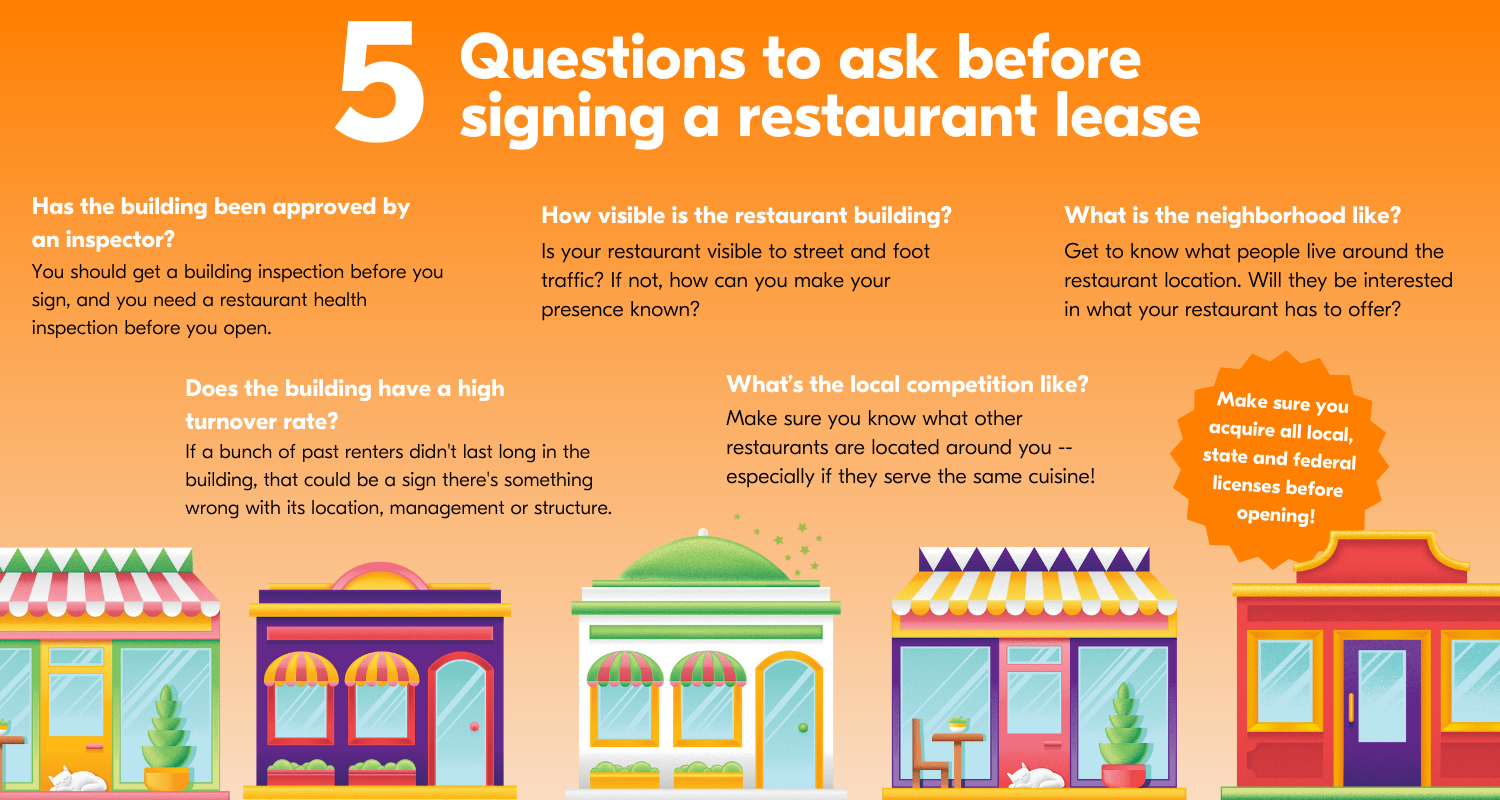
4. Find a restaurant location
Location is one of the most important factors in a restaurant’s success. It determines everything from public perception to the customers you’re most likely to attract. A restaurant that’s highly visible and set in a convenient location may have an easier time than one that’s hidden away on a back street with no parking.
As you evaluate locations, consider these factors:
- Price
- size
- Layouts
- Available parking
- driving distance
- Proximity to public transportation
- Visibility from the sidewalk or road
- Ease of access
- Existing kitchen facilities
Think about your target audience, too. Where do they live? Will they walk or drive to the restaurant? What kind of environment do they prefer?
Use audience insights to guide your property search. If your goal is to be the local date-night hotspot, for example, you might prioritize a property with a beautiful view or an intimate vibe.
5. Obtain restaurant licenses and permits
Every restaurant needs a license; it demonstrates to customers and officials that you know how to operate legally and safely. Restaurant licensing requirements vary based on your location and business and may be required by city, county, state, or federal regulations. Common licenses and permits include:
County/city
- Business license
- Food service license
- Food handler’s license
- Building health permit
- Certificate of occupancy
- Sign permit
state
Federal
6. Create your restaurant menu
Work with your chef to craft a menu. Most menus fall into five categories: static, cyclical, fixed-price, du jour and à la carte. As you choose dishes, consider these factors:
- Alignment with restaurant concept
- Popularity and competitive advantage
- Most important ingredients
- Ingredient availability and seasonality
- Prep time and complexity
- Costs and profit margins for each dish
- Food allergies and dietary preferences
When you come up with a short list of dishes, consider menu pricing; set prices that are acceptable to your target market but still enable you to make a profit. If certain items are too expensive for the restaurant concept, eliminate them from the menu.
At this point, you should have a final list of dishes. To design the menu, follow these tips:
- Separate dishes into categories.
- Allow plenty of white space.
- Highlight priority meals with bold fonts or graphic elements.
- Indicate items that are safe for allergies and dietary restrictions.
- Write applying descriptions.
- Take beautiful photos for your website and delivery menu.
7. Find restaurant equipment and food suppliers
With your menu in mind, find suppliers that can deliver the necessary ingredients on your required schedule. Build community and gain a competitive advantage by working with local suppliers to source high-quality foods with short delivery times. Other options include national wholesalers, catering suppliers, and commercial butchers, farmers, and fishmongers.
Then, purchase the necessary equipment for the restaurant. At a minimum, you’ll need appliances and furniture for:
- Food preparation
- Foodstorage
- Foodservice
- Guest comfort
- safety
- Cleaning
- trash collection
Equipment is a big investment, but you can buy used items to save money without sacrificing functionality.
Technology is another important consideration; it helps you market the company, process orders efficiently, and capture more delivery business. Most restaurants need a point of sale (POS) system, printer, cash drawer, payment processing technology, kitchen displays, and a mobile ordering system. Grubhub can streamline your tech stack — it integrates with many POS systems, so delivery orders flow right through to the kitchen.
8. Hire restaurant staff
Place job postings in local newspapers, on online job boards, and in social media groups. You can also reach out to professional contacts for referrals, especially when it comes to manager and chef candidates.
The number of employees you need depends on the size of the business. At a minimum, you should hire:
- general manager
- Chefs and/or cooks
- Dishwashers
- Hosts
- Bartenders
- Servers
- bussers
- Janitors
In small restaurants, the same people may fill several of these roles. Large or specialized restaurants may need additional staff members, such as a food and beverage manager, executive chef, pastry chef, sommelier and kitchen manager.
Onboarding is paramount for a new restaurant. With thorough orientation and training, workers can do their jobs with confidence and create a positive experience for customers. This is a great time to establish company values and traditions that minimize employee turnover: respect, fair and flexible scheduling, continuing education, staff safety and an inclusive environment.
9. Create a restaurant marketing plan
Marketing is critical for a restaurant startup. Done successfully, it builds a buzz and gets local customers excited to try your food. A marketing plan helps you stay on task and build brand awareness, even amidst the chaos of a grand opening. This document maps out your marketing strategy — what you want to achieve with your promotions, how you’ll do it, and how you’ll know it’s successful.
As you build a restaurant marketing plan, include these items:
- Description of the target audience
- Competitor marketing analysis
- Marketing objectives, such as building brand awareness or increasing foot traffic
- Marketing activities that achieve your objectives, such as social media campaigns or marketing emails
- Metrics to track the performance of marketing activities
For modern restaurants, a website is the most important marketing tool. It’s the core of your web presence; customers will visit to see the menu, look at photos and find opening hours. To drive additional business, consider adding a branded online ordering website with Grubhub Direct.
10. Host a grand opening
There are two phases to a restaurant opening: the soft opening and the grand opening.
During a soft opening, you invite a select group of people to try your restaurant. It’s a great time to get your staff up to speed, refine your operations and experiment with a trial menu to see how customers respond to different dishes. Before your soft launch, you should have a menu with prices, all necessary equipment and trained kitchen and front-of-house staff.
After you implement the lessons from the soft launch, you can plan the grand opening — the first day the restaurant is open to the public. Make sure to build excitement with advertisements, social media posts and influencer marketing. Create a sense of occasion by offering special treats to the first customers, setting up a photo background or planning live entertainment.
Invest in tools to grow your business
Getting to your restaurant’s grand opening takes time and effort, but the results are rewarding. With careful planning and an organized approach, you can set the business up for long-term success. Grubhub is here to support restaurant growth. Our solutions like professional delivery, direct online ordering, POS integration and virtual restaurant support can help get your new restaurant in front of eager customers. Want to learn more about how partnering with Grubhub can benefit your business? Try Grubhub free for 30 days.