

InterContinental Hotels Group (LON:IHG) Lowered to Sell at Redburn Partners
 Redburn Partners lowered shares of InterContinental Hotels Group (LON:IHG – Get Rating) to sell a rating in a research note issued to investors on Tuesday morning, reports Marketbeat Ratings.
Several other equity analysts have also recently issued reports on the company. Jefferies Financial Group lifted their price target on InterContinental Hotels Group from GBX 5,500 ($67.54) to GBX 6,200 ($76.14) and gave the company a buy rating in a research report on Wednesday, January 25th. JPMorgan Chase & Co. reduced their price objective on InterContinental Hotels Group from GBX 6,200 ($76.14) to GBX 6,000 ($73.68) and set a neutral rating for the company in a research report on Wednesday, February 22nd. Deutsche Bank Aktiengesellschaft reaffirmed a buy rating and issued a GBX 5,520 ($67.79) price target on shares of InterContinental Hotels Group in a research report on Tuesday, November 22nd. Barclays lowered InterContinental Hotels Group to an equal weight rating in a research note on Monday, March 6th. Finally, Peel Hunt reiterated a hold rating and issued a GBX 5,750 ($70.61) price objective on shares of InterContinental Hotels Group in a research note on Tuesday, February 21st. One equity research analyst has rated the stock with a sell rating, six have been given a hold rating and five have issued a buy rating to the stock. According to MarketBeat.com, the company has an average rating of Hold and a consensus target price of GBX 5,750 ($70.61).
InterContinental Hotels Group Stock Up 1.8 %
LON:IHG opened at GBX 5,384 ($66.12) on Tuesday. The company has a market cap of £9.43 billion, a PE ratio of 3,130.23, a P/E/G ratio of 0.77 and a beta of 0.98. InterContinental Hotels Group has a 52 week low of GBX 4,174 ($51.26) and a 52 week high of GBX 5,796 ($71.18). The business’s 50 day moving average is GBX 5,561.12 and its two-hundred day moving average is GBX 4,996.47.
InterContinental Hotels Group Increases Dividends
The firm also recently announced a dividend, which will be paid on Tuesday, May 16th. Stockholders of record on Thursday, March 30th will be issued a $0.95 dividend. This is an increase from InterContinental Hotels Group’s previous dividend of $0.44. This represents a dividend yield of 1.4%. The ex-dividend date of this dividend is Thursday, March 30th. InterContinental Hotels Group’s payout ratio is presently 6,744.19%.
Insider Transactions at InterContinental Hotels Group
In other news, insider Paul Edgecliffe-Johnson sold 21,094 shares of the business’s stock in a transaction that occurred on Tuesday, February 21st. The stock was sold at an average price of GBX 5,521 ($67.80), for a total value of £1,164,599.74 ($1,430,185.12). 4.33% of the stock is owned by company insiders.
InterContinental Hotels Group Company Profile
(Get Rating)
InterContinental Hotels Group PLC owns, manages, franchises, and leases hotels in the Americas, Europe, Asia, the Middle East, Africa, and Greater China. The company operates hotels under the Six Senses, Regent, InterContinental Hotels & Resorts, Vignette Collection, Kimpton Hotels & Restaurants, Hotel Indigo, EVEN Hotels, HUALUXE, Holiday Inn, Holiday Inn Express, Holiday Inn Club Vacations, avid, Staybridge Suites, Atwell Suites, Candlewood Suites, voco, and Crowne Plaza.
Featured Stories
Receive News & Ratings for InterContinental Hotels Group Daily – Enter your email address below to receive a concise daily summary of the latest news and analysts’ ratings for InterContinental Hotels Group and related companies with MarketBeat.com’s FREE daily email newsletter.
How To Make a Restaurant Schedule
Restaurant scheduling is both an art and a science — it must simultaneously serve the business, satisfy customer demand, and account for employees’ needs. Given the complex factors involved, it’s safe to expect a certain amount of trial and error. Stick with it and you can create a workable restaurant schedule that keeps operations running smoothly and efficiently.
Why is restaurant scheduling important?
Restaurant scheduling creates the framework for your operations. A predictable schedule makes it easier to assign duties, plan deliveries and ensure busy shifts are adequately staffed. It also helps you spread out the workload, ensuring every employee has a chance to work lucrative shifts. That balance is critical, given that hiring is one of the biggest restaurant challenges in 2023; a fair distribution of labor can keep employees happy and boost retention.
The restaurant schedule you choose depends primarily on your business hours. Some common types of schedules are:
- 5-2-2-5. Employees work 12-hour shifts in the pattern of 5 days on, 2 days off, 2 days on, and 5 days off. While the shifts are tiring, this schedule enables employees to work full-time while enjoying long stretches of time off.
- 2-2-3. If your restaurant is open 24 hours a day, this schedule might be the right choice. Employees work 2 days, have 2 days off, and work 3 days. To make it work, you need four separate teams of employees who are willing to work 12-hour shifts.
- 5-4-9. This schedule follows a 2-week pattern and requires a 5-day work week. The first week, an employee works 4 9-hour days and 1 8-hour day. The second week, they work 4 9-hour days and get the fifth day off. You might also see this method called a 9/80 schedule.
- open. With an open-hour schedule, you publish available shifts in advance. Staff members can then sign up to fill the time slots that fit their schedule.
Instead of sticking to a rigid schedule template, many restaurants opt to split longer shifts into two shorter shifts. Instead of one 12-hour shift, you might plan an 8-hour shift and a 4-hour shift, for example. This strategy limits long, stressful work days, which reduces burnout and employee turnover.
How to build a shift schedule
When you’re building a shift schedule for your restaurant, there are a few key components to keep in mind. First, consider whether you’re using a fixed or rotating schedule. In a fixed schedule, employees work the same days and hours each week. With a rotating schedule, employees move through different shifts; that way, everyone has a chance to work busy hours with the biggest potential for tips. It’s also important to determine the shift length and the ratio of work days to days off.
Policies are another key component of employee scheduling. These rules govern the process and help employees understand what to expect. At a minimum, your restaurant should have written policies for:
- Requesting time off
- Claiming shifts (if applicable)
- Swapping shifts or covering for other workers
- Overtime pay and limits
- Back-to-back shifts
- Maximum hours per week
As you’re creating a shift schedule, follow these basic steps:
- Set the shifts. Determine the number of shifts you need and the best length for each one. The shift structure should typically be the same each week — that way, you can simply use a restaurant schedule template to speed up the process — but you might occasionally need to make small changes based on employee availability and special events.
- List duties for each shift. Examine the calendar for the upcoming week to determine what needs to be done during each shift. Include tasks such as kitchen preparation, sidework, training new employees and setting up for special events.
- Estimated diner volume. Examine your reservations log and historical sales data to determine the expected sales volume for each shift. Make sure to check local event calendars; if there’s a festival or conference happening nearby, you may need a larger staff to handle the extra foot traffic.
- Consider employee needs. Check for time-off requests and employee conflicts for the upcoming week to determine who’s available for each shift.
- Assign employees to each shift. Determine how many people you need for each open shift. Schedule more employees for busy periods; keep staffing light for slow periods to save on labor costs and help workers maximize tips. If some of your staff members work on a fixed schedule, this process might simply involve adding extra workers to busy shifts.
Restaurant schedule: tips for happy employees
Fair, consistent staff scheduling is an essential part of a productive restaurant culture. To make sure the process accommodates your employees’ needs, follow these best practices:
- Publish the schedule as early as possible.
- Use scheduling templates for consistency and speed.
- Select a digital format for convenience and accessibility.
- Make sure employees understand scheduling policies.
- Be flexible to account for employees’ life events.
- Ensure shifts are adequately staffed to avoid overwork.
- Consider employees’ skills and preferences when scheduling.
- Use a central communication hub to keep each shift updated.
Keep in mind that it will take time to develop a schedule that works well for your team and business. Restaurant managers should observe employees, watch the time clock and monitor labor data to make sure the process is equitable. For example, a pattern of excessive shift swaps could indicate your current schedule is at odds with employees’ personal commitments. If you notice certain shifts are consistently understaffed, it might be time to recruit new restaurant staff to provide extra coverage and enable a better distribution of labor.
By adapting the restaurant scheduling system to help employees maintain a better work-life balance, you can increase job satisfaction and increase retention. While you work to find the right solution, employee recognition incentives can encourage staff members to be patient and stick with the company.
Useful restaurant schedule software
If you have a sizable workforce and multiple daily shifts, building a restaurant schedule is a time-consuming task. Restaurant scheduling software can speed up the process and free you up to tackle revenue-generating projects. These programs benefit your business by:
- Enabling you to edit the schedule from anywhere
- Forecasting demand using historical labor data
- Generating automatic schedules
- Allowing employees to request changes digitally
- Adjusting automatically to shift swaps and other staff scheduling changes
- Providing customizable notifications for managers and staff
The right software program improves the experience for everyone on your team. Employees can log in at any time to see their schedule, eliminating confusion and allowing for advance planning. Workers can request changes quickly and conveniently, giving you more time to cover open shifts.
A variety of manufacturers offer scheduling software; popular options include Paycor, 7shifts, Jolt and ToastTab. Like Grubhub, many scheduling programs are engineered to integrate with your POS system for a seamless employee experience. Be sure to check compatibility with your delivery and POS programs before you invest; software that works with your existing tech stack helps the process move faster.
Don’t have a delivery platform? Grubhub makes it easy to connect your POS software and restaurant scheduling programs. To try it out, get started today.

S$0.13 (vs S$0.042 loss in FY 2021)
Hotel Properties (SGX:H15) Full Year 2022 Results
Key Financial Results
Revenue: S$525.5m (up 53% from FY 2021).
Net income: S$76.4m (up from S$21.7m loss in FY 2021).
Profit margin: 14% (up from net loss in FY 2021).
EPS: S$0.13 (up from S$0.042 loss in FY 2021).

All figures shown in the chart above are for the trailing 12 month (TTM) period
Hotel Properties Earnings Insights
Looking ahead, revenue is forecast to grow 10% pa on average over the next 2 years, compared to a 12% growth forecast for the Hospitality industry in Singapore.
Performance of the Singaporean Hospitality industry.
The company’s share price is broadly unchanged from a week ago.
Risk Analysis
Before we wrap up, we’ve discovered 2 warning signs for Hotel Properties (1 is a bit concerning!) that you should be aware of.
Have feedback on this article? Concerned about the content? get in touch with us directly. Alternatively, email editorial-team (at) simplywallst.com.
This article by Simply Wall St is general in nature. We provide commentary based on historical data and analyst forecasts only using an unbiased methodology and our articles are not intended to be financial advice. It does not constitute a recommendation to buy or sell any stock, and does not take account of your objectives or your financial situation. We aim to bring you long-term focused analysis driven by fundamental data. Note that our analysis may not factor in the latest price-sensitive company announcements or qualitative material. Simply Wall St has no position in any stocks mentioned.
Join A Paid User Research Session
You’ll receive a US$30 Amazon Gift Card for 1 hour of your time while helping us build better investing tools for the individual investors like yourself. Sign up here
Restaurant Technology Trends for 2022
The growing demand for off-premise dining has made it even more attractive for restaurants to expand operations. Investing in the latest restaurant technology and digital innovations can help with everything from streamlining order taking to managing multi-channel marketing. Your ability to incorporate technology into your restaurant can have a huge impact on customer experience. The modern diner is tech savvy, and expects their favorite places to grab a bite to be up to date with the latest tech trends.
The online food delivery industry currently generates more than $26.5 billion a year. By 2024, that number is projected to surpass $32 billion. Technology has changed the way we dine and connect with restaurants. Keeping up with these trends can help you secure a loyal customer base and grow your ROI.
Here are the emerging restaurant technology trends every restaurant owner/operator should be mindful of and a few tips to help you as you leverage technology to take your restaurant to the next level.
1. Branded online ordering sites are now a necessity
The online food delivery industry is booming, with restaurants generating an impressive $26.5 billion annually, and considering that online ordering is growing three times as fast as in-house dining, that number will continue to rise. Even as in-person dining is back in full force, online ordering is growing 300% faster than in-house dining.
In a way, hungry diners searching for their next meal via the internet are a captive audience. Typically, they’ve already decided they want delivery or pickup – they’re just waiting to see which dish, cuisine or restaurant promotion piques their most interest. To stay competitive, it’s crucial that restaurants not only understand the importance of online ordering but also that they have a system in place to accommodate the flood of orders that are just around the corner.
Digital innovations in restaurant technology like digital menus, online ordering and secure mobile payment options appeal to consumers. Best of all, they help your restaurant stand out. But putting all that together on your own can be both daunting, time consuming and expensive.
That’s where Direct comes in. Direct is a commission-free online order platform that can be customized to fit your restaurant’s brand. Our easy-to-use ordering system has all the tools you need to create unparalleled ordering and delivery experiences that will keep consumers coming back for more.

2. Digital loyalty programs are evolving
Sometimes having incredible food and top-notch customer service just isn’t enough. Restaurants need an edge in order to outsell the competition. With new restaurant technology, loyalty programs and promotions can be used for just that.
While loyalty programs have been around forever, digitizing these experiences has made it easier for restaurants to reach customers and grow their ROI. 45% of consumers say that mobile ordering or loyalty programs would encourage them to use online ordering services more.
Offering customers an opportunity to turn loyalty into savings forgers a bond between consumers and corporations that’s proven profitable time and time again. Promotions can have the same effect by giving prospective customers a reason to try out a new establishment. It also gives existing customers a reason to come back and try a new dish.
Tie together your loyalty program and food promotions for deals like:
- Discounts or a dedicated mini menu tied to a national food holiday
- Deals linked to repeat visits, such as a free appetizer after five takeout orders
- Dollar deals awarded to customers who refer friends and family that afterward place a successful order
- Discounts celebrating a loyal customer’s birthday or program anniversary
Restaurants that join Grubhub get access to our Grubhub+ customers, where there is an audience of hungry, order-primed and subscription-paying diners waiting to see what your restaurant has to offer.
Direct users can also use built-in tools like direct-to-customer email lists and data streams to run tailored promotions or build a loyalty program from the ground up. Digital-based rewards programs allow restaurants to track customer data to provide more personalized rewards programs tailored specifically to their customers.
Restaurants that are on Grubhub Marketplace also get access to our powerful promotions and loyalty tools: A few of these tools include:
- Targeted promotions that offer superior value by targeting the right demographic
- Increased ROI thanks to smart marketing algorithms and detailed customer data
- Options for multiple campaign goals including attracting new customers, bringing back previous customers, starting a loyalty program or promoting specific menu items or order types
3. Contactless payments brings a new way to check out
The way diners pay for a meal looks a lot different these days. More and more customers have stopped carrying around cash, opting to pay for their food with cards, smartphones and even smartwatches. Contactless payment allows customers to pay for their meals without physically exchanging money.
While over 80% of US consumers have used contactless payments, only 67% of US retailers offer this payment option. Contactless payments are quick and secure, making the checkout process effortless for your customers. Restaurants who don’t incorporate contactless payment options into their business risk losing out on this large chunk of customers who resort to digital transactions.
How can you incorporate contactless payments into your restaurant? Adopting a digital point-of-sale (POS) system is the best place to start. POS technology allows small businesses to digitally manage transactions.
POS integration can also help you aggregate all your restaurant’s digital orders. Your restaurant technology no longer needs to operate on different wavelengths with the latest improvements in POS Integration. Big chain restaurants around the country are getting on board with a new post-pandemic business model that uses emerging restaurant technology to include multiple service channels. When you partner with Grubhub, you can easily integrate your POS system with Grubhub to simplify your order and menu management.
4. QR codes spread the word about your restaurant
Contactless consumer habits have extended beyond just payment with QR codes. A QR code gives consumers the ability to scan a code with their smartphones. Once they scan the code, they will be taken directly to a webpage of your choosing. QR codes allow digital materials to be more accessible – whether that be your restaurant’s menu, website or ordering platform.
QR code menus skyrocketed at restaurants during the COVID-19 pandemic. Diners appreciate the contactless way of placing an order, and the popular technology spread across the restaurant industry. QR codes give you the creative freedom to spread the word about your restaurant. Here are some places you can paste your QR codes to make them pop:
- windows: For potential customers who are trying to decide whether or not to eat at your restaurant, having access to the menu on the outside of windows can help them easily make their decision.
- walls: If you happen to have lines fairly often, then having the QR code menu on the wall where people can see it while waiting can speed up the ordering process.
- Tables: It’s common to see table toppers or small cards attached to tables in restaurants. This can be an easy way to give people more flexibility and time to decide what they want to order.
- Flyers: Print out the QR code menu and spread them all over town. This is a fun way to draw people’s attention to your restaurant, and you could offer a promotional deal for anyone that brings on the flyer the next time they eat at your establishment.
- Stickers: To be extra creative and spread the word about your product offering, you can turn your QR code menu into stickers to give to people or to hang around your community.
- Business cards: Similar to stickers, a business card is an easy item for people to grab and take with them either to their table to order or when they leave the restaurant.
Check out more tips on how you can implement QR codes at your restaurant.
5. Delivery packaging is getting an upgrade
As the channels that customers use are evolving, the way restaurants prepare and send out food has changed as well. Staying up to date on takeout packaging innovations is the key to maintaining customer satisfaction. While food quality has always been top-of-mind for diners, the integrity of the containers that keep their food safe in transit has also become an interest. Sustainability matters when it comes to packaging:
- 80% of consumers are concerned about how food packaging impacts pollution and animal safety
- 63% of the solid waste produced in the US is derived from packaging materials
- Choosing the wrong containers for your food can ruin the appearance, quality and taste of your dishes
No customer wants soggy fries trapped in a sweaty foam container, nor does a hungry family want to open their Mexican takeaway to find their salsa tubs popped open in route, spilling spicy sauce everywhere.
Take advantage of technological advances in container manufacturing by choosing the best to-go food containers that are not only designed for durability, but are also secure, environmentally friendly and crafted with specific types of food in mind.
Sustainability is a hot issue for many diners, and packaging is an area where restaurants can fall short of being eco-friendly. Recyclable containers that use biodegradable plastic, aluminum foil or recycled paperboard are not only good for the environment but can also keep your food safe en route to its destination. Learn more about how you can maintain food quality with sustainable packaging.
6. Third-party delivery is here to stay
Arguably the most significant new technology in restaurants isn’t truly in restaurants, it’s in the hands of customers ready to place an order. Third-party delivery apps have made delivery and takeout trends possible. Over one-third of Americans use a third-party delivery service at least twice a week, proving that third-party partnerships can have a huge impact on a restaurant’s ROI.
These unassuming little apps take care of everything from marketing and promotions to keeping customers up to date on when the order is prepared, packaged and on its way to their front store. But not all delivery apps follow through on their promises.
When you’re looking for a reliable delivery service app, look no further than Grubhub Marketplace. Here you get access to the largest online food delivery marketplace in existence, tied of course to an app that connects you with an audience made up to some 33+ million diners looking for restaurants just like yours.
Here, Grubhub has harnessed the power of restaurant technology to bring together cooks and consumers. Diners get to quiet their hungry bellies, while restaurants get great benefits like:
- Free merchant welcome kit
- A free tablet and/or POS integration for managing orders
- Free photo shoot and expert advice to make your meals look incredible
- Menu consultation services
- Access to a branded ordering site
- Promotional and loyalty tools
- Ability to respond to ratings and reviews
And that’s just the beginning. Partnering with Grubhub is a fast-ticket to better functionality, on-trend restaurant technology, and stress-free integration that powers more effective and efficient restaurant operations.
Restaurant technology in the bigger picture
The food we eat has always been a reflection of larger cultural trends and current events. With everything from the holistic wellness movement to sustainability affecting what we order, cook and consume.
Now, that same trend continues with restaurant technology shaping how we structure our work-from-home days, what we get hungry for when we’re gaming online, and how we expose our taste buds to exciting new cuisine.
Interested in seeing how Grubhub can help you stay on top of restaurant technology trends and usher your business toward a more successful future? Join Grubhub today and try it out free for 30 days. You’re going to love what you discover.

How the property changed hands
DELAND — The historic Hotel Putnam has seen a lot in its 100 years at 225 W. New York Ave. in downtown.
Demolition began on Feb. 13, about six weeks after a structural engineer recommended it be torn down because of the level of deterioration.
Here’s a look at what happened just within the past 10-plus years:
2012: Apartments no more
Owner Jayne Rocco receives notice from the bank that it would begin collecting “all rents and profits” due to her falling behind on mortgage payments.
The last of the remaining tenants were evicted from the Putnam, which had been serving as a 60-unit apartment building, the previous year as many had stopped paying their rent, which led to Rocco falling behind on the mortgage.
The two clubs on the first floor, JR’s Saloon and Club Envy, also closed around this time.
moving out:The Hotel Putnam’s final days as an apartment building in downtown DeLand
2013: New owner from New York City
The Hotel Putnam was purchased from Occor Inc., owned by Rocco, for $902,800, by Soly Halabi with Venture Capital Properties in New York City, according to property records.
Halabi said he and his silent partner in the venture wanted to restore the property for operation as a hotel or possibly apartments.
‘Move quickly’:The new owner talks about intentions for the Putnam Hotel project
2014: Plans for Putnam ‘on hold’
A year into owning the Putnam, Halabi says the plans he and his silent partner have for the building are “on hold for the time being.”
He also said they wouldn’t knock the aging building down.
“There’s too much history with the building,” Halabi said that July.
2015: Sold again
A Daytona Beach-based development company purchases the Putnam for $450,000, according to property records.
Summit Hospitality Management Group declined to comment at that time on the plans for the vacant building.
2016: Hotel Putnam ‘available’
A for-sale sign is posted at the front of the property, just west of the intersection of West New York and Florida avenues.
The listed agent, Scott Garrett with the Orlando-based Boss Commercial Real Estate, said the asking price was $999,999.
Summit Hospitality’s vice president of operations said that September that the company was actually hoping to keep the acquisition and find a possible partner in the project.
2017: New proposal from new developer
Sarasota-based Tony Collins, who was under contract to buy the Putnam, proposes a plan to the City Commission in April that would see the city contribute $750,000 in cash over five years.
![Developer Tony Collins stands in front of the Hotel Putnam in DeLand. [News-Journal/Nigel Cook]](https://www.gannett-cdn.com/authoring/2017/06/05/NDNJ/ghows-LK-4fde5992-04ed-063e-e053-0100007f06ed-f2e1f53e.jpeg?width=660&height=422&fit=crop&format=pjpg&auto=webp)
Additionally, Collins sought a change to the city’s code that would amount to a tax exemption of $600,000 to $700,000 over 10 years. Collins pitched using the Putnam for “high-end” apartments with a museum space on the first floor.
The commission voted that June to invest $500,000 from the general fund over five years.
By the year’s end, the agreement expired as Collins failed to obtain the necessary financing.
expired:The agreement between the developer and DeLand on Hotel Putnam failed to come to fruition
2018: Orlando-based developer enters the picture; a fire breaks out
Mohamed Rashad via his company, Big Bubba Investments, LLC, purchases the Putnam for $1 million.
Not long after making the purchase with plans to turn it into a multi-family project, DeLand firefighters responded to the property after a blaze was spotted.
Future after fire?:Prospects for DeLand’s historic Hotel Putnam uncertain after blaze
The investigation into the “set-fire” was closed six months later, no suspects were identified.
It was common knowledge that trespassers entered the property and/or the actual building now and then.
2021: Utah-based developer brings hope
Axia Partners bought the Putnam Hotel from Rashad for $2.3 million in November.
DeLand City Manager Michael Pleus said he and others familiar with the property’s history were feeling as hopeful as Axia had experience with major redevelopments.
How to login to your Grubhub for Restaurants account
Logging in to your Grubhub For Restaurants account is the way restaurants can manage orders, view account details, manage payments and get help. If you are a restaurant currently live on Grubhub, login to your Grubhub for Restaurants account here. You can access your account as an admin or basic user to manage Grubhub orders. When you go live, you should already have an account created for you- for more info about this you can navigate to the Help center within your account. Read below to learn how to log in for the first time.
Create a Grubhub for Restaurants admin account
With a few days of going live on Grubhub for Restaurants, you should receive an email to login to your account if you are an admin. Review the steps below to reset your password for your Grubhub for Restaurants account.
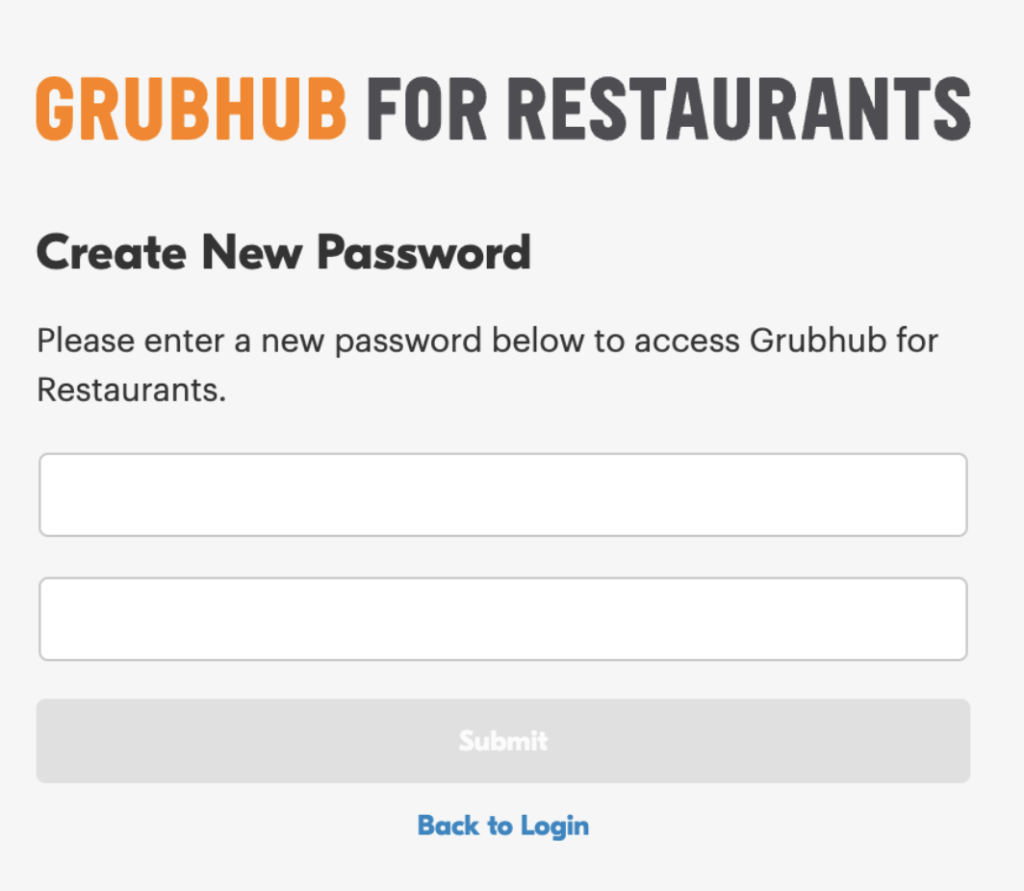
- Click on Create your password.
- Select a new password, confirm it and click Submit.
- You should be automatically redirected to restaurants.grubhub.com
- Use your new password to log in to Grubhub for Restaurants.
- Go to restaurant.grubhub.com
- Type in your username (your email address).
- Type in your password. You can choose to select Remember me, which will save your password so you don’t need to type it every time you log in.
- Select Sign in
Learn more about adding other users who can assist in editing your account.
If you do not receive the login email, contact your sales representative.
How to log in to your Grubhub for Restaurants admin account for the first time
With a few days of going live on Grubhub for Restaurants, you should receive an email to login to your account if you are an admin. Review the steps below to reset your password for your Grubhub for Restaurants account.
Note that depending on your account access, you may have different GFR account capabilities (basic vs. admin). Restaurant managers are typically given admin access, and can set up basic access for their staff within their account. To learn more about basic access, reach out to your restaurant manager.
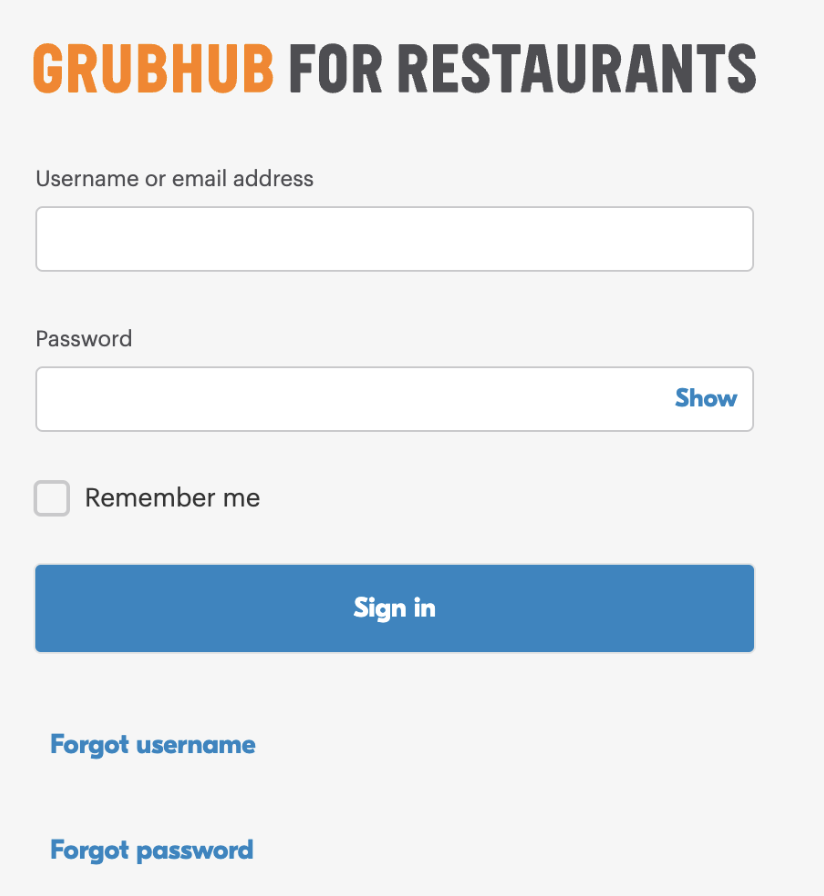
- Visit restaurant.grubhub.com/login
- Enter your username, which should be your email address associated with your Grubhub for Restaurants account. This applies to both basic and admin accounts.
- Click on Forgot Password
- An email will be sent to you with instructions on how to reset your password.
- You should receive instructions in your email within the next few minutes.
- Click on Reset password within the email you receive.
- Create a new password and log in again with your same username and new password.
- Select Sign in.
- Note that access to your Grubhub for Restaurants account may look different depending on whether your account has basic or admin access. For more information on access, reach out to your restaurant manager.
Learn more about adding other users who can assist in editing your account.
If you don’t receive the login email or still have issues, contact your Account Advisor, or, if you haven’t gone live on Grubhub for Restaurants yet, contact your ROI rep.
Forgot Password or Username
If you forget your password or username, select Forgot username or Forgot password, and additional instructions will pop up on the screen.
If you forgot your username, reach out to your restaurant manager and ask them for the login. If you are unable to contact anyone else who can edit your account and provide the right username, contact Grubhub Restaurant Care at 877-799-0790.
Sign Up with Grubhub
Not yet signed up with Grubhub for Restaurants? Get started using the button below and start getting more orders for your business.


How to get your restaurant ready for football’s biggest night
With the nation’s biggest pro football event just weeks away on February 12th, it’s time to draw up a game day menu for this year’s festivities. After all, football’s biggest night could make an even bigger impact on your restaurant’s bottom line.
Of the $14.6 billion spent by fans during last year’s game, 79% went toward food and beverages. ¹ A significant part of that spending goes toward restaurant delivery orders — on Grubhub, this January day was one of the most popular days for delivery in 2022 Gear up for game day with these fan favorites as well as a few tips on how to handle the rush of orders that are sure to come your way.
3 tips to win football’s biggest night
As you look forward to the ultimate championship football game, it’s important to come prepared with a plan. Create a solid game day strategy in advance and you can execute it effortlessly when football Sunday rolls around.
1. Create a winning menu
When you’re preparing your delivery menu for the biggest football game of the year, focus on food that’s easy to eat in front of the TV. Start with classic meals that you can eat with your hands: nachos, tacos, soft pretzels, pizza, wings and burgers, for example. You can also help your customers take their tortilla chips to the next level with a selection of delicious dips. Spinach and artichoke dip, beer cheese, Buffalo chicken and guacamole are always crowd favourites.
Fans love to snack when they’re gathering to watch the game, so it doesn’t hurt to be a little indulgent when you’re designing a menu for football’s biggest night. Don’t forget to add a few healthy options, too, especially if your typical menu is centered on fresh, health-conscious dishes. Consider lighter fare such as your chef’s special winter salad, baked chicken fingers, or a gorgeous crudité platter with house-made hummus or dill dip.
Alcohol delivery is also a popular offering during the big football game. Provide your customers with a safe way to enjoy a beer or cocktail by stocking your menu with drinks. Bottled or canned drinks are easy to transport; you can spice up your usual alcohol options with a special seasonal brew.
No matter what you include on your game-day menu, exclusivity is key — when certain dishes are only available on game day, it gives customers extra incentive to order. With Grubhub, it’s a breeze to make your special menu available for delivery during specific times. That way, you can promote the football-friendly menu as a limited-time offering for the big day. This feature helps your kitchen staff prepare for the rush of orders and ensures the menu automatically returns to normal when the game is over.
2. Score specials
Football’s biggest night is a popular time for restaurant delivery, so competition for orders can be steep. After you design a football Sunday menu, it’s also important to think of ways to help your restaurant stand out from the crowd. One option is to offer irresistible game-day specials. Everyone loves a good deal, especially when they’re ordering for a crowd. If you can provide football-friendly meals and a way for diners to save money, you can create an advantage over restaurants that are charging full price.
When customers are ordering delivery, it’s usually because they want to save time. Make their lives even easier by offering game-day packages — create a bundle of dishes and offer them for a fixed price. You might include a variety of appetizers or create a full meal package with an entrée, snacks, and dessert. It’s an easy way to feed a crowd, so customers can organize an impressive football viewing party with minimal effort. Make the package even more appealing by including serving platters, utensils and napkins.
- Advance ordering discounts: Offer a discount for people who place game-day orders in advance. Customers can relax knowing their menu is ready to go, and the extra notice gives your kitchen crew time to plan and prepare certain items before the big day. It also streamlines the ordering process so you can ensure the storeroom is fully stocked.
- Free or discounted items with purchase: Encourage customers to order more by offering a discount on a second item. You can provide a lower price on a dessert with the purchase of a wing platter or create a deal where diners get three dips for the price of two.
- Dollar amount perks: When customers spend a certain amount of money, offer a special perk. Provide free delivery for orders over $100, for example, or send a free dessert when a customer spends $50. Or, consider offering a 10% discount on all orders over $150.
- Football food discounts: Choose a few game snacks and create a limited-time discount. If your wings are popular with diners, offer a selection of wings for 15% off on game day. Another option is to give 10% off your usual super-sized appetizer platter.
Once you select a game-day special, make sure to promote it. You can also get the word out to new and existing customers using the Smart Promotions and Loyalty tools through Grubhub marketing.
3. Go mobile
If your restaurant’s ordering system depends on phone calls or a web-only option, it’s time to set up a mobile ordering system. Customers love the convenience of ordering from an app, especially if it’s one they already use. This is particularly true for millennials — nearly 40% of millennials have ordered delivery or takeout using their smartphones.²
To capture these tech-savvy diners during the most-watched football game of the year, it’s helpful to find a partner such as Grubhub. You can set up your restaurant’s menu within the Grubhub system so it’s available on the website and via the mobile ordering app. When a diner decides to order food for a party or a last-minute game-day gathering, your restaurant will appear as an option. The top-notch ordering experience can build exposure among new customers, increasing the chances that your restaurant will be a go-to for football-game festivities and everyday ordering.
While you’re thinking about mobile menus, consider other ways to reach customers while they’re scrolling on their phones. Promote your special football menu on your social media profiles and send it out to your email list. You can even include a link to your Grubhub menu so diners can order right away.
To give customers even more opportunities to order from your restaurant, expand your web presence with Grubhub Direct. This service enables you to create a branded ordering website that you can link directly from your emails and social media profiles; you can even integrate it into your existing website. Orders through a Direct website are commission-free, so you keep more of the profit. Plus, when you make an update to your Grubhub menu, it automatically updates your ordering website.
Feed hungry fans with Grubhub Delivery
The biggest night of football is fun for fans, but it’s also a lucrative opportunity for your restaurant. By creating a game plan and loading up your delivery menu with delicious snacks, you can increase revenue and keep hungry diners happy. If you’re ready to reach new customers and expand your business, sign up for Grubhub delivery today.
¹National Retail Federation: Super Bowl Spending Survey
²Oracle — Millennials and Hospitality: The Redefinition of Service