
How to franchise a restaurant like a pro
When you run a successful restaurant, it’s not uncommon to receive franchising requests. The prospect can be attractive — allowing other people to open restaurants under your brand brings in more profit without the work and risk of running other locations yourself. Before you make the decision to franchise a restaurant, be sure to understand the process, the advantages and disadvantages.
What is a franchise?
A franchise is a type of business where a company owner, or franchisor, licenses their company name and brand to other people. These franchisees open their own locations with support from the parent company. In return, they usually pay the franchisor start-up fees and a percentage of the monthly profits.
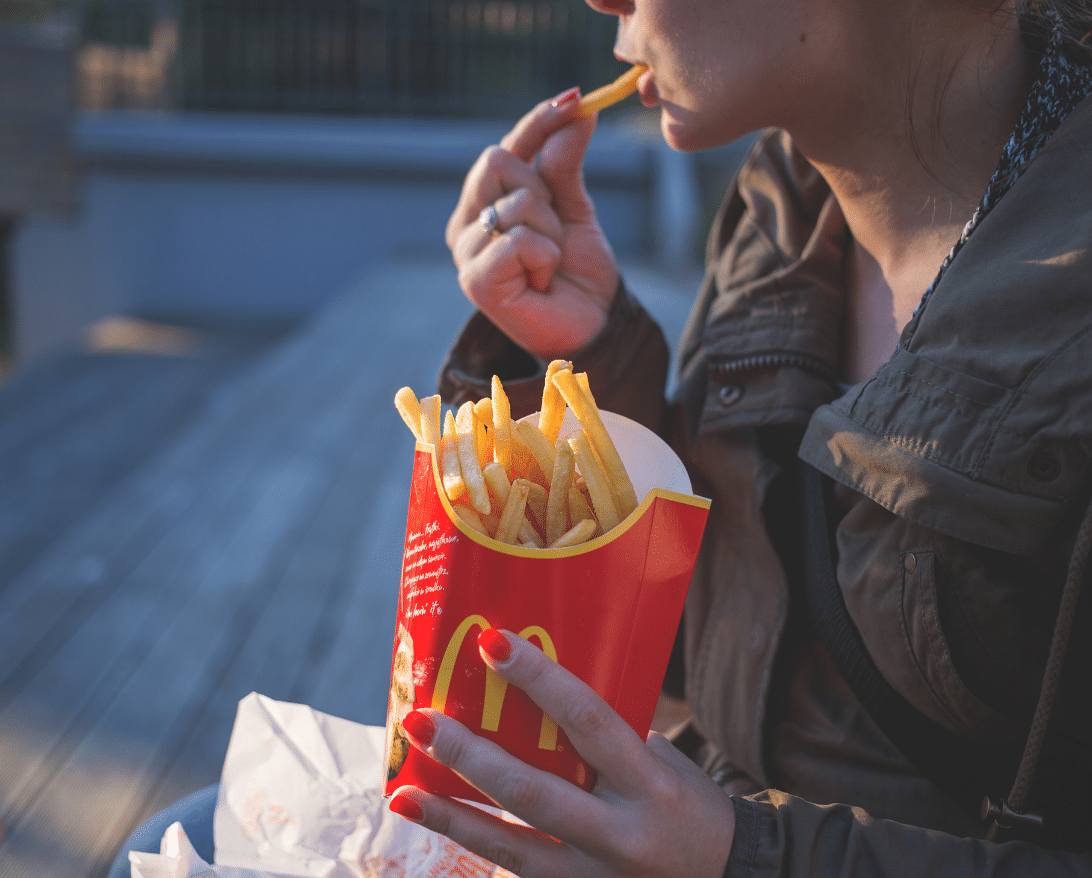
McDonald’s is an example of a successful restaurant franchise — 95% of the company’s US locations are franchised. Each location has the same decor, branding, menu, and design as other McDonald’s locations, but they’re owned by different franchisees.
Many popular restaurants use a similar model, particularly in the fast-food industry. Auntie Anne’s, Taco Bell, Arby’s, Chick-fil-A and Subway are all franchise businesses.
It’s important to note that a franchise is different from a chain restaurant, such as Starbucks or Chipotle. In a chain, new locations are owned and operated by the parent company. Some businesses use a hybrid model that embraces both franchising and corporate-run branches.
Pros and cons of franchising your restaurant
Like any other type of business, restaurant franchising has both pros and cons. As you decide whether to run a franchise restaurant or an independent restaurant, it’s important to consider both sides.
Pros of franchising restaurants
All restaurants come with a certain amount of risk, but franchises have significant advantages that can help parent companies and individual owners reduce uncertainty.
- Faster start-up. New restaurant franchise owners typically receive support from the franchisor to streamline the start-up process. Depending on the business, this might include guidance on finding property, choosing or constructing a building, buying equipment, designing the interior, hiring staff and creating a menu. These established practices save a great deal of time and money, which means the location can open and start turning a profit in less time.
- Including branding. As the parent company, you provide all the marketing materials and branding elements to franchisees. This process lets you maintain control over the brand.
- name recognition. Franchisees don’t need to worry about building an audience from scratch. Because they’re licensing your existing brand name, they gain access to an existing customer base. This can reduce purchasing barriers and make it easier to secure sales.
- Easier operation. You can provide franchise owners with access to your existing advertising, supplier and support network. With these resources, they can run the business without expensive trial and error. The built-in support is especially helpful if you want to attract owners who are new to the restaurant industry.
- Streamlined expansion. Franchising lets you build your brand without the level of investment that’s required to open company-run branches. While other people run individual locations, you still make a profit.
Cons of franchising restaurants
Franchises don’t operate like traditional restaurants, so make sure to understand the drawbacks before you license your restaurant’s brand.
- Ample oversight. To maintain the integrity of the brand, you’ll need to spend a great deal of time and money monitoring individual restaurant franchise locations. If issues arise, you must manage disputes and pursue legal recourse, if necessary.
- Strict requirements. Before you can franchise your restaurant, you’ll need to establish strict requirements. Some companies look for franchisees with experience in restaurants or commercial real estate development. Others require new owners to have a minimum net worth and the ability to pay start-up fees without borrowing money. These qualifications reduce risk, but they also make it more challenging to find qualified entrepreneurs.
- Fees and royalties. Franchises come with a variety of fees, but even so, it takes time for the parent company to realize a profit on a new restaurant franchise.
How to franchise a restaurant
If you own a successful business, franchising is one way to expand your brand. You won’t own each location, but you’ll still receive a percentage of the profits. Learning how to franchise a restaurant takes time; the process varies but usually includes a few common steps:
- Standardize operations. A successful franchise restaurant is one that can be easily recreated by another owner in another location. Standard operating procedures are key — by standardizing and documenting each process in the business, you can help franchisees maintain the same quality and customer experience. You should have solid, repeatable processes for all common tasks, including ordering, inventory management, food service, food preparation, staff training and reporting.
- Claim your brand. Protect yourself and your brand from legal issues by trademarking the company name, logo, tagline and any other prominent identifiers.
- Build a franchise plan. Work with an attorney, a business analyst, and a financial planner to create a basic franchise plan. These professionals can help you analyze property costs, sales data and financial forecasts. With that information, you can determine the franchise fee, start-up costs and required capital. It’s also important to establish requirements for the owner, property, and equipment.
- File a franchise disclosure document (FDD). Use your franchise plan to create this overview document, which is required by the Federal Trade Commission (FTC). The FTC’s format is designed to provide potential franchisors with all the information they need to make a decision. You’ll need this document whether you’re franchising a fast-food or fine-dining brand; in some states, you must file or register the FDD.
- Write a franchise agreement. Have your attorney draw up a legal contract between you and your franchisees. It should spell out the responsibilities of each party in detail so everyone is clear about what to expect. The document should also explain the consequences if you or the franchisee fails to meet one or more obligations.
- Create franchisee resources. Build a resource library to help guide franchisees through the process of opening and operating a business. You might include information about finding property, choosing equipment, working with preferred suppliers, getting required permits, training employees, handling conflicts and managing revenue. If possible, create a forum or communication system that enables franchisees to support each other.
- Establish brand guidelines. Make sure each franchisee represents your brand accurately with clear, specific brand guidelines. This might include rules for social media, logo files, menu templates and interior design requirements. Be sure to explain exactly when and if franchisees have room for creativity in marketing and advertising and when they must follow established standards.
The cost of franchising your restaurant depends on attorney rates, state filing fees, and the complexity of your operations. Costs could range from $15,000 to more than $125,000.
Is franchising right for you?
Learning how to franchise a restaurant is just one way to grow a food-industry business. You can also expand your current location or open additional restaurants in other areas.
Franchising might be right for you if:
- Your business runs on standard operating procedures.
- Your menu is easy to replicate.
- You have a reliable and established network of suppliers.
- You’ve received numerous inquiries from potential franchise owners.
- You have the resources to manage and communicate with each franchisee.
- You want to diversify your income streams.
- Franchisees can open a restaurant for a reasonable price.
Grow your restaurant with a trusted partner by your side
If you’re hoping to franchise your restaurant, either now or in the future, it’s important to build a solid foundation. Adding delivery or using a ghost kitchen can help you develop recipes, bring in new customers and increase brand awareness — all of which make the business more attractive to prospective franchisees. Grubhub can help; to learn more, sign up for a free trial.

How to Create a Compelling Kids’ Menu
Whether ordering in or eating out, mealtimes are often a family affair. Creating a menu specifically designed for kids makes the entire experience much easier for all involved. Does your restaurant have kids meals that have them asking for seconds?
The best children’s menus are both kid-friendly and parent-approved, so here are five kids’ menu ideas to help you please the whole family.
5 menu items you need in your kids meals
What makes a kids meal different from a regular menu is that it’s catered towards kids’ pallets, keeps portions smaller and often comes with a side. Parents appreciate when meals are holistic, keeping in mind nutrients and ingredients. Creating kids meals with a variety of popular mains and a choice of sides keeps kids full and parents happy.
Here are five dishes kids enjoy:
- Mac and Cheese
The gooey combo of melted cheese and macaroni noodles is one no kid can resist, making it a staple on any kids menu. Mac and cheese is the perfect item to let your chef get creative – use fun noodle shapes, combine cheese, add protein or finish with parmesan. Including a dairy-free cheese option or a gluten-free noodle substitute can help make sure this menu item can be enjoyed by all.
Spice up this popular “safe” option with healthy sides like chopped veggies or a cup of fruit. Parents will be thankful for the extra nutrition, and including a free side will make customers feel like they’re getting a good deal.
- Sliders and hot dogs
You can’t go wrong with hot dogs and hamburgers, no matter the season. Make this classic barbecue unique by serving it up in kid-friendly sliders. Offer turkey burgers or veggie dogs to accommodate those with dietary restrictions.
Provide a few sauce options so that the kiddos can dip their bite-sized mains into ketchup, honey mustard or an aioli. Giving kids the power to select what sauces they want can ensure you’re serving them what they like while avoiding wasting ingredients they won’t touch.
- Build-your-own tacos
The best way to satisfy picky eaters is to give them options, and tacos are the perfect food choice. Let kids pick from a variety of fillings, and bring out their choices in separate bowls. Provide a few mini tortillas so that the kids can experiment with their creations. Keep sauce portions small, and try toning down the spice level for young pallets.
- Chicken
While this game may seem basic, the preparation options are endless – keeping all types of little eaters satisfied. Stick to the classics with chicken fingers, or get creative with dino nuggets. You can also size down your most popular adult chicken dish to give kids a chance to try it in an approachable way.
A chicken dish isn’t complete without sides. Give a variety of fun and healthy options for kids to choose from like sweet potato fries, maple roasted carrots, parmesan broccoli or zucchini tots.
- Customizable pizzas
Pizza is another kid-favorite that is sure to be a kids meal hit. Want to take the classic cheese pizza to the next level? Give kids different topping options and create a fun design on the pie with their chosen toppings.
Save money on ingredients and limit food waste by creating an 8-10 inch personal pizza. If you want a healthy take on this quick service classic, try serving flatbreads or whole wheat crusts. Parents will appreciate the nutritional value, and kids may not notice the difference.
How to design a kid-friendly restaurant
Including the perfect kids meal dishes is just the beginning to create a kid-friendly restaurant environment. Here are some other ingredients you need in your recipe for success:
Offer Healthy Options
In kids’ food trends, we’re seeing staple menu items such as macaroni, cheeseburgers and pizza getting phased out in favor of more health-conscious options. Opt for alternatives such as veggies, fruit and lean meat, which are sure to win parental approval. Additionally, consider offering gluten-free or dairy-free options for kids with allergies or dietary restrictions.
Keep with the Theme
There’s no need to reinvent the wheel. Your kids’ menu doesn’t have to stray too far from your other offerings. Offer some of your staple choices in smaller portions that appeal to younger diners. This is especially important for older children who want to act (and eat) more like adults.
Offer combos (and allow for substitutions)
Allow kids to customize their kids meals by offering combo options. For example, let kids pick out their favorite entrée and two sides from a list of options. The best combo menus make it easy for parents and children to avoid certain ingredients – like gluten or meat – to easily accommodate dietary restrictions. If combos are a bit too complicated for your menu, you can still appeal to picky eaters by allowing for easy substitutions.
Keep it Punchy
Kids can have short attention spans, especially when it comes to making decisions. Long descriptions and wordy phrases can cause them to quickly lose interest. Keep descriptions short and to the point to please parents and budding readers alike. Eating is a full sensory experience. Add fun images to make the ordering experience even easier for the little ones.
Make the food fun!
Fun food for kids is key! There are plenty of ways to bring creativity into kids’ cuisine. Here are a few fun ways to make your restaurant kid-friendly:
- Make shapes out of fruit or faces out of veggies
- Use kid-friendly food coloring to play with color in items like drinks or bread
- Serve up your dishes on fun plates to encourage them to eat their meal to discover what’s underneath
- Pack kids take-out drinks in fun cups they can keep
- Create an interactive kids menu with games, coloring and crayons
- Provide high chairs to make it easy for kids to dine at the table
List your kids meal on Grubhub
Kids’ menu orders have grown 40% each year since 2012, which proves that kid-friendly foods are in high demand. Restaurants that can successfully enter those with little appetite will reap big benefits in the long run.
Are your kids meals ready to go? Partner with Grubhub to get your menu on Grubhub Marketplace so customers can enjoy your food on the go. Ready to reach new customers and grow your business with Grubhub? Signup today!
Restaurant health scores: preparing for a successful inspection
When customers are choosing where to eat, restaurant health scores are one of the metrics they use to gauge quality and safety. A high score is a vote of confidence that can give your restaurant a competitive advantage. It also helps you avoid fines and maintain positive relationships with local health officials.
What are restaurant health scores?
A restaurant health score is the rating the state or county health department gives your restaurant after an inspection. It tells the public how well you’re complying with local and state food safety laws. In many areas including New York City, restaurants are required by law to post their scores in a high-visibility location.
Health departments set their own grading scales; most use numerical scores or letter grades. Scoring can vary, but it’s always based on the state and local food codes. Usually, A is the highest score and C or D is the lowest.
In most states, county health inspectors visit every food service operation a few times per year and after every customer complaint. Inspections are usually unannounced to preserve the element of surprise.
During an inspection, the official looks for specific violations of state and local laws. For many violations, you’ll be given a short period of time to fix the issue. After that, the inspector makes a follow-up visit to verify you’re meeting compliance requirements.
Health departments don’t always publish a specific acceptable violation limit. Instead, they consider the overall risk to public or environmental health. If an inspector finds a restaurant poses an immediate health hazard, they’ll typically shut it down right away. This might happen due to multiple severe violations or a single large issue, such as a sewage backup. Before it can reopen, the restaurant owner must prove that they’ve corrected all issues. Inspectors may also shut down restaurants after repeated health-code violations.
How to prepare for a health inspection
The best way to prepare for a health inspection is to run a clean, compliant operation — after all, restaurant inspections can happen at any time. Keep in mind that officials determine your inspection score based on the number of violations, including common issues such as:
- Improper hand-washing
- Lack of hair restraints
- Inappropriate food storage temperature
- Cross-contamination
- Inadequate sanitation
- Expired foods
- Infestation of rodents or insects
- Lack of pest control
- Disrepair of restaurant facilities
If it’s been a while since your last inspection date, now is a great time to prepare your restaurant. To avoid violations, run regular self-inspections using this basic health inspection checklist:
- Train staff members in food safety standards.
- Make sure refrigerated foods are stored below 40 degrees Fahrenheit.
- Ensure freezers are at least zero degrees Fahrenheit or lower.
- Choose hot-food holding systems that are 140 degrees Fahrenheit or higher.
- Mark expiration dates and throw out expired foods immediately.
- Keep equipment and facilities in good repair.
- Establish food handling, cleaning and storage practices that prevent cross-contamination.
- Use thermometers to ensure meat is cooked to a safe temperature.
- Set up hand-washing stations and train staff in proper technique.
- Publish and enforce personal hygiene guidelines.
- Install leakproof garbage bins and remove trash frequently.
- Clean all surfaces and equipment thoroughly and regularly.
- Hire a pest-control service for regular visits.
Remember that the laws governing restaurant health scores can vary considerably from state to state. Make sure to check with your local health department for a location-specific checklist.
What’s so important about your restaurant health score?
Your restaurant’s health score is public information; its purpose is to help customers understand your establishment’s food safety standards at a glance. A high score reassures diners that your facilities are safe and clean. A low score is a red flag that erodes public confidence and reduces your revenue.
The health scoring system encourages restaurants to comply with food safety regulations. When more businesses practice safe food handling and storage, it improves public health, reduces the burden on environmental health services and benefits the entire community.
If your score is lower than you’d like, you can take action to boost it. Start with the violations in your last inspection report — identify the root of the problem and implement a permanent solution. Then, use your local health department’s guidelines to improve your kitchen, food service and front-of-house operations. Even small changes, such as standardized hand-washing rules, can help staff members stay compliant and ready for a surprise inspection.
A high restaurant health score is a sure fire way to maintain a positive reputation and stay compliant with local laws. By implementing standard operating procedures for a clean kitchen and safe food handling, you can welcome health inspectors with confidence.

March game day promotion ideas for your restaurant
The college basketball tournament is coming. 67 games, 179,560 heart-wrenching, bracket-busting, Cinderella-storytelling minutes of action – and your restaurant can’t miss a single one. With over 10 million people tuning in for each basketball game in 2022 there are endless opportunities to score big this March.
Use these tips on how to grow your business, along with Grubhub, to conveniently offer the delicious food, tasty snacks, refreshing drinks and other essentials your hungry diners need to enjoy every minute of the mania.
How to capture more customers on game days
While the college basketball teams battle it out all month long, fans are eager to build their own brackets and follow their favorite teams to the end. The college basketball tournament tips off on March 14, and in the championship game on April 3. That means you have over 20 days to reach basketball fans and encourage them to include your restaurant in their game day strategy.
1. Offer game day deals
Promotions are the easiest way to bring the fans to your restaurant and a great way to encourage on-premise and off-premise dining. An irresistible deal could influence a diners’ game decision and motivate them to order from your restaurant, especially for those who are balling on a budget.
Is your restaurant listed on Grubhub Marketplace? With Marketplace, your restaurant can easily deploy mouthwatering promotions. You can offer a dollar off or a percentage off an order, or gift your customers with free delivery or a free menu item. You can also use promotions to encourage diner loyalty all tournament long. While diners are watching the game and enjoying delicious food, offer them a deal on their next delivery order to enjoy the next game.
Your game day deals can encourage in-person patronage as well.
Is your restaurant located near a college or university? College basketball is a perfect opportunity to get students to stop by. Offer a student discount for those who show you their student ID. Your restaurant can even host a tournament bracket contest where customers with the closest to perfect brackets win a prize.
If your restaurant is the perfect location for game day viewing, offer deals that will keep customers coming back all month long. Go old school and give out punch cards to diners that they can bring each time they visit your restaurant. After five punches, they can get a drink, an appetizer or even a meal for free. Make sure your restaurant is ready for game day viewing – that means televisions, plenty of seating and a stocked bar. You also want to schedule your staff to cover the game time crowd.
2. Create a special game-day menu items
It’s not just the fans cheering who can have all the fun. Use the tournament to create special game-day food bundles and party packages in your delivery menu on Grubhub. Include restaurant favorites or name each combo after one of the NCAA teams playing. Appetizers are likely to be the winning item, so make sure to prepare for larger volumes of orders.
What menu deals are sure to be a slam dunk?
- Game day basketball are great additions to your take out and delivery menus. Feed a watch party with shareable appetizers and drinks.
- happy hour deals score big during the March tournament. Start your happy hour earlier to align with game schedules.
- Team-themed drinks and dishes not only make your restaurant a big tournament contender, but also give you the opportunity to creatively rebrand your menu items all month long.
Is your restaurant located in a team’s homebase? This year there will be games hosted in over a dozen cities across the country. For the fans who made it to the watch party, offer a free drink if your team wins! Or better yet, if they lose, nothing cures the basketball blues like an ice-cold beer, right?
3. Use alcohol to increase online order sales
There’s no doubt alcohol plays a part in the madness this March. As a restaurant, this is a perfect time to promote your drink offerings.
Offering beverage delivery can be a buzzer beater shot that can put your restaurant on top. What are the top drinks during the March tournament? Beer is a must for any game day menu. Canned hard ciders and seltzers are also popular among fans and are easy to add to a delivery order. It’s also a good idea to offer cocktails – you can get creative and make themed cocktails based on the teams in the tournament. Take a look at more tips on how to optimize your restaurant for beverage delivery.
Adding alcohol and cocktails has become a huge opportunity for restaurants on Grubhub to easily increase the average order volume by a whopping $14-15. Read how restaurants are incorporating the latest to-go cocktail trends in their Grubhub delivery strategy.
4. Encourage online dining engagement
It’s no doubt that in order for restaurants to be successful, a strategic online presence is vital, especially during tournament season. In fact, 52% of March basketball tournament viewers were active on social media during the games last year. Twitter is a big hub for basketball fans, with tournament related topics reaching over 576,000 engagements and 1.57 billion impressions.
Does your restaurant have a winning social media presence? Easily connect with your audience online by taking part in the March mania on social media. If your restaurant has that perfect game-day setup, use social media and your restaurant’s website to promote viewing parties on-premises. Get your diners involved by creating a bracket of your restaurant’s best appetizers for hungry customers to vote on which will be half-off on their game day delivery orders.
Use Canva to find tournament-themed graphics and create shareable content to get your restaurant noticed. Check out more tips on how to grow your social media presence.
No restaurant’s digital presence is complete without online ordering. That’s why many restaurants are turning to Direct, our customizable online ordering site that is completely commission-free. With the ability to download diner data and reach out to those owned customers on their own, Direct restaurants are using this data to target loyal customers and boost their orders.
Promote your online ordering platform and restaurant’s website on your social media to turn curious scrollers into raving fans of your food.
What type of tournament promotions should your restaurant run?
It doesn’t matter what type of restaurant you run, there are opportunities to get in on the March tournament madness. Games start in the early afternoon and stretch into the night, giving more opportunities for restaurants to get in on the tournament.
Bars and pubs are the most popular spots for basketball watch parties. The casual atmosphere, big screen TVs and the flow of alcohol and appetizers make for a perfect spot to watch all the action unfold. If you run one of these establishments, encourage customers to dine in and stay awhile while they watch the game at your restaurant.
If you run a casual or a fast casual restaurant, the tournament is the perfect time to double down on delivery. While you may not have the space to host a watch party, your restaurant can still be the center of at-home gatherings if you offer to-go deals. Want to expand your delivery before tipping off? Partner with Grubhub to get your to-go offerings in front of more customers.
Make this tournament season a slam dunk with Grubhub
No matter what restaurant you run there are dozens of opportunities to get in on the basketball madness this March. 92% of basketball fans said they plan to purchase food from bars or restaurants during the game. Turn customers into loyal fans by giving them opportunities to score delicious deals.
Need a teammate to help your restaurant grow? Partner with Grubhub today.
How to leverage customer data for your restaurant
Restaurant owners have endless data at their fingertips from a variety of sources — point-of-sale (POS) systems, marketing platforms, inventory trackers and scheduling software, to name a few. But do you know how to use this data to your advantage?
While it might take some time to understand up front, data analytics can help position your business for long-term growth. By learning how to categorize, collect, and use customer information, you can improve your marketing and build stronger customer relationships.
What are the four types of restaurant customer data?
When you start working with customer data for your restaurant, the sheer volume of information can feel overwhelming. It’s helpful to break everything down into categories:
- Identitydata covers basic information about your diners, enabling you to find your key demographics and spot opportunities for audience expansion. It includes things such as a customer’s name, age, birthday, location, ethnicity, gender, phone number and email address. Depending on your restaurant’s goals, your database might also include information about the customer’s family. You can take identity data a step further to add socioeconomic information such as job title, industry and approximate income.
- Engagement data includes details about how, when and how often customers interact with your restaurant. You can collect this information from your POS system or the analytics that are connected to your website, social media platforms or email marketing program. Useful metrics include website traffic, marketing email open rate, behavioral flow, click-through rate and conversions.
- Behavioral data covers the different ways diners engage with your restaurant. It could include order history, average order value, participation in loyalty programs and use of delivery promotions. On a broader scale, this data can also incorporate things such as email newsletter sign-ups and unsubscribes, creating an account on your delivery system and engagement on different types of devices.
- Attitudinal data involves customers’ attitudes toward your restaurant. It helps you track the opinion of your brand across your diners, the public and specific segments of your audience. For restaurants, it might cover the performance of a menu item, customer reactions to a price or feedback about a seasonal dish. This information typically comes from customer surveys, comment cards, online reviews and complaints.
How to capture customer data
Data can help drive everything from marketing to menu design — but first, you have to collect it. There are many ways to capture data; some are automatic, while others require direct input from your customers.
If you’re new to data analysis, it’s often easiest to start with hands-off data-collection solutions. These systems run in the background, gathering information until you’re ready to use it. Popular options include Google Analytics, which gathers website data, and social media analytics to help you track how customers interact with your profiles and posts.
To collect delivery data, try Grubhub Direct, a service that lets you set up a commission-free online ordering website for your business. As soon as your customers start ordering through your Direct site, the system automatically captures details such as order history, average order, purchase frequency and contact information. Since you own the data, you can download it for free, engage with customers directly and build one-on-one relationships.
When your automatic systems are running, try asking your diners for direct feedback — individual reviews tell you exactly what customers think. Request reviews in person, mention it in your marketing emails and make the request via social media. If your restaurant is on the Grubhub platform, customers can leave feedback after every order. With Grubhub Premium, you can even respond to ratings and reviews to build trust and show you’re serious about creating the best experience possible.
You can also encourage reviews by creating a Google Business profile. Customers can upload photos, rate your restaurant and leave comments. The rating is visible when someone comes across your restaurant through a Google or Google Maps search; a high rating can boost engagement and bring in new diners. Make the most of your Business profile by:
The physical activity in your restaurant is another important data source. Capture information by tracking restaurant capacity and orders per hour. Then, use the data to improve operations. When you understand how order volume and dinner numbers fluctuate throughout the day and week, it’s easier to adjust staffing to meet the demand. Efficient scheduling keeps labor costs in check and ensures employees’ workloads are reasonable.
5 tips to take advantage of customer data
Now that you know how to capture customer data, the next step is to use the information to improve your restaurant operations – and ensure customer satisfaction.
1. Create a customer loyalty program
Loyalty programs can help you collect and use customer data. Diners must sign up to participate, so you can record their names, contact information and order history. As you start to create personal records for each customer, use the data to reward and encourage repeat business:
- Track order value and provide a discount coupon after customers spend a certain amount over time.
- Monitor order frequency gaps and use them to trigger an automated “we miss you” email.
- Work with your delivery platform to offer a deal after a certain number of orders.
Check out more strategies for creating a restaurant loyalty program that stands out.
2. Send targeted promotions
Customer data gives you the power to personalize your marketing efforts. If you’re tracking a customer’s orders, for example, it’s easy to identify the items they order frequently. With that information, you can recommend new menu items, create targeted upsell offers or send customized discount coupons for the diner’s favorite meal.
Order times can be helpful, too. If you know a specific customer often comes in for lunch on Friday at noon, you might schedule a marketing email for 10 am to encourage them to choose your restaurant over a competitor.
Data is particularly useful within your delivery system. Use it to suggest items customers might like, offer a special discount for a larger order, or provide a free item with the purchase of another item. Services such as Grubhub Premium make it easy to access both promotion and loyalty tools to increase exposure and maximize the benefit of customer data. For example, if a quesadilla is your most popular item, consider offering a 10% discount to motivate diners to add it to their cart. Learn more about how you can run promotions on Grubhub.
3. Establish contacts
Once you have a customer’s contact information, use it to create and maintain an open line of communication. Put diners’ email addresses into a mailing list, and send out regular newsletters to promote new specials and announce seasonal menus. To prompt people to come in or order delivery, provide exclusive discount codes or special deals. Depending on your target demographic, you can also send coupons in the mail.
Regular contact can boost business returns, but it also keeps your restaurant top of mind. It’s a good way to announce changes that affect customers as well — holiday hours or a new location, for example. When you’re consistent with the frequency and personality of marketing emails, they can help humanize your brand and make diners feel they’re part of a community.
If you need to start collecting email addresses, there are several ways to go about it without seeming pushy. The trick is to find an incentive that’s appealing enough to get guests to hand over their email. Offer a free dessert to people who join your mailing list, invite social media followers to enter a contest, or require an email to sign in to your restaurant’s Wi-Fi.
4. Show appreciation
Tracking individual data helps you understand your customers on a deeper level. In fact, you probably know more about them than their coworkers. Use that data to show your appreciation and build a positive, lasting relationship. Some options include:
- Send a birthday discount code.
- Include a surprise treat for repeat customers.
- Celebrate the sign-up anniversary for loyalty-program members.
- Host an exclusive tasting or thank-you dinner for loyal diners.
No matter how you show thanks, receiving a special discount or bonus can mean a lot to a customer. Take a look at more ways you can show your customers you appreciate their business.
5. Get social
Social media is critical for restaurants — customers use platforms such as Instagram and TikTok to research restaurants and find exciting new dishes. To make sure your posts are getting in front of the right people, analyze customer data to find out where your target customers spend time online.
Different demographics tend to use different platforms. If you want to reach younger people, consider building a presence on TikTok or Instagram. For an older audience, you might want to double down on your Facebook posting strategy. Then, use your profile to build connections:
- Post videos of new dishes or tempting desserts.
- Release food posts when customers are thinking about their next meal.
- Offer discounts for social media followers.
Check out more tips on how to make your social media pop.
Take control of your customer data with Grubhub
At Grubhub, we understand how data can be powerful for restaurants. We’ve looked into customer data and trends to help independent restaurants like you understand your diners. Dive into our Technomic report where we dig into current online ordering trends and tips for independent restaurants. Take a look at Grubhub’s #2022Delivered to get a look into customer’s ordering habits and cuisine preferences.

Customer data is one of the most valuable tools you have to market your restaurant. The right information enables you to personalize marketing, build relationships, and boost loyalty. If you’re ready to streamline your data collection and marketing for delivery customers, try Grubhub today.
What you need to know about POS Integration
Point-of-sale (POS) integration remains a hot topic among restaurant owners, and for good reason. In its 2016 POS Software Trends Report, Hospitality Technology revealed that more than half of restaurants want to be integrated with their POS systems. Since then, the idea has only picked up steam.
Point-of-sale (POS) integration remains a hot topic among restaurant owners, and for good reason. in its 2016 POS Software Trends Report, Hospitality Technology revealed that more than half of restaurants want to be integrated with their POS systems. Since then, the idea has only picked up steam.
By bringing together various restaurant operations, POS integration helps you better manage staff, access more intelligent business insights and increase efficiencies. And now, Grubhub is bringing its own online ordering capabilities to some of the leading POS systems, including Breadcrumb POS from Upserve, Toast and MICROS, to help restaurant owners integrate their delivery and takeout services with their business.
Curious if this is the right move? Check out three things POS integration can do for your restaurant.
If you are already a POS integrated Grubhub partner, read below to learn more about how to manage Grubhub operations through your provider- or sign in to your Grubhub for Restaurant’s account and navigate to the Help Center for additional guidance.
What does POS integration mean for my staff?
From preparing memorable dishes to maintaining a top-notch dining experience, front- and back-of-house staff members already have a lot on their plates. Help them make the most of their time in the kitchen by integrating your management operations with your POS system.
Not only can the right integration save your staff the trouble of taking orders, but it may also clear countertop space previously occupied by other ordering devices. Perhaps even more importantly, POS integration means you’ll only have to train your staff on one system, saving you tons of time.
Can it make a difference in my restaurant’s bottom line?
Regardless of whether you’re a quick service restaurant or more of a fine dining establishment, chances are you’ve struggled to schedule the right number of staff members for each shift. But with POS integration, you’ll have the luxury of kissing those problems goodbye.
By improving restaurant management efficiency, POS integration can help you deliver more orders without bringing in extra staff. More consolidated finances also enable you to take care of complicated tasks – such as balancing the books or managing tips – with ease.
I like to switch up my menu often, is that something a POS integration can help with?
Whether you’re adding daily specials or incorporating seasonal ingredients into crowd favorites, a POS integration may help speed up the process. When integrating your POS with Grubhub, those menu changes will automatically be reflected every time a front- or back-of-house staff member updates your menu.
How else can I manage Grubhub operations through POS integration?
In addition to updating your Grubhub menu directly through your POS provider, you will also be able to:
- Add menu photos
- Receive and fulfill orders
- Make order adjustments
- Adjust hours of operation
- And more!
Reach out to your provider for further assistance on how to take the actions outlined above.
Ready to reach new customers and grow your business with Grubhub? Signup today!
What POS integrations are capable on Grubhub?
We partner with many POS providers, including:
- Aloha
- Brinker
- Checkmate
- Chick-fil-A
- Chipotle
- Chowly
- Deliverect
- McDonald’s
- lol
- Omnivore
- Panera
- Sicom/RBI
- Taco Bells
- Toasts
- Wendy’s


Grand Gateway Hotel owner claims she can’t get a fair trial in Rapid City

The Grand Gateway Hotel at 1721 N. Lacrosse Street in Rapid City.
Matt Gade, Journal staff
One of the owners of the Grand Gateway Hotel, who allegedly sprayed a chemical at protesters, wants her triple assault case moved to another venue, claiming she is unable to get a fair trial in Pennington County because of media coverage.
An attorney representing Connie Uhre, 75, requested Friday that a Pennington County judge move her triple simple assault case to Fall River County, arguing that media coverage and social media posts have tainted the jury pool.
The Grand Gateway Hotel in Rapid City and Uhre received national media attention following racist comments in March 2022, multiple protests against the business and two federal discrimination lawsuits.
“This is pretrial publicity times ten,” Shawn Tornow told Magistrate Judge Scott Bogue Friday afternoon. “It would be unreasonable not to change the venue.”
Tornow submitted a six-page brief on Dec. 14 asking the court for a change of venue accompanied by a 42-page affidavit in an effort to prove that the social media involvement and media interest in the case has made it impossible for Uhre to have a fair trial in Pennington County.
People are also reading…
Connie Uhre’s motion to change the venue of her case to another county.
Shalom Baer Gee
The affidavit included clippings from the Rapid City Journal and other local media, as well as social media content — including a Facebook message apparently to Uhre that states, in part, “I hope every single business you guys own burns to the ground.”
Tornow appeared on behalf of Uhre, who is facing three misdemeanor counts of simple assault after she was arrested on May 27. She faces up to one year in a county jail and a $2,000 fine for each count if convicted. She has appeared in court herself thus far.
In multiple videos from demonstrators at the NDN Collective picket line boycott event, Uhre could be seen getting out of her vehicle in the Grand Gateway Hotel parking lot and spraying at least three demonstrators with Pledge, a cleaning spray. At least one demonstrator was sprayed directly in the face.

Connie Uhre, 75, owner of the Grand Gateway Hotel, is shown spraying a Native American demonstrator with a cleaning product. Uhre was arrested on three counts of simple assault.
Video capture
In one of the videos, Uhre tells the Native American demonstrators that the spray substance is “bug spray.”
The NDN Collective held the protest and boycott in response to comments Uhre made following a shooting on March 19, 2022 at the hotel involving two young Native American men who ultimately resulted in a murder case after the injured man died.
After the shooting, Uhre posted comments on Facebook saying she would “not allow a Native American to enter our business including Cheers (a bar on the property)” because she can’t tell “who is a bad Native or a good Native.” The comments have since been deleted.
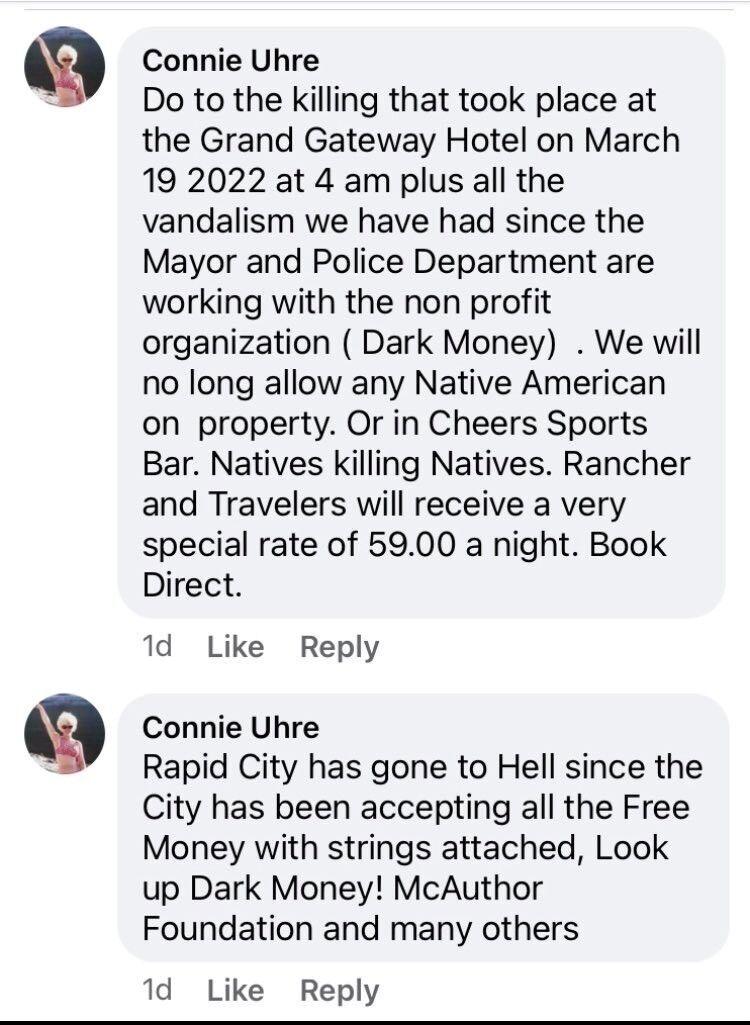

The situation garnered local and national attention and ultimately led to the US Department of Justice filing a federal discrimination lawsuit against the parent company of the Grand Gateway Hotel, the Retsel Corporation. It alleges that Uhre and her son, Nicholas Uhre, discriminated against Native American customers in violation of Title II of the Civil Rights Act of 1964.
The lawsuit alleges that on at least two occasions on March 21 and 22, the defendants turned away Native Americans who sought to book a room in the Grand Gateway.

Katrina Colhoff, of Pine Ridge, holds sage while listening to the speakers at the Andrew W. Bogue Federal building on Wednesday, March 23, 2022 where it was announced that a federal civil rights lawsuit was filed against the Grand Gateway Hotel on North Lacrosse Street for denying services to Native Americans. The rally came just four days after a shooting early Saturday morning at the Grand Gateway Hotel on North Lacrosse Street.
Matt Gade Journal Staff
NDN Collective President/CEO Nick Tilsen announced March 23, 2022 that the organization filed a federal civil rights class action lawsuit against the Retsel Corporation for denying services to Native Americans.
At the time, Tilsen said the NDN Collective sent Sunny Red Bear, then the director of the racial equity campaign for the collective, to the hotel to book a room and she was denied. They then sent the Alberta Eagle director of operations to book rooms on behalf of the organization. He said Eagle was denied and removed from the lobby.
Red Bear, now action organizer at NDN Collective, is one of the alleged victims in the simple assault case against Uhre. She was present in the courtroom on Friday.
She told the Journal that she and the other victims were not notified of the defense’s motion for a change of venue or of the hearing.
“We don’t have a copy of the motion or anything. Just not being informed of what is happening. These are our rights and our rights are still being violated,” she said.
Red Bear also told the Journal that she felt Uhre should have to face the community and that her lawyer didn’t have a solid case for moving the case.
“Social media is a powerful tool, but you can’t tell on social media who’s for it and who’s against it. So there’s gonna be people who are supporting her as well,” Red Bear said. “He just didn’t have anything solid. It was a lot of assumptions being made.”
Tornow added during his argument for the case to be moved to Fall River County that the community takes cues from leadership, citing Major Steve Allender’s public comments following the incident.
Allender was outspoken in his opposition to Uhre’s comments about Native Americans.
“Such statements pitted people and communities against each other, tying race into virtually every community issue and every attempt to address and resolve such issues,” Allender said at the time. “Connie Uhre’s statements are wrong and harmful not only to Native Americans but also to Rapid City businesses and the community at large. Such comments erase the progress that has been made over the last 60 years or so.”
Allender, local businesses, law enforcement and county and tribal officials issued a joint statement condemning Uhre’s comments at a meeting within days of the posts.
“Much work has been done to build a level of trust, to forge relationships and partnerships, and to address major issues involving Rapid City and our Native American community. However, such racist and hateful statements as expressed by a few individuals only reinforces long-term standing feelings of distrust and threatening the relationship of the Rapid City community with its Native American residents and visitors,” a portion of the statement read.
The city of Rapid City, Pennington County, Tribal and business entities condemn recent statements from the family that owns the Grand Gateway Hotel.
The state argued Friday that any issues with prejudice could have worked out during jury selection and coverage spanned the state — meaning a change of venue to Fall River County would not affect the outcome.
Bogue did not make a decision on Friday, stating he would take the motion under advice.
“It’s an interesting issue, the whole question of social media,” he said.
— Contact Shalom Baer Gee at [email protected] —