

Restaurant accessibility: How to run an inclusive restaurant
As a restaurant owner, you strive to make your restaurant welcoming to all customers. Yet without proper accessibility modifications, it can be difficult for those with disabilities to enjoy your delicious food. 61 million adults in the US have a disability. Prioritizing restaurant accessibility allows your business to be inclusive of all.
Designing an accessible restaurant can be daunting, but by following ADA standards you can provide a barrier-free dining experience for customers with disabilities. Not sure where to start? Take a look at our tips on how to make your restaurant accessible.
What is an ADA restaurant?
The Americans with Disabilities Act (or ADA) is a law that prohibits discrimination against individuals with disabilities in all areas of public life, including restaurants. The purpose of this law is to make sure public spaces are accessible for everyone, regardless of physical ability. This law also requires equal employment opportunities for individuals with disabilities.
Title III of the ADA directs businesses to make “reasonable modifications” to their operations when serving people with disabilities. As a business owner, you have a responsibility to make sure that your restaurant is ADA compliant. If you need to make alterations to your restaurant to improve accessibility, your business may be eligible for two federal tax incentives in order to fund the adjustments. There may also be state or local accessibility regulations for your restaurant as well.
6 tips to promote restaurant accessibility
Title III of the ADA states that restaurants must make sure their business facilities are accessible and meet federal standards. So what does accessibility look like? Take a look at these six tips on how to make your restaurant accessible.
1. Update entrances, exits and parking
Your customers’ restaurant experience begins before they even step foot inside. Patrons can’t enjoy your cuisine if they can’t get to your front door. Make sure that there is at least one route from your property’s arrival point to your restaurant that does not require the use of stairs. You may need to add an accessible ramp (less than a 2% slope), handrails or a lift.
If your business has parking, you must provide accessible parking spaces – including van accessible spots. You should have one accessible parking spot for every 25 spots in your lot. Check out ADA’s checklist to learn more about how many accessible parking spaces your restaurant needs.
The entrances and exits of your restaurant must accommodate different abilities. Your door should be able to open 90 degrees, and your entrances and hallways must have at least a 36 inch width. Check to see if your door handles and entrance ways can be navigated by people in wheelchairs. Not all buildings are the same, and the ADA outlines what policy your business should follow to meet the requirements.
2. Design an inclusive dining room
Once customers get through your door, you want to make sure they can navigate your restaurant freely. This means creating a 36-inch aisle to separate fixed seating. To meet the ADA requirements for wheelchair seating, 5% of your tables should be accessible.
Your goal is to make your dining room a comfortable space for everyone. You may consider reserving special hours for different groups like an early bird special for elders, a family-friendly dining hour or sensory-friendly events. Restaurants across the country are finding creative ways to make their business accommodate different needs, such as dedicating quiet dining areas for those with hearing or sensory challenges.
Accessible restrooms offer ample room for wheelchair users to steer around toilets and sinks. You may need to install an accessible stall with safety bars or add braille to your signage. The ADA further outlines how to design an accessible restroom.
3. Check service mobility
The way your restaurant is designed should allow people with disabilities to order and obtain food without assistance. If your restaurant offers self-service, it needs to be accessible. This means wide service spaces, reachable counters, accessible signs and an easy-to-navigate service route. If your menu is posted on the wall, have paper and online versions of your menu to accommodate those with vision impairments.
Customers of all ability levels should be able to get their food easily. Walkways should be at least 36 inches wide, and accessible check out counters must have a maximum height of 38 inches. Check that all your hallways, service routes, checkout stations and elevators comply with the ADA requirements.
4. Provide employee training
Thorough employee training is a must for any restaurant. Onboarding processes ensure that the employees clearly understand expectations and give them the confidence to perform their job successfully.
The ADA mandates accessibility in the workplace. Your onboarding process and materials should accommodate the various needs of employees with different ability levels. These training programs should be accessible for workers with disabilities, foreign language speakers and other demographics within your organization.
Your employee training should also give your staff the tools to accommodate all customers. This includes knowing where accessible tables are, asking diners about their allergies and any other accessibility procedures at your business. If a customer asks about accessible features, your staff should be ready to provide this information.
5. Create an accessible website
While the ADA does not address digital accessibility, reviewing the convenience of your website is good practice to ensure it can be navigated by all your customers. Following the Web Content Accessibility Guidelines (WCAG) international standards will allow people of all abilities to digest your content.
To start, your website should:
- Add proper alt text to images so it can be interpreted by screen readers or Braille devices
- Include headings, readable fonts, color contrast and white space
- Use descriptive URLs, photo captions and text
Don’t have a restaurant website? When you partner with Grubhub you get access to Direct, a commission-free online ordering site for your restaurant. Direct uses integrated management and branded customer experiences to make your operations run smoothly. It’s also easy to customize to reflect your brand while prioritizing an easy customer experience.
6. Design accessible menus
Designing accessible menus can help ensure that every customer can use your offerings. Accessible menus use design techniques and organization so that customers can read menus comfortably and efficiently, regardless of their abilities. Start by using a legible font on your paper menus, and make sure the menu pages are not too overstuffed. Following basic menu engineering tips will make your menus readable, logical and enticing.
Organizing your menu based on different classifications will make it easier for diners to navigate. Adding semantic markups to these classifications will also help those who use assistive technology to read your menu.
Technology has made it easier for those with disabilities to navigate digital menus. Creating a digital menu for your restaurant in plain text format (not PDF) will help those with assistive devices interpret your offerings. If you offer a QR code menu, keep some paper copies on hand.
Expand your reach with Grubhub
Prioritizing accessibility makes it possible for your restaurant to serve more customers. Offering takeout and delivery services can help expand your reach – allowing customers to enjoy your cuisine from the comfort of their home. When you partner with Grubhub you get instant access to 33+ million customers who are eager to order their next meal. Our technology can seamlessly integrate your POS system and simplify your menu management, increasing efficiency and reducing errors.
Ready to expand your restaurant’s reach? Partner with Grubhub today.

How restaurant AI can work for your business
When you think of restaurant AI, you might imagine a kitchen run by sophisticated robots. While automated chefs may be possible in the future, current restaurant technology solutions are focused on driving efficiency and improving the customer experience. Restaurants are using AI technology to streamline every aspect of operations, including ordering, delivery, back-of-house workflows and supply-chain management.
The best part? AI is readily available — in fact, you can start implementing it in your restaurant today.
How AI is being used in restaurants today
AI is everywhere in the restaurant industry; in many cases, companies are building machine learning into existing systems to create a more convenient and efficient process. Some of the AI tools in use today include:
- AI-enabled self-serve kiosks. Self-serve kiosks have provided a convenient ordering experience for years. With the addition of AI, they can deliver extra personalization — by recommending a menu item based on the person’s past orders, for example, or recognizing customer loyalty rewards. Restaurants, including Panera Bread, also allow customers to use kiosks to redeem subscription programs. Some kiosks can even scan a customer’s tray, identify the items and charge accordingly.
- AI-powered inventory management systems. This type of AI system analyzes your restaurant data to help you forecast inventory needs, order efficiently and ensure you always have the right ingredients on hand. Point-of-sales systems use this technology to improve the way you manage your business.
- Voice search. Some restaurants are integrating voice-powered virtual assistants such as Siri or Alexa into the ordering process. That way, customers can simply tell the system what they’d like to order — even if they’re driving home or doing household chores. As this technology evolves, voice AI might also be able to schedule restaurants or answer questions about the menu.
- Food delivery apps. Apps such as Grubhub use AI to deliver a seamless experience for guests and restaurants. The system can analyze data to offer compelling promotions and make personalized recommendations based on order history or customer preferences.
- Scheduling systems. AI-driven scheduling software tracks and correlates sales data, employee hours and individual performance. Then, it can recommend staffing levels, suggest schedules and identify opportunities for training and improvement.
Artificial intelligence is also helping food-service businesses improve the customer experience. One of the most futuristic applications is the self-driving robot — restaurants are using these small devices to run food from the kitchen or deliver food off-site. The robots add an element of fun for customers and reduce labor requirements. On a more practical level, restaurants can use AI to suggest wine pairings, ensure accurate customer orders and detect and prevent payment fraud.
Pros and cons of AI in restaurants
As with any new tool, AI technology has both pros and cons for restaurant owners and restaurant operators. If you’re thinking about implementing AI-driven systems, it’s important to understand the realities of the process.
Advantages of AI in restaurants:
- Reduce food waste by tracking stock and improving order accuracy
- Improve ordering and inventory management
- Create a more pleasant, convenient and personalized guest experience
- Improve customer satisfaction
- Save time for customers and restaurant employees
- Cut costs for labor and food waste
Disadvantages of AI in restaurants:
- Expensive to purchase and implement
- Extra training requirements
- Stored customer data creates privacy and security concerns
- Confusing operation for older guests
- Costly, time-consuming maintenance
How AI could impact the future of the restaurant industry
There’s no doubt about it: Restaurant AI is here to stay. If you run a food-service business, it’s important to track emerging and ongoing trends — that way, you can make smarter investment decisions and keep up with the technology as it changes the restaurant industry.
Based on the latest AI trends in restaurants, it’s safe to expect tech companies to direct their attention to solving common industry problems. One pressing issue? Labor shortages. AI technology has the potential to reduce the number of employees restaurants need to operate at full capacity.
- Fully automated drive-throughs: Using voice-recognition technology, drive-through systems can interact with customers like a voice assistant. Restaurants wouldn’t need to hire a person to work the intercom, and they could take a large number of orders simultaneously.
- Automated food prep: For businesses that use premade ingredients and limited menu selections, AI could streamline some or all of the food-prep processes in the restaurant operations. Chipotle has tested a robot that makes tortilla chips, and pizza vending machines are already using this technology to prepare, bake, package and dispense pizzas.
- Automated food delivery. Self-driving delivery robots use AI to plan a route, navigate sidewalks, and verify the customer’s identity. As weatherproofing, security, and traffic sensors improve, these robots can handle short-range restaurant deliveries.
It’s likely that artificial intelligence will be used to deliver a more personalized customer experience. Writing tools such as ChatGPT could be trained to write menu descriptions and respond to customer service emails, social media comments and reviews. Automated marketing programs might track guest behavior, manage customer segmentation, identify triggers and automatically send discount codes or promotional emails exactly when a person is in the mood to buy.
Customer data collection made easy
Every AI solution depends on a steady flow of data — the more information you can input, the better results the AI algorithm can deliver. Whether you’re planning to implement artificial intelligence in a few months or a few years, now is a great time to start collecting data on your business and your customers. Grubhub can help you get a head start. When you join, the system automatically starts gathering information about customers, orders and revenue. You always have access to customer data, and the system’s built-in data analytics can help you track sales, monitor orders and keep an eye on customer demand. To start using the customer insights dashboard, sign up for Grubhub today.
FY2024 EPS Estimates for Host Hotels & Resorts, Inc. Raised by Analyst (NASDAQ:HST)
Host Hotels & Resorts, Inc. (NASDAQ:HST – Get Rating) – Zacks Research increased their FY2024 earnings estimates for shares of Host Hotels & Resorts in a note issued to investors on Thursday, June 22nd. Zacks Research analyst N. Dass now anticipates that the company will post earnings per share of $1.87 for the year, up from their previous estimate of $1.86. The consensus estimate for Host Hotels & Resorts’ current full-year earnings is $1.91 per share.
HST has been the subject of several other research reports. Morgan Stanley upped their price objective on shares of Host Hotels & Resorts from $18.00 to $19.00 in a research report on Friday, May 12th. StockNews.com started coverage on Host Hotels & Resorts in a report on Thursday, May 18th. They issued a “hold” rating for the company. Citigroup lowered their price objective on Host Hotels & Resorts from $22.00 to $21.00 and set a “buy” rating for the company in a research note on Friday, March 3rd. Wells Fargo & Company cut their price target on shares of Host Hotels & Resorts from $21.00 to $18.00 and set an “overweight” rating on the stock in a report on Thursday, March 30th. Finally, Compass Point upgraded Host Hotels & Resorts from a “neutral” rating to a “buy” rating and set a $22.00 price objective for the company in a report on Friday, May 5th. Three equity research analysts have rated the stock with a hold rating and seven have given a buy rating to the company. Based on data from MarketBeat.com, the company has an average rating of “Moderate Buy” and an average price target of $20.86.
Host Hotels & Resorts Trading Down 1.6 %
HST stock opened at $16.24 on Monday. The company has a debt-to-equity ratio of 0.61, a current ratio of 5.44 and a quick ratio of 5.44. The company has a fifty day moving average price of $17.10 and a two-hundred day moving average price of $16.46. Host Hotels & Resorts has a one year low of $14.51 and a one year high of $19.76. The stock has a market cap of $11.55 billion, a price-to-earnings ratio of 14.50 and a beta of 1.29.
Hedge Funds Weigh In On Host Hotels & Resorts
Several hedge funds have recently modified their holdings of the stock. Ronald Blue Trust Inc. increased its position in Host Hotels & Resorts by 96.7% during the fourth quarter. Ronald Blue Trust Inc. now owns 1,617 shares of the company’s stock valued at $25,000 after acquiring an additional 795 shares during the last quarter. Allworth Financial LP lifted its stake in Host Hotels & Resorts by 82.3% in the first quarter. Allworth Financial LP now owns 1,506 shares of the company’s stock worth $25,000 after acquiring an additional 680 shares during the period. GPS Wealth Strategies Group LLC purchased a new stake in Host Hotels & Resorts in the first quarter worth about $26,000. Brown Brothers Harriman & Co. lifted its stake in Host Hotels & Resorts by 1,921.5% in the first quarter. Brown Brothers Harriman & Co. now owns 1,314 shares of the company’s stock worth $26,000 after acquiring an additional 1,249 shares during the period. Finally, Belpointe Asset Management LLC lifted its stake in Host Hotels & Resorts by 66.2% in the first quarter. Belpointe Asset Management LLC now owns 1,871 shares of the company’s stock worth $31,000 after acquiring an additional 745 shares during the period. Hedge funds and other institutional investors own 97.92% of the company’s stock.
Insider Transactions at Host Hotels & Resorts
In related news, Director Walter C. Rakowich sold 3,688 shares of the business’s stock in a transaction that occurred on Monday, June 5th. The shares were sold at an average price of $17.47, for a total transaction of $64,429.36. Following the completion of the sale, the director now directly owns 58,616 shares in the company, valued at $1,024,021.52. The sale was disclosed in a document filed with the Securities & Exchange Commission, which is accessible via this link. Company insiders own 1.20% of the company’s stock.
Host Hotels & Resorts Increases Dividends
The business also recently declared a quarterly dividend, which will be paid on Monday, July 17th. Stockholders of record on Friday, June 30th will be paid a $0.15 dividend. The ex-dividend date of this dividend is Thursday, June 29th. This is a positive change from Host Hotels & Resorts’s previous quarterly dividend of $0.12. This represents a $0.60 dividend on an annualized basis and a dividend yield of 3.69%. Host Hotels & Resorts’s payout ratio is currently 53.57%.
About Host Hotels & Resorts
(Get Rating)
Host Hotels & Resorts, Inc is an S&P 500 company and is the largest lodging real estate investment trust and one of the largest owners of luxury and upper-upscale hotels. The Company currently owns 72 properties in the United States and five properties internationally totaling approximately 41,900 rooms.
Further Reading
Receive News & Ratings for Host Hotels & Resorts Daily – Enter your email address below to receive a concise daily summary of the latest news and analysts’ ratings for Host Hotels & Resorts and related companies with MarketBeat.com’s FREE daily email newsletter.
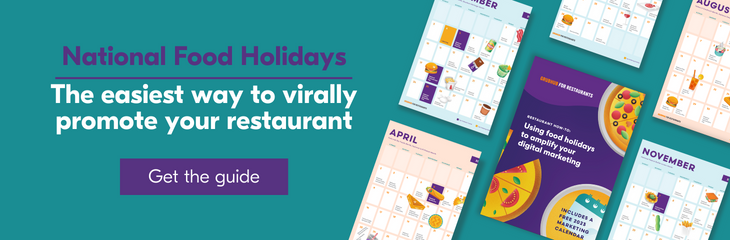
19 June food holidays for your restaurant to celebrate
Did you know 45% of US customers say they’ve tried a new restaurant after seeing a restaurant’s post on social media? That’s why it’s more important than ever to make sure your restaurant is establishing an effective social media strategy to grab customers’ attention. One great way to make your restaurant stand out online is to celebrate national food holidays on social media.
Take a look at these tips on how you can take advantage of food holidays this month and keep scrolling to get the full June calendar.
What are national food holidays?
National food holidays are micro holidays that center around a certain cuisine. They are often celebrated on social media and encourage diners to band together to show appreciation for everything from veggie burgers (June 5) to cannolis (June 16). While these holidays don’t warrant a day off, they can still be fun to observe and celebrate. As a restaurant owner, a food holiday is the perfect excuse to offer an irresistible promotion that will encourage diners to place an order.
Why your restaurant should celebrate national food holidays
Everyone loves having something to celebrate, and restaurants can use food holidays to build excitement around their dishes. Food holidays are particularly popular on social media as diners go online to share what cuisine they’re celebrating. Acknowledging a food holiday on social media by using the holiday’s hashtag can instantly make your restaurant relevant to a wider audience.
Food holidays put specific dishes top of mind. When diners are craving pizza on National Vanilla Milkshake Day (June 20), you want your frosty creation at the center of the celebration. Posting about your food can motivate diners to order from your restaurant. In fact, 53% of millennial TikTok users visited a restaurant after seeing it on the app. Incorporating food holidays in your social media strategy incentivizes hungry diners to check out your cuisine.
3 tips for marketing national food holidays
A successful food holiday marketing strategy begins with a strong digital presence. Modern diners flock online to discover new restaurants and place orders. Digital tactics are important for your restaurant marketing strategy.
To make your national food holiday celebrations as effective as possible, tie them into a larger restaurant marketing strategy that looks at the big picture, not just a single opportunity. A restaurant marketing strategy is a formal plan that documents, tracks and analyzes all your marketing efforts and activities.
1. Pile on promotions
Nothing motivates a diner to press ‘order now’ more than a discount. Rolling out promotions not only attracts more customers to your menu, but also encourages loyalty. Diners are more likely to place repeat orders if they think a restaurant has a good deal. In fact, 81% of consumers would switch restaurants if they saw a good deal. Your food holiday promotions can be the first thing that catches a potential customer’s eye.
Here are some promotion ideas that can get diners drooling for your dishes:
- Discount dollar amounts: On National Smoothie Day (June 21), offer $1 off your smoothies.
- Discounted items: Celebrate National Strawberry Shortcake Day (June 14) by offering 50% off a slice of shortcake when a customer purchases an entrée.
- Discount-themed ingredients: Celebrate Cheese Day (June 4) by offering 20% off all cheesy menu items.
- Free items with purchase: On National Donut Day (June 2) offer a free donut to every customer that orders from your app.
When you partner with Grubhub, launching promotions is as easy as pie. Restaurants that partner with Grubhub gain access to free-to-use promotional and marketing tools that are proven to increase orders and customers.
With Grubhub’s Promotions and Loyalty Tools, you can:
- Run seasonal promotions to make the most of national food holidays
- Offer your customer the right discount at the right time
- Increase your ROI with our advanced technology and huge volumes of restaurant and customer data
2. Highlight online ordering
Getting customers excited about a food holiday is great, but unless you give them an easy avenue to place an order, all that momentum around your dishes will be lost.
Your restaurant’s website serves as the backbone of your digital presence. Your website should have all things a diner needs to know about your restaurant – this includes your menu, hours, location, story and an online ordering platform. Finding a platform that converts curious diners into satisfied customers can be difficult. That’s why restaurants are turning to Direct to reach more customers, drive online ordering and establish their advertising efforts with zero commission costs.
88% of restaurant operators stated a branded experience is very important for sales. With Direct, your restaurant can create an online ordering web page that’s designed and branded to match your existing restaurant’s look and feel. It can be easily integrated into your existing website (if you have one) or can act as your main site if need be. Learn more about how Direct can drive online ordering.

Once your website is up and running, you want to make sure it’s searchable. When potential diners search your restaurant on Google, your Business Profile is usually the first thing to pop up. Claim your restaurant’s Google Business Profile so that you can make sure it correctly displays your hours, address, pricing and website link. When your Business Profile features the correct info and links, it’s far more likely a customer will place an order or come in to check you out.
3. Get social
Nobody will know your restaurant is celebrating a national food holiday unless you spread the word. That’s where social media comes in. TikTok, Instagram and Facebook are all powerful places to establish a restaurant social media presence.
Looking for some tips to make your restaurant pop on social media? Try these ideas:
- Showcase your dishes by posting delectable photos and videos of them on national food holidays.
- Use trending hashtags like #NationalCheeseDay or #NationalDonutDay to reach a larger audience beyond your social media followers.
- Use local hashtags like #BostonFoodie or #NYCeats to connect with customers nearby.
- create a quiz about your dishes to boost engagement with your national food holiday promotions.
- Launch a contest with prizes that relate to your restaurant and die in with your national food holiday promotion.
It’s easy for restaurant owners’ plates to pile up, leaving little time to strategize about marketing. That’s why developing a social media calendar is essential for planning out how you will roll out your promotions.
A social media calendar is a way to organize your upcoming social media posts and promotions by date. Planning posts in advance gives you time to lay out promotions, batch content and solidify your menu to align with your offerings.
Check out these tips on how to market national food holidays on social media.
What social media holidays are coming next?
June signals the start of summer where customers are eager to celebrate everything from veggie burgers (June 5) to ice cream cake (June 27). June also brings Pride Month, Juneteenth and Father’s Day. Last year, over 450,000 orders were placed on Father’s Day. Is your restaurant prepared for this top ordering holiday? No matter what cuisine you’re celebrating, it pays to run a food holiday promotion.
Download our Guide to National Food Holidays to learn how to spearhead your promotional marketing and elevate your digital presence. Use your new calendar to create a marketing plan or amplify your existing one. National food holidays could be your next step toward increased sales and a wealth of new customers.

June national food holidays
June is National Soul Food Month and National Steakhouse Month.
- June 2: National Donut Day
- June 3: National Egg Day
- June 4: National Cheese Day
- June 5: National Veggie Burger Day
- June 6: National Churros Day
- June 7: National Chocolate Ice Cream Day
- June 9: National Strawberry Rhubarb Pie Day
- June 10: National Egg Roll Day
- June 11: National Corn on the Cob Day
- June 12: National Falafel Day
- June 14: National Strawberry Shortcake Day
- June 16: National Cannoli Day
- June 18: Father’s Day
- June 20: National Vanilla Milkshake Day
- June 21: National Smoothie Day
- June 22: National Onion Ring Day
- June 24: National Pralines Day
- June 26: National Chocolate Pudding Day
- June 27: National Ice Cream Cake Day
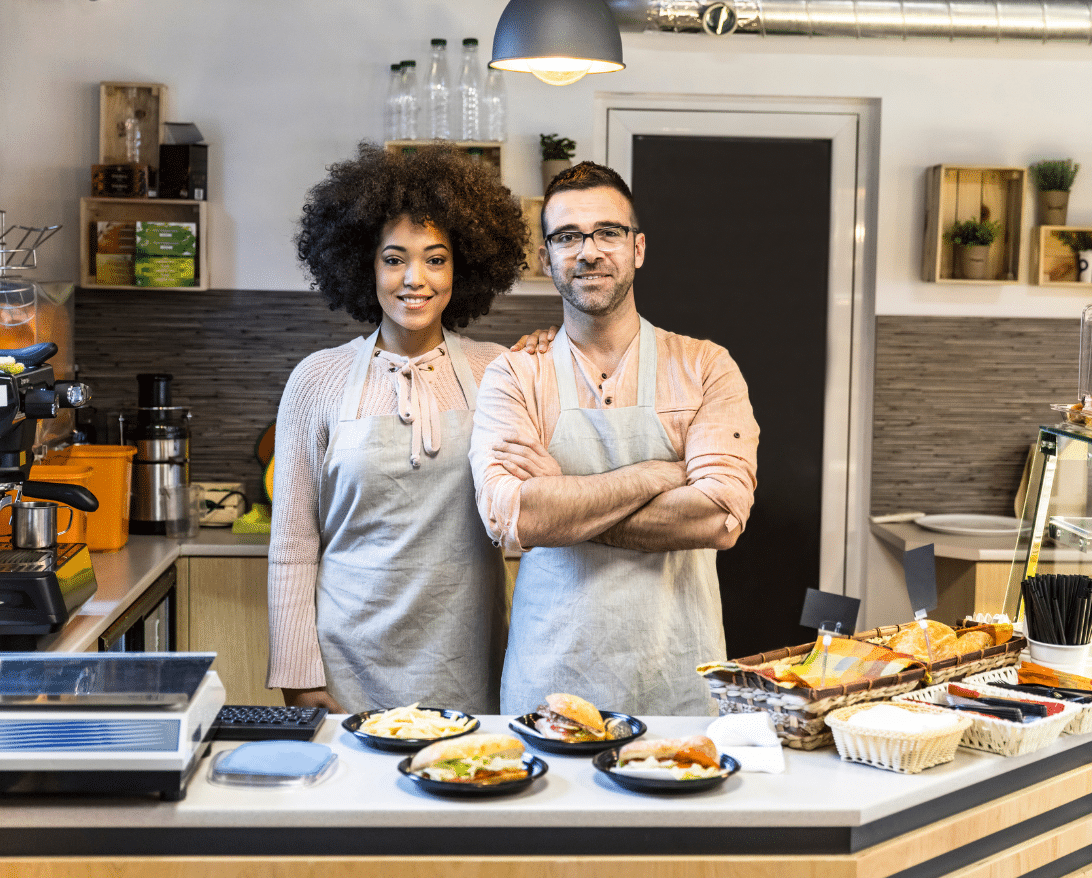
What you need to know about tip pooling
Tips are an integral part of the restaurant industry. They motivate employees to provide exceptional service, creating an experience that brings customers back time and again. For employers in many states, tips can also make up the difference between the server minimum wage and the federal minimum wage. If you’re looking for ways to distribute tips more fairly among employees, tip pooling is one option.
What are the tips for pooling?
Tip pooling is a practice where restaurant employees put all or part of their tips into a communal pool. The employer divides the total funds among eligible workers, either equally or using a predetermined ratio. This method is an alternative to tip sharing, where servers and bartenders voluntarily hand over part of their tips to other employees who help with service but don’t receive tips.
As you might guess, tip pooling can be a polarizing tipping method. It’s usually beneficial for employees such as bussers and expediters, but servers who tend to receive higher tips may find the practice unfair. And if certain employees work harder than others, either in perception or reality, tip pooling can create conflict among the staff.
For some employers, tip pools are the most sensible option. Take coffee shops, for example — multiple people are involved in taking orders and making drinks, but customers only tip once. By pooling tips, everyone receives their fair share. The same goes for any counter-serve restaurant where cashiers and kitchen employees work together to prepare orders.
Tip pooling is less common in traditional table service restaurants, but that’s not out of the question. As an employer, you might use this method to promote a collaborative rather than competitive atmosphere. If you’re currently using a tip credit system to satisfy minimum-wage requirements, you can still use a tip pooling system as long as you stay compliant with any applicable laws.
How are pooled tips calculated?
The way you calculate pooled tips depends on local, state and federal laws. All restaurants are subject to the Fair Labor Standards Act (FLSA), which allows employers to mandate a tip pooling arrangement for staff members. If you take a tip credit, the FLSA only permits your tip pool to include employees who traditionally receive tips. When you pay a minimum wage for all employees, you can also include non-tipped workers such as chefs or dishwashers. According to employment law, employers, managers and supervisors may not accept money from a tip pool.
The tip pooling method and timeline you choose also affects the calculation. If you pool tips for each shift and distribute them evenly, the process is simple. Add together all the tips at the end of the shift and divide them by the number of employees working. If the tips total $1,000 and you have 10 employees, each person will receive $100.
When you choose a percentage or points-based system, the process is slightly more complex. Imagine you have two servers that receive 40% each, a host that receives 15% and a busser who gets 5%. For a shift with $1,000 in tips, each server would get $400, the host would receive $150, and the busser would get $50.
Federal tip pooling law requires you to distribute the tip pool by payday at the latest. For card tips, you’re permitted to deduct the credit card company’s transaction fee percentage — unless doing so pushes the employee’s compensation below the minimum wage.
At tax time, your employees must report 100% of the tips they receive. The IRS also monitors employee tips as a percentage of your restaurant’s income. If tips make up less than 8% of your gross receipts, you must make up the difference and split it among tipped employees.
Tip pooling methods to try
Tip sharing is rarely a one-size-fits-all solution; as an employer, you can customize the process to fit your operations and employee preferences. Keep in mind that tip sharing doesn’t require you to pool 100% of tips. If servers and other tipped employees are good at the prospect, consider creating tip pools from 20% to 50% of the total gratuities.
Common tip-splitting methods include:
- Even distribution. The tip pool is split evenly between all employees. This method is useful for bakeries, fast food outlets, coffee shops and counter-serve restaurants where employees work together to prepare orders, serve meals and clean up after customers.
- Percentage-based. Employees receive a percentage of the tip pool based on their contribution to service. Because servers handle the bulk of the customer-facing duties, they typically get a majority of tips. Bussers, hosts and bartenders usually receive smaller percentages.
- Points. This tip-pooling method is similar to the percentage system, except employees receive a certain number of points depending on their role. Add up the points for everyone who’s working, then divide the total tips by the number of points to get a per-point dollar value. The point value changes every shift, helping to account for variations in staffing and order volume.
After you choose a tip-pooling method, you must decide whether to calculate tips at the end of each shift or at the end of the day. Shift-based distribution requires more accounting work on the employer’s side, but it offers fair compensation for employees who work the busiest shifts. You might choose a workday distribution method — where employees receive tips based on the number of hours they work — if you’re open for a limited number of hours or if your orders tend to be stable across shifts.
The pros and cons of pooling tips
Not sure if tip pooling is right for your restaurant? The pros and cons can help you make a decision.
Pros of pooling tips
- All service employees receive tips from the tip pool.
- Employees aren’t penalized when they’re assigned to a low-tipping table.
- Tip pools can encourage teamwork.
Cons of pooling tips
- Tip pooling laws can complicate your tip credit system.
- Employees are compensated equally even if they put in less work.
- It can create conflict between average and high-performing workers.
- Pooling tips adds complexity to employer accounting procedures.
When in doubt, ask your restaurant employees how they feel about pooled tips. Experienced, highly skilled workers may be strongly opposed; if they’re forced to pool tips with new or lower-performing workers, they’ll almost certainly make less money. When employees rotate positions in a counter-serve restaurant, however, the system can benefit the entire team.
Keep employees happy while growing your business
If your employees are happy with it, a tip pool can boost morale across the entire team. But employee appreciation shouldn’t stop there. Taking time to show your employees you appreciate their work will help foster a healthy work environment. Keeping employee practices consistent and fair will help minimize turnover.
Don’t forget to include your delivery tips, too. With Grubhub, you can opt to self-deliver orders within your preferred radius to ensure all tips remain with in-house staff. To learn more or try the system for free, get started with a Grubhub account.
Restaurant Logo Ideas | Grubhub for Restaurants
Your restaurant’s logo is the most recognizable and influential part of your restaurant’s brand — it helps your company stand out in a crowd and creates a strong connection with customers. Logos create a visual and emotional tie between customers and their favorite brands. If you ask the average diner what a McDonald’s logo looks like or what colors the Domino’s logo has, they probably can answer at the drop of a hat. Creating a logo that resonates with customers can help make your restaurant more recognizable, keeping your brand on customers’ minds.
If your logo is ready for a refresh, it’s helpful to start by browsing popular restaurant logo ideas. When you can pinpoint why certain designs are successful, it’s easier to create a logo that elevates your company’s visual branding.
Restaurant branding: what makes it important?
Branding is the way you convey your restaurant’s identity and distinguish it from competitors. A brand consists of multiple components, including its values, visual identity, messaging, and unique selling proposition.
The visual identity of a brand — the fonts, colors, and graphics that represent the company — helps shape the public perception of your restaurant. Done well, these elements can create a positive impression even before diners take their first bite. Done poorly, they can turn off customers and prevent them from giving your food a chance.
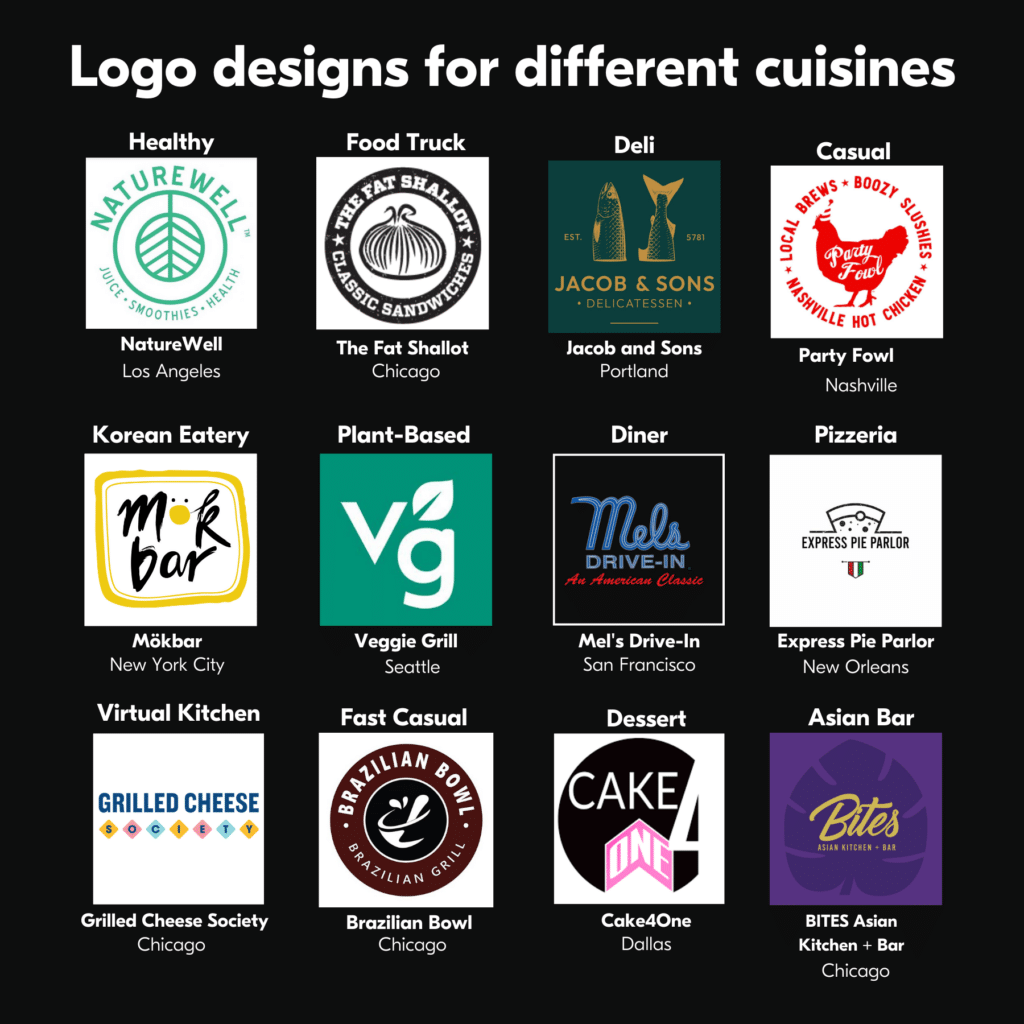
Branding also helps potential customers understand your business. Your logo, in particular, provides clues about the style and type of food you serve. That’s why vegan and vegetarian restaurants often use leaf imagery and shades of green; because these elements are associated with fresh, healthy and natural food, they signal that a restaurant serves plant-based cuisine. Likewise, fine-dining restaurant logo designs tend to use delicate fonts and sparse, abstract imagery to convey exclusivity and elegance.
A strong logo is essential to building brand awareness — the extent to which the public is familiar with your restaurant’s name and visual identity. Think about the biggest brands in the world; chances are, you can picture their logos immediately. That’s because they’re distinctive, simple, and tied strongly to the company’s identity.
When you’re looking for ways to boost your digital restaurant branding strategy, a great logo is a must. With the prevalence of logo makers and logo templates, creating a stunning design has never been more accessible.
Key elements of good logo design
Logos might seem simple, but the graphic design process is surprisingly detailed. Whether you’re using a restaurant logo maker or working with a marketing agency, make sure to keep these rules in mind:
- Keep it simple. Your logo will be published in a wide variety of sizes across both digital and print mediums. Minimal detailing makes it easier to read, even at the smallest sizes.
- Make it striking. The most memorable restaurant logos use at least one bold element. The McDonald’s logo, with its oversized “M” and bright yellow and red color scheme, is a good example.
- stay with the times. There’s a reason restaurant logos change over time — they need to keep up with changing customer preferences for design and style. The best logos feel contemporary, but not trendy.
- Be original. It’s easy to fall back on cliches or copy existing logos, but originality can help your business stand out from the crowd.
- Follow design rules. Stick to two critical principles of good restaurant logo design: balance and proportion. Logos that are off-balance or disproportionate tend to make customers feel uncomfortable.
Most logos have two key parts: the wordmark and the mark. The wordmark consists of the logo’s text — usually, the name of your restaurant. The mark, which is also called the logomark, is the graphical element. It might be an image, an icon or a shape. On the Taco Bell logo, the mark is the brand’s iconic bell.
Keep in mind that some logos use a wordmark only. When that happens, the designer typically selects an eye-catching font to help the logo stand out. Your design might also include a tagline or a frame.
4 restaurants logo ideas
Graphic designers tend to use a few similar patterns when creating restaurant logos. As you’re searching for restaurant branding inspiration, consider these four tried-and-true layout ideas:
- Wordmark only. Simple and clean, these logos are the easiest to make; just select a font and add color. This style is popular with upscale restaurants such as Noma and The Wolseley.
- Separate wordmarks and marks. This type of logo features the name of your restaurant below or to the right of a graphic mark. An example is the Dunkin’ Donuts logo, which features a cup of coffee positioned next to the stacked brand name.
- Wordmark framed by graphic. For a strong visual statement, frame your restaurant name with your mark. Arby’s logo follows this pattern; the name sits in the center of a cowboy hat.
- Wordmarks with taglines. If your tagline is essential to your food business’s brand, this option can help you incorporate it elegantly. Make sure to create a hierarchy by placing the tagline below the restaurant name in a smaller font. Most brands use this format sparingly; occasionally, you’ll see the McDonald’s logo paired with “I’m lovin’ it” or the Papa John’s logo positioned above “Better ingredients. Better Pizza.”
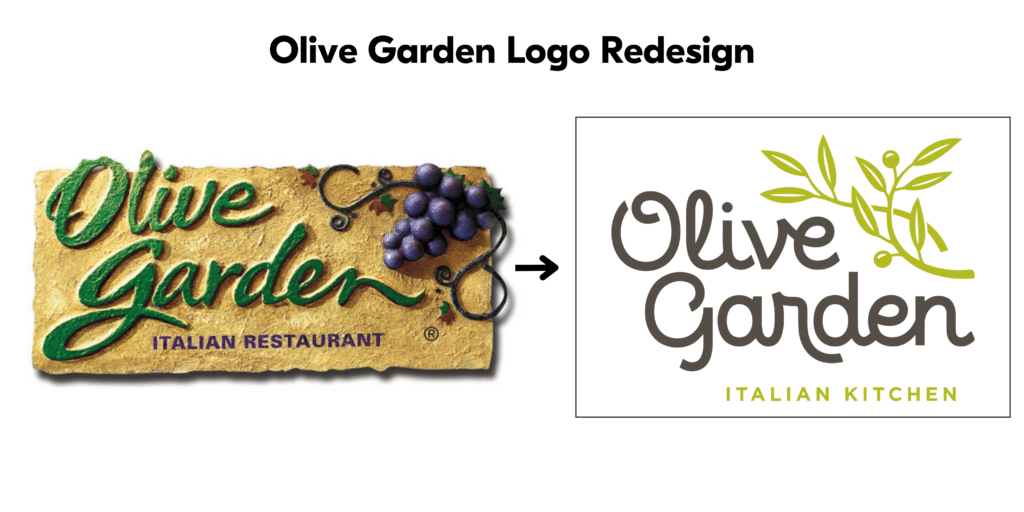
When restaurants rebrand, their new logos can attract a great deal of attention. Olive Garden is a prime example — their 2014 logo redesign revealed a cleaner, more modern look that marked a significant departure from the dated, overly detailed original. Starbucks has also evolved its logo over the years to keep up with changing design styles, all while maintaining an instantly recognizable visual identity and consistent imagery.
Tips for making a restaurant logo
As you create a logo design for your restaurant, choose each element carefully. The fonts, colors and graphics you choose will affect how customers view your brand.
Font selection, in particular, is critical. To start, pick an option that’s easy to read, even at small sizes. Then, look for styles that represent the personality of your restaurant. It’s usually best to avoid polarizing fonts that elicit strong negative reactions, such as Papyrus and Comic Sans.
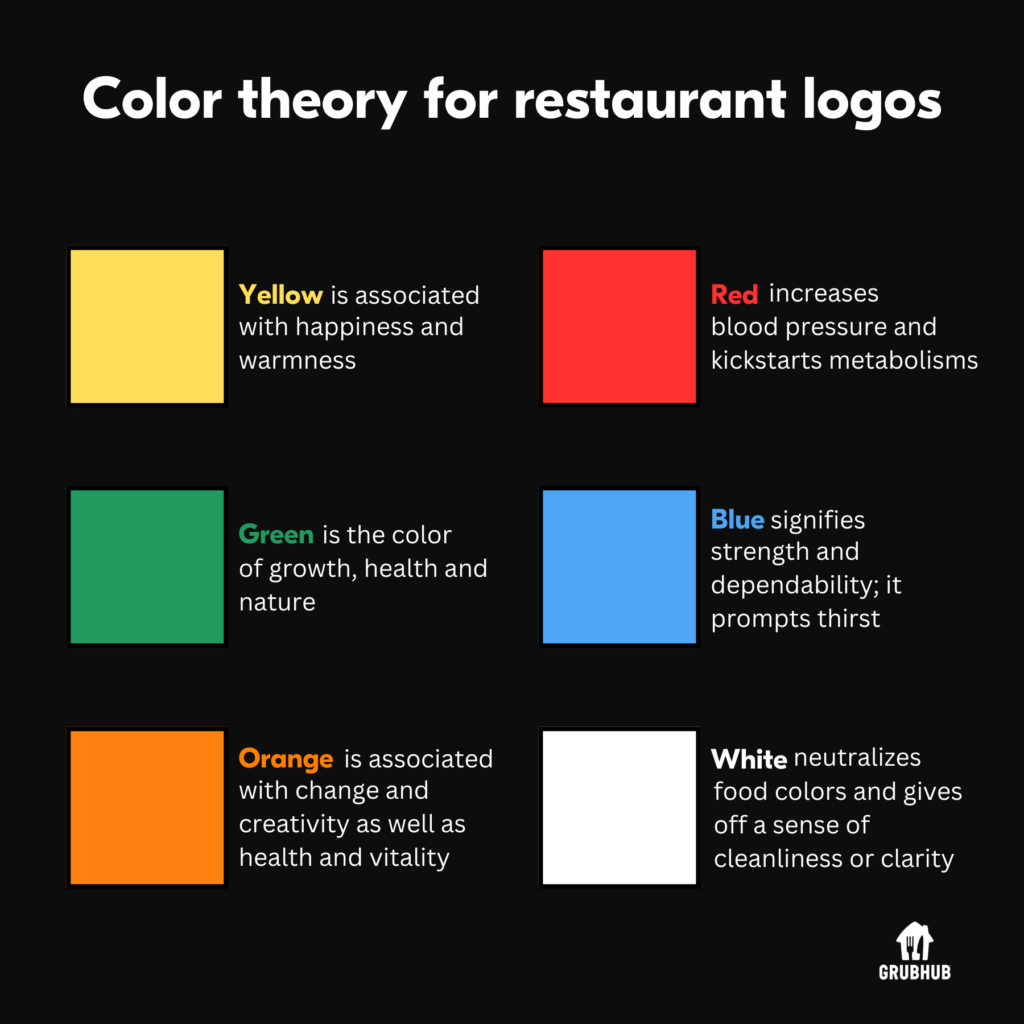
Logo colors are important because they’re tied to both emotions and stereotypes. Seafood restaurants often use blue because of its association with the ocean. Mexican restaurants often use orange and yellow; these warm shades hint at spicy food and colorful cultural imagery. Red is a popular color among fast-food restaurants because it’s powerful, it’s energetic, and it stands out in a crowded environment.
When it comes to graphics, proceed with caution. The best logos stick to simplified silhouettes that relate directly to the brand. The Sonic logo, for example, features shapes that hint at a vintage drive-in sign.
Finding the right placement for your restaurant logo
Before you finalize the graphic design of your logo, make sure it will work on different marketing channels. After all, you’ll want to place it in multiple locations to reinforce your restaurant branding. At a minimum, it should appear on:
- Print and digital menus
- Restaurant signage
- Business cards
- Printed brochures, coupons, and flyers
- Social media profiles
- staff uniforms
- Professional e-mail signatures
- Business merchandise
- Restaurant website
- Branded delivery websites from services such as Grubhub Direct
- Food delivery apps
Your logo plays a big role in the way the public sees your restaurant. By spending the time to create a strong design and placing it prominently on all key marketing materials, you can build stronger brand awareness and keep your company at the top of customers’ minds.
Are you ready to get your logo in front of more customers? Partner with Grubhub today to help market your brand and drive more orders to your restaurant.

Restaurant health scores: preparing for a successful inspection
When customers are choosing where to eat, restaurant health scores are one of the metrics they use to gauge quality and safety. A high score is a vote of confidence that can give your restaurant a competitive advantage. It also helps you avoid fines and maintain positive relationships with local health officials.
What are restaurant health scores?
A restaurant health score is the rating the state or county health department gives your restaurant after an inspection. It tells the public how well you’re complying with local and state food safety laws. In many areas including New York City, restaurants are required by law to post their scores in a high-visibility location.
Health departments set their own grading scales; most use numerical scores or letter grades. Scoring can vary, but it’s always based on the state and local food codes. Usually, A is the highest score and C or D is the lowest.
In most states, county health inspectors visit every food service operation a few times per year and after every customer complaint. Inspections are usually unannounced to preserve the element of surprise.
During an inspection, the official looks for specific violations of state and local laws. For many violations, you’ll be given a short period of time to fix the issue. After that, the inspector makes a follow-up visit to verify you’re meeting compliance requirements.
Health departments don’t always publish a specific acceptable violation limit. Instead, they consider the overall risk to public or environmental health. If an inspector finds a restaurant poses an immediate health hazard, they’ll typically shut it down right away. This might happen due to multiple severe violations or a single large issue, such as a sewage backup. Before it can reopen, the restaurant owner must prove that they’ve corrected all issues. Inspectors may also shut down restaurants after repeated health-code violations.
How to prepare for a health inspection
The best way to prepare for a health inspection is to run a clean, compliant operation — after all, restaurant inspections can happen at any time. Keep in mind that officials determine your inspection score based on the number of violations, including common issues such as:
- Improper hand-washing
- Lack of hair restraints
- Inappropriate food storage temperature
- Cross-contamination
- Inadequate sanitation
- Expired foods
- Infestation of rodents or insects
- Lack of pest control
- Disrepair of restaurant facilities
If it’s been a while since your last inspection date, now is a great time to prepare your restaurant. To avoid violations, run regular self-inspections using this basic health inspection checklist:
- Train staff members in food safety standards.
- Make sure refrigerated foods are stored below 40 degrees Fahrenheit.
- Ensure freezers are at least zero degrees Fahrenheit or lower.
- Choose hot-food holding systems that are 140 degrees Fahrenheit or higher.
- Mark expiration dates and throw out expired foods immediately.
- Keep equipment and facilities in good repair.
- Establish food handling, cleaning and storage practices that prevent cross-contamination.
- Use thermometers to ensure meat is cooked to a safe temperature.
- Set up hand-washing stations and train staff in proper technique.
- Publish and enforce personal hygiene guidelines.
- Install leakproof garbage bins and remove trash frequently.
- Clean all surfaces and equipment thoroughly and regularly.
- Hire a pest-control service for regular visits.
Remember that the laws governing restaurant health scores can vary considerably from state to state. Make sure to check with your local health department for a location-specific checklist.
What’s so important about your restaurant health score?
Your restaurant’s health score is public information; its purpose is to help customers understand your establishment’s food safety standards at a glance. A high score reassures diners that your facilities are safe and clean. A low score is a red flag that erodes public confidence and reduces your revenue.
The health scoring system encourages restaurants to comply with food safety regulations. When more businesses practice safe food handling and storage, it improves public health, reduces the burden on environmental health services and benefits the entire community.
If your score is lower than you’d like, you can take action to boost it. Start with the violations in your last inspection report — identify the root of the problem and implement a permanent solution. Then, use your local health department’s guidelines to improve your kitchen, food service and front-of-house operations. Even small changes, such as standardized hand-washing rules, can help staff members stay compliant and ready for a surprise inspection.
A high restaurant health score is a sure fire way to maintain a positive reputation and stay compliant with local laws. By implementing standard operating procedures for a clean kitchen and safe food handling, you can welcome health inspectors with confidence.

Insider Selling: Sotherly Hotels Inc. (NASDAQ:SOHO) Chairman Sells $39,600.00 in Stock
 Sotherly Hotels Inc. (NASDAQ:SOHO – Get Rating) Chairman Andrew Sims sold 20,000 shares of the company’s stock in a transaction on Wednesday, March 29th. The shares were sold at an average price of $1.98, for a total transaction of $39,600.00. Following the completion of the sale, the chairman now owns 1,500 shares of the company’s stock, valued at approximately $2,970. The transaction was disclosed in a filing with the SEC, which is available through this hyperlink.
Sotherly Hotels Stock Performance
Shares of SOHO opened at $2.00 on Friday. The company has a debt-to-equity ratio of 6.27, a quick ratio of 1.29 and a current ratio of 1.29. The stock has a market capitalization of $38.38 million, a P/E ratio of 1.43 and a beta of 1.69. The company’s fifty day moving average is $2.20 and its two-hundred day moving average is $2.05. Sotherly Hotels Inc. has a 1 year low of $1.48 and a 1 year high of $3.11.
Hedge Funds Weigh In On Sotherly Hotels
Several institutional investors have recently bought and sold shares of the company. Thompson Davis & CO. Inc. grew its stake in shares of Sotherly Hotels by 32.8% during the 3rd quarter. Thompson Davis & CO. Inc. now owns 1,108,044 shares of the real estate investment trust’s stock worth $2,083,000 after purchasing an additional 273,747 shares during the period. JW Cole Advisors Inc. grew its stake in shares of Sotherly Hotels by 65.6% during the 3rd quarter. JW Cole Advisors Inc. now owns 49,750 shares of the real estate investment trust’s stock worth $94,000 after purchasing an additional 19,700 shares during the period. Seneca House Advisors acquired a new position in shares of Sotherly Hotels during the 3rd quarter worth $68,000. Jane Street Group LLC grew its stake in shares of Sotherly Hotels by 218.4% during the 4th quarter. Jane Street Group LLC now owns 35,030 shares of the real estate investment trust’s stock worth $63,000 after purchasing an additional 24,028 shares during the period. Finally, Virtu Financial LLC acquired a new position in shares of Sotherly Hotels during the 1st quarter worth $55,000. 21.57% of the stock is owned by institutional investors and hedge funds.
Wall Street Analysts Forecast Growth
Several analysts recently commented on SOHO shares. TheStreet upgraded shares of Sotherly Hotels from a “d” rating to a “c” rating in a research report on Friday, March 3rd. StockNews.com started coverage on shares of Sotherly Hotels in a research report on Wednesday. They issued a “hold” rating for the company.
Sotherly Hotels Company Profile
(Get Rating)
Sotherly Hotels, Inc. is a real estate investment trust. It engages in the business of acquisition, renovation, upbranding, and repositioning of upscale to upper-upscale full-service hotels. The company was founded in August 2004 and is headquartered in Williamsburg, VA.
Further Reading
Receive News & Ratings for Sotherly Hotels Daily – Enter your email address below to receive a concise daily summary of the latest news and analysts’ ratings for Sotherly Hotels and related companies with MarketBeat.com’s FREE daily email newsletter.