
/cloudfront-us-east-1.images.arcpublishing.com/dmn/AGPQSNCM4ZCQVPB7OWA6NP4WFA.jpg "McKinney’s Denizen Hotel eyes summer groundbreaking")
McKinney’s Denizen Hotel eyes summer groundbreaking
Developers working for more than a year on a new McKinney hotel hope to break ground on the project in the coming months.
The Denizon Hotel is planned on State Highway 121 at Alma Road in the huge Craig Ranch development.
Archstreet Hotel Partners will build the more than 100-room hotel as part of the mixed-use District 121 project. The almost 20-acre development also includes a new office building plus restaurant and retail space. The four-story hotel building is expected to cost about $20 million.
“We hope to start work this summer and open in the fall of 2024,” Archstreet founder Michael Mueller said. He previously founded Nylo Hotels, which built properties in Las Colinas and Plano.
Dallas architect 5G Studio Collaborative is designing the luxury hotel.
The Denizen Hotel will be the latest addition to the hospitality market along SH 121 between Frisco and McKinney – a corridor that’s seen dramatic growth.
The Craig Ranch development includes thousands of homes plus commercial and retail construction.
Dallas-Fort Worth is the country’s fastest growing hotel market with more than 170 projects in the development pipeline.
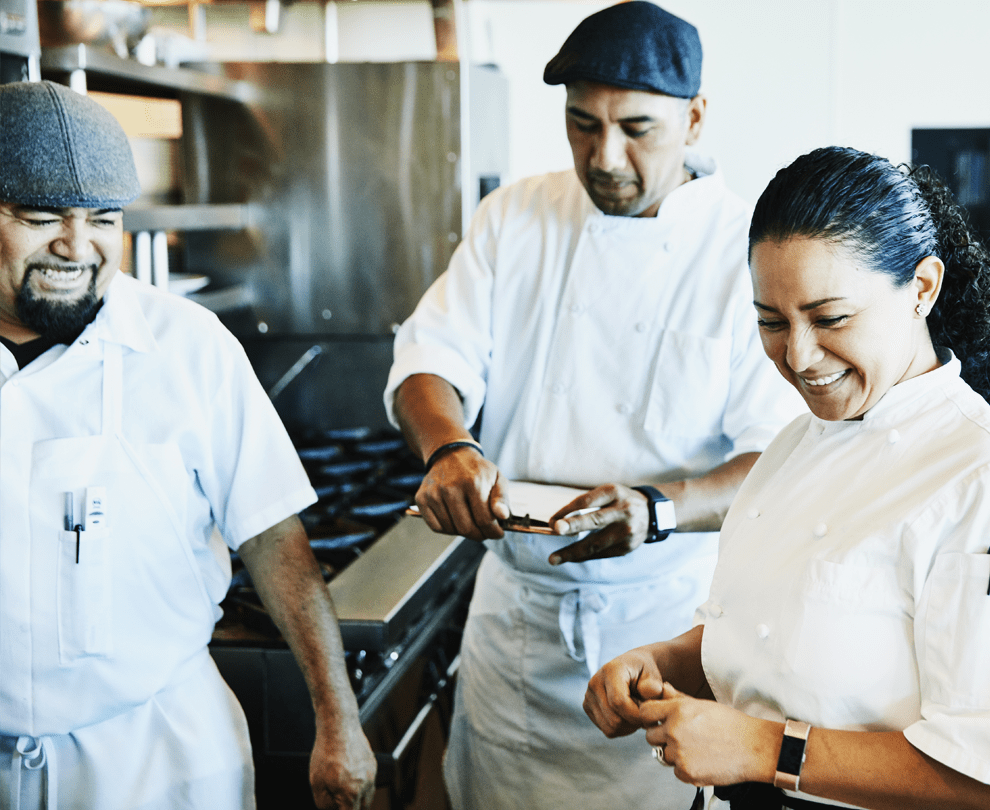
How to increase restaurant sales with 2022 National Food Holidays
When it comes to marketing, national food holidays and restaurants are the perfect match. Every year, there are hundreds of national food holidays that encourage people across the country to band together and share affection for everyone from
These famously celebratory days are a fantastic opportunity to reach out to new customers while also re-engaging with the people who may be familiar with your restaurant but haven’t visited or ordered take-out in a while.
Seasonal marketing matters
One thing that’s certain is that our world is constantly changing. People’s lives, technology, food ingredients, trends and diner behaviors are forever evolving. And although a business plan may seem constant, restaurants should never forget about their diners’ current reality when it comes to marketing.
That’s why the best chance restaurants will get to be relevant year-round is to connect with their customers in real-time through real-life happenings – like national food holidays. Use our top marketing tips for restaurants and free calendar downloads to help you create entertaining and eye-catching promotions that build your brand and boost your revenue.
How to use the top National Food Holidays of 2023 for your restaurant marketing strategy
To make your national food holiday promotions as effective as possible, tie them into a larger restaurant marketing strategy that looks at the big picture, not just a single opportunity. A restaurant marketing strategy is a formal plan that documents, tracks and analyzes all your marketing efforts and activities.
Use these simple steps to help you implement national food holidays into your marketing strategy today:
Find the food holidays that fit
Incorporating national food holidays into your marketing strategy is a huge opportunity for growth and engagement, but it can also damage your brand if you aren’t careful about which holidays you choose. Every holiday you choose to promote should fit not only your brand but your menu.
For example, it doesn’t make much sense to launch a huge National Hot Dog Day campaign (July 23) if your menu serves classic French cuisine. Start with your own concept and see which food holidays feel like an authentic fit.
Pick your promotions
Food holidays are prime time for freebies and discounts. Nothing motivates a diner to press ‘order now’ more than a discount.
Some offers you may consider running during a national food holiday include:
- Free menu items: Allow customers to redeem a specific free item with their purchase, such as a free chocolate chip cookie (May 16) with every entree
- Free menu selection: Highlight a specific area of your menu, perhaps discounting all your salads for National Kale Day (October 5)
- Dollar-off: Offer a fixed amount of money off for new customers during a national food holiday, giving $1 off everything with fries in honor of National French Fry Day (July 13)
- Percentage off: Choose a fixed percentage off orders during a national holiday, like advertising 20% off all caffeinated drinks on National Coffee Day (September 29)
- Free delivery: If your restaurant offers self-delivery, you can food the bill for all delivery fees during a national holiday, like on National Dessert Day (October 14)
Spread the word
It’s important to use all the channels available to share your national food holiday promotions. When your restaurant joins the Grubhub Marketplace, you get immediate access to powerful marketing and promotional tools to help maximize your sharing and build a loyal fan base.
Social media is also a powerful tool for restaurant owners because it’s immediate. It’s direct and it costs as little or as much as you want. Use organic posts like behind-the-scenes photos to gain traction or use some of your marketing budget to take advantage of paid advertising on platforms like Facebook, TikTok and Instagram.
Remember, the goal is to find ways to build brand awareness, attract new customers, expand your market and nurture customer loyalty.
4 social media posts ideas to promote your 2023 national food holiday campaigns
The key to being successful on social media is making sure you have a presence. In fact, 45% of diners have tried a restaurant because of social media. Creating an eye-catching social media presence can turn curious social media scrollers into satisfied customers.
Here are some ideas on how you can start sharing your national food holiday deals in a smart way that boosts engagement and gets your restaurant noticed.
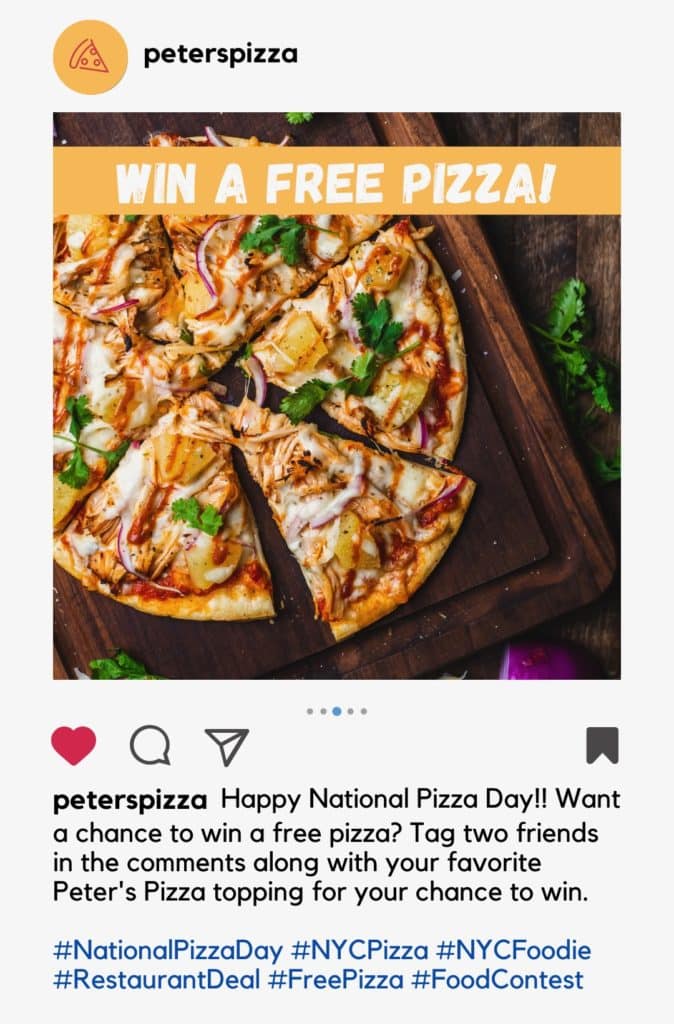
1. Run a social media contest
People love to win stuff. Even if they don’t come out on top, studies show that consumers are more likely to engage with a post if that post is promoting some kind of contest. Contests convert at a rate of 3.7% higher than posts with other non-costed CTAs.
Instagram contests are similarly popular, with contest-related posts getting more than triple the likes and 64 times more comments than other types of posts. That’s a major engagement.
Big Idea: Take advantage by running contests that encourage interaction, such as asking food trivia questions and counting each commented answer as an entry, requiring users to like and share your post to win, or asking followers to tag a friend in your post as part of their entry .
2. Use trending hashtags
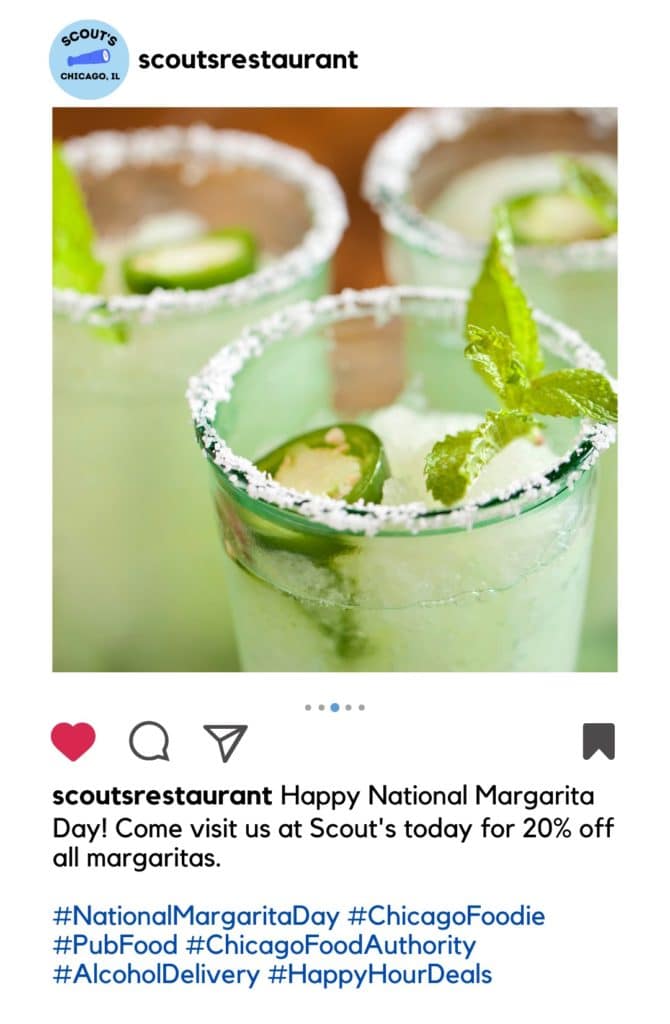
Because national food holidays are a coast-to-coast affair, there are often trending hashtags you can use to ride the wave of popularity and get your restaurant into the national spotlight. Hashtags allow your posts to enter different categories online, bringing your restaurant into people’s social media feeds.
Big Idea: Along with using the obvious national food day hashtags like #NationalMargaritaDay, make sure to also incorporate your restaurant’s city-specific hashtags like #EatAustin, #ChicagoFoodAuthority of #NYCEats. Using these will allow you to tap into the already-there audience you’re looking for.
3. Promote your online ordering site
Most promotions work best when you remove any possible hurdles that stand between your customer and the order button. In the world of online ordering, that means making it as easy as possible for diners to find your menu, put their food on their virtual card, and pay up.
When you share your promotional posts on social media, offering customers the ability to order directly from you can help you drive more sales through your national food holiday campaigns.
Don’t have the ability to take online orders? Grubhub can help! Direct is a commission-free platform designed to help you reach loyal diners and build your online brand. With Direct, you can drive customers to your very own online ordering website, customized just for your restaurant. Read all about how Brooklyn-based Broccolini did just this and more.
Big Idea: Include links to your online ordering site on your social media pages so that you can convert curious scrollers into customers. Make sure you highlight your online ordering site in your captions so that it’s clear how diners can place an order.
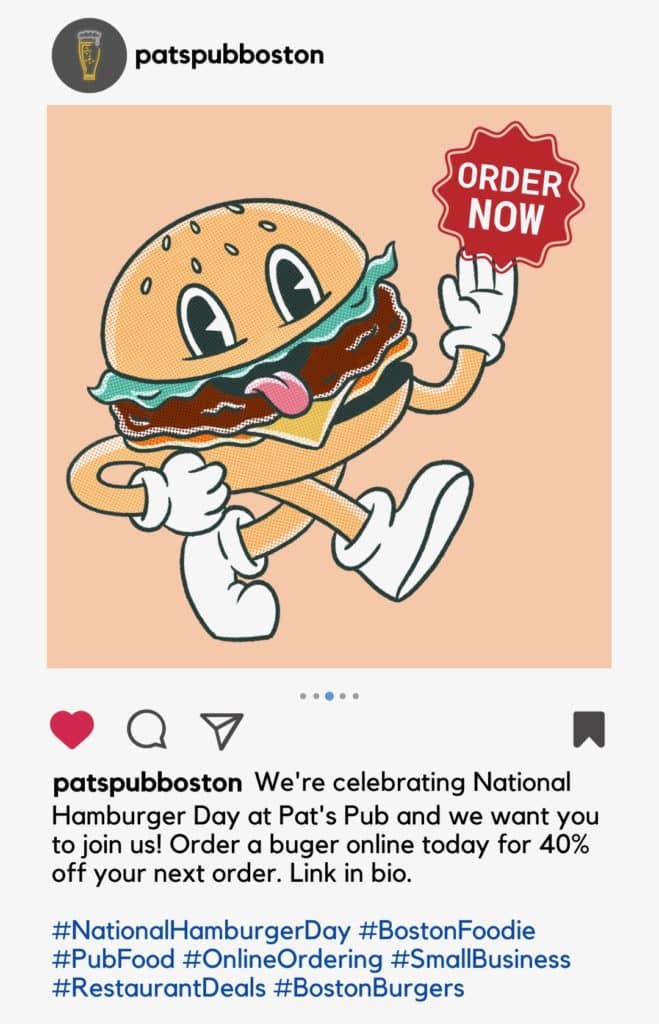
4. Highlight your dishes
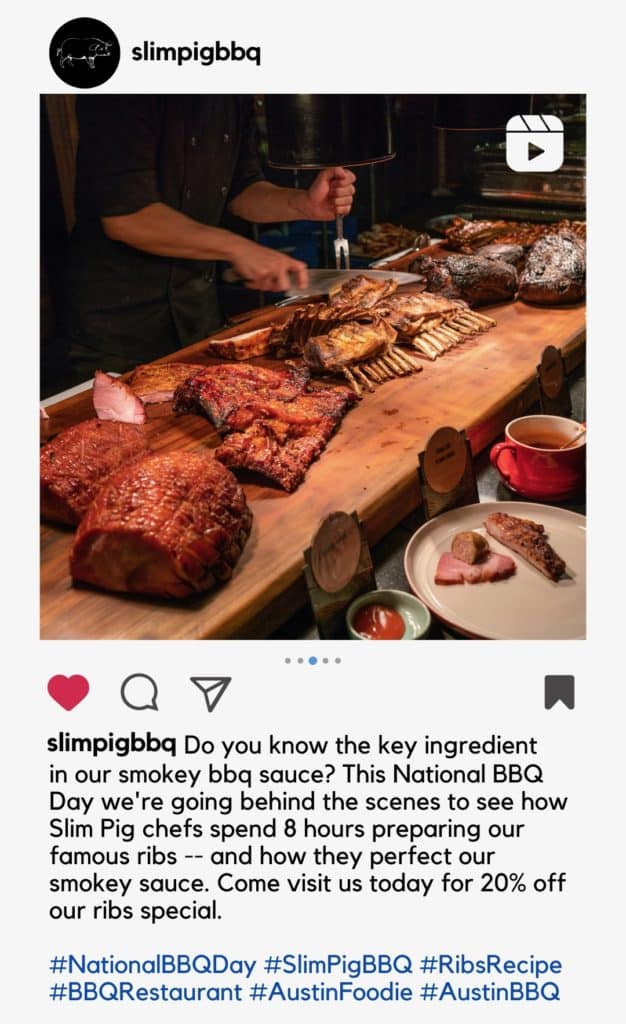
Your food is your pride and joy and what keeps customers coming back for seconds. Making your cuisine the prime feature of your social media profile not only shows off your specialty, but also gets diners’ mouths watering. Nothing gets a diner more motivated to place an order than a juicy photo of a rack of ribs on National Barbecue Day (May 16).
Taking and presenting high quality photos of your food is essential to creating an effective social media presence. When you partner with Grubhub, you can schedule a free photoshoot for your restaurant.
Partnering with micro influencers can help your restaurant gain more exposure. Encourage those who visit your restaurant to post photos of their food online. Delectable food pics can stand out in people’s feeds.
Big ideas: Make sure to feature high quality photos of the dishes you are preparing for national food holidays. You can even give a behind the scenes look into your chef’s meal preparation. Post these photos onto your restaurant’s social media to appeal to diners’ taste buds.
Start your restaurant’s celebration today
The best thing you can do when using national food holidays to promote your restaurant is to create a solid plan. That way, you’re ready and prepared to give your diners the best reason to indulge in your delicious food – daily!
Lucky for you, we’ve already done step one for you. We’ve compiled all the national food holidays in one place and created a complete calendar listing and it’s available to you for FREE to download now.
Use your new calendar to create a new marketing plan or amplify your existing one, and national food holidays could be your next step toward increasing sales and a wealth of new customers.
Already eager to get ready for your next national food holiday promotion? Sign up with Grubhub for Restaurant to access powerful promotion and loyalty tools today!

Restaurant Technology Trends for 2022
The growing demand for off-premise dining has made it even more attractive for restaurants to expand operations. Investing in the latest restaurant technology and digital innovations can help with everything from streamlining order taking to managing multi-channel marketing. Your ability to incorporate technology into your restaurant can have a huge impact on customer experience. The modern diner is tech savvy, and expects their favorite places to grab a bite to be up to date with the latest tech trends.
The online food delivery industry currently generates more than $26.5 billion a year. By 2024, that number is projected to surpass $32 billion. Technology has changed the way we dine and connect with restaurants. Keeping up with these trends can help you secure a loyal customer base and grow your ROI.
Here are the emerging restaurant technology trends every restaurant owner/operator should be mindful of and a few tips to help you as you leverage technology to take your restaurant to the next level.
1. Branded online ordering sites are now a necessity
The online food delivery industry is booming, with restaurants generating an impressive $26.5 billion annually, and considering that online ordering is growing three times as fast as in-house dining, that number will continue to rise. Even as in-person dining is back in full force, online ordering is growing 300% faster than in-house dining.
In a way, hungry diners searching for their next meal via the internet are a captive audience. Typically, they’ve already decided they want delivery or pickup – they’re just waiting to see which dish, cuisine or restaurant promotion piques their most interest. To stay competitive, it’s crucial that restaurants not only understand the importance of online ordering but also that they have a system in place to accommodate the flood of orders that are just around the corner.
Digital innovations in restaurant technology like digital menus, online ordering and secure mobile payment options appeal to consumers. Best of all, they help your restaurant stand out. But putting all that together on your own can be both daunting, time consuming and expensive.
That’s where Direct comes in. Direct is a commission-free online order platform that can be customized to fit your restaurant’s brand. Our easy-to-use ordering system has all the tools you need to create unparalleled ordering and delivery experiences that will keep consumers coming back for more.

2. Digital loyalty programs are evolving
Sometimes having incredible food and top-notch customer service just isn’t enough. Restaurants need an edge in order to outsell the competition. With new restaurant technology, loyalty programs and promotions can be used for just that.
While loyalty programs have been around forever, digitizing these experiences has made it easier for restaurants to reach customers and grow their ROI. 45% of consumers say that mobile ordering or loyalty programs would encourage them to use online ordering services more.
Offering customers an opportunity to turn loyalty into savings forgers a bond between consumers and corporations that’s proven profitable time and time again. Promotions can have the same effect by giving prospective customers a reason to try out a new establishment. It also gives existing customers a reason to come back and try a new dish.
Tie together your loyalty program and food promotions for deals like:
- Discounts or a dedicated mini menu tied to a national food holiday
- Deals linked to repeat visits, such as a free appetizer after five takeout orders
- Dollar deals awarded to customers who refer friends and family that afterward place a successful order
- Discounts celebrating a loyal customer’s birthday or program anniversary
Restaurants that join Grubhub get access to our Grubhub+ customers, where there is an audience of hungry, order-primed and subscription-paying diners waiting to see what your restaurant has to offer.
Direct users can also use built-in tools like direct-to-customer email lists and data streams to run tailored promotions or build a loyalty program from the ground up. Digital-based rewards programs allow restaurants to track customer data to provide more personalized rewards programs tailored specifically to their customers.
Restaurants that are on Grubhub Marketplace also get access to our powerful promotions and loyalty tools: A few of these tools include:
- Targeted promotions that offer superior value by targeting the right demographic
- Increased ROI thanks to smart marketing algorithms and detailed customer data
- Options for multiple campaign goals including attracting new customers, bringing back previous customers, starting a loyalty program or promoting specific menu items or order types
3. Contactless payments brings a new way to check out
The way diners pay for a meal looks a lot different these days. More and more customers have stopped carrying around cash, opting to pay for their food with cards, smartphones and even smartwatches. Contactless payment allows customers to pay for their meals without physically exchanging money.
While over 80% of US consumers have used contactless payments, only 67% of US retailers offer this payment option. Contactless payments are quick and secure, making the checkout process effortless for your customers. Restaurants who don’t incorporate contactless payment options into their business risk losing out on this large chunk of customers who resort to digital transactions.
How can you incorporate contactless payments into your restaurant? Adopting a digital point-of-sale (POS) system is the best place to start. POS technology allows small businesses to digitally manage transactions.
POS integration can also help you aggregate all your restaurant’s digital orders. Your restaurant technology no longer needs to operate on different wavelengths with the latest improvements in POS Integration. Big chain restaurants around the country are getting on board with a new post-pandemic business model that uses emerging restaurant technology to include multiple service channels. When you partner with Grubhub, you can easily integrate your POS system with Grubhub to simplify your order and menu management.
4. QR codes spread the word about your restaurant
Contactless consumer habits have extended beyond just payment with QR codes. A QR code gives consumers the ability to scan a code with their smartphones. Once they scan the code, they will be taken directly to a webpage of your choosing. QR codes allow digital materials to be more accessible – whether that be your restaurant’s menu, website or ordering platform.
QR code menus skyrocketed at restaurants during the COVID-19 pandemic. Diners appreciate the contactless way of placing an order, and the popular technology spread across the restaurant industry. QR codes give you the creative freedom to spread the word about your restaurant. Here are some places you can paste your QR codes to make them pop:
- windows: For potential customers who are trying to decide whether or not to eat at your restaurant, having access to the menu on the outside of windows can help them easily make their decision.
- walls: If you happen to have lines fairly often, then having the QR code menu on the wall where people can see it while waiting can speed up the ordering process.
- Tables: It’s common to see table toppers or small cards attached to tables in restaurants. This can be an easy way to give people more flexibility and time to decide what they want to order.
- Flyers: Print out the QR code menu and spread them all over town. This is a fun way to draw people’s attention to your restaurant, and you could offer a promotional deal for anyone that brings on the flyer the next time they eat at your establishment.
- Stickers: To be extra creative and spread the word about your product offering, you can turn your QR code menu into stickers to give to people or to hang around your community.
- Business cards: Similar to stickers, a business card is an easy item for people to grab and take with them either to their table to order or when they leave the restaurant.
Check out more tips on how you can implement QR codes at your restaurant.
5. Delivery packaging is getting an upgrade
As the channels that customers use are evolving, the way restaurants prepare and send out food has changed as well. Staying up to date on takeout packaging innovations is the key to maintaining customer satisfaction. While food quality has always been top-of-mind for diners, the integrity of the containers that keep their food safe in transit has also become an interest. Sustainability matters when it comes to packaging:
- 80% of consumers are concerned about how food packaging impacts pollution and animal safety
- 63% of the solid waste produced in the US is derived from packaging materials
- Choosing the wrong containers for your food can ruin the appearance, quality and taste of your dishes
No customer wants soggy fries trapped in a sweaty foam container, nor does a hungry family want to open their Mexican takeaway to find their salsa tubs popped open in route, spilling spicy sauce everywhere.
Take advantage of technological advances in container manufacturing by choosing the best to-go food containers that are not only designed for durability, but are also secure, environmentally friendly and crafted with specific types of food in mind.
Sustainability is a hot issue for many diners, and packaging is an area where restaurants can fall short of being eco-friendly. Recyclable containers that use biodegradable plastic, aluminum foil or recycled paperboard are not only good for the environment but can also keep your food safe en route to its destination. Learn more about how you can maintain food quality with sustainable packaging.
6. Third-party delivery is here to stay
Arguably the most significant new technology in restaurants isn’t truly in restaurants, it’s in the hands of customers ready to place an order. Third-party delivery apps have made delivery and takeout trends possible. Over one-third of Americans use a third-party delivery service at least twice a week, proving that third-party partnerships can have a huge impact on a restaurant’s ROI.
These unassuming little apps take care of everything from marketing and promotions to keeping customers up to date on when the order is prepared, packaged and on its way to their front store. But not all delivery apps follow through on their promises.
When you’re looking for a reliable delivery service app, look no further than Grubhub Marketplace. Here you get access to the largest online food delivery marketplace in existence, tied of course to an app that connects you with an audience made up to some 33+ million diners looking for restaurants just like yours.
Here, Grubhub has harnessed the power of restaurant technology to bring together cooks and consumers. Diners get to quiet their hungry bellies, while restaurants get great benefits like:
- Free merchant welcome kit
- A free tablet and/or POS integration for managing orders
- Free photo shoot and expert advice to make your meals look incredible
- Menu consultation services
- Access to a branded ordering site
- Promotional and loyalty tools
- Ability to respond to ratings and reviews
And that’s just the beginning. Partnering with Grubhub is a fast-ticket to better functionality, on-trend restaurant technology, and stress-free integration that powers more effective and efficient restaurant operations.
Restaurant technology in the bigger picture
The food we eat has always been a reflection of larger cultural trends and current events. With everything from the holistic wellness movement to sustainability affecting what we order, cook and consume.
Now, that same trend continues with restaurant technology shaping how we structure our work-from-home days, what we get hungry for when we’re gaming online, and how we expose our taste buds to exciting new cuisine.
Interested in seeing how Grubhub can help you stay on top of restaurant technology trends and usher your business toward a more successful future? Join Grubhub today and try it out free for 30 days. You’re going to love what you discover.

2023 Alcohol Delivery Trends for Restaurant Owners
Alcohol Delivery is expected to grow exponentially over the next few years – it’s time you learn how to capture this growing demand for to-go cocktails and alcoholic beverages. Check out what spiked drinks are trending in 2023 and how you can quench your diners’ thirst.
The pandemic kickstarted changes in local regulations to allow restaurants to incorporate alcohol delivery into their delivery strategy. Over 17 states and districts have decided to allow restaurants to sell to-go cocktails permanently, and customers love the ability to order to-go cocktails, beer and wine from their favorite restaurants on Grubhub.
Find out more about the benefits of offering alcohol delivery as part of your business model and see which cocktails seem to hit the spot best for thirsty diners eager for an effortless at-home happy hour.
The benefits of offering alcohol delivery or to-go cocktails
Curious whether it’s worth it to add alcohol to your delivery and to-go menus?
While it does take an up-front investment of both time and money to reconfigure your day-to-day operations and ensure your new alcohol offerings adhere to guidelines, Grubhub data shows a clear payoff.
Adding alcohol to your delivery menu on Grubhub can increase the average order value by a whopping $14-$15.
Think about that in terms of daily or weekly revenue; If you deliver 100 orders a day, you stand to see an average overall increase of $1400-$1500 per day and $9800-$10500 per week.
Of course, alcohol delivery on Grubhub is not available everywhere.
It’s important to do your research before you commit to a menu change or start collaborating with a local mixologist on cocktail ideas. If you’re a current Grubhub restaurant partner, please check with your Account Advisor to find out if you can offer alcohol.
To learn more about how you can add alcohol to your Grubhub menu, check out our guide to Grubhub alcohol delivery.
What were the top alcohol delivery and cocktail-to-go items ordered on Grubhub in 2022?
Grubhub’s #2022Delivered showed an uptick in alcohol orders, with a handful of cocktails seeing a meteoric rise in popularity.

- Beer
Whether it’s paired with a juicy burger or helps wash down game day wings, Grubhub diners’ go-to alcoholic drink is an ice cold beer. Beer is an easy addition to any alcohol delivery menu. Its pre-canned packaging means that you can offer a wide array of ales and lagers without a lot of prep work.
- margaritas
Frozen, on ice, with salt or without, margaritas continue to be a hugely popular drink that’s perfect for washing down that spicy carne asada on Taco Tuesday.
Keep delivery constraints in mind while you finalize your menu – frozen margaritas are harder to prepare and deliver without seeing a dip in quality. Also, too many flavor options could complicate things for your bartenders.
- Hot Sake
This hot Japanese drink has taken beverage delivery by storm. Hot sake, also known as ‘Kanzake,’ is a warm alcoholic beverage made from fermented rice. It comes in a wide variety of flavors and is known for having a higher alcohol content than wine. You can serve Sake pre-bottled and give diners quick instructions on how they can heat it up so they can perfect their at-home happy hour.
- Piña Colada
Cream of coconut, pineapple juice and rum can turn any cloudy day into a trip to the tropics. You can serve it blended or shaken with ice, and garnish it with a pineapple wedge, maraschino cherries, or both. Check out tips on how to make sure your Pina Coladas can stay fresh on the road. No matter how you prepare it, diners are going bananas for this fruity classic.
- Sauvignon Blanc
Sauvignon blanc is a fruity, light white wine that pairs perfectly with a soft cheese or a smoked salmon. Adding sealed bottles of wine to your delivery menu can help you easily take liquids on the road. Think about offering white wine pairings with your dinner entrees so your diners know exactly what bottle washes down their meal best.
Hello, 2023: Alcohol delivery and cocktail trend predictions for the year ahead
Half the battle when creating an alcohol delivery menu is deciding which cocktails to include. On the one hand, you want to appeal to various tastes; on the other hand, a streamlined menu with few items helps reduce buyer confusion and makes it easier for your staff to execute orders on time.
Getting to know what cocktail trends you should watch in 2023 could help you create a menu that hits all the right notes without going overboard. The result? More sales and less stress!
Bold and bubbly
If there’s one thing taking 2023 by storm it’s bold flavors. Diners are craving online ingredients both in their food and drink. Spicy cocktails are rising in popularity, combining the fiery sting of alcohols like tequila with the hot taste of chili peppers. Customers are turning toward bitter tastes as well, sipping on espresso martinis and Manhattans.
Bold flavor cravings have encouraged customers to embrace high-end spirits. Diners are willing to spend more for premium ingredients, especially if those ingredients break the norm. Don’t be afraid to offer a few higher-end cocktails and bottles of bubbles on your beverage menu for those who are looking for something bold and fancy to sip on.
Growing interest in low-ABV and alcohol-free beverages
The alcohol-free spirit movement is chugging right along, with “mocktails” getting more creative. You can buy infused faux alcohols to make mixed drinks, or rely on herbs and fruits to create fancy beverages that feel special without imparting an alcohol-based buzz. Mocktails can make your fancy drinks appeal to customers of all ages.
Global flavors are landing on drink menus
Diner’s don’t need to travel to Japan to enjoy the popular hot Sake, or fly south for a tasty Mexican beer. Global flavors are on the rise in the US as customers crave worldwide ingredients. Some of the most popular alcoholic drinks hail from all across the globe, and customers appreciate when they are paired with global ingredients. Try adding popular global drinks like Sangria, Negroni or Irish coffee to your beverage menu.
Hard seltzer are essential to any menu
Hard seltzers have continued to be an unstoppable addition to the beverage sector. Their undeniable popularity makes them a widespread winner because they tick many boxes.
They’re a lighter drink that appeals to people who might not love the taste of alcohol, they’re typically lower in calories than sugar-laden bottled cocktails and they’re nice to drink on a hot summer day.
Customers gravitate toward local spirits
Like local food, local spirits are getting a lot of support from people who want the money they spend to funnel back into their own community. As people strive to support small businesses, customers seek menu offerings that include liquor from local distilleries, breweries and winners.
Tequila (still) increasing in popularity
Margaritas are the number one drink of choice for Grubhub customers, but now their love for tequila is spreading. Try out some other accessible tequila cocktails like a Paloma grapefruit or experiment with the smokier, more complex aroma and taste of mezcal.
Grow your bottom line in the new year with Grubhub beverage delivery
According to BeverageDaily, alcohol e-commerce is expected to grow by 66% between 2020 and 2025. Much of that growth can be attributed to rising alcohol sales through online platforms like Grubhub Marketplace.
The first step to adding alcohol delivery to your business is to sign up with Grubhub for Restaurants. We have all the tips and tricks to help optimize your restaurant for beverage delivery so that your delicious concoctions make it to satisfied customers.
As a Grubhub restaurant partner, you’ll have a dedicated Account Advisor who can let you know if your market allows alcohol sales. If so, your Advisor will help you add alcohol to your account successfully so you can get up and running quickly.

Catering Menu Ideas for Your Restaurant to Try
As the restaurant industry slowly rebounds from COVID-19, operators are looking for new ways to diversify their business. One idea that many restaurant owners have capitalized on is catering.
When it reached its peak in 2019, the global catering market was valued at an impressive $64 billion, most of which went to restaurants that offered catering services. Despite two-thirds of operators suspending their catering business during the pandemic, many are bringing it back into the fold.
In other words, it’s time to dust off the catering menu and start cooking up some fresh food ideas. Whether you’ve done it before or you’re brand new to the game, catering menu ideas aren’t easy to come by. To take advantage of this opportunity, you need to get creative — luckily, that’s why we’re here.
Here, we’ll walk you through all there is to know about putting together the perfect catering menu.
What you need to know about catering menus
Before you start coming up with catering menu ideas, you need to take a step back and fully understand the concept. Let’s get down to basics.
What is a catering menu?
A catering menu shows the list of food and drink options that a restaurant offers and the prices for those items and overall catering service. Event catering refers to companies that prepare food for special occasions according to the needs of the customer and their specific event. Unsurprisingly, the catering menu is the most important aspect of any catering business. It’s the first thing potential customers ask for when evaluating their options, which means it’s a make-or-break selling point that needs to be carefully considered.
But don’t be fooled: a catering menu and a typical restaurant menu are not the same. Restaurant menus are generally far more complex and comprehensive than a catering menu and might slow down a busy kitchen. Small menus are essential for event catering because they’re faster and more efficient.
What’s also important to remember is that not every catering business operates the same way. Generally speaking, you can lump them into two categories:
- catering services: A catering service is a company that exclusively caters special events. They don’t operate a brick-and-mortar food service operation.
- Restaurant catering: Not all restaurants are catering companies, but many restaurants cater. Whether they cook primarily on-premises in their kitchen or off-premises at the venue, any brick-and-mortar restaurant can break into the catering business.
How to say restaurant catering work?
Ultimately, you can execute your restaurant’s catering service any way you want. Traditionally, restaurants choose one of two paths:
- Full-service catering: You not only prepare the food but also provide service like you would at your restaurant. That means you supply the kitchen staff, bartenders and waitstaff for the event.
- Delivery and drop-off catering: Your kitchen simply prepares the food rather than serving it to your patrons. A customer might come to your restaurant and pick up the food, or you might arrange for delivery to the venue. Everything else is up to the customer to plan on their own.
Types of catering menus
The type of catering menu you create depends heavily on the type of event you want to cater for. Most catering events fall under the following categories:
- corporate catering: This may include small office meetings, corporate gatherings, training sessions and large regional events.
- wedding catering: A wedding menu is highly variable. Whether it’s a small bite during cocktail hour (like roasted tomatoes and fresh mozzarella) or a larger plate at dinner (like fresh herb grilled chicken), weddings tend to be more elegant and upscale.
- Social event catering: Menus tend to be more casual at social events and may cover a wide variety of options. We’re talking party food: fried chicken, BBQ, etc.
- Concession catering: Concession catering plays into the favorites that a majority of people will enjoy (ie, comfort food). Hot dogs, hamburgers, fries and ice cream are the usual suspects.
Benefits of a catering menu
As a restaurant owner, you already have an established brand, name and menu. That’s a fantastic starting point for adding a catering service to your operation. Here’s how it can benefit your business:
- Diversify your revenue: Before the pandemic, 90% of operators agreed that catering was important to their business. why? Because it increases profitability. Research shows that the average check size at a catering event is $283.
- Supports your workforce: Catering offers an opportunity for staff to earn money outside your restaurant’s regular operating hours.
- Boosts your brand: Launching a catering business is just another way for people to experience your food and can drive customers to eat at your restaurant.
Still curious? Let’s keep it rolling.
Catering menu tips and best practices
Creating a catering menu is a tricky business. Luckily, we’ve put together a recipe for success.
Here are some tips you can use to get started.
Match your concept to your restaurant
Don’t reinvent the wheel. You already have a restaurant menu full of great food ideas. If diners ask you whether or not you cater, chances are they’re loving what you’re already cooking up in the kitchen.
Here’s an idea: take your top-selling items and use them to form the basis of your catering menu. Determine which ones can be made in bulk without sacrificing quality or flavor and which ones can travel well or quickly be prepared at the venue.
Another good idea is to keep your menu short and sweet. Offer enough options for an appetizer, dinner and dessert so that people of all dietary restrictions have something they can enjoy, but only so much that your kitchen can easily master them.
Determine your style
Decide how your food will be served at the event. Here are some standard options:
- Serving stations: Staff serve food at designated locations.
- Action stations: Food is cooked to order in front of guests to ensure freshness.
- Portion controlled buffets: Staff serve dinners as they progress through a buffet.
- Self-serve buffets: Diners serve themselves.
- Plated: Waiters serve food like they would at a sit-down restaurant.
- family style: Every table receives a large platter of food, from which guests serve themselves.
Consider your variables
Before you choose one recipe over another, it’s important to have your bases covered. Many variables may influence this decision, but these three are the most significant:
- Cost per serving: Consider how much each plate will cost your business. You may find that one item is simply too expensive to cook in bulk and that the return doesn’t justify the cost.
- Ingredient availability: If you don’t want to make changes throughout the year, think about which ingredients are seasonally available compared to those that are easy to acquire at a moment’s notice. If a recipe calls for something especially exotic, you may need to order it far in advance. This is an added expense that may subtract from your total profits. To save money on ingredients for catering purposes, use ingredients that can easily be bought in bulk and are already being used in your regular menu items.
- Prep time: No. two recipes are created equal; some take longer to cook than others. If one dish takes too much time to prepare, it can throw off other important tasks in the kitchen.
Price your menu wisely
Obviously, you need to make sure your catering business is worth the effort. Catering costs normally include the price of food, service and additional expenses that may arise. Here are some ways to price your menu:
- Fixed pricing: Every item on the catering menu has a fixed cost. For example, a tray of finger food might cost $30 per order.
- Tiered pricing: This pricing strategy applies best to a buffet. The more guests at the event, the lower the cost per plate.
- Custom pricing: If you have a customizable menu, the price will be set according to the customer’s needs.
Make sure you also determine the markup for your menu. In other words, decide how much you’ll charge customers in addition to the cost of ingredients (ie, the cost of preparing, serving and delivering the food).
Catering menu ideas you can try
One of the biggest challenges of event catering is knowing what to put on your menu. Every recipe matters, which is why it takes so much time to plan.
That’s why we’re helping you cut to the chase. Here are some catering menu ideas you can use for your next event.
Tiny tastes that pack a punch
Pro tip: don’t put all the pressure on your kitchen to cook everything up on the big day, especially if they’re preparing food at the venue. There are plenty of tasty dishes that can be pre-portioned in advance:
- Fingerfoods: Mini sandwiches, charcuterie boards, pigs in a blanket — three fantastic choices that won’t let you down when they travel to the event.
- fruit cups: Who doesn’t love fresh fruit? They’re an easy-to-make snack that’s even easier on your budget.
- Soft pretzel bars: Spice up your buffet with the warm and savory bite of a pretzel that pairs nicely with the dipping sauces.
Vegetarian and eco-friendly food options
Make sure your menu has something for everyone — no matter the dietary restrictions. That means sourcing food mindfully from local vendors who supply natural foods and seasonal ingredients.
- Caprese skewers: Fresh mozzarella, tomatoes, basil and a dash of balsamic vinegar — that’s it! It’s an incredibly simple vegetarian option that delivers a complex and unforgettable flavor.
- Grain bowls: Layer a bowl of grains like farro, quinoa or rice with plenty of locally sourced veggies. Guests can mix and match the bowl as they wish (and even add protein like grilled chicken or beef if they choose).
- Egg plant parmesan: It’s the incredible flavor of chicken parmesan minus the chicken. Not only is it a great vegetarian option, but it’s also one you can easily prepare in advance.
Fan favorites and crowd pleasers
As previously mentioned, don’t stray too far from your restaurant menu. Using your menu as inspiration, think of the classic dishes that your diners can’t seem to get enough of.
- Seafood: People love a good seafood bar during cocktail hour or at a special event. Serve up a variety of shellfish like clams, oysters, shrimp or even lobster.
- Mini sliders: What’s a better way to keep the crowd happy than with comfort food? Whether it’s hamburgers, mac and cheese or another tasty creation, sliders are always a safe bet.
- Skirt steaks: If you’re appealing to an upscale crowd, steak might as well be given. Skirt steak is an especially popular choice of protein that packs a bit of extra elegance.
New to catering? Grubhub is here to help
Whether you’re preparing for your first foray into the catering world or you’re an industry veteran, you need to be ready for what’s ahead. With Grubhub, you can rest assured you have a partner on your side every step of the way.
33+ million diners are looking for their next meal on Grubhub. But did you know that they’re also browsing for catering menus too? When you’re on Grubhub, you can easily add your catering menu to your listing. That means diners can quickly access your menu and place an order — all from the Grubhub website.
Better yet, we make it easy for you to manage catering orders online from the convenience of your Grubhub for Restaurants portal. You can receive orders via email, Grubhub Marketplace or even your Direct online ordering site.
Want to learn more about catering? Check out our blog for more information. But if you’re ready to get started, sign up for Grubhub today!

Implementing a QR Code Menu
The restaurant industry has seen many advances over the years, and the COVID-19 pandemic has definitely had a hand in some of those rapid changes. Instead of remaining closed, many restaurants have found ways to reopen their establishments in a safe way. According to the National Restaurant Association, all restaurants in the country are back to 50% capacity or higher, which is a testament to the hard work and dedication of restaurant owners across the United States.
Whether you like it or not, going out to eat will never look the same thanks to the technological advances that have been put into place to keep people safe and boost customer satisfaction. One of the newer developments in the food industry is QR code menus. While some restaurants have been using this style of online menu for a long time, they have risen in popularity in the post-pandemic world.
If you’re interested in implementing QR code menus at your restaurant or simply want to learn more about this type of technology, continue reading.
What is a QR code menu?
You’ve most likely seen the small, black box known as a QR code before. It’s been around since the 1990s and is a machine-readable label that holds data and information about whatever the creator wants.
A contactless menu — a style of ordering that increases safety — features a QR code that your customers can scan with their smartphone cameras. Once they scan the code, they will be taken directly to your menu where they can browse food and drink options.
How to make a QR code menu
Making a QR code menu doesn’t have to be complicated. Even if you’re not tech-savvy, this is something you can do. Follow these steps to get started:
1. Find a QR code generator: There are many options for creating a QR code, but most will give you the option to create a PDF menu, JPEG menu and H5 menu file solution.
2.Choose your file: After picking the QR code creator, upload your menu file to the generator. Depending on the type of website or app that you’re working with, you may be able to personalize the type of file that is created.
3. Generate your QR code: Now that your file is uploaded to the QR code generator, you can complete the creation process. With your custom QR code, you may also be able to edit the design, color, patterns and edges to match your brand.
4. Test drive your QR code: Before you place your contactless QR code all over your restaurant, make sure that it works correctly. Use your smartphone to scan it to ensure the menu pops up on your web browser and is readable for easy use.
5. Download the code: Once you’re sure that the code works, download whatever file type works best for you. Generally, an SVG or PNG format is easy to use in print and online advertising.
6. Print the code: Now that you’ve downloaded the QR menu, all you need to do is print it and implement it where you’d like.
How to use a QR code menu in your restaurant
One of the wonderful things about QR code menus is their versatility. Unlike paper menus that are generally placed on tables or placed on the wall, contactless QR codes can be placed anywhere you desire. But, what are the most effective placement options for your menu? Let’s dive into some creative and effective places to put your QR code:
- Windows: For potential customers who are trying to decide whether or not to eat at your restaurant, having access to the menu on the outside of windows can help them easily make their decision.
- Walls: If you happen to have lines fairly often, then having the QR code menu on the wall where people can see it while waiting can speed up the ordering process.
- Tables: It’s common to see table toppers or small cards attached to tables in restaurants. This can be an easy way to give people more flexibility and time to decide what they want to order.
- Flyers: Print out the QR code menu and spread them all over town. This is a fun way to draw people’s attention to your restaurant, and you could offer a promotional deal for anyone that brings on the flyer the next time they eat at your establishment.
- Stickers: To be extra creative and spread the word about your product offering, you can turn your QR code menu into stickers to give to people or to hang around your community.
- business cards: Similar to stickers, a business card is an easy item for people to grab and take with them either to their table to order or when they leave the restaurant.
Boost customer experience with QR codes
In the technology-focused world that we’re living in, people enjoy fast-paced dining and hands-on experiences. QR code menus provide the self-service element that many customers desire when choosing a restaurant. It gives people the ability to scan the food, dessert and drink menus right when they sit down without waiting for a server to bring them.
It also eliminates the problem of menu sharing — the unfortunate occurrence when a restaurant doesn’t have enough menus for each person at a table. If you’ve ever been at a table with a hungry crowd without enough menus to look at, you understand the frustration of menu sharing. Adding a QR code menu can help you avoid hangry customers and allow everyone to individually spend time browsing your delicious options.
What should you consider when implementing a digital menu?
As helpful as QR code menus are, they still have their cons. If you’re considering exchanging your physical menus for contactless ones, make sure that you pay attention to the potential issues that come by relying on digital menus. Here are some challenges to consider:
Not everyone has a smartphone
Although smartphones have become a staple in most people’s lives, not everyone has a phone that will enable them to scan a QR code. To ensure you won’t lose business from this audience, it’s important to keep a couple of copies of a physical menu on hand just in case.
It can get in the way of communication
There are many reasons that people may be eating at your restaurant, but a group of friends or family might be getting together to catch up and communicate with one another. Having to sit down and instantly look at your phone to see the menu may put a barrier between interaction with your guests.
A QR code can take away from your restaurant’s aesthetic
For fine-dining or fancier restaurants, a QR code menu may feel like a disruption to your establishment’s upscale brand. Physical menus tend to feel more classic or traditional, so consider what type of restaurant you run and whether or not a contactless menu style will help the overall customer experience.
How can your restaurant benefit from a QR code menu?
Although the physical menus are great, there are many benefits that come from implementing a contactless QR code menu in your establishment. Here are some reasons to try them out:
Safety first
Traditional menus are often passed around to multiple diners and the staff without being sanitized. Eliminating physical menus reduces the possibility for bacteria living on shared surfaces or spreading through physical contact. A QR code menu doesn’t require customers to touch it, and the QR code flyers can easily be replaced.
Updating is easy
Because a QR code menu is digital, you can easily switch out entrees or drinks when you’re wanting to try out new dishes without having to reprint your restaurant menu. It also gives you the ability to update your menu’s design whenever you want to. Your staff just needs to edit the online menu and the QR codes will automatically sync with the updated info.
Fast table turnovers
Because there is no need to drop off or pick up menus and there is less obligation to sanitize surfaces between uses, you can save time and get more people in and out of your restaurant quickly. Quick table turnover means you can serve more customers daily.
Reduces costs
Buying physical menus and replacing them can add up, especially if you need to print many copies for all of your expected customers. Since QR code menus are digital, you skip the printer and save lots of money on design and printing services.
Integrates seamlessly
If you’re nervous about trying and implementing a QR code because you already have a stable technology stack in use, don’t worry! This contactless menu works well alongside any existing tech and online ordering systems because they are easy to upload to your website and display on TV or iPad screens.
Help restaurants
After the COVID-19 pandemic, many restaurants have struggled to fill empty staffing and serving positions within their businesses. QR code menus can help lower-staffed establishments because customers can use the menu without having to wait for it to be brought to the table.
Environmentally friendly
By using digital menus, you avoid using the large amounts of paper and plastic that physical menus require. This is a much more sustainable solution and is better for the environment. According to a study done by SmartBrief, customers are 50% more likely to choose a restaurant that operates with environmentally friendly practices over an establishment that doesn’t.
A partnership with Grubhub can benefit your restaurant
Implementing QR code menus isn’t the only way to improve your restaurant operations. Partner with Grubhub to get the following:
- Technology integrations: Gain access to point-of-sale and tech integrations to help simplify your processes.
- Grubhub Direct: Create a commission-free ordering website that matches your existing branding. Direct also makes it easy for you to integrate your QR code menu onto your site, making it easy for customers to order directly off your commission-free site with just one scan. For extra exposure, print out your QR codes and put them in your delivery bags for the next time someone wants to order from your restaurant.
- Delivery options: Seamlessly incorporate our flexible driving solutions to get orders where they need to go quickly.
- 24/7 support: When you partner with us, you get to work with a real person who wants your restaurant to thrive. Ask any questions from our experts and let us help you meet your goals.
There are so many people all over the country who are looking for a new restaurant to try out — 33+ million to be exact. If you want to turn these diners into repeat customers, partner with us!
Ready to get started? Partner with Grubhub today.